
 About the Fellowship
Martin Redfern
Martin Redfern is a senior producer in the BBC Radio Science Unit, where he has worked for most of the last 25 years. He joined the BBC as a studio manager after graduating from University College London, where he studied geology. He has spent time as a science producer in BBC TV and as science news editor for BBC World Service. Most of his work now is on science feature programs for Radio 4 and World Service, where he enjoys pushing the boundaries of science. In 2005, he won the Science Writers' Award from Association of British Science Writers for "the best scripted/edited radio programme on a science subject." He has also written extensively on science for magazines and newspapers and, more recently, popular science books. In quiet moments he enjoys the natural world and especially the small corner of it behind his home in Kent.
| Radio Broadcast |
 Discovery: All Persuasive Life is HerePsychologist Kevin Dutton explores how to transform a situation with extreme persuasion.  At the end of a dinner party, Winston Churchill spots a fellow guest surreptitiously pocketing an expensive silver salt-cellar. To avoid an undignified contretemps, Churchill has to think quickly. He picks up a silver pepperpot and places it in his own coat pocket. Then, approaching the gentleman in question, takes the pepperpot out of his pocket and sets it down in front of him. “I think they’ve seen us,” he says. “We had better put them back.” Dumbfounded, the would-be thief returns the stolen salt-cellar to its rightful place. That’s a small example of the creative, split-second negotiating skill that characterises extreme persuasion. On the larger stage of international conflict, industrial relations, business deals and even fraud, it’s a technique that can transform the world. Some show great talent for it. These are the extreme persuaders. In this programme, we look at the evolutionary and psychological roots of extreme persuasion. Game theory shows the selective advantage of cooperation through negotiation; brain science reveals how we are wired to take mental short-cuts, discarding the irrelevant to get maximum advantage from minimum effort. Some learn the skills, in others they seem innate. We meet professional persuaders and gifted amateurs to learn their secrets. read more… listen… [bbc iplayer] |
| Radio Broadcast |
Darwin in the WorldEvolution and faith in the 21st century  Published 150 years ago, Charles Darwin's seminal work, On the Origin of Species, continues to cause debate between scientists and some people of religious faith for whom the idea that man evolved from more primitive animals remains controversial. Bridget Kendall chairs a debate about evolution and faith from a conference at the famous Bibliotheca Alexandrina in Egypt. She is joined by an audience of students and academics and a panel including: John Hedley Brooke from the Theology Department of Oxford University; Nidhal Guessoum, Professor of Physics and Astronomy at the American University of Sharjah in the United Arab Emirates; Salman Hameed, Professor of Integrated Science and Humanities at Hampshire College in Massachusetts; Eugenie Scott, Director of the US National Centre for Science Education in California; and Samy Zalat, Professor of Biodiversity at the University of the Suez Canal. They discuss how Darwin’s ideas were received around the world in his own time, and how attitudes vary today, from the Christian fundamentalist heartland in the USA to faith schools in the Middle East. Will there always be conflict between evolution and religion? Do they apply to different, non-overlapping worlds? Or can science live in harmony with faith? Related Links Darwin Now read more… listen… [53 minutes, BBC iPlayer] |
| Radio Broadcast |
Creationist Museum Challenges EvolutionFor some a battle between science and religion is being fought for the soul of America. The Creationists argue God created the world in six days and want their beliefs given equal status to evolutionary science. 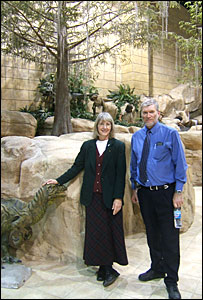 Petersburg, Kentucky, is in the middle of North America. It is supposedly within a day’s drive of two-thirds of the US population. For the rest, it is just 10 minutes from Cincinnati International Airport. That is why it was picked as the site for a new museum, due to open in a couple of months. We enter the landscaped grounds through gates flanked by wrought iron stegosaurs. The lobby is modelled on a cliff in the Grand Canyon. But this is no ordinary museum of science and geology. It is the dream of Ken Ham, president of Answers in Genesis, a Christian ministry that promotes the idea that the Biblical book of Genesis should be taken literally in describing the creation of the world, life and humans as carried out by God over a six-day period a few thousand years ago. We get as far as the museum bookshop—already well-stocked with creationist titles—but no further. Officials tell us that state regulations forbid it. It is still under construction and closed to visitors. Is this, I wonder, because I am accompanied by Eugenie Scott, director of the National Centre for Science Education and a polite but determined campaigner against attempts to teach creationism alongside evolution in American school science classes.Sharp teethSo, it is round the back to the offices, to receive Ken Ham’s crushingly sincere handshake. He came to the US from Australia 20 years ago, founded Answers in Genesis and never left. He lectures or broadcasts almost daily and clearly has the charisma to raise $27m for this ambitious museum. He is also not afraid to show us what is inside, and turns on the animatronic dinosaurs. On a rocky ledge, there is a pair of small theropods—young T. rex individuals, we’re told. And near to them (“hold onto your hat,” says Ken, anticipating our disbelief) there are two human children playing by a stream. Most geologists would say humans and dinosaurs were separated by more than 60 million years. And those dinosaurs have very sharp teeth! “So do bears,” says Ken, “but they eat nuts and berries! Remember, before the sin of Adam, the world was perfect. All creatures were vegetarian.” One of the dinosaurs lets out a rather contradictory roar. |
| Radio Broadcast |
Heart and SoulIn the Beginning  In scientific circles over the last 150 years, Charles Darwin‘s theory of evolution by natural selection has become the accepted explanation for how we and all other living things evolved from primitive, single-celled ancestors. Most biologists in most respected universities support that explanation and most agree that that process has taken hundreds of millions of years. Geologists now have evidence that our planet‘s history dates back about 4.6 billion years and cosmologists will tell you that our universe came into being through a process known as the Big Bang more than 13 billion years ago. In spite of that, many people are guided by a different set of beliefs, based on scripture. In the United States the incidence of such beliefs is particularly high. In a recent survey, more than 40% of Americans said they thought that humans and other creatures had been created in their present forms and have not evolved. Of those who did accept evolution, a third thought that it was guided by some supreme being. In two editions of Heart and Soul, the BBC World Service explores the controversy in the United States between creation and evolution and investigates a spectrum of beliefs. To gain insights into the minds of the personalities involved, the BBC gave microphones to two of the key players from very different |
| Radio Broadcast |
 The Anthropic UniverseIt‘s called the anthropic universe: a world set up so that human beings could eventually emerge. So many physical constants, so many aspects of our solar system, so much seems to be finely tuned for our benefit. But was it? We hear from Professors Martin Rees, Paul Davies, and Frank Tipler, as well as many others, about one of the ultimate questions. |
| Article |
 Intelligent Design Has Not Surfaced in the British PressAt a journalism seminar, a BBC producer was ‘struck by the concern about intelligent design amongst our transatlantic colleagues.’ I’ve been asking a few friends who are neither journalists nor scientists— nor, for that matter, Americans— what they understand by the term “intelligent design.” “Isn’t that the slogan of that German car company?,” one said, in a remark typical of what I often hear. In Europe, intelligent design is nowhere near the big issue that it is in North America. Serious newspapers have been giving brief coverage to the Dover, Pennsylvania court case on their inner pages, but in the popular press and on television there is not a mention made. It’s interesting to reflect on why that might be. After all, according to the U.S. Constitution, church and state are separate whereas over here, the queen is both head of state and head of the Church of England. And many schools are church schools with religious education a small but significant part of their curriculum, and a brief act of worship is an almost daily event. But it is hard to find anyone here who thinks that intelligent design is serious science or that it should be taught as such in schools, or at least who is prepared to say so in public. The Church of England, for the most part, seems to be on the side of the biologists, and even the Catholic Church has gone on record as saying that evolution is more than just a theory. |
| Radio Broadcast |
 Arthur C. Clarke: The Science and the FictionSixty years ago this month, in October 1945, the magazine Wireless World published an article by a relatively unknown writer and rocket enthusiast. Its title was: "Extra-Terrestrial Relays: Can Rocket Stations Give World Wide Radio Coverage?" Today, the author's name is known throughout the world. He is the science fiction writer Arthur C Clarke, and his prediction of satellite communications has come true in ways even he never imagined. To mark the anniversary, Heather Couper travels to Sir Arthur's home in Sri Lanka to hear his own story. read more… listen… [hosted at www.bbc.co.uk, RealPlayer required] |
| Radio Broadcast |
Arthur C Clarke Still Looking Forward It was 60 years ago this month that the popular magazine Wireless World published an article entitled Extra-terrestrial Relays: Can rocket stations give worldwide radio coverage? The author was a young writer by the name of Arthur C Clarke. His "rocket stations" are today known as communications satellites. Eighty-seven years and the after-effects of polio have left Sir Arthur in a wheelchair and somewhat forgetful of past events; but as a science visionary, he is as sharp as ever, looking forward to the time when other predictions he has made come true. He is convinced that we will become a space-faring species. That people have not been back to the Moon for more than 30 years he regards as merely a temporary glitch. As he points out in a special documentary on BBC Radio 4 this Wednesday, some of the greatest explorations in history were not followed up for decades. He is sure that we will journey to Mars and eventually on to other solar systems; first sending robot probes, then humans, perhaps in suspended animation or even with their thoughts and consciousness transferred into a machine. "When their bodies begin to deteriorate", he says, "you just transfer their thoughts, so their personalities could be immortal. You just save their thoughts on a disc and plug it in, simple!" he says, with a characteristic grin. 'Crazy' ideaClarke grew up on a farm near Minehead, Somerset. His memories of that time are becoming hazy, but his younger brother, Fred, who still lives in the area, remembers the times well. Arthur, he says, used to slip out from school in the lunch-break to search for copies of science fiction magazines, such as Astounding Stories. |