
 About the Fellowship
Michael Fitzgerald
Michael Fitzgerald is a freelance writer on issues in technology, science, business, and culture. His work appears in publications such as the Boston Globe Magazine, The Economist, and Technology Review. He also writes the Prototype column for the New York Times. He has received numerous awards as a writer and editor, including the top prize for a news story or series from the American Society of Business Press Editors and from the Computer Press Association as well as the 2000 Folio Editorial Excellence Gold Medal, the 2001 Maggie Award for best online publication, and the 2007 Outstanding Business and Technology Article award from the American Society of Journalists and Authors.
| Interview |
 Why Science is More Fragile than Faith We tend to see modernity in part as a triumph of science--an age when experimental discoveries and analysis have eclipsed religion and other ancient beliefs. And it is our scientific understanding of the world and mastery of technology that will mold the future of human affairs. Not so fast, says Robert N. McCauley. McCauley, a philosopher of science at Emory University, looks at the contemporary world and sees it differently: It is science, not religion, that is fragile. In a new book, "Why Religion is Natural and Science Is Not," McCauley argues that, if you consider how the human mind actually works, science faces challenges even where it seems ascendant. Religion is too intuitive, too natural a style of thinking, to be gotten rid of.
In contrast, modern scientific thinking is radically unnatural. It is difficult to acquire as a skill, and researchers find that even people trained in science can easily revert to nonscientific thinking. McCauley’s best-known work, the 1990 book "Rethinking Religion: Connecting Cognition and Culture," written with E. Thomas Lawson, helped start the scientific study of religious cognition, influencing or foreshadowing well-known thinkers on religion and culture such as Pascal Boyer, Daniel Dennett, and Scott Atran. Those thinkers have tended to use evolutionary explanations of religion as a means to dismiss it, part of an increasingly fractious war over whether belief has any place in a rationalist world. McCauley himself considers the whole debate over science and religion overblown--it’s like comparing apples and sofas, he says. Even in places that seem to have abandoned religion, like Northern Europe, he questions whether there hasn’t simply been a shift toward a less-organized form of spiritual expression. As for the unnatural world of science, he’s worried. He spoke to Ideas twice by phone; this interview was edited and condensed from those conversations. IDEAS: Back in 1990, you and Tom Lawson pioneered the scientific study of religion, by trying to trace the cognitive basis for religion. What’s changed in the field in the last two decades? MCCAULEY: The changes are huge! Things like social neuroscience didn’t exist in the 1980s much. There are both new tools and new findings. The most prominent tools have been those for neuroimaging. We’re seeing lots of interesting findings. Emma Cohen studied Oxford’s rowing teams. One finding she got is the guys who were rowing in synchrony have far, far higher pain thresholds, by virtue, it looks like, of their joint effort. That seems to resonate fairly closely with what we know about religion. IDEAS: What popular ideas have emerged that are wrong? |
| Interview |
How Puritans Became CapitalistsA historian traces the moment when Boston's dour preachers embraced the market. 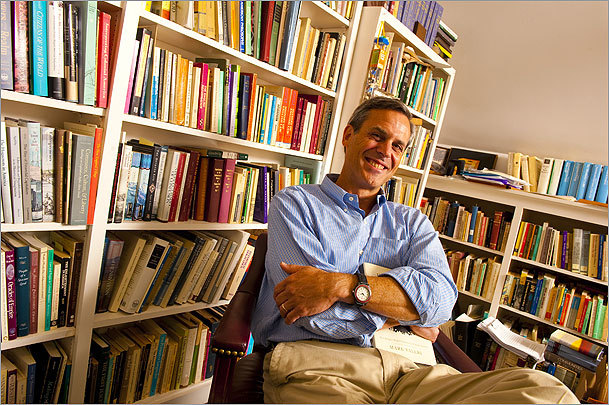 Even in down times like these, America’s economy remains remarkably productive, by far the world’s largest. At its base is a distinctive form of market-driven capitalism that was championed and shaped in Puritan era Boston. But the rise of Boston’s economy contains a deep contradiction: The Puritans whose ethic dominated New England hated worldly things. Market pricing was considered sinful, and church communities kept a watchful, often vengeful eye on merchants. How could people who loathed market principles birth a modern market economy? That question captivated Mark Valeri after he read sermons by the fiery revivalist Jonathan Edwards that included detailed discussions of economic policy. Edwards turned out to be part of a progression of ministers who led their dour and frugal flocks down a road that would bring fabulous riches, and ultimately give rise to a culture seen as a symbol of material excess. In his new book, "Heavenly Merchandize," Valeri, professor of church history at Union Theological Seminary in Richmond, finds that the American economy as we know it emerged from a series of important shifts in the relationship between the Colonies and England, fomented by church leaders in both London and early Boston. In the 1630s, religious leaders often condemned basic moneymaking practices like lending money at interest; but by the 1720s, Valeri found, church leaders themselves were lauding market economics. Valeri says the shift wasn’t a case of clergymen adapting to societal changes--he found society changed after the ministers did, sometimes even decades later. |
| Review |
A New Way of Thinking about Social Networks and the World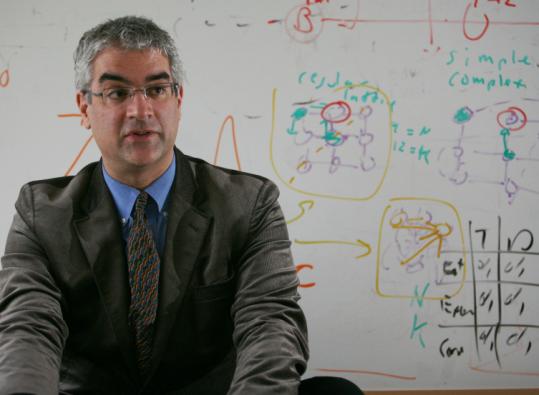 Our social networks and where we sit in them set the course for much of what happens in our lives, say Nicholas A. Christakis, a doctor and sociology professor at Harvard, and James H. Fowler, a political scientist at the University of California-San Diego. In their book "Connected: The Surprising Power of Our Social Networks and How They Shape Our Lives’’ they argue that our social networks actually comprise a "super-organism.’’ Our lives take shape not just via those we know, our friends and relations, but through their friends and relations, even if we never meet those people. You might wonder whether too much time on Facebook has addled their brains. But online social networks have little to do with their theory, and human history offers much to support it. They start the book by looking at feud-driven violence, like revenge killings of extended family members and friends in 19th century Corsica, showing how simply knowing someone can put us in harm’s way. They then take us on a pleasant walk through interesting research in anthropology, archeology, history, politics, psychology, medicine, and sociometry (the study of social networks). We learn what it means that we evolved primarily in groups of about 150 members, how a social network brought the Medicis to power in Florence and ultimately opened the modern world to democracy, and how Barack Obama’s use of social networking made him president. They also cite their own 2007 paper arguing that obesity is contagious across social networks. While the authors say their study has been confirmed several times over, even they feel compelled to note that "social network effects are not the only explanation for the obesity epidemic,’’ listing eight others. |
| Interview |
Genesis, the Soap OperaJohn Coats reclaims the first book of the Bible for the nonreligious. 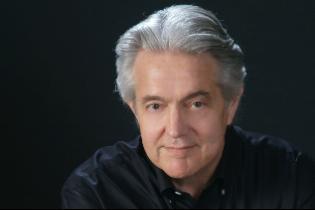 The book of Genesis forms a cultural cornerstone for a large mass of humanity. Even people who have never opened a Bible know its stories - Adam and Eve in the garden of Eden, Noah’s ark, the destruction of Sodom and Gomorrah. It is Genesis that introduces Abraham, the patriarch of Christians, Jews, and Muslims alike. It contains the creation story that fundamentalists use to deny evolution; it also tells the story of Joseph, which became an Andrew Lloyd Webber musical. For all of its familiarity, and its sacred aura, Genesis is a quirky work of literature, less a well-organized narrative than an outline for an epic that leaves out heaps of important details. Along to fill them in for the 21st century comes John Coats. In his book "Original Sinners," he unpacks the first book of the Bible, story by story, mining it for very modern psychological insights. We see Noah’s family, post-Flood, slipping into a kind of madness straight out of "Apocalypse Now"; we see Joseph’s bedazzling coat hiding the fact that he was a snot-nosed brat we’d all love to hate. God pops up here and there, an omnipotent Jehovah-in-the-box who twists the plot in some impossible direction while the characters try to wrestle him back down. Coats, a former Episcopalian priest, is also a management consultant and a motivational speaker. He wrote his book as an argument that Genesis should be read not just a religious text, but as a human allegory relevant to us all, believer or not. He spoke with Ideas by phone from his home in Houston. IDEAS: Reinterpreting the book of Genesis has a long history - way back in the fourth century, the theologian St. Augustine said those who took the words of Genesis literally were like little children. What’s new about your approach? COATS: My approach is not a religious approach. I’m trying to get the reader to see that these stories belong to you whether you’re religious or not religious or sort of religious. Because they’re human stories, and also because they’re foundational stories in our civilization. |
| Editorial |
Finance MinisterHedge fund executive and ordained clergyman Mark Hostetter weighs the morality of the financial system.  Mark Hostetter occupies an unusual perch in the financial world: he is both CEO of Vinik Asset Management, a $5 billion Boston hedge fund, and an ordained Presbyterian minister. As an executive, he manages a firm that handles money in eye-popping quantities. As a minister, one of several associate pastors at the First Presbyterian Church of New York, he organizes seminars at New York’s Auburn Theological Seminary where CEOs discuss how they can embody personal and societal values, including secular ones, in their working lives. Hostetter, 50, walks a tricky line - we expect ministers to occupy the moral high ground, while money managers are paid to deliver profits first. Despite anger nationally about the behavior of hedge funds and the rest of the finance industry, where a single-minded focus on high returns helped destabilize the economy, Hostetter says he rarely encounters people in his business who lack personal integrity - though he concedes that most know he’s also a minister and he may get people on their best behavior. The system-shaking excesses of the last decade have Hostetter calling for a more moral capitalism, one in which people put the stability of the entire system above their own personal gain. He spoke with Ideas by phone from his office in Boston. Ideas: Doesn’t the Book of Matthew say you cannot serve God and mammon? MH: If you take traditional Christian theology, the economic system is part of God’s plan. In the parable of the talents, the servant that is rewarded is the one who utilizes that money - who isn’t scared of the money, isn’t paralyzed by it, but sees it just like anything else, as a tool to be utilized in promoting whatever God’s goals are in the particular context. There may be a preference for the poor |
| Radio Broadcast |
 Satan and Economic Growth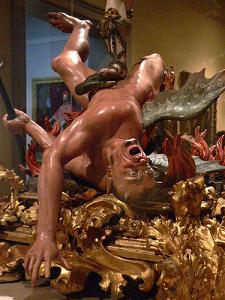 We continue exploring the relationship between religious beliefs and economies. We just heard about possible links between the prosperity gospel and risky behaviors that led to the housing bubble and subsequent crash. Now, we ask whether belief in eternal damnation might help economies grow. Education, access to technology, the rule of law and trade policy all influence economies. But a pair of Harvard researchers has sifted through 40 years worth of data from dozens of countries, and conclude that religious beliefs have a measurable effect on developing economies – especially the fear of hell. For more we’re joined by Michael Fitzgerald. He wrote about this topic for The Boston Globe Ideas Section. He researched the article while a Templeton-Cambridge Journalism Fellow. read more… listen… [7 minutes, mp3 format] |
| Article |
Satan, the Great MotivatorThe curious economic effects of religion  What makes economies grow? It’s a question that has occupied thinkers for centuries. Most of us would tick off things like education levels, openness to trade, natural resources, and political systems. Here’s one you might not have considered: hell. A pair of Harvard researchers recently examined 40 years of data from dozens of countries, trying to sort out the economic impact of religious beliefs or practices. They found that religion has a measurable effect on developing economies - and the most powerful influence relates to how strongly people believe in hell. That hell could matter to economic growth might seem surprising, since you can’t prove it exists, let alone quantify it. It stands as one of the more intriguing findings in a growing body of recent research exploring how religion might influence the wealth and prosperity of societies. In recent years, Italian economists have presented findings that religion can boost GDP by increasing trust within a society; researchers in the United States showed that religion reduces corruption and increases respect for law in ways that boost overall economic growth. A number of researchers have documented how merchants used religious backgrounds to establish one another’s reliability. The notion that religion influences economies has a long history, but the specifics have been vexingly difficult to pin down. Today, as researchers start to answer the question more definitively with the tools of modern economics, what’s emerging is a clearer picture of |
| Article |
 Sumo Wrestlers Are BigBut are they a Big Question?  Friedrich Hayek’s 1944 book The Road to Serfdom, with its sweeping theme that any form of collective government leads to tyranny, laid the groundwork for the Chicago School of Economics. Will another book lead to its unraveling? Freakonomics, the 2005 book by Chicago economist Steven Levitt and journalist Stephen Dubner, uses economic techniques to study questions nontraditional in the world of economics, such as whether Japanese sumo wrestlers cheat and whether legalizing abortion led to less crime. The book has sold 3 million copies, inspiring lots of talk about economics and a regular New York Times blog by the authors. But it also brought out critics, including from within Chicago’s economics department. The New Republic’s Noam Scheiber took aim at the Freakonomics phenomenon in his April 2007 article "Freaks and Geeks: How Freakonomics is Ruining the Dismal Science." Heavily quoted in the piece: Chicago Nobel laureate James J. Heckman. Heckman doesn’t cite Levitt by name, but he does complain about a trend that finds economists going after only small, manageable questions and discouraging them from pursuing problems they can’t solve quickly or easily, such as the nature of business cycles. Scheiber connects the dots for those who didn’t get it: "Heckman’s allusion to a certain pedagogical technique is almost surely a shot at his Chicago colleague, Steve Levitt." Heckman has nothing against Levitt, he says in an interview. "What I’m concerned about is not him personally; he’s fine." But he disdains Levitt’s approach: "Freakonomics is an exercise in triviality. It’s intellectual escapism. It substitutes cuteness for substance. And the style of research that suggests that you need to somehow produce a paper every two months that’s cute and catches the eyes of the New Yorker reader damages the kind of long-term research that economists do and still do at Chicago." |
| Article |
Chicago SchooledThe visible hand of the recession has revitalized critics of the Chicago School of Economics.  On a sunny day this spring, more than 1,000 people streamed into the Sheraton near the Gleacher Center for a conference on the Future of Markets. Its keynote panel, headlined by Nobel laureate Gary S. Becker, AM’53, PhD’55, featured six Chicago economists with differing viewpoints. The stock market was in the early part of a rally that would yield its best quarter since 1998. Stock-market turnarounds usually signal better times coming, but in an economy contracting 6 percent, better was relative. So the rally didn’t change the feeling among the free-market enthusiasts at the University of Chicago Booth School of Business management conference that market economics was on shaky ground: most of the financial industry, they felt, had been nationalized in all but name. Two of the three U.S. automakers looked like they would follow suit. The government was capping pay in the financial services. What in the name of the Chicago School was going on? The central idea of the Chicago School of Economicsholds that economies work best when markets operate freely, with limited government participation. The Chicago School, a phrase coined in the 1950s, championed an old idea: 1870s neoclassical economics. Yet in the wake of the Great Depression and World War II, it was a radical proposition. It went against the ideas of John Maynard Keynes, who believed government should play an important role across an economy. At the time, the U.S. government was viewed with reverence, as the force that beat the Depression, won World War II, and was girding to rebuild Europe. Keynesianism held "a virtual monopoly," says James J. Heckman, the Henry Schultz distinguished service professor of economics and 2000 winner of the Nobel Memorial Prize in Economic Sciences. "People thought markets couldn’t work, incentives weren’t important."The Chicago School took almost the opposite tack, expressing near disdain for government. Some of that disdain was echoed during May’s Future of Markets keynote panel by Kevin Murphy, PhD’86, who holds an endowed chair named for 1982 Nobel laureate George J. Stigler, PhD’38, a pillar of the Chicago School, along with Milton Friedman, AM’33. Wearing his habitual baseball cap despite the suits and ties all round him, Murphy ticked off the challenges facing the nation. When he got to the problem of remaking General Motors, he paused. "Who in their right mind would put the government in charge of that task?" Titters came from the audience, then applause. Another crowd might have booed—say, at Columbia University, current home of economist Joseph Stiglitz, who won the 2001 Nobel Prize for work on how markets misfire. Stiglitz threw this bomb via a Bloomberg News article last winter: "The Chicago School bears the blame for providing a seeming intellectual foundation for the idea that markets are self-adjusting and the best role for government is to do nothing." In his 2003 book The Roaring Nineties, Stiglitz recounts how, in the four-year period between 1997 to 2001, private companies and capital markets invested $65 billion into building telecom networks. They lost $61 billion of it. The episode is his version of Murphy’s question above: "Who in their right mind would put markets in charge of that task?" Salon commentator Andrew Leonard also called out the Chicago School, writing in an April 29 column, "The direction in economic thought pioneered by Milton Friedman and enthusiastically adopted by Ronald Reagan and his Republican successors helped to get us where we are today—in the worst economic contraction in 50 years, characterized by an increasing concentration of wealth in the top tiers of society." |
| Article |
 How Innovations from Developing Nations Trickle-Up to the WestA funny thing has happened on the way to globalization: Innovation now trickles up from emerging to advanced economies. And it may be the way of the future.  We know how innovation works. We get iPhones; those less fortunate overseas get whatever we dropped in the recycling bin on our way out of the Apple Store. We get Gore-Tex; they get 2007 New England Patriots 19-0 T-shirts. We get the Wii; they play rock-paper-scissors. We get collateralized-debt obligations ... well, we can't win them all. Innovation has always been about people in rich nations getting the latest stuff and the rest of the world getting our castoffs as our markets scale and prices come down. So why is Nokia [0] looking to use Kenya to debut a free classifieds service (think a mobile-phone version of Craigslist), complete with a first-ever feature that lets people shop using voice commands to browse for goods? And why are Western banks seeking ideas from India's ICICI when its average deposits are one-tenth of those in the West? The answer is that the traditional model of developing new products is quietly reversing course. Call it "trickle-up innovation," where ideas take shape in developing markets first, then work their way back to the West. "If it's radically innovative and reduces costs, it's going to get looked at and will accelerate," says Michael Chui, the consultant doing heavy lifting on a McKinsey Technology Initiative report on this subject that includes more than 100 PowerPoint slides crammed with examples. As the credit crunch forces frugality on companies everywhere, it should turbocharge the shift toward developing markets. |
| Discussion |
 Physicist and PriestAn interview with John Polkinghorne 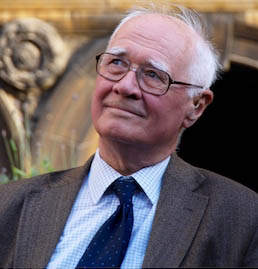 Ordained an Anglican priest after a career as one of the world's top quantum physicists (his work helped lead to the discovery of the quark, a basic element of matter), John Polkinghorne vigorously argues that science and religion are not at odds. He served as the first president of the International Society for Science and Religion and helped organize the Society of Ordained Scientists. He delivered the 1993-1994 Gifford Lectures (which became the book The Faith of a Physicist) and in 2002 received the Templeton Prize for Progress Toward Research or Discoveries About Spiritual Realities. Polkinghorne has written more than 15 books, including The Quantum World (1985) and Quantum Theory: A Very Short Introduction (2002). His books on science and religion include The Faith of a Physicist (1996), Belief in God in an Age of Science (1999) and, most recently, From Physicist to Priest: An Autobiography (published in the United Kingdom in October). Do you ever have any regrets about having left the discipline of physics? No, I think I left at the right time. One reason is that you don't get better at these things as you get older. You probably do your best work in physics before you are 45. The other reason is that the subject has changed. All the time I was in physics, the field was driven by experimentation. There were lots of very clever theorists around, but the experimentalists provided the motivation. Since then the subject has become very speculative, with little empirical input. That's actually not good for physics, and in that respect I'm not sorry to have left the game. Do you think you would have a similar view if the field were biology? Biology is different. Accumulated experience is important in biology in a way that isn't the case with mathematical physics. Also, biologists see a different slice of reality from the physicists. Physicists are deeply impressed with the wonderful order of the world, so "mind of God" language comes quite naturally to them, whereas biologists see the much more ambiguous process of life—extinctions |
| Article |
 How to End Poverty The third section of Creating a World Without Poverty details Muhammad Yunus' vision for creating social businesses and how they will eliminate poverty. Yunus recaps some of the hoops that had to be jumped through before Grameen Danone could start making high-nutrition, low-cost yogurt in Bangladesh. Capital markets and regulators aren't set up to finance social businesses or to tax them (or exempt them from taxes, as may be the case), and Group Danone had to do yeoman's work with shareholders and regulators, including creating a social mutual fund that did not promise to maximize returns first and foremost. His goal is to expand market capitalism by making the unconventional conventional, working in an idea for a Social Dow Jones Index, Social MBAs and other ideas for increasing the visibility – and viability — of such businesses. He also has high expectations for turning information technology as an engine for eliminating poverty. His experiences in Bangladesh suggest that the digital divide is not inevitable, and where it exists it does not need to be permanent. He cites the One Laptop Per Child and Intel Classmate PC projects as examples, and throws out a few other ideas that he hopes someone will pursue. Yunus' vision will either inspire or irritate, because it is an outsized vision – a world with no poverty, a capitalism that doesn't weigh only profits – that stands outside today's reality. It will make many business people uncomfortable, and many others disdainful. By the end of the book, when he discusses the consumer society and whether it can and should be sustained, and says not in its current form, he will be preaching to a choir, and also to converts. |
| Article |
How Muhammad Yunus Created an Impossible Business Grameen Bank is an improbable business worth study. In the second section of Creating a World Without Poverty, Muhammad Yunus details the ongoing evolution of what he calls "The Grameen Experiment." Yunus was an economist, not a banker, and he needed to invent his bank for the poor, ignoring naysayers and regulatory obstacles at almost every step. It's a classic example of how someone who does not realize that what he intends to do is impossible is thus able to achieve it. Economists may find themselves frowning in this section of the book. Yunus tweaks his former colleagues for their blind spots and their refusal to look at people except in abstract terms like "labor." His is another voice in favor of 'experimental' economics, the part of the field that tries to look at human behavior as it is, rather than as economists say it should be. That kind of anthropological economics resulted in many useful business practices at Grameen, and Yunus is generous in discussing what has worked and what has needed revising. For instance, it found that the wisdom of crowds works among the very poor: it has learned to lend to people in groups of five, and they all have to vouch for the person receiving the loan. It's also learned that lending to women has a bigger potential for getting families out of poverty than lending to men. |
| Article |
Yunus: Capitalism is Half-Baked In "Creating a World Without Poverty," Muhammad Yunus has written a dangerous book. Not so much for his goal – that's merely outlandish, since most people expect the poor will always be. Besides, Yunus knows how to make audacious ideas real – he created Grameen Bank to bring financial services to the poor, and proved that microfinance can be profitable and powerful. Doing so earned Yunus and Grameen the 2006 Nobel Peace Prize (arguably it should have been the Economics Prize). What's dangerous are his questions. Like, if capitalism is so effective, why must 60 percent of the world's population squeak by on six percent of its income? Why is it that China's remarkable economic growth is ruining its environment? Why is poverty on the rise in the United States, even as its overall wealth skyrockets? These questions skewer conventional economic wisdom that our current model of capitalism is the be-all and end-all for global economics. Yunus dares to say that market capitalism is both underdeveloped and, in its current form, bad for most of us. He echoes J.A. Hobson, the early 20th century critic of capitalism whose 1902 book Imperialism skewered British capitalists, accusing them of being economic parasites. (He also echoes Adam Smith himself, who wrote in the Wealth of Nations about inequities in the system that reduced competition and the flow of labor). Yunus is not so vituperative as Hobson, but he does call out business leaders, saying bluntly that "capitalism is a half-developed structure" and that modern economics is guilty of
…assuming that people are one-dimensional beings concerned only with the pursuit of maximum profit…. We've created a one-dimensional human being to play the role of business leader, the so-called entrepreneur. We've insulated him from the rest of life, the religious, emotional, political and social. He is dedicated to one mission only – maximize profit. He is supported by other one-dimensional human beings who give him their investment money to achieve that mission. To quote Oscar Wilde, they know the price of everything and the value of nothing.Yunus believes that governments, nonprofit organizations, international organizations like the World Bank and attempts at corporate social responsibility all have failed to address the problems of modern free-market capitalism. |
| Article |
Can Community Gardens Save a City?In Holyoke, urban agriculture is spurring development and improving nutrition. 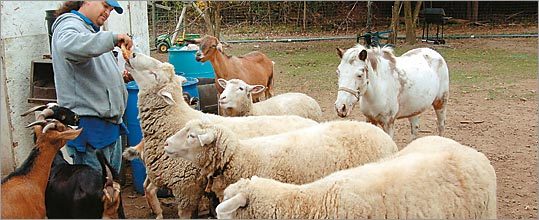 Daniel Ross walks through a garden in South Holyoke with plants straight out of Puerto Rico, chicharos and jabaneros. This was the first of what are now 10 jardines comunitarios -- community gardens -- located throughout low-income neighborhoods in the area, and it sits about a half block from the blighted Main Street shopping district, a place where vacant buildings and overgrown lots seem to outnumber functioning businesses. "Hey, Carmelo," he calls to a man working a plot in midmorning. It's Carmelo Ortiz, a retiree who emigrated from Puerto Rico to Holyoke decades ago and helped found this garden back in 1991, working with local volunteers to reclaim a lot made vacant when a church burned down. These seemingly humble gardens are part of a local success story with national significance. They've blossomed because of the nonprofit agency Nuestras Raices -- Our Roots -- which has received numerous honors for its model of using urban agriculture to spur economic development, enrich a community through cultural pride, and improve nutrition for youth and the community in general. The gardens are cooperatively maintained but are overseen by Nuestras Raices, which helps people get access to the lots. The gardeners use the food for their own households, share it with neighbors, or sell it at farmers' markets. The nonprofit also has a 30-acre farm site where it teaches people who were farmers in Puerto Rico or other countries how to be commercial farmers in Massachusetts. |
| Article |
Save My Brain!The mind, like the body, gets flabbier with age. Can a crash course in, well, anything, keep it in shape? We sent a boomer to One Day University to find the answer. 
IT'S THE BRAIN THAT SETS US APARTfrom other creatures. That's why its decline fills us with dread - it foreshadows not just death, but also a shuffling toward being something less than human. We fear devolution. * My brain is my bond to the baby boom, to which I belong only demographically. I was born in 1964, the last year of the boom, so I feel like a Generation Xer. But I'm a boomer about my brain. * Baby boomers like to try to stave off the inevitable - inventor Ray Kurzweil even thinks he can beat death. So why should my brain slip? I regularly play Brain Age or Big Brain Academy, games that claim to keep my neurons firing. I try to drive different routes, to keep my brain from falling into a routine (it's never boring to get lost). I force myself to read things like Paradise Lost (a better exercise when my brain was younger). And, recently, I attended One Day University - after all, what could be better for my brain than a little schooling?One Day U offers sessions in various cities throughout the year, with each featuring four lectures on diverse topics, given by gifted teachers from top schools. The day I go, the profs come from Brown, Harvard, Syracuse, and Dartmouth. It's open to anyone (a cadre of high school students from Boston regularly attend), but it's clearly targeted at boomers, and we make up most of the class. We sit though four lectures of about 70 minutes each, including time for questions at the end. The program, based in Northampton, bills itself as "the most stimulating day of college available anywhere." Sprinkle some salt on that: One Day U's cofounder and director, Steve Schragis, bankrolled Spy magazine back in the day. Schragis tells the several hundred of us gathered in our "classroom," an auditorium at Babson College in Wellesley, that "there is no homework, no exams, you can't fail, and you've already earned an A." Today's classes will be political science, psychology, history, and cosmology. I know something about all these things, and in two of them, I think I know quite a bit. But the only thing I care about is, will I feel brainier at the end of the day? |
| Article |
 The Science of Religion: Where angels no longer fear to treadScience and religion have often been at loggerheads. Now the former has decided to resolve the problem by trying to explain the existence of the latter. 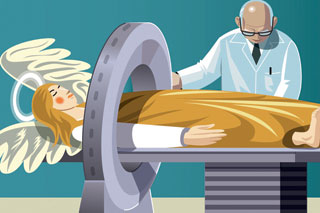 BY THE standards of European scientific collaboration, €2m ($3.1m) is not a huge sum. But it might be the start of something that will challenge human perceptions of reality at least as much as the billions being spent by the European particle-physics laboratory (CERN) at Geneva. The first task of CERN's new machine, the Large Hadron Collider, which is due to open later this year, will be to search for the Higgs boson—an object that has been dubbed, with a certain amount of hyperbole, the God particle. The €2m, by contrast, will be spent on the search for God Himself—or, rather, for the biological reasons why so many people believe in God, gods and religion in general. "Explaining Religion", as the project is known, is the largest-ever scientific study of the subject. It began last September, will run for three years, and involves scholars from 14 universities and a range of disciplines from psychology to economics. And it is merely the latest manifestation of a growing tendency for science to poke its nose into the God business. Religion cries out for a biological explanation. It is a ubiquitous phenomenon—arguably one of the species markers of Homo sapiens—but a puzzling one. It has none of the obvious benefits of that other marker of humanity, language. Nevertheless, it consumes huge amounts of resources. Moreover, unlike language, it is the subject of violent disagreements. Science has, however, made significant progress in understanding the biology of language, from where it is processed in the brain to exactly how it communicates meaning. Time, therefore, to put religion under the microscope as well. I have no need of that hypothesisExplaining Religion is an ambitious attempt to do this. The experiments it will sponsor are designed to look at the mental mechanisms needed to represent an omniscient deity, whether (and how) belief in such a "surveillance-camera" God might improve reproductive success to an individual's Darwinian advantage, and whether religion enhances a person's reputation—for instance, do people think that those who believe in God are more trustworthy than those who do not? The researchers will also seek to establish whether different religions foster different levels of co-operation, for what reasons, and whether such co-operation brings collective benefits, both to the religious community and to those outside it. It is an ambitious shopping list. Fortunately, other researchers have blazed a trail. Patrick McNamara, for example, is the head of the Evolutionary Neurobehaviour Laboratory at Boston University's School of Medicine. He works with people who suffer from Parkinson's disease. This illness is caused by low levels of a messenger molecule called dopamine in certain parts of the brain. In a preliminary study, Dr McNamara discovered that those with Parkinson's had lower levels of religiosity than healthy individuals, and that the difference seemed to correlate with the disease's severity. He therefore suspects a link with dopamine levels and is now conducting a follow-up involving some patients who are taking dopamine-boosting medicine and some of whom are not. |
| Article |
 Capital Ideas and Social Goals SINCE 2001, Lee Zimmerman's Evergreen Lodge has helped almost 60 low-income young adults get their lives on track, while consistently paying 9 percent back to investors backing his business. Pura Vida Coffee, of which John Sage was a co-founder in 1997, has generated $2.7 million in cash and resources for health and education programs for children and their families. Both companies deserve praise for their good deeds. But what might be more remarkable about the founders of Pura Vida and Evergreen Lodge is the way they raised capital to build businesses that have two bottom lines: one financial and one social. Such business models are becoming increasingly popular among philanthropists and foundations, which like the idea of self-sustaining charities. They also want their investments to have the same kind of social impact as their donations, an idea called mission-related, or program-related, investing. A study released earlier this year by FSG Social Impact Advisors, a consultancy founded by Michael E. Porter, a Harvard Business School professor, and Mark Kramer, a former venture capitalist, calculated that mission-related investing has grown by 16.2 percent a year over the last five years. At the same time, businesses like Pura Vida and Evergreen blur the line between charities and companies. That's a hurdle to raising money, because investing in a for-profit company does not yield a tax deduction. And such businesses often need extra time to succeed. Grameen Bank, which won the Nobel Peace Prize in 2006 for validating the idea of microfinance, was subsidized for 15 years, notes J. Gregory Dees, a professor at the Fuqua School of Business at Duke University. (In 2006, Grameen made $20 million on $135 million in revenue.) There is not yet a template for financing such businesses, says R. Todd Johnson, a lawyer at Jones Day who has handled a number of deals for social entrepreneurs and is writing a book to be called "Greed Is Bad." Because the entrepreneurs want to make sure that investors can't change the social mission for the sake of profits, "you get these one-off, crazy, debt-equity weird structures," he says. "People say, 'Gosh, you're making my head hurt.'" |
| Article |
 Embryonic Stem Cells without EmbryosWilliam Hurlbut on the embryonic future 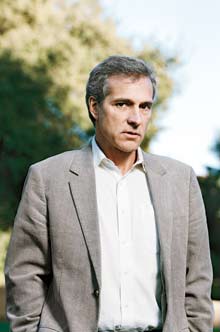 William Hurlbut, a physician and ethicist, is best known as a member of the President's Council on Bioethics. Though he has spoken out against the destruction of embryos for research purposes, he is nonetheless a supporter of embryonic-stem-cell research. He avoids what would otherwise be a terminal paradox through a proposal that he calls "altered nuclear transfer," or ANT. His goal: to create embryonic stem cells without destroying human embryos. One of the most promising methods for creating embryonic stem cells is cloning: the nucleus of an egg cell is replaced by the nucleus of an adult cell, a process called somatic-cell nuclear transfer. The egg is then induced to divide, and the stem cells harvested from the resulting embryo are pluripotent, meaning they can form any sort of tissue in the body. But harvesting the stem cells destroys the embryo. By contrast, ANT (which has been shown to work in mice, if not humans) switches off vital genes--through alteration of the somatic-cell nucleus, the cytoplasm of the egg, or both--before the transfer takes place. Hurlbut says the resulting cell mass could not become an embryo but could produce pluripotent stem cells. Hurlbut recently spoke with Michael Fitzgerald about ANT.
MF:What compelled you to come up with altered nuclear transfer?William Hurlbut: When the President's Council met [to debate the ethics of stem-cell research, in 2002], it was clear that both sides of this debate are promoting important positive goods: that on the one hand you have people trying to defend human dignity from its earliest stages, and on the other hand you have people trying to promote advances in science and medicine. And as I sat there and listened to this debate, I thought, "Isn't there an answer to this? Isn't there some third option, some way that both of these goals can be achieved?" I thought of dermoid cysts, benign ovarian tumors that produce all the cell types, tissues, and partial organs of the human body. Clearly something like embryonic stem cells is being produced in those tumors. And I thought to myself, "If nature can do this, we can do it. There must be simple technological alterations we could use in concert with nuclear transfer such that we produced embryonic-type, pluripotent stem cells, but without producing the unitary organism that is a human embryo." |
| Article |
It Takes Deep Pockets to Fight Global Warming Global warming is by nature a big-enough problem to create the kind of necessity that could be mother, father and midwife to invention. And plenty of big ideas are out there to address it, some that may even lead to substantial enterprises much as our military needs have. But the ideas being backed in the United States are things like biofuels and carbon-emissions trading. These are good approaches, but they may not hold much potential for actually staving off climate change. James E. Lovelock, a British scientist whose 2006 book, The Revenge of Gaia, argued that most of humankind is doomed, does not think much of renewable energy. At a panel on climate change at the University of Cambridge this summer, Mr. Lovelock was asked what would be the most effective action people could take. Because humans and their pets and livestock produce about a quarter of the carbon dioxide in the atmosphere, he said, "just stop breathing." Now there’s a fine idea. But even a gloom-and-doomer like Mr. Lovelock thinks that all is not lost. He supports replacing coal-powered utilities with nuclear power, but he also extols largely untested processes, like shooting particles into the atmosphere to deflect the sun’s rays. He also endorses sucking carbon dioxide out of the sky and burying it, a process known as carbon equestration. These are big ideas, and all of them aim directly at global warming, but they are too costly for individual inventors or even companies to pursue. Howard J. Herzog at the Massachusetts Institute of Technology is a proponent of carbon sequestration, which you might call creating carbon landfills. The basic technologies are already used in the energy business. For example, oil companies pump carbon dioxide into old fields to force out more oil. But we don’t know if it can be done on a scale that will let us keep up with the growth in coal-fired power plants, for instance, or if the carbon dioxide will stay put. To find out, Mr. Herzog estimates that it will take $1 billion a year over the next 8 to 10 years to build a |