
 About the Fellowship
Steve Paulson
Steven Paulson is the executive producer and an interviewer for To the Best of Our Knowledge, a radio program produced at Wisconsin Public Radio and syndicated nationally by Public Radio International and Sirius Satellite Radio. The program won the George Foster Peabody Award in 2005. He has also received awards from the Northwest Broadcast News Association and the Milwaukee Press Club. He received a master's degree from the University of Wisconsin School of Journalism and Mass Communication. He has written for The Independent, Milwaukee Journal Sentinel, and other newspapers. His radio reports have also been broadcast on NPR's Morning Edition, All Things Considered, and Weekend Edition Sunday.
| Column |
 Does Islam Stand Against Science?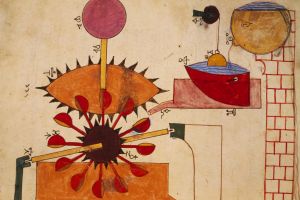 We may think the charged relationship between science and religion is mainly a problem for Christian fundamentalists, but modern science is also under fire in the Muslim world. Islamic creationist movements are gaining momentum, and growing numbers of Muslims now look to the Quran itself for revelations about science. Science in Muslim societies already lags far behind the scientific achievements of the West, but what adds a fair amount of contemporary angst is that Islamic civilization was once the unrivaled center of science and philosophy. What's more, Islam's "golden age" flourished while Europe was mired in the Dark Ages. This history raises a troubling question: What caused the decline of science in the Muslim world? Now, a small but emerging group of scholars is taking a new look at the relationship between Islam and science. Many have personal roots in Muslim or Arab cultures. While some are observant Muslims and others are nonbelievers, they share a commitment to speak out—in books, blogs, and public lectures—in defense of science. If they have a common message, it's the conviction that there's no inherent conflict between Islam and science. Last month, nearly a dozen scholars gathered at a symposium on Islam and science at the University of Cambridge, sponsored by the Templeton-Cambridge Journalism Programme in Science & Religion. They discussed a wide range of topics: the science-religion dialogue in the Muslim world, the golden age of Islam, comparisons between Islamic and Christian theology, and current threats to science. The Muslim scholars there also spoke of a personal responsibility to foster a culture of science. One was Rana Dajani, a molecular biologist at Hashemite University, in Jordan. She received her undergraduate and master's degrees in Jordan, then took time off to raise four children before going to the University of Iowa on a Fulbright grant to earn her Ph.D. Now back in Jordan, she is an outspoken advocate of evolution and modern science. She has also set up a network for mentoring women, and she recently started a read-aloud program for young children at mosques around Jordan. As if that weren't enough, Dajani helped organize a committee to study the ethics of stem-cell research, bringing together Jordanian scientists, physicians, and Islamic scholars. (The traditional Muslim belief is that the spirit does not enter the body until 40 days after conception, which means many human embryonic stem cells can be harvested for research.) "Being a Muslim, living in a Muslim world, Islam plays a big role in our everyday lives," she says. "We need to understand the relationship between Islam and science in order to live in harmony without any contradictions." For these scholars, the relationship between science and Islam is not a dry, academic subject. Many of the hottest topics in science—from the origins of the universe and the evolution of humans to the mind/brain problem—challenge traditional Muslims beliefs about the world. "Remember, these are human issues," says Nidhal Guessoum, an Algerian-born astrophysicist at the American University of Sharjah, in the United Arab Emirates, who was also at the Cambridge symposium. "It's not an experiment in the lab. I'm talking about my students, my family members, the media discourse that I hear every day on TV, the sermons I hear in the mosque every Friday." With his blend of charisma and keen sense of how to navigate the tricky terrain between modern science and Muslim faith, Guessoum is emerging as one of the key figures in public debates about Islam and science. He has a new book, Islam's Quantum Question: Reconciling Muslim Tradition and Modern Science (I.B. Tauris), and this month his university will host an international conference called "Belief in Dialogue: Science, Culture and Modernity." |
| Column |
 Spiritual Science, Rational MoralityRethinking the Divide between Science and Religion  The atheist Sam Harris has just lobbed a bombshell into the roiling debate over science and religion. In his new book The Moral Landscape, he argues for an entirely new understanding of morality, based not on religion but on new insights from science, especially brain science. Harris, a neuroscientist himself, is out to demolish the idea that science is by definition a value-free space. "The split between facts and values - and, therefore between science and morality - is an illusion," he writes. "Science has long been in the values business." He believes science and rationality provide a far better foundation for moral guidance than tired prescriptions from religion. Harris' book comes on the heels of Stephen Hawking's recent assault on religion and philosophy. His claim that "the universe can and will create itself out of nothing" -- without God's intervention -- sparked a predictable furor. But even more provocative is Hawking's assertion that science can finally answer some of the great existential questions: Why is there something rather than nothing? And why do we exist? As Hawking and fellow physicist Leonard Mlodinow write in their book The Grand Design, "Traditionally, these are questions for philosophy, but philosophy is dead." Why? Because it hasn't kept up with modern developments in science, particularly physics. For centuries, philosophers and theologians have presided over these questions about values and purpose, but scientists such as Harris and Hawking are no longer willing to cede this territory to religion. The cutting edges of science -- from cosmology and evolutionary biology to neuroscience -- are now tackling the most profound questions of our existence. Even the soul is under scientific scrutiny. Or at least the soul as it's defined by modern science: the self-aware mind with its keen sense of morality and free will. Is this scientific overreach? The late biologist Stephen Jay Gould certainly thought so. In his 1999 book Rocks of Ages, he tried to broker a truce between science and religion by claiming they are two utterly distinct realms of understanding, what he called "nonoverlapping magisteria" (NOMA). Science, according to Gould, covers the empirical world of fact and theory, while questions about moral meaning and value fall within the religious realm. This attempt to divide the world between fact and meaning has shaped the discussion of science and religion, but we're now moving beyond Gould's dichotomy. |
| Book |
 Atoms and EdenConversations on Religion and Science 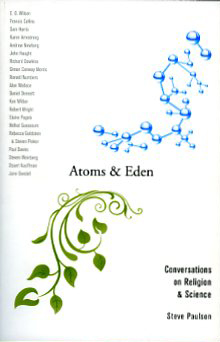 Here is an unprecedented collection of twenty freewheeling and revealing interviews with major players in the ongoing--and increasingly heated--debate about the relationship between religion and science. These lively conversations cover the most important and interesting topics imaginable: the Big Bang, the origins of life, the nature of consciousness, the foundations of religion, the meaning of God, and much more. In Atoms and Eden, Peabody Award-winning journalist Steve Paulson explores these topics with some of the most prominent public intellectuals of our time, including Richard Dawkins, Karen Armstrong, E. O. Wilson, Sam Harris, Elaine Pagels, Francis Collins, Daniel Dennett, Jane Goodall, Paul Davies, and Steven Weinberg. The interviewees include Christians, Buddhists, Jews, and Muslims, as well as agnostics, atheists, and other scholars who hold perspectives that are hard to categorize. Paulson's interviews sweep across a broad range of scientific disciplines--evolutionary biology, quantum physics, cosmology, and neuroscience--and also explore key issues in theology, religious history, and what William James called ''the varieties of religious experience.'' Collectively, these engaging dialogues cover the major issues that have often pitted science against religion--from the origins of the universe to debates about God, Darwin, the nature of reality, and the limits of human reason. These are complex, intellectually rich discussions, presented in an accessible and engaging manner. Most of these interviews were originally published as individual cover stories for Salon.com , where they generated a huge reader response. Public Radio's "To the Best of Our Knowledge" will present a major companion series on related topics this fall. A feast of ideas and competing perspectives, this volume will appeal to scientists, spiritual seekers, and the intellectually curious. |
| Article |
 God, He's MoodyIn an interview with something to offend everyone, Robert Wright explains why religion has given us a fickle deity.  Robert Wright has carved out a distinct niche in American journalism. While his essays range freely across the political landscape -- from foreign policy to technology -- it's his meaty, book-length forays into evolutionary psychology and the sweep of history that have set him apart. Now his latest book goes after bigger game: God Almighty. Actually, "The Evolution of God" never grapples with the most basic religious question -- the existence of God. Instead it charts the twists and turns of how God's personality has kept changing over the centuries, and specifically, how the rough-and-tumble politics of the ancient Middle East shaped the Abrahamic religions. The book is filled with richly observed details about the Bible and the Quran, though Wright wears his learning lightly as he guides us through several thousand years of religious history. There's something to offend just about everyone in this book. Wright recounts in harrowing detail how the early Israelites, who'd been conquered and humiliated by the Babylonians, invoked Yahweh to wreak vengeance on their enemies. This is no God for the faint of heart! And he's no gentler on Christianity. Wright's Jesus is not the prophet of peace and love but a sometimes mean-spirited apocalyptic preacher obsessed with the approaching End Times. Islam's founder, Muhammad, comes across as much a warrior as a prophet, bent on annihilating his enemies when they cross him. Despite all this religious mayhem, the book also shows a gentler side of the Abrahamic religions, especially when they manage to find common cause with their heathen neighbors and rival monotheists. At first, "The Evolution of God" reads like another atheistic tract exposing the seamier side of religion. But then I came to Wright's t first, "The Evolution of God" reads like another atheistic tract exposing the seamier side of religion. But then I came to Wright's account of the "moral imagination" and his surprising conclusion: He may not believe in God, but Wright thinks humanity is marching -- however wobbly -- toward moral truth.
In our interview, we talked about the bloody history of monotheism, what a mature religion would look like, and Wright's own spiritual awakening at a meditation retreat. At the very beginning of your book, you describe yourself as a materialist. This raises an interesting question: Can a materialist really explain the history of religion?
I tend to explain things in terms of material causes. So when I see God changing moods, as he does a lot in the Bible and the Quran, I ask, what was going on politically or economically that might explain why the people who wrote this scripture were inclined to depict God as being in a bad mood or a good mood? Sometimes God is advocating horrific things, like annihilating nearby peoples, or sometimes he's very compassionate and loving. So I wanted to figure out why the mood fluctuates. I do think the answers lie in the facts on the ground. And that's what I mean by being a materialist.
|
| Article |
Jane Goodall's Animal PlanetIn a surprising interview, the famous primatologist talks about her mystical experiences in the jungle and her ever-increasing passion for animal rights and cleaning up the "horrendous mess" of our environment.  Jane Goodall has an iconic status like no other living scientist. For decades, she's lived in the public eye, as we've watched her evolve from curious ingenue to celebrated sage. By now, she's so widely admired that it's easy to forget how she once rattled the cages of the scientific establishment. At a time when wildlife biologists were taught that animals didn't have minds or personalities, Goodall wrote vivid accounts of David Greybeard, Flo and the other chimpanzees she studied in Tanzania's Gombe Stream. She was the first scientist to observe that chimps not only use tools but make tools. And she was the first to discover that chimpanzees hunt other animals. In three decades of field study, Goodall revolutionized the study of primates and forced people to re-think what it means to be human. As Stephen Jay Gould said, "Jane Goodall's work with chimpanzees represents one of the Western world's greatest scientific achievements." Goodall's appeal, though, has always stretched beyond her scientific accomplishments. Partly it stems from those old National Geographic shows of the lone white woman out in the bush with these wild apes. The cultural critic Donna Haraway once wrote, "There could be no better story than that of Jane Goodall and the chimpanzees for narrating the healing touch between nature and society," though Haraway went on to say that our fascination with Goodall also played on Western stereotypes about Africa: "It is impossible to picture the entwined hands of a white woman and an African ape |
| Article |
God EnoughWe should see the ceaseless creativity of nature as sacred argues biologist Stuart Kauffman, despite what Richard Dawkins might say.  If this sounds heady, it is. And getting Kauffman to explain his theory of self-organization, "thermodynamic work cycles" and "autocatalysis" to a non-scientist is challenging. But Kauffman is at heart a philosopher who ranges over vast fields of inquiry, from the origins of life to the philosophy of mind. He's a visionary thinker who's not afraid to play with big ideas. In his recent book, "Reinventing the Sacred," Kauffman has launched an even more audacious project. He seeks to formulate a new |
| Radio Broadcast |
 Electrons to EnlightenmentThe Cosmos Where do we come from? That’s one of the greatest questions of humankind. For science, it’s the Big Bang. An unimaginable explosion some 15 billion years ago that gave birth to energy and life as we know it. For religion, it’s the mysterious hand of God. Is there room in the cosmos for both? SEGMENT 1: Physicist Joel Primack and Nancy Abrams are the authors of "The View from the Center of the Universe." They tell Steve Paulson how humanity has moved back into the center of our myth-making centuries after Copernicus shattered the old notion of an earth-centered universe. Also, Don Gurnett has been working with NASA, recording audio from space for years. He plays some of his favorite space sounds for Jim Fleming and explains where they come from. SEGMENT 2: Do people believe there is life on other planets? A medley of responses to this burning questions begins this segment. Thebe Medupe is an astrophysicist and producer of the documentary film "Cosmic Africa." He tells Anne Strainchamps about spending time with the Kalahari Bushmen and the Dogon people of Mali to learn their legends about the stars. SEGMENT 3: Daniel Matt is the author of "God and the Big Bang" and one of the foremost scholars of Jewish mysticism and the Kaballah. He tells Steve Paulson that the Big Bang Theory is science's creation myth and that the mystical and rational traditions can inform each other. Also, theoretical physicist Michio Kaku thinks that nature is God's greatest creation. Kaku is the author of "Parallel Worlds: The Science of Alternative Universes and Our Future in the Cosmos." |
| Radio Broadcast |
Electrons to EnlightenmentAwe and Wonder In the world where we take out the garbage and brush our teeth, we sometimes brush up against wonder, and awe. Some people live their lives hoping for another glimpse into this realm. We all look for it in different places. Some of us find it in God, like the great mystic poet, Rumi. Others find it on terra firma - in the magnificent intricacies of life on planet earth. SEGMENT 1: Robert Fuller is the author of "Wonder" - the first in-depth look at one of humanity's most important emotions. Fuller tells Jim Feming wonder may be the bedrock of all spirituality. Fuller teaches religious studies at Bradley University. Also, plant biologist Nicholas Harberd took a year off to study a common weed - the thalecress - he found growing in a country churchyard. He kept a journal that became "Seed to Seed: The Secret Life of Plants." Harberd tells Steve Paulson what he found so fascinating about thalecress and reads from his book. Also, Pulitzer Prize-winning poet Mary Oliver reads her poem "The Kingfisher." SEGMENT 2: We hear from some ordinary people about what inspires awe and wonder in them and where they find god. Also, cell biologist Ursula Goodenough tells Steve Paulson that she finds the commonplaces of nature entirely miraculous without reference to a Supreme Being. Her book is "The Sacred Depths of Nature." Also, Scott Topper is a geneticist at the University of Wisconsin in Madison, and a poet. He reads from the meditation journal he kept after learning a simple meditation from Buddhist monk George Churinoff. SEGMENT 3: Coleman Barks has made it his life's work to translate the poetry of 13th century mystic and poet Rumi. Barks recites several short Rumi works for Anne Strainchamps and they talk about mystical ecstasy. |
| Radio Broadcast |
Electrons to EnlightenmentDebating Darwin The theory of evolution is the flashpoint in the war between science and religion. Polls show that nearly half of all Americans believe the Biblical story of creation. Only a quarter accept evolution. And that's infuriated a lot of people. The philosopher Daniel Dennett thinks we need to "break the spell" of religion. But creationist Paul Nelson says evolution simply can't explain certain mysteries. SEGMENT 1: Philosopher Daniel Dennett is the author of "Darwin's Dangerous Idea" and "Breaking the Spell: Religion as a Natural Phenomenon." He tells Steve Paulson why he finds ignorance of evolutionary biology so appalling. Also, Randy Olson is a Harvard-trained evolutionary biologist and creator of the documentary film "Flock of Dodos." We hear a clip, and Olson tells Jim Fleming why he has no use for the intelligent design movement. Also, Steve Paulson reports from Cambridge University in England on Charles Darwin's own views regarding whether his theory of evolution was compatible with religious faith. We hear from Paul White of the Darwin Correspondence Project. SEGMENT 2: Ordinary people weigh in on the evolution/creationism debate. Also, biologist Richard Dawkins (author of "The God Delusion") is the man the Intelligent Design Movement loves to hate. He explains why he thinks Darwinism leads to atheism. And creationist Paul Nelson, a fellow at the Discovery Institute, makes the case for his point of view. Also, paleontologist Simon Conway Morris talks with Steve Paulson about convergence and the evolution of intelligence. Morris is the author of "Life's Solution: Inevitable Humans in a Lonely Universe." SEGMENT 3: Biologist Elisabet Sahtouris is the author of "Earthdance: Living Systems in Evolution." Sahtouris has no truck with Biblical creationists but thinks the standard story of evolution has major problems. She talks with Anne Strainchamps. |
| Radio Broadcast |
Electrons to EnlightenmentScience vs. Religion Do science and religion have to be at war with each other? Francis Collins doesn't think so. As head of the Human Genome Project, he has a distinguished track record as a gene hunter. He's also an evangelical Christian who believes in miracles. But biologist and atheist Richard Dawkins says religion can never be reconciled with science. SEGMENT 1: Steve Paulson immmersed himself in the subject of science and religion as one of this year's Templeton-Cambridge Fellows. He filed this report on his experience at Cambridge University with comments from philosopher Ken Wilber, socio-biologist E.O. Wilson, popular writer on the history of religion, Karen Armstrong and evolutionary biologist and atheist, Richard Dawkins. SEGMENT 2: We hear some opinions of ordinary people on the relative importance of science and religion. Also, Jim Fleming talks with Rebecca Goldstein, author of "Betraying Spinoza: The Renegade Jew Who Gave Us Modernity." Goldstein explains how Spinoza envisioned God and why his conception appealed to later scientists like Einstein. Also, Francis Collins is one of America's most prominent scientists, longtime head of the Human Genome Project and author of "The Language of God." He's also a Christian and talked with Steve Paulson about his conversion and what it's meant for his beliefs about science and religion. Collins also sings and plays the guitar. We hear a bit of his version of "All the Good People" in honor of the genome's promise for curing rare diseases. SEGMENT 3: Wicca or Neo-paganism began as a movement to recreate pre-Christian nature religions. It turns out to be just what a lot of scientists are looking for. Anne Strainchamps prepared this report on the growing popularity of Wicca. We hear from Ronald Hutton, a historian of paganism and author of "Triumph of the Moon," and from Margot Adler, NPR's New York Bureau Chief and author of "Drawing Down the Moon." We also hear from Wicca practitioners in Wisconsin and Scotland. |
| Radio Broadcast |
Electrons to EnlightenmentThe Brain and Belief One of the Dalai Lama's favorite places in America is a neurobiology lab at the University of Wisconsin. Researchers there are putting Buddhist monks inside brain scanners, looking for scientific proof that meditation works. In other labs across the country, radiologists are watching nuns pray and gene hunters are decoding the genetics of faith. In this hour we'll look at the emerging biology of belief. SEGMENT 1: Independent producer Karen Michel reports that some of the country's leading neuro-biologists are collaborating with Buddhist monks in an effort to understand the effects of meditation on the mind and the brain. Karen goes into Richie Davidson's lab at the University of Wisconsin to check out his findings. Also, Andrew Newberg directs the Center for Spirituality and the Mind at the University of Pennsylvania. He's the author of "Why We Believe What We Believe." Newberg tells Steve Paulson what brain imaging technology can tell us about the experiences of Franciscan nuns and Pentecostalists at prayer. SEGMENT 2: Ordinary people share their first memories of God or the first time they were sure god didn't exist. Also, molecular biologist Dean Hamer tells Steve Paulson that human beings are hard-wired for belief and are genetically pre-disposed to reach beyond their own limitations. SEGMENT 3: Deborah Blum is the author of "Ghost Hunters: William James and the Search for Scientific Proof of Life after Death." She talks with Anne Strainchamps about the serious scientific effort undertaken by an elite group of scientists and scholars a hundred years ago to investigate the supernatural. What they found was mostly fraud. Also, Bruce Greyson is considered the father of research into the Near Death Experience. He's the Director of the Division of Perceptual Studies at the University of Virginia and edits the Journal of Near-Death Studies. Greyson tells Jim Fleming what scientific basis there is for believing in NDEs. |
| Discussion |
Religion is PoetryThe beauties of religion need to be saved from both the true believers and the trendy atheists, argues compelling religious scholar James Carse.  Take a snapshot of the conflicts around the world: Sunnis vs. Shiites, Israelis vs. Palestinians, Serbs vs. Kosovars, Indians vs. Pakistanis. They seem to be driven by religious hatred. It's enough to make you wonder if the animosity would melt away if all religions were suddenly, somehow, to vanish into the ether. But James Carse doesn't see them as religious conflicts at all. To him, they are battles over rival belief systems, which may or may not have religious overtones. Carse, who's retired from New York University (where he directed the Religious Studies Program for 30 years), is out to rescue religion from both religious fundamentalists and atheists. He worries that today's religious zealots have dragged us into a Second Age of Faith, not unlike the medieval Crusaders. But he's also critical of the new crop of atheists. "What these critics are attacking is not religion, but a hasty caricature of it," he writes in his new book, "The Religious Case Against Belief." |
| Discussion |
You are the river: An interview with Ken WilberThe integral philosopher explains the difference between religion, New Age fads and the ultimate reality that traditional science can't touch.  Ken Wilber may be the most important living philosopher you've never heard of. He's written dozens of books but you'd be hard-pressed to find his name in a mainstream magazine. Still, Wilber has a passionate -- almost cultlike -- following in certain circles, as well as some famous fans. Bill Clinton and Al Gore have praised Wilber's books. Deepak Chopra calls him "one of the most important pioneers in the field of consciousness." And the Wachowski brothers asked Wilber, along with Cornel West, to record the commentary for the DVDs of their "Matrix" movies. A remarkable autodidact, Wilber's books range across entire fields of knowledge, from quantum physics to developmental psychology to the history of religion. He's steeped in the world's esoteric traditions, such as Mahayana Buddhism, Vedantic Hinduism, Sufism and Christian mysticism. Wilber also practices what he preaches, sometimes meditating for hours at a stretch. His "integral philosophy," along with the Integral Institute he's founded, hold out the promise that we can understand mystical experience without lapsing into New Age mush. |
| Discussion |
Susan Sontag's Final WishShe wanted hope, a reason to believe she would survive cancer. In a candid interview, her son, David Rieff, discusses his mother's battle to live and his struggle to hide the truth.  David Rieff has written a sobering and often horrifying account of his mother's final days. In 2004, his mother, Susan Sontag, died from a brutal form of blood cancer, myelodysplastic syndrome. She fought her illness to the end, implicitly asking those closest to her, including her son, to lie: She didn't want anyone to tell her she was dying. It's a striking contrast. The celebrated writer demanded honesty of intellectuals -- Rieff says she loved reason and science "with a fierce, unwavering tenacity bordering on religiosity" -- yet maintained a willful delusion about her death. In "Swimming in a Sea of Death," Rieff wrestles with how to be a dutiful son to his dying mother while being true to himself. It's a remarkably unsentimental account. There's no gushing between mother and son or deathbed reconciliations. This is not a portrait of Rieff's relationship with Sontag, though at one point he refers to their "strained and at times very difficult" relations. It is a book about dying, grieving and what it means to survive the death of a loved one. Beginning in the 1960s, Sontag became a cultural critic with enormous range, dissecting everything from camp to Marxist critic Walter Benjamin, from photography to how illness is misread as a metaphor for patients' psychology. She was a best-selling novelist and a singular presence -- the brainy, glamorous woman who held her own among the testosterone-filled intellectuals of the period. Rieff is a distinguished author in his own right. A contributing writer to the New York Times Magazine, and a past contributor to Salon, he's reported on war-ravaged countries and carved out his own reputation as an acute analyst of foreign policy. Rieff refers to writing s "the family olive oil business." His father, the sociologist Philip Rieff, wrote his own masterpiece, "The Triumph of the Therapeutic: Uses of Faith After Freud." Sontag married Rieff when she was 17 and left him seven years later. In her later years, she had a |
| Radio Broadcast |
 Einstein, God, and the Universe Albert Einstein died more than half a century ago, but there's still a raging debate over what he thought about religion. He once said “Science without religion is lame, religion without science is blind.” In this excerpt from To the Best of Our Knowledge, what exactly did Einstein conclude about religion? Steve Paulson speaks with several scientists, religious scholars and atheists about Albert Einstein's religious beliefs. We hear from Richard Dawkins, Elaine Pagels, and Einstein biographer Walter Isaacson who debate what Einstein meant by “god.” |
| Article |
The Atheist DelusionTheologian John Haught explains why science and God are not at odds, why Mike Huckabee worries him, and why Richard Dawkins and other “new atheists” are ignorant about religion.  Evolution remains the thorniest issue in the ongoing debate over science and religion. But for all the yelling between creationists and scientists, there's one perspective that's largely absent from public discussions about evolution. We rarely hear from religious believers who accept the standard Darwinian account of evolution. It's a shame because there's an important question at stake: How can a person of faith reconcile the apparently random, meaningless process of evolution with belief in God? The simplest response is to say that science and religion have nothing to do with each other–to claim, as Stephen Jay Gould famously did, that they are "non-overlapping magisteria." But perhaps that response seems too easy, a politically expedient ploy to pacify both scientists and mainstream Christians. Maybe evolutionary theory, along with modern physics, does pose a serious challenge to religious belief. To put it another way, how can an intellectually responsible person of faith justify that faith–and even belief in a personal God–after Darwin and Einstein? That's the question John Haught has set out to answer by proposing a "theology of evolution." Haught is a Roman Catholic theologian at Georgetown University and a prolific author. His books include God After Darwin, Is Nature Enough? and the forthcoming God and the New Atheism. He's steeped in evolutionary theory as well as Christian theology. Haught believes Darwin is "a gift to theology." He says evolutionary biology has forced modern theologians to clarify their thinking by rejecting outdated arguments about God as an intrusive designer. Haught reclaims the theology of his intellectual hero, Jesuit priest and paleontologist Pierre Teilhard |
| Article |
Proud AtheistsSteven Pinker and Rebecca Goldstein, America's brainiest couple, confess that belonging to one of America's most reviled subcultures doesn't mean they believe scientists can explain everything.  "I've always been obsessed with the mind-body problem," says philosopher Renee Feuer Himmel. "It's the essential problem of metaphysics, about both the world out there and the world in here." Renee is the fictional alter ego of novelist and philosopher Rebecca Goldstein. In her 1983 novel, "The Mind-Body Problem," Goldstein laid out her own metaphysical concerns, which include the mystery of consciousness and the struggle between reason and emotion. As a novelist, she's drawn to the quirky lives of scientists and philosophers. She's also fascinated by history's great rationalist thinkers. She's written nonfiction accounts of the 17th-century Jewish philosopher Baruch Spinoza and the 20th-century mathematician-philosopher Kurt Gödel. Perhaps it's not surprising that Goldstein would end up living with Steven Pinker, a leading theorist of the mind. He's a cognitive psychologist at Harvard; she's a philosopher who's taught at several colleges. Although they come out of different disciplines, they mine much of the same territory: language, consciousness, and the tension between science and religion. If Boston is ground zero for intellectuals, then Pinker and Goldstein must rank as one of America's brainiest power couples. With a series of bestselling books on language and human nature, including How the Mind Works, Pinker has emerged as his generation's most influential cognitive theorist. His work on the evolution of language, and how humans possess an innate capacity for language, revolutionized linguistics. His writing about the |
| Article |
The Religious State of Islamic ScienceTurkish–American physicist Taner Edis explains why science in Muslim lands remains stuck in the past—and why the Golden Age of Mesopotamia wasn't so golden after all.  In October, Malaysia's first astronaut will join a Russian crew and blast off into space. The news of a Muslim astronaut was cause for celebration in the Islamic world, but then certain questions started popping up. How will he face Mecca during his five daily prayers while his space ship is whizzing around the Earth? How can he hold the prayer position in zero gravity? Such concerns may sound absurd to us, but the Malaysian space chief is taking them quite seriously. A team of Muslim scholars and scientists has spent more than a year drawing up an Islamic code of conduct for space travel. This story illustrates the obstacles that face scientists in Muslim countries. While it's always risky to draw generalizations about Islam, even conservative Muslims admit that the Islamic world lags far behind the West in science and technology. This is a big problem for Muslims who envy the economic and military power of the United States. What's so striking about the Muslim predicament is that the Islamic world was once the unrivaled center of science and philosophy. During Europe's Dark Ages, Baghdad, Cairo and other Middle Eastern cities were the key repositories of ancient Greek and Roman science. Muslim scholars themselves made breakthroughs in medicine, optics and mathematics. So what happened? Did strict Islamic orthodoxy crush the spirit of scientific inquiry? Why did Christian Europe, for so long a backwater of science, later launch the scientific revolution? Taner Edis, the author of An Illusion of Harmony: Science and Religion in Islam, is in a unique position to examine these questions. He grew up in Turkey, the son of a Turkish father and an American mother, and now teaches physics at Truman State University in Missouri. Though he comes from a Muslim country, his family wasn't religious. Today, Edis calls himself an "Enlightenment rationalist." |
| Article |
We Are Meant To Be Here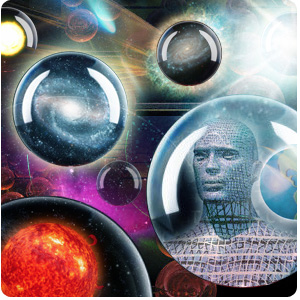 Forget science fiction. If you want to hear some really crazy ideas about the universe, just listen to our leading theoretical physicists. Wish you could travel back in time? You can, according to some interpretations of quantum mechanics. Could there be an infinite number of parallel worlds? Nobel Prize-winning physicist Steven Weinberg considers this a real possibility. Even the big bang, which for decades has been the standard explanation for how the universe started, is getting a second look. Now, many cosmologists speculate that we live in a "multiverse", with big bangs exploding all over the cosmos, each creating its own bubble universe with its own laws of physics. And lucky for us, our bubble turned out to be life-friendly. But if you really want to start an argument, ask a room full of physicists this question: Are the laws of physics fine-tuned to support life? Many scientists hate this idea–what's often called "the anthropic principle". They suspect it's a trick to argue for a designer God. But more and more physicists point to various laws of nature that have to be calibrated just right for stars and planets to form and for life to appear. For instance, if gravity were just slightly stronger, the universe would have collapsed long before life evolved. But if gravity were a tiny bit weaker, no galaxies or stars could have formed. If the strong nuclear force had been slightly different, red giant stars would never produce the fusion needed to form heavier atoms like carbon, and the universe would be a vast, lifeless desert. Are these just happy coincidences? The late cosmologist Fred Hoyle called the universe "a put-up job." Princeton physicist Freeman Dyson has suggested that the universe, in some sense, "knew we were coming." British-born cosmologist Paul Davies calls this cosmic fine-tuning the "Goldilocks Enigma". Like the porridge for the three bears, he says the universe is "just right" for life. Davies is an eminent physicist who's received numerous awards, including the Templeton Prize |
| Article |
Manufacturing BeliefThe origin of religion is in our heads, explains developmental biologist Lewis Wolpert. First we figured out how to make tools, then created a supernatural being.  In Lewis Carroll's Through the Looking Glass, Alice tells the White Queen that she cannot believe in impossible things. But the Queen says Alice simply hasn't had enough practice. "When I was your age, I always did it for half-an-hour a day. Why, sometimes I've believed as many as six impossible things before breakfast." That human penchant for belief–or perhaps gullibility–is what inspired biologist Lewis Wolpert to write a book about the evolutionary origins of belief called Six Impossible Things Before Breakfast. Wolpert is an eminent developmental biologist at University College London. Like fellow British scientist Richard Dawkins, he's an outspoken atheist with a knack for saying outrageous things. Unlike Dawkins, Wolpert has no desire to abolish religion. In fact, he thinks religious belief can provide great comfort and points to medical studies showing that the faithful tend to suffer less stress and anxiety than nonbelievers. In Wolpert's view, religion has given believers an evolutionary advantage, even though it's based on a grand illusion. p> He has a theory for why religion first took root. He thinks human brains evolved to become "belief engines". Once our ancient ancestors understood cause and effect, they figured out how to manipulate the natural world. In essence, toolmaking made us human. Similarly, early hominids felt compelled to find causes for life's great mysteries, including illness and death. They |
| Article |
Gospel According to JudasThe recently unearthed Gospel of Judas “contradicts everything we know about Christianity,” says religious historian Elaine Pagels.  As almost every child knows, Judas was the disciple who betrayed Jesus, selling his life for 30 pieces of silver. If there's an arch villain in the story of Jesus, it's Judas Iscariot. Or is it? The newly discovered Gospel of Judas suggests that Judas was, in fact, the favorite disciple, the only one Jesus trusted to carry out his final command to hand him over to the Romans. Rumors about the gospel have circulated for centuries. Early church fathers called it a "very dangerous, blasphemous, horrendous gospel," according to historian Elaine Pagels. We now know that the manuscript was passed around the shadowy world of antiquities dealers, at one point sitting in a safe deposit box in a small town in New York for 17 years. Pagels herself was once asked by a dealer in Cleveland to examine it, but he only showed her the last few pages, which revealed little more than the title page. She assumed there was nothing of significance. Finally, the manuscript was acquired by the National Geographic Society, which hired Pagels as a consultant to study it. More than any other scholar, Pagels has brought the lost texts of early Christianity to public attention. A Princeton historian of religion, she wrote the 1979 bestseller The Gnostic Gospels–the book that launched the popular fascination with the Nag Hammadi manuscripts found by Egyptian peasants in 1945. That book, which |
| Article |
The Modern MuslimControversial scholar Tariq Ramadan explains why Mohammed had progressive views of women, why the Quran is a prescription for peace–and why he is banned from Saudi Arabia and the U.S. 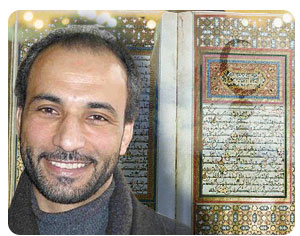 Controversial scholar Tariq Ramadan explains why Mohammed had progressive views of women, why the Quran is a prescription for peaceâ€"and why he is banned from Saudi Arabia and the U.S. Why are there so few moderate Muslims speaking out against Islamic terrorism? That's a common complaint heard in the West, but in truth, plenty of Muslims are critical of suicide bombers. What's harder to find are Muslim leaders who condemn terrorism while also maintaining credibility among disaffected Muslims, and intellectuals who can appeal to both secular Europeans and Middle Eastern imams. That's why the Swiss-born Tariq Ramadan is such a compelling figure. Ramadan has been called the Muslim Martin Luther King, and he's often described as Europe's most important Muslim intellectual. He has no shortage of charismaâ€"a quality that serves him well as he reaches out to various constituencies. There's no doubt that Ramadan commands a large following. Hundreds of young Muslims turn up at his public talks, and tapes of his lectures are widely circulated. He travels frequently throughout the Islamic world, trying to build bridges between European Muslims and conservative clerics. But there are some countries Ramadan can't visit. The United States, Egypt and Saudi Arabia have all banned him–each for different reasons. In 2004 Ramadan was all set to move his family to Indiana, where he'd accepted a teaching position at Notre Dame. But the U.S. State Department revoked his visa–though exactly why remains a mystery. Ramadan says it's because he's an outspoken critic of U.S. foreign policy. His critics say he has ties to Muslim terrorists. No evidence of a direct link to terrorism has ever surfaced, though plenty of people have looked for one. Yet his most vocal critics are in France, where Ramadan is a prominent public intellectual. The French journalist Caroline Fourest even wrote a book-length attack on Ramadan, titled Brother Tariq. One reason Ramadan garners such close scrutiny is his distinguished–some would say notorious–family background. In 1928 his grandfather, Hassan al-Banna, founded the Muslim Brotherhood in Egypt–the group that later spawned al-Qaida's Ayman al-Zawahiri. Al-Banna was murdered in 1949. Ramadan's parents fled Egypt and settled in Switzerland, where his father, Said Ramadan, emerged as a major Islamic thinker. Tariq Ramadan resists simple labels. He's a devout Muslim, but one who wants to loosen the strict interpretations of Islamic law. He embraces the Western values of pluralism and democracy, while also retaining the anti-colonial mantle of his grandfather. Ramadan is often accused of being two-faced, making nice with Western journalists while giving fiery speeches to young Muslims. Ramadan says his tone may change, but he insists that his message is consistent. |
| Article |
Seeing the Light—of ScienceRonald Numbers—a former Seventh-day Adventist and author of the definitive history of creationism—discusses his break with the church, whether creationists are less intelligent and why Galileo wasn't really a martyr.  Despite massive scientific corroboration for evolution, roughly half of all Americans believe that God created humans within the past 10,000 years. Many others believe the ‘irreducible complexity’ argument of the intelligent design movement–a position that, while somewhat more flexible, still rankles most scientists. This widespread refusal to accept evolution can drive scientists into a fury. I've heard biologists call anti-evolutionists "idiots", "lunatics" and worse. But the question remains: How do we explain the stubborn resistance to Darwinism? University of Wisconsin historian Ronald Numbers is in a unique position to offer some answers. His 1992 book The Creationists, which Harvard University Press has just reissued in an expanded edition, is probably the most definitive history of anti-evolutionism. Numbers is an eminent figure in the history of science and religion–a past president of both the History of Science Society and the American Society of Church History. But what's most refreshing about Numbers is the remarkable personal history he brings to this subject. He grew up in a family of Seventh-day Adventists and, until graduate school, was a dyed-in-the-wool creationist. When he lost his religious faith, he wrote a book questioning the foundations of Adventism, which created a huge rift in his family. Perhaps because of his background, Numbers is one of the few scholars in the battle over evolution who remain widely respected by both evolutionists and creationists. In fact, he was once recruited by both sides to serve as an expert witness in a Louisiana trial on evolution. (He went with the ACLU.) Numbers says much of what we think about anti-evolutionism is wrong. For one thing, it's hardly a monolithic movement. There are, in fact, fierce battles between creationists |
| Article |
Buddha on the BrainEx-monk B. Alan Wallace explains what Buddhism can teach Western scientists, why reincarnation should be taken seriously and what it's like to study meditation with the Dalai Lama.  B. Alan Wallace may be the American Buddhist most committed to finding connections between Buddhism and science. An ex-Buddhist monk who went on to get a doctorate in religious studies at Stanford, he once studied under the Dalai Lama, and has acted as one of the Tibetan leader's translators. Wallace, now president of the Santa Barbara Institute for Consciousness Studies, has written and edited many books, often challenging the conventions of modern science. "The sacred object of its reverence, awe and devotion is not God or spiritual enlightenment but the material universe," he writes. He accuses prominent scientists like E.O. Wilson and Richard Dawkins of practicing "a modern kind of nature religion." In his new book, Contemplative Science: Where Buddhism and Neuroscience Converge, Wallace takes on the loaded subject of consciousness. He argues that the long tradition of Buddhist meditation, with its rigorous investigation of the mind, has in effect pioneered a science of consciousness, and that it has much to teach Western scientists. "Subjectivity is the central taboo of scientific materialism," he writes. He considers the Buddhist |
| Radio Broadcast |
Electrons to EnlightenmentA five-part series on Science & Religion 
The Big Questions:
Part One: Science vs. ReligionCan Science ever be reconciled with Religion? Do science and religion have to be at war with each other? Francis Collins doesn't think so. As head of the Human Genome Project, he has a distinguished track record as a gene hunter. He's also an evangelical Christian who believes in miracles. But biologist and atheist Richard Dawkins says religion can never be reconciled |
| Article |
The Flying Spaghetti MonsterWhy are we here on earth? To Richard Dawkins, that's a remarkably stupid question. In a heated interview, the famous biologist insists that religion is evil and God might as well be a children's fantasy.  In the roiling debate between science and religion, it would be hard to exaggerate the enormous influence of Richard Dawkins. The British scientist is religion's chief prosecutor–"Darwin's rottweiler," as one magazine called him–and quite likely the world's most famous atheist. Speaking to the American Humanist Association, Dawkins once said, "I think a case can be made that faith is one of the world's great evils, comparable to the smallpox virus but harder to eradicate." Not surprisingly, these kinds of comments have made Dawkins a lightning rod in the debate over evolution. While he's a hero to those who can't stomach superstition or irrationality, his efforts to link Darwinism to atheism have upset the scientists and philosophers, like Francis Collins and Michael Ruse, who are trying to bridge the gap between science and religion. Yet, surprisingly, some intelligent design advocates have actually welcomed Dawkins' attacks. William Dembski, for instance, says his inflammatory rhetoric helps the I.D. cause by making evolution sound un-Christian. Dawkins' outspoken atheism is a relatively recent turn in his public career. He first made his name 30 years ago with his groundbreaking book The Selfish Gene, which reshaped the field of evolutionary biology by arguing that evolution played out at the level of the gene itself, not the individual animal. Dawkins now holds a chair in the Public Understanding of Science at Oxford University. Thanks to his tremendous talent for clear and graceful writing, he's done more to popularize evolutionary biology than any other scientist, with the possible exception of Stephen Jay Gould. Dawkins has a gift for explaining science through brilliant metaphors. Phrases like "the selfish gene" and "the blind watchmaker" didn't only crystallize certain scientific ideas; they entered the English vernacular. And his concept of "memes"–ideas themselves evolving like genes–spawned a new way of thinking about cultural evolution. |
| Article |
Divining the BrainAndrew Newberg discusses what happens in our brains during prayer, meditation and mystical visions. Yet understanding the brain, argues the neuroscientist, does not close the book on the nature of religious experience. 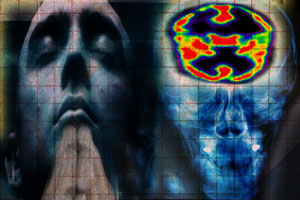 Can we actually see God in the brain? Well, not exactly. But a few enterprising neuroscientists have found ways to detect and measure the varieties of our religious experience. Using brain scanning technology, researchers have been able to pinpoint which parts of the brain are activated during prayer and meditation. While they can't answer the biggest question of all–does God exist?–they are probing one of the deepest mysteries in science: the nature of consciousness. They're also wading into a thorny issue in the science and religion debate: the connection between brain and mind. Most neuroscientists assume the mind is nothing more than electrochemical surges among nerve cells in the brain. But neuroscientists who study spirituality tend to be open to the possibility that the mind could exist independently of the brain. Some even question the materialist paradigm of science–-the idea that the only reality worth studying is what can be tested, quantified and reproduced. They wonder whether current scientific methods will ever be able to explain consciousness. But others are skeptical. Stephen Heinemann, president of the Society for Neuroscience, recently told the Chronicle of Higher Education, "I think the concept of the mind outside the brain is absurd." One of the pioneers in the new field of neurotheology is Andrew Newberg, a 40-year-old physician at the University of Pennsylvania and director of the Center for Spirituality and the Mind, who has just published a book, Why We Believe What We Believe: Uncovering Our Biological Need for Meaning, Spirituality, and Truth, written with his colleague Mark Robert Waldman. Over the last decade, Newberg has conducted a series of brain-imaging studies of various spiritual practitioners, including Franciscan nuns, Buddhists and Pentecostal Christians who speak in tongues. His lab research has brought some surprising–and curious–results. For instance, during his study of Pentecostals, Newberg was amazed to see one of his own lab assistants start to sing and speak in tongues. It turned out that she had been doing it as part of her own religious practice for almost 10 years. |
| Article |
The BelieverFrancis Collins–head of the Human Genome Project–discusses his conversion to evangelical Christianity, why scientists do not need to be atheists, and what C.S. Lewis has to do with it.  As the longtime head of the Human Genome Project, Francis Collins is one of America's most visible scientists. He holds impeccable scientific credentials–a medical degree as well as a Ph.D. in physics–and has established a distinguished track record as a gene hunter. He's also an evangelical Christian, someone who has no qualms about professing his belief in miracles or seeing God's hand behind all of creation. The cover of his new book illustrates this unusual mixture: The book's title, The Language of God, is superimposed on a drawing of the double helix. "The God of the Bible is also the God of the genome," he writes. "He can be worshiped in the cathedral or in the laboratory." Collins hopes to stake out the middle ground between Darwinian atheists and religious fundamentalists. "Both of these extremes don't stand up to logic, and yet they have occupied the stage," he told me. "We cannot let either side win." Unlike so many of those players most invested in this culture war, Collins sees no inherent conflict between science and religion. Yet his book is likely to alienate plenty of people on both sides of the debate. His frequent references to God's almighty power might be difficult for secular readers to swallow. And his scathing critique of both Young Earth creationism and intelligent design probably won't attract the hordes of readers buying Ann Coulter's latest diatribe against evolution. The Language of God offers an unusually personal look at a leading scientist's search for meaning. Collins recounts his own struggles with faith, as well as his daughter's rape by a man who broke into her apartment and held a knife to her throat. This trauma became a test of faith for Collins and a lesson in how suffering can lead to personal growth. His book also recaps his scientific triumphs, including his discovery of the long-sought gene that causes cystic fibrosis. And later, when he stood by Bill Clinton's side as the president announced that the mapping of the human genome was complete. It turns out that Collins worked with the president's speechwriter to help craft Clinton's religious spin on this scientific breakthrough. "Today," Clinton said, "we are learning the language in which God created life." |
| Article |
The DisbelieverSam Harris, author of The End of Faith, on why religious moderates are worse than fundamentalists, 9/11 led us into a deranged holy war, and believers should be treated like alien-abduction kooks.  Three-quarters of all Americans believe the Bible is God’s word, according to a recent Pew poll. Numbers like that make an outspoken atheist like Sam Harris seem either foolhardy or uncommonly brave. Two years ago, when the 39-year-old launched a full-scale attack on religious belief in his provocative book The End of Faith, he was an unknown. That changed overnight when his book shot up the New York Times bestseller list and later went on to win the 2005 PEN/Martha Albrand Award for First Nonfiction. Since then, The End of Faith has earned an avid following among atheists and lapsed churchgoers; it’s the kind of book that gets passed around from one friend to another to another. Here, finally, was someone willing to do the unthinkable: to denounce religious faith as irrationalâ€"murderous, even. The heart of Harris' book is a frontal assault on Islam and Christianity, carrying both pages and pages of quotations from the Quran imploring the faithful to kill infidels, and a chilling history of how Christian leaders have brutally punished heretics. Harris argues that much of the violence in today's world stems directly from people willing to live and die by these sacred texts. |
| Article |
Going Beyond GodHistorian and former nun Karen Armstrong says the afterlife is a “red herring,” hating religion is a pathology and that many Westerners cling to infantile ideas of God.  Karen Armstrong is a one-woman publishing industry, the author of nearly 20 books on religion. When her breakthrough book "A History of God" appeared in 1993, this British writer quickly became known as one of the world's leading historians of spiritual matters. Her work displays a wide-ranging knowledge of religious traditions–from the monotheistic religions to Buddhism. What's most remarkable is how she carved out this career for herself after rejecting a life in the church. At 17, Armstrong became a Catholic nun. She left the convent after seven years of torment. "I had failed to make a gift of myself to God," she wrote in her recent memoir, The Spiral Staircase. While she despaired over never managing to feel the presence of God, Armstrong also bristled at the restrictive life imposed by the convent, which she described in her first book, Through the Narrow Gate. When she left in 1969, she had never heard of the Beatles or the Vietnam War, and she'd lost her faith in God.Armstrong went on to work in British television, where she became a well-known secular commentator on religion. Then something strange happened. After a TV project fell apart, she rediscovered religion while working on two books, A History of God and a biography of Mohammed. Her study of sacred texts finally gave her the appreciation of religion she had longed for–not religion as a system of belief, but as a gateway into a world of mystery and the ineffable. Muhammad: A Biography of the Prophet also made her one of Europe's most prominent defenders of Islam. Armstrong now calls herself a "freelance monotheist." It's easy to understand her appeal in today's world of spiritual seekers. As an ex-nun, she resonates with people who've fallen out with organized religion. Armstrong has little patience for literal readings of the Bible, but argues that sacred texts yield profound insights if we read them as myth and poetry. She's especially drawn to the mystical tradition, which–in her view–has often been distorted by institutionalized religion. While her books have made her enormously popular, it isn't surprising that she's also managed to raise the ire of both Christian fundamentalists and atheists. |
| Article |
Religious Belief Itself Is an Adaptation For a man who's obsessed with tiny critters, Edward O. Wilson has a strange knack for stirring up controversy about life's biggest questions. The Harvard biologist is a renowned expert on insects, co-author of the Pulitzer Prize-winning book The Ants. But it was his seminal 1975 book Sociobiology, which laid the groundwork for the new field of evolutionary psychology, that made Wilson a scientific luminary–and a major intellectual force in America. That book, along with its Pulitzer Prize-winning sequel, On Human Nature, argued that many human behaviors–including aggression, altruism and hypocrisy–are shaped by evolution. Wilson's tilt toward nature in the age-old nature/nurture debate may have put him on the map, but it also made plenty of enemies. Fellow Harvard biologists Stephen Jay Gould and Richard Lewontin denounced sociobiology, saying it provided a genetic justification for racism and Nazi ideology. Wilson's classes were picketed. In one famous incident, demonstrators at a scientific meeting stormed the stage where he was speaking and dumped a pitcher of water over his head, chanting, "Wilson, you're all wet!" Over the years, sociobiology–once so controversial–became a widely accepted branch of science. Ultimately, Wilson won the National Medal of Science for his scholarship. And his own popularity soared when he emerged as a champion of biodiversity and a passionate advocate for endangered species. His 1992 book The Diversity of Life became a bestseller. But he stirred up more trouble in the late '90s with another book, Consilience. This was his attempt to outline a unified theory of knowledge, which had the effect of elevating science at the expense of religion and the arts. In his view, knowledge of the world ultimately comes down to chemistry, biology and–above all–physics; people are just extremely complicated machines. Wendell Berry, among other critics, railed against Wilson's scientific reductionism, calling it a "modern superstition." |