

Juliet Eilperin

As the national environmental reporter for the Washington Post, Juliet Eilperin covers science, policy, and politics in areas including climate change, oceans, and air quality. In pursuit of those stories she has gone scuba diving with sharks in the Bahamas, trekking on the Arctic tundra with Selma Hayek and Jake Gyllenhaal, and searching on her hands and knees for rare insects in the caves of Tennessee. A graduate of Princeton University, she served as Princeton's youngest-ever McGraw Professor of Journalism in 2005. Her first book, Fight Club Politics: How Partisanship Is Poisoning the House of Representatives, was published that same year.
| Article |
 Norway Debates the Promise, Costs of New DrillingOil Means More Revenue But More Climate Change. This small country, which has a vast treasure of undersea oil and an intense civic concern about global warming, is struggling with a dilemma—but it is one that most nations would envy. In little more than two generations, oil and gas have transformed Norway from a country recovering from World War II occupation into an economic powerhouse. But now its citizens and politicians are debating whether it should take advantage of Earth’s warming to drill for more oil above the Arctic Circle, knowing that consumption of that oil will accelerate climate change. Energy experts estimate that as much as 73 billion barrels of oil and natural gas could be trapped in a 1,220-mile-long stretch of the Arctic seabed. Complicating the argument further, those resources would be easier to tap in a warmer environment. Given the value of Norway’s existing oil and gas—the country ranks as the world’s third biggest gas exporter and fifth largest oil exporter, and petroleum accounted for 36 percent of the government’s revenue last year—its political and business leaders are increasingly focused on the opportunities in what they call “the High North”. They know that if Norway holds back, Russia, Denmark, Canada and other countries with Arctic claims could well vie to exploit these resources. (This month, a Russian mini-submarine planted the Russian flag, encased in a titanium capsule, on the seabed at the North Pole in a symbolic gesture to underscore its claims to the |
| Article |
Warming Draws Evangelicals into Environmentalist Fold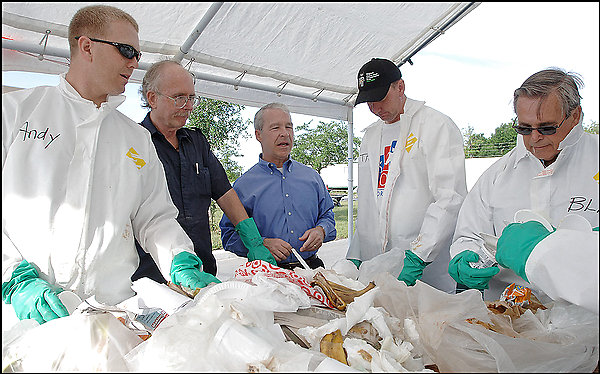 She and several fellow parishioners picked apart the garbage to analyze exactly how much and what kind of waste their megachurch produces, looking for ways to reduce the congregation's contribution to global warming. “I prayed about it, and God really revealed to me that I had a passion about creation,” said Kirsop, who has since traded in her family's sport-utility vehicle for a hybrid Toyota Prius to help cut her greenhouse gas emissions. “Anything that draws me closer to God—and this does—increases my faith and helps my work for God.” Her conversion to environmentalism is the result of a years-long international campaign by British bishops and leaders of major U.S. environmental groups to bridge a long-standing divide between global-warming activists and American evangelicals. The emerging rapprochement is regarded by some as a sign of how dramatically U.S. public sentiment has shifted on global warming in recent years. It also has begun, in modest ways, to transform how the two groups define themselves. “I did sense this is one of these issues where the church could take leadership, like with civil rights,” said Northland's senior pastor, Joel C. Hunter. “It's a matter of who speaks for evangelicals: Is it a broad range of voices on a broad range of issues, or a narrow range of voices?” Hunter has emerged among evangelicals as a pivotal advocate for cutting greenhouse gas emissions that scientists say are warming Earth's climate. A self-deprecating 59-year-old minister who can quote the “Baby Jesus” speech that Will Farrell delivered in the 2006 |