


Science of Hope
Across a Fridley street—and a religious divide—a Catholic-school biology teacher and a Muslim-school science instructor reach out to each other, planting seeds of cultural understanding in the process.
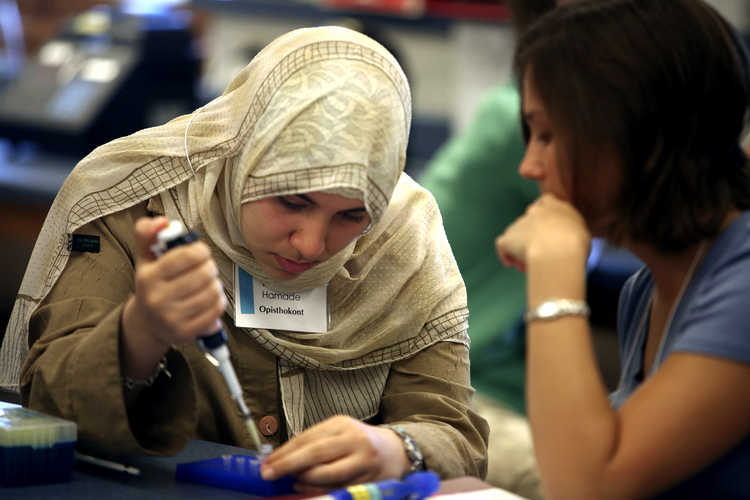
Two-lane Gardena Avenue and a stand of oak trees are all that physically separate the Al-Amal Muslim School and Totino–Grace Catholic School in Fridley. But in the science classrooms, the schools are divided by deep tenets of faith and centuries of East–West tradition.
Totino–Grace’s biology teacher, Marcia Wiger, opens a lesson on evolution by reading from Genesis and then explaining Charles Darwin’s landmark theory. She sees no conflict between the two: “We look at religion as religion and science as science.”
Across Gardena, though, evolution stops before it reaches humans. “We cannot believe that man came from apes,” said Al-Amal’s science teacher, Hala Bazzi. “Allah gave man full conscience and intelligence and knowledge that made him superior.”
Still, science has served as a bridge for Wiger and Bazzi, who started out as collaborators and along the way became friends.
At a time when tension between the Muslim world and the West is dangerously high and news is dominated by violence and body counts, the rarely told story is the quiet diplomacy conducted close to home as Muslims and Christians seek to understand one another. And whether the topic is the universe or the human body, science is providing neutral ground for dialogue.
Al-Amal (Arabic for “hope”) opened in 1995 and attracted a large, recent influx of immigrants speaking many languages. A call to prayer sounding through the hallways, though, requires no translation. Children of Somali cabdrivers and children of Lebanese doctors respond.
The larger, older Roman Catholic high school watched its neighbor grow in tandem with Minnesota’s burgeoning Muslim population. In 2001, when Al-Amal took its share of post-Sept. 11 backlash against American Muslims, Totino–Grace extended a hand. Among other gestures, Totino–Grace shared its facilities, including a well-equipped biology lab where an ornate Christian cross graces one wall and a model of DNA’s double helix dominates the ceiling.
Wiger took the gesture a step further last year, helping Bazzi’s class with experiments such as extracting DNA from strawberries and solving fictitious crimes with DNA evidence. “All of the kids loved it,” Wiger said.
Both teachers had been schooled in respect for diversity. Bazzi grew up in Lebanon’s multireligious mix. Wiger, a former nun, has a passion for exploring the world’s cultures. All they needed to break the ice was their mutual interest in science. Then Bazzi, whose son’s urgent need for a kidney transplant brought her family to the University of Minnesota, started crossing Gardena Avenue just to talk.
Theirs is a small, close-to-home example of the détente that scientific leaders hope to foster globally. Alan Leshner of the American Association for the Advancement of Science is one of many leaders calling for a renewed “science diplomacy”. During the Cold War, U.S. scientists quietly opened discussions with their counterparts in China and the Soviet Union. Now the world is again at a moment when “history requires a deeper, more urgent sense of engagement,” Leshner said.
Hope from history
Western science has roots in ancient Greece, where Aristotle and other philosophers sought to understand the natural world. It started centuries before Jesus Christ gave rise to a new religion in the West and the Prophet Muhammad shared divine revelations that were to unite the Arab world and much of Asia behind Islam.
Students at Al-Amal are well-versed in what happened after the Roman Empire collapsed in the fifth century and Europe plunged into the Dark Ages. The spirit of scientific inquiry took hold in modern-day Iraq, Iran and Egypt. Sponsored by Muslim caliphs, scholars there preserved Greek texts, translated them and built upon them.
If not for those efforts, a good portion of the European discoveries would have been lost. But the Muslim contributions were largely forgotten. Math teacher Fatina Shaheen is determined that they be remembered at Al-Amal. “Our students need to connect with their past,” she said. “They need to know about these famous Muslim scholars who contributed a lot to Western civilization.”
Now, though, the Arab world ranks with sub-Saharan Africa as regions with the lowest level of research intensity, according to the United Nations. And the broader Muslim world hasn’t kept pace with investment in science.
One of Europe’s prominent intellectuals, Tariq Ramadan, is urging Muslim scientists in the West to take a lead in spurring achievement in the Muslim world, where many dismiss science as a tool the West uses to dominate, said Ramadan, a research fellow at Oxford University in England.
Al-Amal alumnae Heba Abdel-Karam, 18, and Rawan Hamade, 16, eagerly accepted Ramadan’s challenge. They are launching science careers this year at the University of Minnesota.
After Abdel-Karam earns a degree in genetic cell biology, she hopes to return to Egypt, her homeland. Her inspiration came from relatives: An aunt is a chemist; a brother, a software engineer. But she also is driven by the sorry state of scientific achievement in the predominantly Muslim world.
“We were once a great civilization and now everything has started to decline,” she said.
Hamade has set her sights on a medical degree and a doctorate in genetics. Halla Bazzi is her mother, so she is well-schooled in the high-minded spirit of science diplomacy. But as a young girl in Lebanon, she also learned tough-minded realism.
“It is the right idea to have, but politics can influence everything else,” Hamade said.
What went wrong?
There is heated debate over the reasons Muslim regions now rank low in science. Many in the West agree with Toby Huff, chancellor professor of sociology at the University of Massachusetts in Dartmouth, that Islam gradually shut out free thought. Meanwhile, science rose in the West through a series of intellectual clashes.
“People like Galileo had to join battle with established church authorities in order to warrant the claims they made for their scientific knowledge as well as their human capacity to achieve it,” Huff wrote in The Rise of Early Modern Science: Islam, China, and the West.
Under Islam, challenges to religious authority weren’t tolerated, Huff said, and science came to serve religion. It was encouraged where it could be useful, he said—for example, how astronomy could help determine the direction toward Mecca.
Prof. F. Jamil Ragep disagrees. Muslims’ achievements have far surpassed their religion’s practical needs, said the science historian at McGill University’ s Institute of Islamic Studies in Montreal.
“You don’t need Aristotle’s metaphysics to figure out the direction to Mecca,” Ragep said in a lecture this year for the Templeton–Cambridge Journalism Fellowship at England’s Cambridge University. Further, Ragep said, the achievements continued for nearly 1,000 years, too long to support the notion that Islam is inherently antagonistic to science.
A different explanation came from Ziauddin Sardar, a Pakistan-born writer and visiting professor at the City University of London in England. “Colonialism, more than any other factor, played a major part in the suppression and eventual disappearance of science and learning from Muslim societies,” Sardar said in a recent lecture.
“The teachings of Islam are the same now as they were 1,000 years ago,” he said. “Islam was not a problem then. It is not the problem now.”
The world on Gardena Avenue
Although Gardena Avenue is relatively peaceful, it is not free of the larger conflicts. Students and teachers worry about cultural friction that has surfaced in Minnesota over passengers carrying alcohol in taxis driven by Muslims, the election of a Muslim to Congress and accommodations for Muslims to take prayer breaks and wash their feet.
Cultural differences are easy to find on Gardena Avenue, too. Upper-grade Muslim girls at Al-Amal cover their arms and heads in the various traditions of the countries their families represent. Across the avenue, Catholic girls run the gym floors in shorts and tank tops. Lunch on a typical day at Totino–Grace might include pork; never at Al-Amal.
Against that backdrop, Bazzi said the chance to talk about Islam—its history of scientific achievement and its views on modern-day issues—has helped break down stereotypes.
“This is the first time we are talking about Islam from the right point of view,” she said. “I feel we have more objectivity.”
Bazzi teaches chemistry this year, so she doesn’t need Wiger’s biology lab. But there is another reason to keep crossing Gardena Avenue.
“We have friendship now,” Bazzi said.