
 About the Fellowship
Science, Faith Used To Be Allies
Tellingly, President Obama's pick to head the National Institutes of Health, Francis Collins, touts this symbiotic relationship today.
by Mark Pinsky
In recent years, some Americans have come to view science and religion as consistent antagonists, butting heads over everything from the origin of the cosmos to when human life begins (abortion) and when it ends (euthanasia).
Conservative denominations, like the Southern Baptists, Catholics, Assemblies of God and some non-denominational evangelicals, object to particular areas of scientific research — embryonic stem cells and cloning, for instance. By contrast, mainline Protestant and Jewish denominations, as well as Hindu and Muslim communities, have tended to support embryonic stem cell research, adding a new voice to such highly politicized debates.
What is sometimes obscured by the clamor is that there was once an era in American history when science and religion were considered symbiotic allies, rather than the rancorous adversaries they too often are today.
The issue surfaced again over the summer. When President Obama named Francis Collins, an outspoken evangelical as well as former director of the Human Genome Project, to head the National Institutes of Health, some scientists, secularists and at least one prominent atheist criticized the appointment. They were concerned that Collins' faith might influence his decisions at the NIH. This despite the fact that Collins, author of The Language of God, supports both evolution and embryonic stem cell research — although he has also written that he does not believe homosexuality is "hard-wired."
The Senate confirmed Collins unanimously in August,and his critics might have been stilled several weeks ago, when Obama announced a $5 billion grant to the NIH, including funds for stem cell research that he called the "single largest boost to biomedical research in history."
After his tour of the NIH's Maryland facility with Obama, Collins said, "We can't know where this research will lead. That's the nature of science."
In 2007, as the culture war heated up between certain researchers and their evangelical critics, Collins established the BioLogos Foundation and website (http://www.biologos.org/) to advance what he saw as the essential harmony of faith and science. The organization emphasizes the compatibility of scientific research and Christian belief. Collins stepped down as president of the foundation the day before he was sworn in as head of the NIH.
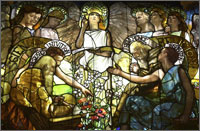
Collins' supporters can look to an unlikely, artistic source for inspiration: American stained-glass master Louis Comfort Tiffany. In 1889-90, Tiffany executed a large window for Yale University's library addition that had as its central motif the interdependence of science and religion. It was commissioned by Simeon Baldwin Chittenden, a rough-hewn, self-made Brooklyn businessman who spent some of his teenage years in New Haven, and went on to become a minor railroad magnate and U.S. congressman.
Titled Education, the window is spread over five panels but clustered around four elements: science, religion, art and music. Both ethereal and allegorical, the human figures are religious, winged and haloed, although they could as easily be muses as angels. What is most significant is that science and religion occupy the center of the work, facing each other and flanking a standing, female angel holding the "Book of Life." This panel appears as a thumbnail image on the BioLogos website. "Religion and science are not only central to the image, but also in dialogue with one another," says the Rev. Guy Pujol, adjunct professor of pastoral liturgy at Atlanta's Interdenominational Theological Center.
In Tiffany's mind — and/or Chittenden's — science and religion were inextricably linked, in what Yale curators call a "visual sermon." At the time the window was installed, the tableau reflected academic attitudes on campus. For obvious reasons, the Chittenden window resonates among supporters of Collins' views. "This personal integration of science and religion — and a belief that this well-balanced perspective may appease both sides of the stem-cell research debate — was a decisive factor for President Obama in appointing Collins," says Pujol.
Unfortunately, the relationship idealized in the Chittenden window was called into question within decades of its dedication. Darwinian evolution first became a flashpoint with fundamentalists in the rural South and Midwest heartland in the 1920s, immortalized in the play and film Inherit the Wind.
These cycles of controversy and cooperation are not unique to the contemporary era, nor to the United States.
As the window reminds us, in medieval times theology was known as "the queen of the sciences," existing for the most part in harmony with astronomy and cosmology, as well as with astrology and alchemy. Catholic observers were pioneers in celestial observations. Even so, there were occasional (and infamous) bumpy moments, clashes between religious authorities and believing researchers such as Galileo, Copernicus and Kepler, whose findings were seen as challenging church doctrine.
Collins earned his Ph.D. in chemistry at Yale in the early 1970s, and I find no mention of the Chittenden window in his writings, or whether the NIH head has contemplated its significance to his own life. But in a commentary for the Christian Broadcasting Network, he displays sentiments consonant with the window's message.
"The God of the Bible is also the God of the genome," Collins said. "God can be found in the cathedral or in the laboratory. By investigating God's majestic and awesome creation, science can actually be a means of worship."
Mark I. Pinsky, a longtime religion writer for the Los Angeles Times and Orlando Sentinel, was a Templeton-Cambridge Journalism Fellow in Science & Religion at the University of Cambridge.
(Interdependence: A Tiffany window at Yale University shows harmony between science and religion./Michael Marsland, Yale University.)
(end of article)
return to list of publications