

 About the Fellowship
Science & Religion
Why Science is More Fragile than Faith


We tend to see modernity in part as a triumph of science--an age when experimental discoveries and analysis have eclipsed religion and other ancient beliefs. And it is our scientific understanding of the world and mastery of technology that will mold the future of human affairs.
Not so fast, says Robert N. McCauley.
McCauley, a philosopher of science at Emory University, looks at the contemporary world and sees it differently: It is science, not religion, that is fragile.
In a new book, "Why Religion is Natural and Science Is Not," McCauley argues that, if you consider how the human mind actually works, science faces challenges even where it seems ascendant. Religion is too intuitive, too natural a style of thinking, to be gotten rid of.
In contrast, modern scientific thinking is radically unnatural. It is difficult to acquire as a skill, and researchers find that even people trained in science can easily revert to nonscientific thinking.
McCauley’s best-known work, the 1990 book "Rethinking Religion: Connecting Cognition and Culture," written with E. Thomas Lawson, helped start the scientific study of religious cognition, influencing or foreshadowing well-known thinkers on religion and culture such as Pascal Boyer, Daniel Dennett, and Scott Atran.
Those thinkers have tended to use evolutionary explanations of religion as a means to dismiss it, part of an increasingly fractious war over whether belief has any place in a rationalist world. McCauley himself considers the whole debate over science and religion overblown--it’s like comparing apples and sofas, he says. Even in places that seem to have abandoned religion, like Northern Europe, he questions whether there hasn’t simply been a shift toward a less-organized form of spiritual expression.
As for the unnatural world of science, he’s worried. He spoke to Ideas twice by phone; this interview was edited and condensed from those conversations.
IDEAS: Back in 1990, you and Tom Lawson pioneered the scientific study of religion, by trying to trace the cognitive basis for religion. What’s changed in the field in the last two decades?
MCCAULEY: The changes are huge! Things like social neuroscience didn’t exist in the 1980s much. There are both new tools and new findings. The most prominent tools have been those for neuroimaging. We’re seeing lots of interesting findings. Emma Cohen studied Oxford’s rowing teams. One finding she got is the guys who were rowing in synchrony have far, far higher pain thresholds, by virtue, it looks like, of their joint effort. That seems to resonate fairly closely with what we know about religion.
IDEAS: What popular ideas have emerged that are wrong?
Robert McCauley: Why Religion is Natural
(And Science is Not)


Over the last decade, there have been many calls in the secular community for increased criticism of religion, and increased activism to help loosen its grip on the public.
But what if the human brain itself is aligned against that endeavor?
That's the argument made by cognitive scientist Robert McCauley in his new book, Why Religion is Natural and Science is Not.
In it, he lays out a cognitive theory about why our minds, from a very early state of development, seem predisposed toward religious belief—and not predisposed towards the difficult explanations and understandings that science offers.
If McCauley is right, spreading secularism and critical thinking may always be a difficult battle—although one no less worthy of undertaking.
Dr. McCauley is University Professor and Director of the Center for Mind, Brain, and Culture at Emory University. He is also the author of Rethinking Religion and Bringing Ritual to Mind.
- listen… []
A Knack for Bashing Orthodoxy
Profiles in Science: Richard Dawkins

OXFORD, England —You walk out of a soft-falling rain into the living room of an Oxford don, with great walls of books, handsome art and, on the far side of the room, graceful windows onto a luxuriant garden.
Does this man, arguably the world’s most influential evolutionary biologist, spend most of his time here or in the field? Prof. Richard Dawkins smiles faintly. He did not find fame spending dusty days picking at shale in search of ancient trilobites. Nor has he traipsed the African bush charting the sex life of wildebeests.
He gets little charge from such exertions.
"My interest in biology was pretty much always on the philosophical side," he says, listing the essential questions that drive him. "Why do we exist, why are we here, what is it all about?"
It is in no fashion to diminish Professor Dawkins, a youthful 70, to say that his greatest accomplishment has come as a profoundly original thinker, synthesizer and writer. His epiphanies follow on the heels of long sessions of reading and thought, and a bit of procrastination. He is an elegant stylist with a taste for metaphor. And he has a knack, a predisposition even, for assailing orthodoxy.
In his landmark 1976 book, "The Selfish Gene," he looked at evolution through a novel lens: that of a gene. With this, he built on the work of fellow scientists and flipped the prevailing view of evolution and natural selection on its head.
He has written a string of best sellers, many detailing his view of evolution as progressing toward greater complexity. (His first children’s book, "The Magic of Reality," appears this fall.) With an intellectual pugilist’s taste for the right cross, he rarely sidesteps debate, least of all with his fellow evolutionary biologists.
When Is It Ramadan?
An Arab Astronomer Has Answers.

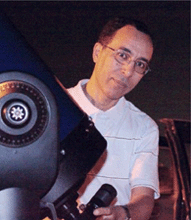
This week will see the start of the Islamic holy month of Ramadan, a time when hundreds of millions of Muslims around the globe devote themselves to fasting and prayer. But to Algerian scientist Nidhal Guessoum, a Sunni Muslim, it's also a time of chaos—and "an embarrassment" to Islam.
Tradition dictates that Ramadan, like other holy months in the Islamic calendar, begins the day after the thin crescent of the new moon is first seen with the naked eye. Because visibility is very dependent on local atmospheric conditions, religious officials in different countries—relying on eye-witness observations from volunteers—often disagree on the exact moment, sometimes by as much as 3 or 4 days. It's a recipe for international confusion.
Guessoum, an astrophysicist at the American University of Sharjah in the United Arab Emirates, is one of the most high-profile advocates of a scientific approach to the problem that would end the confusion. Its adoption would not only help Muslims plan their lives—"I need to know whether I can hold a meeting on August 30," Guessoum says—but also be a sign that Muslim countries, once at the forefront of science, are again "able to integrate science into social and cultural life," he says.
Guessoum, the vice president of an international organization known as the Islamic Crescents' Observation Project (ICOP), believes science can help solve other practical problems in the Muslim faith. In frequent TV appearances, public lectures, blog posts, and books, he has explained how astronomical techniques can help determine prayer times in countries far from the equator or establish the direction of Mecca.
His attempts to apply science to Islamic rituals has earned him respect, but they have also ruffled the feathers of religious conservatives. So has his support for biological evolution and his rejection of claims that the Koran anticipated much of modern science. He can make people without much scientific knowledge "uneasy," says Zulfiqar Ali Shah, an influential U.S. cleric who supports his ideas about the Islamic calendar. When dealing with religious scholars, Guessoum "is very respectful but forceful," Ali Shah adds.
Guessoum, 50, obtained a physics degree in Algeria in 1982. He earned a Ph.D. in theoretical astrophysics at the University of California, San Diego, after which he spent 2 years at NASA's Goddard Space Flight Center in Greenbelt, Maryland, working on gamma ray astrophysics, which is still the focus of his research. A "moral and financial duty" to pay back for his education made him return to Algeria in 1990. There, ordinary people and religious officials often asked him to explain the science of crescent sighting, a topic that astronomer Bradley Schaefer, now at Louisiana State University in Baton Rouge, had got him interested in. He published a book on the topic in Arabic in 1997.
Science is the Only Road to Truth? Don't Be Absurd.
Overvaluing science leads to illogicality, as a Nobel prize winner has proved.

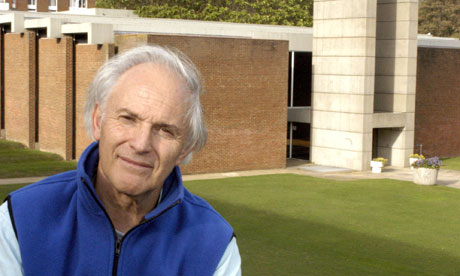
By the standards of very clever men who believe some very silly things, Harry Kroto is a quite unremarkable scientist. Unlike some other Nobel prize winners, he is not an enthusiastic Nazi, a Stalinist, a eugenicist, or even a believer in ESP. He did play a prominent, and I think disgraceful part in the agitation to have Michael Reiss sacked from a job at the Royal Society for being a priest. But the video of his speech at the Nobel laureates meeting this year in Lindau, Austria, is something else. Much of it is great stuff about working for love, not money; and about the importance of art, but around eight minutes in he goes off the rails. First there is a slide saying (his emphases): "Science is the only philosophical construct we have to determine TRUTH with any degree of reliability." Think about this for a moment. Is it a scientific statement? No. Can it therefore be relied on as true? No.
But formal paradoxes have one advantage well known to logicians, which is that you can use them to prove anything, as Kroto proceeds to demonstrate. Or, as he puts it: "Without evidence, anything goes." Remember, he has just defined truth (or TRUTH) as something that can only be established scientifically. So nothing he says about ethics or intellectual integrity after that need be taken in the least bit seriously. It may be true, but there is no scientific way of knowing this and he doesn't believe there is any other way of knowing anything reliably.
Note how this position completely undermines what he then goes on to say – that "the Ethical Purpose of Education must involve teaching our young people how they can decide what they are being told is true" (his caps). Again, this is not a scientific statement, and therefore cannot, on Kroto's terms, be a true one.
The Priest-Physicist Who Would Marry Science to Religion
John Polkinghorne leads a disparate group of scientists on the controversial search for God within the fractured logic of quantum physics.

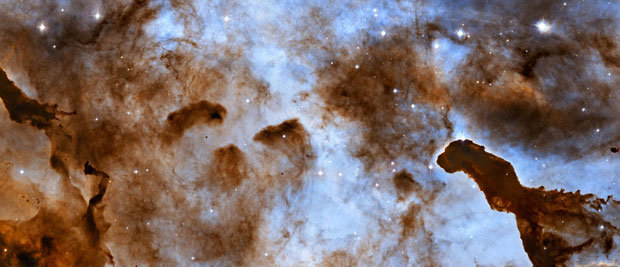
When he describes his line of work, John Polkinghorne jests, he encounters "more suspicion than a vegetarian butcher." For the particle physicist turned Anglican priest, dissonance comes with the territory. Science parses the concrete: the structure of the atom and the workings of the brain. Religion confronts the intangible: questions about ethics and the purpose of life. Taken literally, the biblical story of Genesis contradicts modern cosmology and evolutionary biology in full.
Yet 21 years ago, in a move that made many eyes roll, Polkinghorne began working to unite the two sides by seeking a mechanism that would explain how God might act in the physical world. Now that work has met its day of reckoning. At a series of meetings at Oxford University last July and September, timed to celebrate Polkinghorne’s 80th birthday, physicists and theologians presented their answers to the questions he has so relentlessly pursued. Do any physical theories allow room for God to influence human actions and events? And, more controversially, is there any concrete evidence of God’s hand at work in the physical world?
Sitting with Polkinghorne on the grounds of St. Anne’s College, Oxford, it is difficult to regard the jovial gentleman with suspicion. Oxford has been dubbed the "city of dreaming spires," and Polkinghorne is as quintessentially English as the university’s famed architecture, with college towers and church spires standing side by side. The bespectacled elder statesman of British science walks with a stick and wears hearing aids in both ears. But he retains a spring in his step and a quick wit. ("He will charm you in conversation, as long as you get him in his better ear," a colleague says.)
Polkinghorne’s dual identity emerged early. He grew up in a devout Christian family but was always drawn to science, and in graduate school he became a particle physicist because, he explains modestly, he was also "quite good at mathematics." His scientific pedigree is none too shabby. He worked with Nobel laureate Abdus Salam while earning a doctorate in theoretical physics from Cambridge University, where he later held a professorial chair. One of his students, Brian Josephson, went on to win a share of the Nobel Prize in Physics in 1973. Polkinghorne himself joined Nobel laureate Murray Gell-Mann in research that led to the discovery of the quark, the building block of atoms. But in 1979, after 25 years in the trenches, Polkinghorne decided that his best days in physics were behind him. "I felt I had done my bit for the subject, and I’d go do something else," he says. That is when he left his academic position to be ordained.
The Science of Why We Don't Believe Science
How our brains fool us on climate, creationism, and the vaccine-autism link.

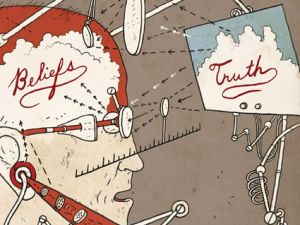
"A MAN WITH A CONVICTION is a hard man to change. Tell him you disagree and he turns away. Show him facts or figures and he questions your sources. Appeal to logic and he fails to see your point." So wrote the celebrated Stanford University psychologist Leon Festinger [1] (PDF), in a passage that might have been referring to climate change denial—the persistent rejection, on the part of so many Americans today, of what we know about global warming and its human causes. But it was too early for that—this was the 1950s—and Festinger was actually describing a famous case study [2] in psychology.
Festinger and several of his colleagues had infiltrated the Seekers, a small Chicago-area cult whose members thought they were communicating with aliens—including one, "Sananda," who they believed was the astral incarnation of Jesus Christ. The group was led by Dorothy Martin, a Dianetics devotee who transcribed the interstellar messages through automatic writing.
Through her, the aliens had given the precise date of an Earth-rending cataclysm: December 21, 1954. Some of Martin's followers quit their jobs and sold their property, expecting to be rescued by a flying saucer when the continent split asunder and a new sea swallowed much of the United States. The disciples even went so far as to remove brassieres and rip zippers out of their trousers—the metal, they believed, would pose a danger on the spacecraft.
Festinger and his team were with the cult when the prophecy failed. First, the "boys upstairs" (as the aliens were sometimes called) did not show up and rescue the Seekers. Then December 21 arrived without incident. It was the moment Festinger had been waiting for: How would people so emotionally invested in a belief system react, now that it had been soundly refuted?
The Mythical Sam Harris
Sam Harris, one of the loudest New Atheists, has built a morality on a home-made myth and calls it scientific.
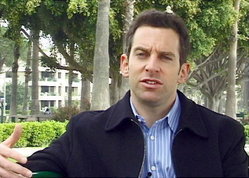
To open with a nerd joke: religion is like Unix in that those who do not understand it are compelled to reinvent it, badly. Watching Sam Harris at a packed Kensington Town Hall last night, it was obvious that he fits squarely into the American tradition of religious leaders who preach liberation from religion into something they call science. He is Mary Baker Eddy for the 21st century.
He was jet-lagged, which may account for some of the incoherence of his position, but he's a very practised performer, and has presumably given this speech hundreds of times before.
What he wants to do is to establish that moral facts exist, and that the division between fact and value is not absolute. This is hardly earth-shaking and certainly not original. Nobody was arguing against it, either on the podium or on the floor: when a show of hands was taken at the beginning of the evening, perhaps a dozen out of at least 1,000 hands went up. The difficulty, of course, comes in establishing what moral facts actually are. This Harris assumes is something to be solved by utilitarian calculation. Understandably he skips over any effort to explain or justify this assumption by argument. Instead he uses a myth.
Consider, he says, "the worst possible misery for everyone". This is a factual state which surely involves a moral obligation to diminish it. So everything which moves away from that, in the long term, is objectively good. And everything which tends to move the world closer to that state is objectively bad.
The obvious retort to this is that our judgements about the way things are tending must involve an element of faith which is something that in other contexts Harris has hoped to escape. But there is a deeper and perhaps less obvious snag.
Martin Rees's Templeton Prize May Mark a Turning Point in the "God Wars"
Awarding the Templeton prize to Rees suggests science is rejecting the advocacy of the likes of Richard Dawkins

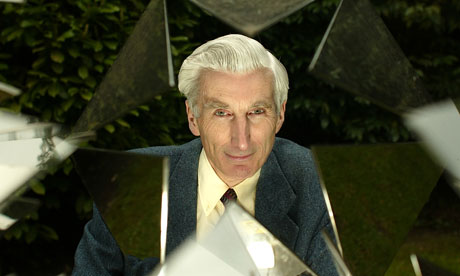
Richard Dawkins – author of The God Delusion and theorist of the selfish gene – could claim to be the most famous scientist in Britain. Sir Martin Rees – astronomer royal, former president of the Royal Society, master of Trinity College, Cambridge – is arguably the most distinguished.
Last year, Dawkins published an ugly outburst against the softly spoken astronomer, calling him a "compliant Quisling" because of his views on religion. And now, Rees has seemingly hit back. He has accepted the 2011 Templeton prize, awarded for making an exceptional contribution to investigating life's spiritual dimension. It is worth an incongruous $1.6m.
Dawkins is no stranger to pungent rhetoric when it comes to religion. But "Quisling" is strong even by his standards. It was originally hurled against fascist collaborators during the second world war. Rees, a collaborator? What was the crime that warranted such approbation? The Royal Society lent its prestige to the Templeton Foundation by hosting events sponsored by the fund, which supports a variety of projects investigating the science of wellbeing and faith.
Dawkins and Rees differ markedly on the tone with which the debate between science and religion should be conducted. Dawkins devotes his talents and resources to challenging, questioning and mocking faith. Rees, on the other hand, though an atheist, values the legacy sustained by the church and other faith traditions. He confesses a liking for choral evensong in the chapel of Trinity College. It seems a modest indulgence. The ethereal voices of rehearsing choristers can literally be heard from his front door. But for Dawkins this makes the man a "fervent believer in belief". And that is a foul betrayal of science.
I should declare an interest here, as I too would be what Dawkins calls an "accommodationist", (when he is being polite). I often write about the relationship between science and religion, and have been a Templeton-Cambridge Journalism Fellow, the beneficiary of a first-rate seminar programme organised by Cambridge academics, funded by the Templeton Foundation. But then I love the big questions.
What Would "Evidence" for God Look Like?

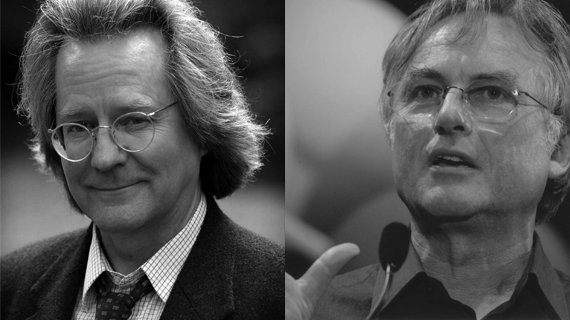
University of Chicago biologist Jerry Coyne was inspired by a recent discussion between Richard Dawkins and A. C. Grayling to defend the notion that there could be scientific evidence that might persuade him to believe in God. Coyne has tangled in the past with other atheists among the science bloggers who on a-priori grounds dismiss any such possible evidence.
Maybe I’m foolish or credulous, but I continue to claim that there is some evidence that would provisionally—and I emphasize that last word—make me believe in a god. (One can always retract one’s belief if the god evidence proves to be the work of aliens, or of Penn and Teller). I agree, of course, that alternative explanations have to be ruled out in a case like this, but remember that many scientists have accepted hypotheses as provisionally true without having absolutely dismissed every single alternative hypothesis. If a violation of the laws of physics is observed, that would be telling, for neither aliens nor human magicians can circumvent those laws.
While I agree with Coyne, there are good philosophical reasons traditional theists would offer for not expecting to be able to find scientific evidence either. But that’s opening up a can of worms. Grayling soon responded.
What I’d like to entertain is a thought experiment that might offer the kind of evidence, or at least data, to make a skeptic take a second look.
Here is a scenario I’ve adopted from an idea that New Testament scholar Ben Witherington used in a recent novel. In terms of evidence for God it’s much less fanciful than a being accompanied by angels descending from the sky in view of hundreds of people, but:
An archeologist working in Israel, discovers an ossuary from the NT era: the inscription on the stone in Aramaic reads: "Twice dead under Pilatus; Twice born of Yeshua in sure hope of resurrection." And the name corresponds to what in Greek would be Lazarus.
Uncertainty's Promise
Whether with science or religion, only by embracing doubt can we learn and grow.

We live in an age intolerant of doubt. Communicating uncertainty is well nigh impossible across fields as diverse as politics, religion and science. There's a fear of doubt abroad too. It's most palpable, at the moment, whenever there's news of economic uncertainty. Waves of nervousness ripple through financial markets and supermarkets alike. And yet, at the same time, few would deny that only the fool believes the future is certain. And who doesn't fear that most shadowy figure of our times, the fundamentalist – with their deadly, steadfast convictions?
The confusion is understandable. Doubt is unsettling. It's not for nothing that old maps inscribed terra incognita with the words "here be dragons". Further, the tremendous success of science, and the transformation of our lives by technology, screens us from many of the troubling uncertainties that our ancestors must have been so practised in handling.
But are we losing what might be called the art of doubt too? For, in truth, without doubt there is no exploration, no creativity, no deepening of our humanity – which is why the individual who claims to know something beyond all doubt is a person to shun, not emulate. Stick to what you know and you'll find some security, but you'll also find yourself stuck in a rut. Learn to welcome the unknown, to embrace its thrill, and new worlds might open up before you.
My old physics tutor, Carlos Frenk, is an excellent case in point. He is one of the world's leading researchers on dark matter – as is advertised by a large poster that hangs outside his office. It is inscribed with five bold words: "Dark Matter – Does It Exist?" To put it another way, Professor Frenk has forged a career out of navigating the terra incognita of the cosmos. He believes there is dark matter. It makes sense of the way visible matter in the universe hangs together. But there are no guarantees. Moreover, that's a fact that his peers ache to exploit. They seek to falsify his thesis, a negative process by which they hope to prove him wrong. That's what you have to live with when your expertise is on what's uncertain. And yet, Professor Frenk remains persistently sanguine. Falsity is the only certainty in science, he tells me. Science is organised doubt. It's only when scientists can no longer say no to a thesis that it stands.
How Much Should Science Accommodate Religion

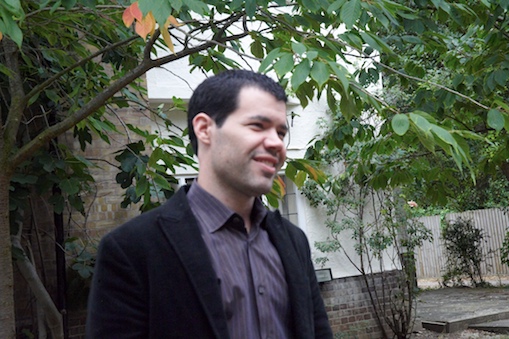
Find a public debate about the intersection of science and religion and you also can expect to find PZ Myers, a biology professor at the University of Minnesota Morris.
This month, Myers debated author Chris Mooney over questions of how far science should go to accommodate religion and whether those who champion science must oppose faith.
The debate, reported by Discover Magazine, came at a conference of the Council for Secular Humanism in Los Angeles. It continued in a special episode of Point of Inquiry, a podcast sponsored by the Center for Inquiry, where Mooney is one of three hosts.
It’s no surprise that Myers was unyielding. He has been associated with the movement called New Atheism in which authors such as Richard Dawkins and Christopher Hitchens argue that many religious claims — including the virgin birth of Jesus — are scientific in nature and thus, like other hypotheses, can be tested and proven false.
"Talking about accommodating ourselves to others’ ideas is fine in a political and diplomatic sense, but there are core issues that we are not going compromise on," he said. "Foremost, we think religion is false."
But Myers allowed some room for framing certain relevant conversations.
"I’ve talked to fundamentalists, and often one big issue is they want to send their kids to college, they want them to succeed in this economy, and they feel really, really frightened by the fact that they’ll go off to college and be converted to godless atheists," he said. "What I will say to them is I am not going to compromise. I am an atheist. But when I teach classes....I’m too busy teaching biology to talk about this other stuff."
Mooney also is a self-described atheist and a critic of science illiteracy. He is the author of three books: The Republican War on Science, Storm World, and Unscientific America. But he differs considerably from Myers in that he argues for accommodation, or accepting a place for religious faith in scientific inquiry.
Religion is vastly diverse across America, Mooney argued. And many faiths allow varying degrees of compatibility with science.
"You will have actual Christians who, nevertheless, are supportive of the teaching of evolution, embryonic stem cell research and all of the rest," he said. "There are Christian ministers who certainly have Christian beliefs [who] say evolution is good science and it’s OK to have this....What do we do with them?"
listen now or download Point of Inquiry Debate
Spiritual Science, Rational Morality
Rethinking the Divide between Science and Religion

The atheist Sam Harris has just lobbed a bombshell into the roiling debate over science and religion. In his new book The Moral Landscape, he argues for an entirely new understanding of morality, based not on religion but on new insights from science, especially brain science. Harris, a neuroscientist himself, is out to demolish the idea that science is by definition a value-free space. "The split between facts and values - and, therefore between science and morality - is an illusion," he writes. "Science has long been in the values business." He believes science and rationality provide a far better foundation for moral guidance than tired prescriptions from religion.
Harris' book comes on the heels of Stephen Hawking's recent assault on religion and philosophy. His claim that "the universe can and will create itself out of nothing" -- without God's intervention -- sparked a predictable furor. But even more provocative is Hawking's assertion that science can finally answer some of the great existential questions: Why is there something rather than nothing? And why do we exist? As Hawking and fellow physicist Leonard Mlodinow write in their book The Grand Design, "Traditionally, these are questions for philosophy, but philosophy is dead." Why? Because it hasn't kept up with modern developments in science, particularly physics.
For centuries, philosophers and theologians have presided over these questions about values and purpose, but scientists such as Harris and Hawking are no longer willing to cede this territory to religion. The cutting edges of science -- from cosmology and evolutionary biology to neuroscience -- are now tackling the most profound questions of our existence. Even the soul is under scientific scrutiny. Or at least the soul as it's defined by modern science: the self-aware mind with its keen sense of morality and free will.
Is this scientific overreach? The late biologist Stephen Jay Gould certainly thought so. In his 1999 book Rocks of Ages, he tried to broker a truce between science and religion by claiming they are two utterly distinct realms of understanding, what he called "nonoverlapping magisteria" (NOMA). Science, according to Gould, covers the empirical world of fact and theory, while questions about moral meaning and value fall within the religious realm. This attempt to divide the world between fact and meaning has shaped the discussion of science and religion, but we're now moving beyond Gould's dichotomy.
Atoms and Eden
Conversations on Religion and Science

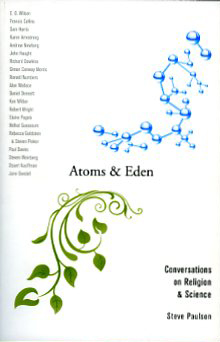
Here is an unprecedented collection of twenty freewheeling and revealing interviews with major players in the ongoing--and increasingly heated--debate about the relationship between religion and science. These lively conversations cover the most important and interesting topics imaginable: the Big Bang, the origins of life, the nature of consciousness, the foundations of religion, the meaning of God, and much more.
In Atoms and Eden, Peabody Award-winning journalist Steve Paulson explores these topics with some of the most prominent public intellectuals of our time, including Richard Dawkins, Karen Armstrong, E. O. Wilson, Sam Harris, Elaine Pagels, Francis Collins, Daniel Dennett, Jane Goodall, Paul Davies, and Steven Weinberg. The interviewees include Christians, Buddhists, Jews, and Muslims, as well as agnostics, atheists, and other scholars who hold perspectives that are hard to categorize. Paulson's interviews sweep across a broad range of scientific disciplines--evolutionary biology, quantum physics, cosmology, and neuroscience--and also explore key issues in theology, religious history, and what William James called ''the varieties of religious experience.''
Collectively, these engaging dialogues cover the major issues that have often pitted science against religion--from the origins of the universe to debates about God, Darwin, the nature of reality, and the limits of human reason. These are complex, intellectually rich discussions, presented in an accessible and engaging manner. Most of these interviews were originally published as individual cover stories for Salon.com , where they generated a huge reader response. Public Radio's "To the Best of Our Knowledge" will present a major companion series on related topics this fall.
A feast of ideas and competing perspectives, this volume will appeal to scientists, spiritual seekers, and the intellectually curious.
New Atheism or Accommodation?
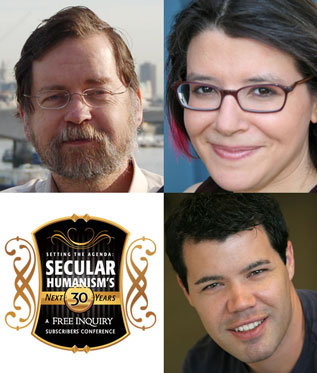
Recently at the 30th anniversary conference of the Council for Secular Humanism in Los Angeles, leading science blogger PZ Myers and Point of Inquiry host Chris Mooney appeared together on a panel to discuss the questions, "How should secular humanists respond to science and religion? If we champion science, must we oppose faith? How best to approach flashpoints like evolution education?"
It's a subject about which they are known to... er, differ.
The moderator was Jennifer Michael Hecht, the author of Doubt: A History. The next day, the three reprised their public debate for a special episode of Point of Inquiry, with Hecht sitting in as a guest host in Mooney's stead.
This is the unedited cut of their three way conversation.
PZ Myers is a biologist at the University of Minnesota-Morris who, in addition to his duties as a teacher of biology and especially of development and evolution, likes to spend his spare time poking at the follies of creationists, Christians, crystal-gazers, Muslims, right-wing politicians, apologists for religion, and anyone who doesn't appreciate how much the beauty of reality exceeds that of ignorant myth.
Jennifer Michael Hecht is the author of award-winning books of philosophy, history, and poetry, including: Doubt: A History (HarperCollins, 2003); The End of the Soul: Scientific Modernity, Atheism and Anthropology (Columbia University Press, 2003); and The Happiness Myth, (HarperCollins in 2007). Her work appears in The New York Times, The Washington Post, The New Republic, and The New Yorker. Hecht earned her Ph.D. in History from Columbia University in 1995 and now teaches in the graduate writing program of The New School University.
- listen… []
Cosmology, Cambridge Style: Wittgenstein, Toulmin, and Hawking
Hawking Said, "Let There Be No God!," and There was Light!

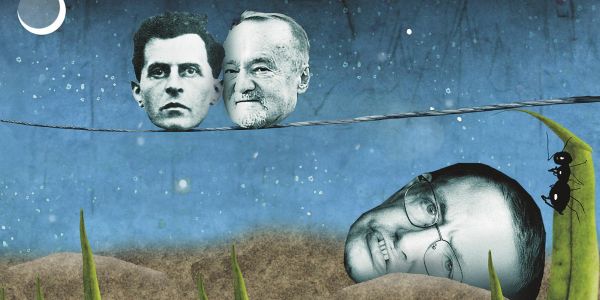
Hawking Said, "Let There Be No God!," and There was Light!
That headline flashed to all corners of the media universe this month. Of course, we don't know whether a universe has corners. Truth is, we don't know much about the universe that isn't astonishingly inferential. Alas, you'd hardly know that from listening to the retired Lucasian Professor of Mathematics at the University of Cambridge and his media echo chamber.
The breaking news originated in the latest book by Stephen Hawking, The Grand Design (Bantam), co-written with physicist Leonard Mlodinow. It excited front-page editors as few science tomes do. Britain's Mirror exclaimed, "Good Heavens! God Did Not Create the Universe, Says Stephen Hawking." Canada's National Post drolly chimed in with, "In the Beginning, God Didn't Have to Do a Thing."
In his new book, Hawking, the celebrated author of A Brief History of Time (Bantam, 1988), declares on the first page that "philosophy is dead" because it "has not kept up" with science, which alone can explain the universe. "It is not necessary to invoke God," the authors write, "to light the blue touch paper and set the universe going." Hawking sound-bited the hard stuff for interviewers: "Science makes God unnecessary," he told Good Morning America. Something simply came out of nothing.
If you've followed the science-religion debate in recent times, there's nothing new about such claims. Many scientists take Hawking's side, some do not. Almost everyone agrees that, as Hawking told ABC News, "One can't prove that God doesn't exist." The Templeton Foundation, which specializes in prodding believers and nonbelievers to discuss such things in civilized ways, has published all sorts of booklets, like "Does Science Make Belief in God Obsolete?," in which some eminent scientists answer "Yes" and others answer "No."
Why, then, the uproar? Largely because Hawking has been anointed by the media as possibly "the smartest man in the world" (ABC News) and the "most revered scientist since Einstein" (The New York Times)—a genius, and so on. A genius, presumably, must be right about everything. Especially if he managed to sell nine million copies of a book.
Hawking's latest claims also sparked attention because A Brief History of Time ended with his observation that, if we could achieve a unified theory in physics, we would "know the mind of God." While Hawking's fellow atheists took that coda as a play on Einstein's earlier use of the phrase, many believers chose to read it as open-mindedness toward a possible creator, making this new book a sharp U-turn.
Harvest Moons and the Seeds of Our Faith
How the fall equinox, and the science of ancient astronomy, helped shape religions.


Next Wednesday heralds the official end of summer—the autumnal equinox —when the length of day and night are equal (circa 11:09 p.m. ET). In the 21st century, this astronomical event is little more than a passing curiosity. But rewind by about three millennia to the time of the ancient Babylonians, and the autumnal equinox marked the start of the "minor new year." Not only did celestial events define sacred festivals. Conversely, religion powered the development of astronomy, the first science.
Today, science and religion are often thought to be very different, unconnected disciplines. But looking back at our ancient past, we see that the development of religion and early science have really gone hand-in-hand, shaping some of the characteristics of mainstream religion in ways we may not realize.
For instance, while the Babylonians celebrated their "main new year" in the spring, their tradition of having a minor autumnal new year has carried over into both mainstream religion and secular practice. Nick Campion, a historian of cultural astronomy at the University of Wales, notes two echoes of ancient autumn observances today. "It's a custom inherited by Jews—hence Rosh Hashanah," he told me, "while the beginning of the academic year in autumn is a secular legacy."
The Babylonians made meticulous records of celestial events. To them, as to many ancient civilizations, the sky was thought to be the writing pad of the gods, while the stars and planets were the ink used to communicate divine messages.
Through today's lens, the practices of star-gazing Babylonian priests may appear to be based mostly in superstition. Each night they searched the sky for omens sent by the great god Marduk or one of his entourage of lesser deities. Unexpected wanderings of the planets might foreshadow a poor harvest in the village, while the early risings of the moon could portend malformed births. By far the worst harbinger was a lunar eclipse, which signaled that the gods were angry with the king and called for his death.
Much early astronomy dealt with developing techniques to predict these omens, allowing crucial time for pre-emptive prayers and rituals to ward off misfortune.
Despite being tied to religious ritual (and often to gruesome sacrifice), the work of these priests marks the beginnings of science, says John Steele, a historian of ancient astronomy at Brown University. "They were making mathematical predictions based on empirical observations, which is astronomy by definition," he says.
Spirituality Can Bridge Science-Religion Divide


We hear a lot these days about the "conflict" between science and religion — the atheists and the fundamentalists, it seems, are constantly blasting one another. But what's rarely noted is that even as science-religion warriors clash by night, in the morning they'll see the battlefield has shifted beneath them.
Across the Western world — including the United States — traditional religion is in decline, even as there has been a surge of interest in "spirituality." What's more, the latter concept is increasingly being redefined in our culture so that it refers to something very much separable from, and potentially broader than, religious faith.
Nowadays, unlike in prior centuries, spirituality and religion are no longer thought to exist in a one-to-one relationship.
This is a fundamental change, and it strongly undermines the old conflict story about science and religion. For once you start talking about science and spirituality, the dynamic shifts dramatically.
Common ground
The old science-religion story goes like this: The so-called New Atheists, such as Richard Dawkins, uncompromisingly blast faith, even as religiously driven "intelligent design" proponents repeatedly undermine science. And while most of us don't fit into either of these camps, the extremes also target those in the middle. The New Atheists aim considerable fire toward moderate religious believers who are also top scientists, such as National Institutes of Health Director Francis Collins. Meanwhile, people like Collins get regular flack from the "intelligent design" crowd as well.
In this schematic, the battle lines may appear drawn, the conflict inescapable. But once spirituality enters the picture, there seems to be common ground after all.
Spirituality is something everyone can have — even atheists. In its most expansive sense, it could simply be taken to refer to any individual's particular quest to discover that which is held sacred.
That needn't be a deity or supernatural entity. As the French sociologist Emile Durkheim noted in 1915: "By sacred things one must not understand simply those personal beings which are called Gods or spirits; a rock, a tree, a spring, a pebble, a piece of wood, a house, in a word, anything can be sacred."
Something Rather Than Nothing
The scientists who find space for religion


Not all scientists share Stephen Hawking’s view that modern physics makes the Creator redundant, writes Edwin Cartlidge.
Among these is John Polkinghorne of Cambridge University, who is well known for his studies on the relationship between science and religion, having worked as a particle physicist for 25 years before becoming ordained in the Church of England. Polkinghorne says his religious belief does not spring from one "knockdown argument" for the existence of God but instead derives from a number of different sources. Among these are personal experience, including worship and reflecting on the decisions he has taken in life. But he also draws faith from the very fact that the universe is intelligible and describable in terms of mathematics, and that the laws of nature appear to be finely tuned to support life. This observation he believes is more satisfactorily explained by the existence of God than the possibility of countless parallel universes – among which one is bound to be suited to life – or simply the brute fact of existence.
Polkinghorne finds much common ground with nuclear physicist and theologian Ian Barbour of Carleton College in the US, including the belief that both science and religion seek to explain an objective reality that cannot be understood in a straightforward way. But Polkinghorne has a more traditional view of Christ than Barbour, believing that Christ was both fully human and fully divine, that he was born of a virgin and that he was resurrected. Indeed, Polkinghorne believes there is both good historical evidence and strong theological motivation for the Resurrection. Barbour, however, disputes both the reality of the empty tomb and the virgin birth.
The ‘Messy’ God of Science
A recent conference at Oxford brought scientist-theologians together to discuss the work of John Polkinghorne.


The department of physics in the University of Oxford is a hodgepodge of buildings, old and new. In a warren of rooms, its scientists pursue interests from quantum computing to theoretical cosmology. The diversity says much. As a tree of knowledge, modern physics has branches that shoot off in all directions.
Just opposite the department stands a very different building: Keble College. Its unified, gothic structure is unforgettable—built in polychromatic brick, sometimes referred to as the ‘holy zebra’ style. The ‘holy’ refers to the college’s Victorian founder, John Keble, who is famous for spearheading the Catholic revival in the Church of England.
Today, Keble College appears to gaze across the road at its neighbor, as if musing on what science has done to religion. So the lecture theaters of the physics department were an excellent place to host a conference on that very subject, celebrating and critiquing the work of John Polkinghorne, one of the best known scientist-theologians of our times.
For the first part of his career, Polkinghorne was a mathematical physicist, rising to the position of professor in the University of Cambridge. Then, in 1979, he resigned his chair, and trained to become an Anglican priest. In the quarter century since, he has written about two dozen books on the relationship between science and religion. A delightful man to meet, between papers and presentations he talked quite as easily with humble journalists as with distinguished peers.
Polkinghorne describes himself as a ‘bottom-up’ theologian. He is concerned to show not only that modern science is compatible with orthodox Christian belief, but that the believer can have as rational a basis for their commitment as the scientist has for theirs. He borrows a notion put forward by the philosopher Michael Polanyi, of well-motivated belief, which seeks: "a frame of mind in which I may hold firmly to what I believe to be true, even though I know it may conceivably be false."
High-Tech Test of Dead Sea Scrolls
Under way at Science Museum of Minnesota

Since 1947, when a shepherd searching caves near the Dead Sea discovered fragments of ancient texts, scholars have sought ways to study the remarkable discovery — now known as the Dead Sea Scrolls — without damaging the 2,000-year-old documents. That quest continued in St. Paul on Tuesday when delegates from the Israel Antiquities Authority tested a new digital infrared camera system at the Science Museum of Minnesota.
Images in different wavelengths
In a secured and climate-controlled room at the museum, Tania Treiger used her gloved hands and assorted instruments to carefully arrange fragments of the priceless scrolls under an overhead camera. She is a conservator from Israel, one of only three people in the world who are trained and authorized to handle the ancient documents.
When the fragments were ready, overhead lights went out. Equipment beeped. Lights flickered in eerie shades. More beeps. Lights on.
Images of the fragment had been captured in 11 different wavelengths — some for reproductions in the part of the electromagnetic spectrum that is visible to humans and some in the infrared, said Gregory Bearman.
Bearman, a former scientist for NASA’s Jet Propulsion Laboratory in California, has pioneered the application of imaging techniques used to observe objects in space to the study of archeological artifacts. He had arranged for a company called MegaVision to demonstrate its new imaging system for possible use with the Dead Sea Scrolls.
Did Jesus Die?

This film investigates the variety of stories surrounding the New Testament account of the crucifixion, death, resurrection and ascension of Jesus, by interviewing historians, theologians and historical researchers. This exploration of the latest theories about what really happened to Jesus 2000 years ago uncovers some surprising possibilities.
At the heart of the mystery is the suspicion that Jesus might not actually have died on the cross. The film concludes that it was perfectly possible to survive crucifixion in the 1st Century – there are records of people who did. But if Jesus survived, what happened to him afterwards?
One of the most remarkable stories concerns the charismatic preacher Jus Asaf (Leader of the Healed) who arrived in Kashmir in around 30 AD. Just before he died at the age of 80, Jus Asaf claimed that he was in fact Jesus Christ and the programme shows his tomb, next to which are his carved footprints which bear the scars of crucifixion.
Fine-Tuning the Universe
Physicists and theologians gathered in Oxford last week to discuss the complex relationship between their two disciplines, and to pay tribute to physicist and priest the Revd Dr John Polkinghorne. But in doing so, some also posed challenges to his thinking.
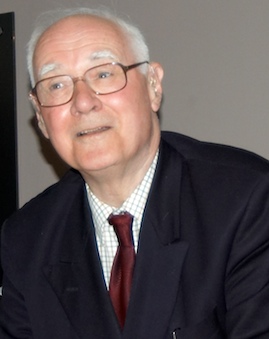
'Epistemology models ontology" is one of the Revd Dr John Polkinghorne’s favourite phrases. It means, roughly speaking, that what we know is a reliable guide to what is actually out there in the world. In fact, he used to say it so often that his wife gave him a T-shirt with the words emblazoned upon it. It was in the same spirit that staff from the Ian Ramsey Centre for Science and Religion at the University of Oxford tried unsuccessfully to find a T-shirt with another of Dr Polkinghorne’s trademark expressions, "bottom-up thinker", ahead of a four-day conference being held at the centre last week to mark Dr Polkinghorne’s eightieth birthday later this year.
Bottom-up thinking is central to Dr Polkinghorne’s view of reality. He carried out research in particle physics for nearly 25 years before quitting academia and training for the Anglican priesthood. Then, after serving as a parish priest for several years, he returned to the academic fold to become president of Queens’ College, Cambridge, and to investigate the interplay between science and religion.
He says that his work as a scientist showed him the importance of experience as a guide to what is true, rather than assuming that the world will conform to certain preconceived abstract principles. He maintains that the core of modern physics – quantum mechanics – with its strange, probabilistic conception of nature, would never have been dreamed up from scratch but instead came about because experimental results demanded it.
For Dr Polkinghorne, this way of thinking applies equally to theology. He argues that it is mistaken to try to prove that God exists using pure logic since, as he puts it, "clear and certain ideas often turn out to be neither clear nor certain". Indeed, he says, there is no "knockdown argument" for the existence of God. Rather, his religious belief derives from a number of different sources. These include his experience of worship and a reflection on the decisions he has taken in his life, as well as his belief in the Resurrection of Jesus Christ.
In addition, Dr Polkinghorne draws on a couple of general observations he can make as a scientist. One of these is simply the very intelligibility of the universe, the fact that it is possible to make theories about the way the world works and to use mathematics as the language of those theories, an ability which, he claims, could not have come about through mere evolutionary necessity.
Chaos Theory and Divine Action
Physicist John Polkinghorne is often accused of offering up a God-of-the-gaps argument. But his work has subtler shades.
The question: Can science explain everything?
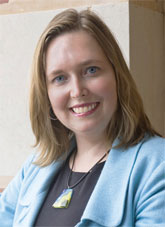
Whether or not science can explain everything is a question that was never far from the minds of a large group of theologians and scientists who met in Oxford last week. They'd assembled to celebrate the 80th birthday of John Polkinghorne, the professor of mathematical physics who made his name for his work on quarks, now an Anglican priest, and author of many books on science and religion. Moreover, it turns out that the question of science's limitations is intimately linked to Polkinghorne's much misunderstood account of God's action in the world.
The challenge is to avoid concocting a "God of the gaps" – a deity whose action occurs in the gaps where scientific explanations apparently fall short. The best known example of this is probably the bacterial flagellum. Advocates of intelligent design have argued that these whip-like devices for locomotion can only be explained by divine intervention because of their supposed "irreducible complexity". The trouble is that science progresses. What can't be explained in one decade is often explained in the next. Gaps get filled, and so God gets squeezed out.
Polkinghorne has been accused of advocating a God-of-the-gaps approach too. He has been taken to argue that chaos theory offers a way of understanding divine action, by virtue of the mistaken assumption that chaos theory paints a picture of an indeterminate world: if it's impossible to forecast the weather next week with any degree of accuracy, then perhaps that points to a pervasive randomness in the physical world, which God might exploit to divine advantage.
But that's not his idea, as Nick Saunders pointed out at the conference. As Polkinghorne knows better than most, the equations of chaos theory do, in fact, yield tightly causal results. The issue at stake in chaos theory is rather that you need to know the initial conditions of any system to an astonishingly high degree of accuracy to make accurate predictions. In practice, that's impossible to achieve. In other words, chaotic systems are not indeterminate, but underdetermined.
Craig Venter and the Nature of Life
The world has its first synthetic cell, and the question 'what is life?' is more relevant than ever.


Craig Venter may not be a god, but when he makes an announcement, the world shakes.
In 2000, the "dazzling showman of science," as he has been called, announced, together with U.S. National Institutes of Health scientist Francis Collins, a draft mapping of the human genome. So momentous was this announcement that not one but two world leaders -the U.S.'s Bill Clinton and the U.K.'s Tony Blair -felt the need to participate.
Now a decade later, Venter has done it again with the announcement that scientists at the J. Craig Venter Institute have created the world's first synthetic cell. This announcement also caught the ear of world leaders, as President Barack Obama fired off a missive to the Presidential Commission for the Study of Bioethical Issues, giving it six months to prepare a report on the promises and perils of synthetic biology.
Environmental groups were also quick to respond to the announcement, with some calling for a moratorium on such research, and other suggesting some form of regulation is in order.
And in response to the news that Venter "created" a synthetic cell, officials with the Catholic Church warned scientists not to forget that "there is only one creator: God."
Many of the concerns expressed are not unreasonable, though they aren't without hyperbole either. To see this, let's review what Venter actually did.
Venter's team of 25 scientists mapped the genome of a bacterial cell on a computer, modified it, broke it into 1,100 pieces and synthesized the pieces using four chemicals. They then assembled the genome fragments, and transplanted the complete genome into a cell that had had its genome removed. The synthetic genome was then "booted up" and the new "synthetic" cell began self-replicating.
Naturally, Venter emphasizes the promise of such research: The U.S. National Institutes of Health have provided him with funding for work that could lead to rapid development of flu vaccines, and Exxon has promised funding to create bacteria that can produce biofuels from algae. Beyond that, it might be possible to create bacteria that can aid in cleaning up oil spills, something that looms large in the American consciousness at present.
But just as advocates emphasize the promise of synthetic biology, critics highlight safety and security concerns. There is always the fear that a laboratory-created pathogen could escape the lab, and wreak havoc on the public and the environment. This doesn't have to occur by accident: Critics note that bioterrorists could synthesize their own pathogenic bacteria and hold the world hostage, if there is any world left.
That's a little dramatic, of course, but synthetic biology's potential threat to our safety and security is worthy of consideration. Curiously, though, the public doesn't seem particularly concerned, possibly because they don't see the potential threats as appreciably different from those presented by genetic engineering, which has already be the subject of intense debate, and more than a few sci-fi novels.
What has piqued public interest, though, is the suggestion that synthetic biology amounts to playing God. This was, of course, a charge also levelled at genetic engineering, and at virtually every new technology. But there seems to be something special about synthetic biology, since all this talk about creating a synthetic cell led some people to question whether Venter created life.
Life, but Not as We Know It
Last week researchers in America announced that they had created a new kind of artificial life. Is this venture into the unknown fraught with danger, or a useful step forward with beneficial consequences for us all?

To many people, the idea of a living being suggests something that is more than just atoms but also a thing formed with a divine spark or a vital essence. But now what we mean by life itself will have to change following the creation by Craig Venter of the world’s first "synthetic cell". It is, as Venter puts it: "The first self-replicating species that we’ve had on the planet whose parent is a computer." Venter, the biologist who mapped the human genome in 2001, has designed a bacterial genome on a computer, building the genome from scratch using chemicals, inserting the genome into a hollowed-out cell and then watching that cell reproduce. But have Venter and his colleagues really synthesised new life in the laboratory? And if so, what does this achievement tell us about life itself, and what benefits – and ethical dangers – might it bring to mankind?
The cell created by Venter and colleagues at the J. Craig Venter Institute in Maryland is the result of a research programme that has lasted more than a decade and cost around US$40m. As reported in the journal Science, the cell was made in a multi-stage process that included the sequencing, or mapping out, of the one million chemical bases of the bacterium Mycoplasma mycoides. After digitising this code on a computer and tweaking it to eliminate a few unwanted genes and add in "watermarks" that would identify the genome as synthetic, the researchers split the genome into about 1,000 segments of equal length. The job of actually building these segments fell to an outside synthesis company.
Then, with the segments in hand, Venter’s group stitched them together using yeast and inserted the complete synthesised genome into the cell of a different, but related, bacterium. Finally, with the genome of the host bacterium destroyed as a result of the transfer, the cell reproduced to generate multiple copies of Mycoplasma mycoides. The breakthrough has created intense media interest worldwide and has clearly impressed many scientists and other academics, none more so than Arthur Caplan, a professor of bioethics at the University of Pennsylvania in the United States. Describing the work as "monumental", he argues it "brings to an end a 3,000-year-old debate about the nature of life" – whether living things are fundamentally different to non-living things in that they require some kind of a vital spark to animate them. For Caplan, the fact that Venter and co-workers created a living, reproducing cell using a genome that was built up from chemicals and not from other living matter means that the debate has now been settled. "Vitalism has been put to bed," he says.
Scientific Fundamentalism Goes Off the Rails
Dogmatism obscures the fact that we humans "are truly extraordinary," Marilynne Robinson tells Martin Levin.


Martin Levin: What possessed you to immerse yourself in the roiling waters of the science-religion wars?
Marilynne Robinson: I happen to be deeply interested in science and religion, so well disposed toward them both that the idea that they are natural adversaries has always bothered me. And I am fascinated by the idea that civilizations generate a hum of insight, invention, disputation, affirmation and controversy, each one like a great mind engaged with its own preoccupations. So for me, attentiveness to these "wars" is attentiveness to the unfolding of human history. That said, the issues that emerge in any culture can be profound or vacuous, brilliantly articulated or dealt with crudely. Science and religion are both profoundly important to our culture, so the integrity of the conversation around them is important as well.
G&M;: What determined your approach?
MR: I think of Absence of Mind as a critique of a prevailing curriculum, which is the actual basis for the world view that in the context of this controversy is called "scientific." These new-atheist writers carry forward an elderly tradition of polemic against religion which predates modern science and has always been and still is dependent upon positivist notions of rationalism and of the nature of physical reality. So I approach the subject as a problem in the history of ideas.
G&M;: Despite the assault of science on religion, it's only in apparent decline in the West and seems to growing in reach and, indeed, fervour in much of the rest of the world. How do you account for this?
MR: Has science in fact assaulted religion? Or is it only that the prestige of science has been appropriated in order to make an argument against religion appear authoritative? Somehow it seems to have been accepted by people on both sides of the question that religion stands or falls on the literal truth of one reading of Genesis I. It could as well be argued, for those who attach importance to such things, that the Genesis account is surprisingly consistent with the Big Bang, with the emergence of life in progressive stages, and with the remarkable phenomenon of speciation. But these questions only seem important because the actual substance of religion, the thought and art that have made it the great germinative force behind civilization, are not consulted by people on either side.
How Religious Are Scientists?
An interview with Elaine Howard Ecklund
It’s hard to think of an issue more contentious these days than the relationship between faith and science. If you have any doubt, just flip over to the science blogosphere: You’ll see the argument everywhere.
In the scholarly arena, meanwhile, the topic has been approached from a number of angles: by historians of science, for example, and philosophers. However, relatively little data from the social sciences has been available concerning what today’s scientists actually think about faith.
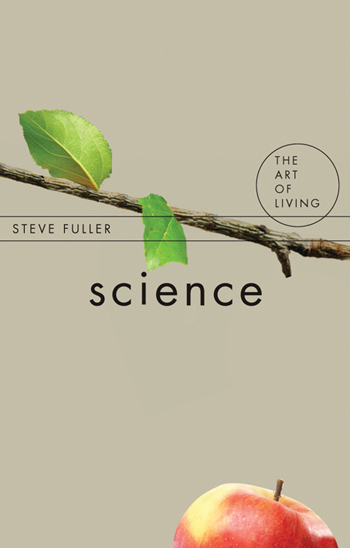
Today’s Point of Inquiry guest, sociologist Dr. Elaine Ecklund of Rice University, is changing that. Over the past four years, she has undertaken a massive survey of the religious beliefs of elite American scientists at 21 top universities. It’s all reported in her new book Science vs. Religion: What Scientists Really Think.
Ecklund’s findings are pretty surprising. The scientists in her survey are much less religious than the American public, of course—but they’re also much more religious, and more "spiritual," than you might expect. For those interested in debating the relationship between science and religion, it seems safe to say that her new data will be hard to ignore.
Elaine Howard Ecklund is a member of the sociology faculty at Rice University, where she is also Director of the Program on Religion and Public Life at the Institute for Urban Research. Her research centrally focuses on the ways science and religion intersect with other life spheres, and it has been prominently covered in USA Today, The Chronicle of Higher Education, Newsweek, The Washington Post, and other prominent news media outlets. Ecklund is also the author of two books published by Oxford University Press: Korean American Evangelicals: New Models for Civic Life (2008), and more recently the new book Science vs. Religion: What Scientists Really Think (2010)
Physicists Study How Moral Behaviour Evolved


A statistical-physics-based model may shed light on the age-old question "how can morality take root in a world where everyone is out for themselves?" Computer simulations by an international team of scientists suggest that the answer lies in how people interact with their closest neighbours rather than with the population as a whole.
Led by Dirk Helbing of ETH Zurich in Switzerland, the study also suggests that under certain conditions, dishonest behaviour of some individuals can actually improve the social fabric.
Public goods such as environmental resources or social benefits are often depleted because self-interested individuals ignore the common good. Co-operative behaviour can be enforced via punishment but ultimately co-operators who punish will lose out to co-operators who don't punish because punishing requires time and effort. These non-punishing co-operators then lose out to the non co-operators, or free riders. With free riders dominant the resource is depleted, to the detriment of everyone – a scenario known as "tragedy of the commons".
How, then, does co-operation arise? Some researchers have proposed that co-operators who punish could survive through "indirect reciprocity", the idea that working for the common good will enhance a person's reputation and ensure that they benefit in the future. Helbing's group, however, has shown that this is not needed for co-operation to flourish.
Emergent phenomena
They came to this conclusion by focusing on how individuals behave with their nearest neighbours, rather than a wider group that is representative of the entire population. Like nearest-neighbour models of magnetism – which are often more realistic than mean-field approximations – they say that this approach captures "emergent" phenomena that would otherwise be lost.
Science Warriors' Ego Trips
The champions of empiricism show an unattractive hubris when they go after what they see as pseudoscience.


Standing up for science excites some intellectuals the way beautiful actresses arouse Warren Beatty, or career liberals boil the blood of Glenn Beck and Rush Limbaugh. It's visceral. The thinker of this ilk looks in the mirror and sees Galileo bravely muttering "Eppure si muove!" ("And yet, it moves!") while Vatican guards drag him away. Sometimes the hero in the reflection is Voltaire sticking it to the clerics, or Darwin triumphing against both Church and Church-going wife. A brave champion of beleaguered science in the modern age of pseudoscience, this Ayn Rand protagonist sarcastically derides the benighted irrationalists and glows with a self-anointed superiority. Who wouldn't want to feel that sense of power and rightness?
You hear the voice regularly—along with far more sensible stuff—in the latest of a now common genre of science patriotism, Nonsense on Stilts: How to Tell Science From Bunk (University of Chicago Press), by Massimo Pigliucci, a philosophy professor at the City University of New York. Like such not-so-distant books as Idiot America, by Charles P. Pierce (Doubleday, 2009), The Age of American Unreason, by Susan Jacoby (Pantheon, 2008), and Denialism, by Michael Specter (Penguin Press, 2009), it mixes eminent common sense and frequent good reporting with a cocksure hubris utterly inappropriate to the practice it apotheosizes.
According to Pigliucci, both Freudian psychoanalysis and Marxist theory of history "are too broad, too flexible with regard to observations, to actually tell us anything interesting." (That's right—not one "interesting" thing.) The idea of intelligent design in biology "has made no progress since its last serious articulation by natural theologian William Paley in 1802," and the empirical evidence for evolution is like that for "an open-and-shut murder case."
Pigliucci offers more hero sandwiches spiced with derision and certainty. Media coverage of science is "characterized by allegedly serious journalists who behave like comedians." Commenting on the highly publicized Dover, Pa., court case in which U.S. District Judge John E. Jones III ruled that intelligent-design theory is not science, Pigliucci labels the need for that judgment a "bizarre" consequence of the local school board's "inane" resolution. Noting the complaint of intelligent-design advocate William Buckingham that an approved science textbook didn't give creationism a fair shake, Pigliucci writes, "This is like complaining that a textbook in astronomy is too focused on the Copernican theory of the structure of the solar system and unfairly neglects the possibility that the Flying Spaghetti Monster is really pulling each planet's strings, unseen by the deluded scientists."
Theology: Natural and Unnatural
Is there any possible defence for "Intelligent Design"? Is there any way for theists to abandon the idea?
Steve Fuller is the sociologist of science notorious for arguing that Intelligent Design was not necessarily a bad research programme even though it was rotten science. In this capacity he appeared as a witness for the defence in the Dover trial in the US, the most recent attempt to smuggle creationism into the public school system there. He has written a new book on science as the heir to religion, which will be published later this spring, and there will be a Question series about this later.
Commissioning pieces for this got me thinking about the boundaries of natural theology and how we can classify it. It is an undisputed fact that many great scientists have been driven by Christian faith and the roots of modern science lay in the belief that the scientist was "reading the book of Nature", which was understood to be a revelation of God's purposes and character quite as much as the other Book, the Bible was.
This was certainly Newton's motivation, and Faraday's. But it seems also to have been contested from an early stage. Looking back at Wesley's pamphlet on the Lisbon earthquake, which was written much closer to Newton's death than Faraday's, we can see him already arguing against an atheist who believes only in "the fortuitous concourse and agency of blind material causes." So we know that there were materialists to argue against. What there were not, then, were believers in scientific progress, nor anyone who could foresee the enormous advances of the nineteenth century. For Wesley the response to plague was prayer, not bacteriology.
The progressive or whiggish account of natural theology would say that in order to find the hidden regularities of nature we needed to believe they were there, and, Christian faith gave scientists the confidence needed to do so. But – this account continues – once the architecture of the universe had been sketched out, the need for an architect receded. The elegant mathematics of the universe that physics revealed became their own justification: Laplace, when asked what God did in his model of the solar system, replied "I have no need for that hypothesis"; later, something similar happened in biology under Darwin's influence.
Natural theology had started as a way of understanding God; in the eighteenth century it became a way of proving God's existence, which is something rather different, which turned out to be catastrophic for Christian apologetics, as is shown by the fact that Richard Dawkins works entirely within this tradition: he shows instance after instance of design in the natural world, and then shows that there is no need for a designer, and that if any agency had designed the natural world we see, we couldn't call it wise or loving.
But Dawkins, here, is kicking at an open door. Many others have been through it before him. Once you destroy the idea that science can prove the existence of God, or can discover things that only God's existence can explain, the first half of natural theology also looks pointless: why investigate the nature of a non-existent being?
'Is God Dying?'
Questions on morality, evolution and the mind
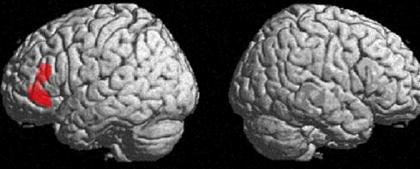
Are we evolving away from belief in God? Why did thousands of intelligent people let themselves be deceived by investment fraud king Bernie Madoff? Is morality really in decline in the West and can it be reconstructed?
Such questions are in the air at a seminar on science, morality and the mind at the University of Cambridge, this weekend sponsored by the Templeton Foundation. I've participated in the Templeton-Cambridge Fellowships in Science & Religion since 2005. And for the next few days, I'd like to bring you along for a taste of the lectures and discussions.
It all starts with questions. Fraser Watts, a professor of theology and science, and Director of Studies, Queens' College set the program off with a wave of his own: What can science tell us about the origin and workings of morality? How did moral capacity arise? Is it all evolutionary? What's the role of neuroscience? What goes on in the brain when we're making moral judgments? Can we use this knowledge to reconstruct morality?
Michael Reiss, Professor of Science at the Institute of Education University of London, a specialist in evolutionary biology (and an ordained Anglican priest) walked us through the history of theories on altruism as an evolutionary phenomenon (like vampire bats who support each other by offering up blood if a mate didn't succeed in his own hunting) and the advantages of being good at deception (think Bernie Madoff).
Even so, just knowing something has an evolutionary origin "tells you nothing about whether it is valid or useful," Reiss says.
Atheist with a Soul
Philosopher and novelist Rebecca Goldstein speaks with Martin Levin about God and godlessness, and her new novel

I’m thinking that Cass, who’s called an "atheist with a soul," is the character who most embodies your own views, his disbelief in God combined with a larger respect for the religious impulse.
He is. In terms of his life, he’s a little hapless and prone to be taken over by personalities larger than his own. I hope I’m not like that, but in terms of his world views, I am with him.
Tell me about Azarya [a six-year-old mathematical genius whose abilities will be sacrificially lost in the Hasidic world in which he lives.
I thought of this story at least 15 years ago and just didn’t want to write it because I found it heartbreaking and I knew it would have to be tragic. It was an impossible dilemma I was putting this kid in, and I actually thought I’d have to kill him. I resisted writing this for a very long time, but when I got involved with the New Atheism, I thought I could use it as a platform for the Azarya story. His story is the heart of the novel.
Your last book was about Spinoza, and his spirit seems to hover over this one as well.
Spinoza is the great demonstrator that there can be deep experience of transcendence and the sublime, and what one could call a spiritual experience that is not about God. It is about being itself. Cass endorses this view and often expresses himself this way.
The grounding of morality seems to be an important theme, especially as it emerges in the climactic formal debate between Cass and a professor who’s a believer.
One of things I wanted to show was that there’s a fallacy in understanding the grounds of morality, that you don’t need God to be moral, sometimes quite the contrary. In the U.S, religious agendas, especially under the last administration, were being legislated and intruding on things like stem-cell research. You hear people say that the godless must be immoral, since you need God to ground morality. No politician in America can say they don’t believe in God. How could they be moral?
What do you see as the future for atheism, since religion seems to be declining only in Western Europe and growing throughout the rest of the world.
Europe went through its Enlightenment only following protracted, horrible religious wars, when people were convinced that their earlier certitudes were untrustworthy, and modern science and modern philosophy grew out of this. A large part of the world hasn’t gone through this yet. Europe had to have half of its population wiped out before the voices of reason got listened to. But that took a long time. Can we afford that when we have the kind of weaponry that advances in science have given us? We’re in quite a predicament. These very primitive religious emotions – to see the strength of their gathering is terrifying.
Are Science and Atheism Compatible?
Science brings no comfort to to anyone with dogmatic beliefs about world.
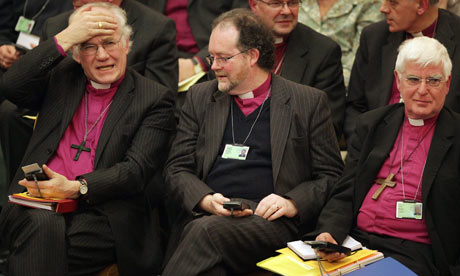
The General Synod this morning held a debate on whether science and religion are mutually exclusive, full of ordained scientists arguing that of course they are, and indeed the final vote was 241 to two in favour of the motion. I have failed to establish the identity of the dissident two. Faced with such a consensus I thought it might be fun to flip the question on its back and ask to what extent science is compatible with atheism.
Obviously the two are closely linked, in as much as science assumes the falsity, or at least irrelevance, of supernaturalism. But science is more than physics and chemistry, more even than biology, and the human sciences challenge a lot of beliefs held by many atheists.
The modern efflorescence of evolutionarily inspired psychology and sociology tells us that the elements of religion are natural, and unavoidable, and sometimes useful; that they are present in all societies, whether literate or pre-literate, whether in states or hunter-gatherer, though they are combined in very different forms of social organisation.
So we learn at the very least that they can't be abolished. This doesn't show that they need be combined into things we call "religions"; but at the very least they will tend to combine into social groupings and mechanisms which perform the same functions.
Further, the sociology of religion shows clearly that modern monotheistic religion is not an intellectual pursuit. People do not join churches because they agree with the doctrines. Nor do they often leave for intellectual reasons. They join – and leave – for all sorts of largely social reasons, and even within the churches, their allegiance to, and knowledge of, the official doctrine is slight. Heresy can matter enormously, but that's because it defines an outgroup. And the execration of heretics flourishes among atheist societies, too. It seems to be very widespread social mechanism.
A Very Modern Illusion
Charles Taylor shows how faith and scientific progress both require leaps into the unknown
Is science closer to religion than is typically assumed? Is religion closer to science? Might rational enquiry, based on evidence, share similarities with faith? These questions were raised by Charles Taylor, the distinguished Canadian philosopher, speaking at a Cambridge University symposium (pdf). He suspects that in the modern world we've bought into an illusion, one that posits a radical split between reason and revelation. Today, given the tension and violence that arises from misunderstandings about both, is a good time to examine them again.
The illusion, if that is what it is, emerged after the Enlightenment, when epistemological authority was questioned. It came to be assumed that you have to chose between one or the other – or, at least, if you appeal to revelation, its "truth" will only stand if allowed by the court of reason.
The new power invested in reason itself arose from the tremendous success of the natural sciences. Physics, geology and the like set a new standard of rational enquiry that is couched in procedural terms. Hence, what is rational has come to be equated with what is logically coherent. Further, it must be derived by proper methods including repeated observation and correct inference. In short, it's what scientists do.
Further, science's success carries political implications, for it seems that the rational can be disengaged from the specifics of culture, ethnicity and religion. A physicist in Sante Fe can communicate easily and directly with a physicist in Shanghai. From that observation, which is undoubtedly true, comes the dream of a brighter tomorrow: if only humanity could approach all its problems in the same way – deferring only to evidence and reason – then perhaps it could solve its problems too, or at least a fair number of them. Moreover, if people would only drop their appeals to revelation – which conflict, are irrational, and have a marked tendency towards violence – then perhaps the world would become a more peaceful place. That's the promise. Who'd deny its appeal?
A Third Way through the Bible
In his take on the Bible, Howard Jacobson avoided religious and atheistic extremes, finding something much more worthwhile.

"Absolute atheism and absolute creationism dance to the same tune." So observed the atheist author and journalist, Howard Jacobson, in his TV programme on the Bible's account of creation last night. Too true. We'd already seen Richard Dawkins, whom Jacobson called the "high priest" of contemporary atheism, solemnly intoning his condemnation of the God of the Hebrew Bible. Dawkins was not interviewed for the film, but was shown in old footage, which had the subtle effect of casting him as yesterday's man.
As for the absolute creationists, we met a handful. One was a Christian, Greg Haslam, whose church "honours the whole of God's word as unchanging truth". Haslam seemed like an unobjectionable pastor, though a quick glance online suggests that his church is something of a family affair: Ruth Haslam is his pastoral assistant; Andrew and Joshua Haslam run the youth group and website. Hardly a place that seems to be commanding a wide and diverse following. I wonder whether the programme makers actually had difficulty finding a creationist church to film. That aside, a clear message came across. Poor Greg is fighting a losing battle: he believes that science will show the account of the flood to be literally true. That's what a youth spent watching too many Charlton Heston films does for you.
The other creationists we met were strictly observant Jews from Jacobson's own family. They were more interesting, because when Jacobson asked them why they believe in the traditional six days, the response was because it's the tradition. This kind of biblical literalism, if that is what it is, is not so much a desire for certainty as a desire for identity.
But Jacobson's issue is different. How can he, a person repelled by both absolutes alike, find a way of appreciating a text that is holy, for want of a better word. "In the beginning God created heaven and earth." The exquisite beauty and serenity in those lines was noted repeatedly, as was the power of a poetry that speaks to our existence, that roots us in the drama of our own story. It addresses Jacobson's humanity, which is to say it enlarges his humanity. Could he, as a non-believing secular Jew, find a way to honour that?
The Doctrine of Mary's Virginity
The virgin birth is a scientific impossibility. Shouldn't we remember Mary for the real woman she was?

The question: What would you get rid of for Christmas?
The first followers of Jesus – those individuals whom the church now celebrates as apostles and saints – could not have believed in the virgin birth of the messiah, let alone the perpetual virginity of Mary, his mother, a doctrine which the Roman Catholic church subsequently declared necessary to confess for salvation. The apostles knew of the surviving brothers and sisters of Jesus, and probably knew them in person. Seeing her as a virgin mother would have been vergin' on the ridiculous.
The New Testament remembers Jesus' siblings too. Reconciling the biblical evidence with official doctrine has been a problem for believers ever since. As Erasmus put it: "We believe in the perpetual virginity of Mary, although it is not expounded in the sacred books." He was scholar. He knew that Matthew was misquoting when, in his gospel, he recorded a virgin conceiving and bearing a son called Emmanuel. The original passage from the Hebrew Bible refers, merely, to a "young woman." Matthew had the luxury of writing long after Jesus' contemporaries were dead.
So the first reason for wanting to be rid of the references to virginity at Christmas are historical. It's not true, and no one amongst Jesus' intimates, not least his mother, could possibly have believed it.
Darwin Still Influencing Religious Thinking in Minnesota
This is the second in an occasional series of articles the MinnPost will run in this year that scientists have dubbed "The Year of Darwin."

Here's a news item you've probably never read or heard: The issue was evolution. It drew some 40 Christians to the Augsburg College campus in Minneapolis. But this was no protest. These Lutherans were celebrating the 150th anniversary of the publication of Charles Darwin's "On the Origin of the Species."
Religious opposition to the theory of evolution has dominated America's headlines for so long that you could be forgiven for thinking that evolution forced stark choices for all people of all faiths: If Darwin was right, the scriptures must be wrong — or vice versa. If God created man in his own image, then humans couldn't have evolved in a process that led through swamps to apes to me writing this article on a tool created with dazzling human intelligence?
The tradeoff never was that clear, though. While the spotlight focused on controversy, most people of faith were forming a far more nuanced understanding of how belief squares with Darwin's theory.
And some actually embraced evolution. Take those Lutherans. Their Oct. 31 symposium was billed as a celebration of "our knowledge of the world — of God's creation — gained through science and evolutionary biology."
Now comes the to be sure, inevitably essential in a report about anything as complex as religion. There are Lutherans — indeed, whole congregations of them — who reject Darwin's theory.
400 Years After Galileo


When Galileo Galilei pointed his newly built telescope skyward in 1609, he transformed our view of the cosmos. Among his discoveries were mountains on the moon, spots on the sun, vast numbers of new stars and four satellites orbiting Jupiter.
It was this last discovery in particular that convinced him that the Earth moves round the sun rather than vice-versa, since the orbit of the moons demonstrated the reality of rotation around something other than our home planet. But his discoveries brought him in direct conflict with the Catholic Church. The church taught that the Earth stood still at the center of the universe – and as a result condemned Galileo in 1633 for defending the heliocentric hypothesis and denying the scientific authority of the Bible.This conflict might now seem of purely historical interest. After all, we all know the Earth goes around the sun, and modern astronomical discoveries only seem to confer upon the Earth a less central position in the scheme of things – as a planet orbiting a medium-sized star in the outer reaches of a galaxy that is itself not in the center of a galaxy cluster. Indeed, the church itself has recognized the veracity of Galileo's arguments; Pope John Paul II admitted in 1992 that the church was in error when it insisted on the centrality of the Earth and in 2000 issued a formal apology for the trial of Galileo.
The relationship between science and religion, however, clearly continues to create dispute. Recent years have seen the publication of many books by prominent atheist scientists pronouncing that God has no place in our modern world. And the debate over the teaching of intelligent design continues unabated. What, then, is the proper relationship between our understanding of nature and a religious faith? Does the former render the latter redundant? Can the two instead co-exist happily but separately? Or do they stand in some more complex relationship with one another?
Discussing this question in the context of the Galileo affair, on the 400th anniversary of the Tuscan astronomer's groundbreaking observations, scientists, theologians and philosophers met two weeks ago at the Pontifical Lateran University in Rome. Part of the meeting was devoted to exploring the latest developments in cosmology and understanding how these relate to the
Face to Faith
Galileo's lunar work drew on another Christian iconoclast who had lived 1,000 years earlier.
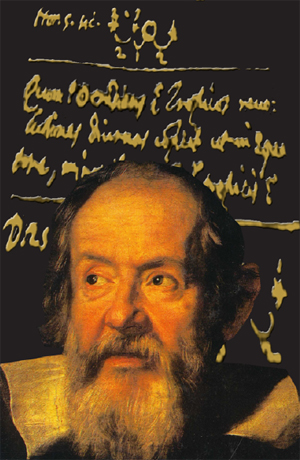
Galileo's earliest surviving drawing of the moon can be dated to 30 November 1609, almost exactly 400 years ago. In the months before he made his observations, he'd become aware of an extraordinary new instrument that brought the far away much nearer: the telescope. Immediately, he'd seen its potential for science. And now, having polished up the original designs, and improved on its power, he turned the new instrument to the starry heavens and the still lunar surface. On that night – armed with his watercolours, ink and brushes too – he was the first to capture that most extraordinary of celestial sights: the details of an alien world.
What he experienced can still be enjoyed today. For it is easy to capture the wonder of the moment by focusing a telescope or binoculars on our heavenly companion. As an undergraduate I studied physics, and for one project I had to measure the heights of lunar mountains – a task that Galileo himself undertook. I had to take photographs of the shadows that fell across the peaks, valleys and plains. My efforts were, of course, utterly trivial so far as science is concerned. However, the experience was invaluable. I rose at 3am on dark, frosty mornings to ensure that there'd be clear skies. It reminded me of the monks who say the office of matins at similar hours while the world sleeps. What awaited was the gift that comes with contemplating the lunar surface, if through bleary eyes. The moon is a high-contrast place of greys and whites. Pitted like pumice, it feels close even when viewed through a relatively low-powered instrument.
Galileo's exploration of the moon was aesthetic as well as cartographical. In the book he wrote about his observations, The Sidereal Messenger, he commended his readers to the "great and marvellous sights" he'd seen. He also included one image painted in 1609 that was adjusted to make it more beautiful. "Galileo is much more interested in the play of light and shadow than in accurate mapping," explains Owen Gingerich of the Harvard-Smithsonian Centre for Astrophysics. "He is interested in the heights and depths that reveal an earthlike moon."
And that, in fact, is the lasting legacy of Galileo's work. He imagined the moon as earthlike. That could not be more significant. According to Aristotelian cosmology, the objects that filled the heavens were perfect, nestling among crystalline spheres. Rendering the moon with apparent flaws, such as craters and peaks, shattered those assumptions. Galileo's drawings were another nail in the coffin of the old cosmology.
Only, Galileo was far from the first to think like this. In order to interpret what he saw, he drew on an Alexandrian philosopher, John Philoponus, who'd lived 1,000 years before him. John was a Christian thinker who wrote about physics and theology. He challenged Aristotelian cosmology too, by reasoning that the earth and the heavens must be alike, and his ideas were known to many. But they were resisted by the establishment, perhaps because John had been declared a heretic by the church – not for his scientific views but because of his speculations about God. So, it is fascinating to ponder whether Galileo felt John was a kind of soulmate, as the Italian too headed for trouble with the church. He certainly cites John frequently in his writings. When he sketched his first images of the moon, he must have been thinking of the older iconoclast.
More Confusion than Light from Sacks
The chief rabbi's speech last week contained some dramatic soundbites. But the reasoning behind them doesn't stack up.
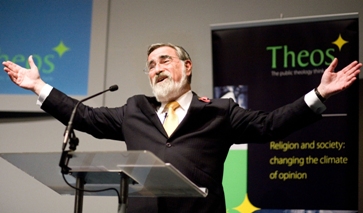
"Falling birth rate is killing Europe", "Islam must separate religion from power". Just two of the striking headlines that followed the Theos lecture last week, given by Jonathan Sacks. What had the chief rabbi said? Were strong headlines riding roughshod over his nuance?
It seems not. For having read the lecture, there is something about it that is unsettling. It's not that his arguments appear a little confused, though they do. For example, at one point, Sacks argues we need religion because science can't yield meaning, only later to declare that science is yielding "wonderful new insights" into meaningful behaviour. Or, he commends Tocqueville on the separation of religion and politics, apparently forgetting that he is the ennobled Lord Sacks of Aldgate.
Rather, it is the discussion of cultural decline, on which he spent some time, that is disquieting. Sacks links a supposed European decay to falling population levels – or to be more precise, to falling indigenous birth rates. He illustrates his point by quoting the historian Polybius, who developed a similar line of rhetoric to explain the apparent decline of ancient Greece. The people "had entered upon the false path of ostentation, avarice and laziness," Polybius wrote. Hence, they were not prepared to have children, or only to have one or two.
Now, Sacks is simply wrong about the population, at least in the UK. Levels are rising according the Office for National Statistics because of immigration, decreases in deaths and increases in births. Sacks could well be mistaken to quote Polybius too, because scholars debate why Athens declined. Perhaps it was as a result of the conquests of Alexander, not any collapse in Greek personal morality. After all, the Stoics and Epicureans of the Hellenistic period taught that the good life is a virtuous life, and these philosophies continued to shape people's lives for centuries, as the Greek world became Roman. Following that, Stoicism greatly influenced the formation of Christianity and even, it has been argued, the life of at least one very well known first century Jew, called Jesus.
The Music of the Spheres
Kepler founded modern astronomy by looking for a harmony that we wouldn't recognise as scientific at all.
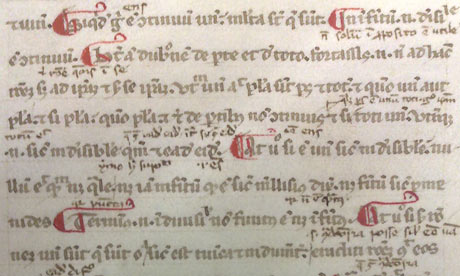
Paper darkens as it grows old, but vellum just goes duller white, like the belly of a snake: looking at some of the manuscripts through which learning made its serpentine passage across the medieval world makes it obvious that you couldn't call those ages "dark". The library of The Royal Observatory in Edinburgh holds one of the finest collections of early astronomical books and manuscripts in the world, collected by Lord Crawford in the 19th century. He left them to the city on condition that they built an observatory to house them. Being civilised, the city fathers did. So there I was on Tuesday, touching the vellum of a 13th century manuscript of Alhazen, another of Aristotle, and then a first edition of Copernicus' De Revolutionibus and one of Kepler's Nova Astronomia. In the shelves on the wall were Galileo's works.
We were meant to be making a radio programme – an interval talk for Radio 3 – but the producer and I and our guest Ken MacLeod just frolicked round that room of priceless books like salmon woken by a spate. Serious work was impossible for a while. There was nothing to say that was adequate in the face of so much beauty and so much history; for anyone who writes, the feel of a physical object which has been read for 800 years is a quite extraordinary thrill.
Alhazen is almost forgotten now, and Aristotle little read or acknowledged outside the Roman Catholic intelligentsia. But when those first manuscripts were only three hundred years old, the books which we all know have changed the world were published. First there
Science, Faith Used To Be Allies
Tellingly, President Obama's pick to head the National Institutes of Health, Francis Collins, touts this symbiotic relationship today.
In recent years, some Americans have come to view science and religion as consistent antagonists, butting heads over everything from the origin of the cosmos to when human life begins (abortion) and when it ends (euthanasia).
Conservative denominations, like the Southern Baptists, Catholics, Assemblies of God and some non-denominational evangelicals, object to particular areas of scientific research — embryonic stem cells and cloning, for instance. By contrast, mainline Protestant and Jewish denominations, as well as Hindu and Muslim communities, have tended to support embryonic stem cell research, adding a new voice to such highly politicized debates.
What is sometimes obscured by the clamor is that there was once an era in American history when science and religion were considered symbiotic allies, rather than the rancorous adversaries they too often are today.
The issue surfaced again over the summer. When President Obama named Francis Collins, an outspoken evangelical as well as former director of the Human Genome Project, to head the National Institutes of Health, some scientists, secularists and at least one prominent atheist criticized the appointment. They were concerned that Collins' faith might influence his decisions at the NIH. This despite the fact that Collins, author of The Language of God, supports both evolution and embryonic stem cell research — although he has also written
When Science Meets Pop Culture
Many people think of the scientist as a disinterested observer of the world, an abstracted intellectual who deals with empirical facts, his mind unclouded by subjective passions and dogmas. That's a myth. Scientists are not machines, but human beings, and as such cannot help being influenced by the culture in which they live and work.
Take Charles Darwin. In 1859, the publication of his On the Origin of Species was an event so earth-shaking that 150 years later, the trembling still reverberates. In their recent book Darwin's Sacred Cause, Adrian Desmond and James Moore argue that the Darwin family's deep roots in the British anti-slavery movement caused young Charles to start asking questions about the common origins of humanity. "It is the key to explain why such a gentleman of wealth and standing should risk all to develop his bestial 'monkey-man' image of our ancestry in the first place," they write.
The authors make a case that Darwin, who was never himself a social activist, undermined racial prejudice with his discoveries. That is true – to a point.It is also true that Darwin's work on evolution and natural selection, as it became popularized, inspired scientists and laymen to take more interest in racial differences, an intellectual passion that would have sinister consequences in the science of eugenics – founded in the late 19th century by Darwin's cousin, Francis Galton.
Eugenics attempted to discern genetic characteristics particular to races and classes, with the idea of "improving" humanity through what one might call unnatural selection. Eugenics was considered cutting-edge science, and the Progressive Era policies of "racial hygiene" developed from its research were widely endorsed. The Nazi legacy ended that.
So, can Darwin be justly credited for having a role in freeing the slaves? Can he be blamed to some degree for Bergen-Belsen? The problem, says Cambridge University literary critic Gillian Beer, is that you can find support in Darwin's research and writing for both abolitionism and eugenics.
Exploring the Nature of Reality
Buddhism and science are not always in agreement, but they still have much in common.

A first glance at Buddhism -- and most Westerners have had at most a quick glance at this ancient religion -- suggests that it has little in common with science.
For example, we most frequently hear the Dalai Lama preach about the importance of love and compassion. These subjects, while not at odds with science, concern how the world ought to be, not how the world is, and are therefore not the proper subjects of scientific study.
Given the different interests of scientists and Buddhists, then, it might be surprising to learn that some practising scientists are also practising Buddhists, and that the Dalai Lama himself has a longstanding interest in science.
Consequently, with the support of His Holiness, a series of "Mind and Life" dialogues between scientists and Buddhists began in 1987. This led to the development of the Mind and Life Institute in 1990, under the initial direction of neuroscientist and Buddhist practitioner Francisco Varela.
Varela died in 2001, but the Institute and the dialogues live on, with world-renowned scientists and Buddhist monks meeting regularly at conferences in Dharamsala, India, the residence of the Tibetan government in exile.
In the recently released book, Mind and Life: Discussions with the Dalai Lama on the Nature of Reality, University of Rome biologist Pier Luigi Luisi recounts the details of one conference, which probed deeply into physics, among other subjects.
In so doing, the conference illuminated much about the current scientific understanding of the nature of the material world, as well as Buddhism's conception of this aspect of reality. And while it revealed that Buddhism and science are not always in
Mayan Calendar Spurs End-Of-The-World Debate

For those people making long-term plans, note this: The end of the world as we know it will be on Dec. 21, 2012 — at least, that's if you believe the Mayan calendar.
According to the ancient Mayas, who were known for their timekeeping prowess, the end of the "long count" calendar is only 1,241 days away — and Lawrence Joseph is waiting.
"2012 is indeed considered a profoundly pivotal date in human and in terrestrial history," Joseph says.
Joseph, who authored Apocalypse 2012, says he began looking at Mayan prophecy several years ago. He noticed that the Mayas' end date coincided with peak activity of solar flares three years from now. He says those flares could fry the world's electrical systems, leaving people without electricity for months or years — affecting the distribution of water, fresh food and medication.
"I think we're looking at a nonnegligible possibility that the year 2012 can be really, unprecedentedly tumultuous, and lead to a next and scary chapter in civilization's history," Joseph says.
Joseph doesn't predict the end of the world.
But Hollywood does. The Sony picture 2012 starring John Cusack comes to theaters this fall, and it's no picnic. There are tsunamis cresting over mountains, covering cities, and toppling the Dome of St. Peter's Basilica in Rome, which then rolls down the avenue. The storyline is drawn from various scenarios laid out in books such as The Complete Idiot's Guide to 2012, which foresee earthquakes, drought and planetary collisions. Those books point both to scientifically accepted events such as an upcoming alignment of planets in our solar system — and to, well, not scientifically accepted events such as the arrival of a mysterious Planet X into Earth's orbit.
Skeptical Scientists
Not surprisingly, scientists are not convinced. "We don't miss big things like that," says Lawrence Rudnick, an astronomer at the University of Minnesota. Planet alignment will not change the tides or create tsunamis. There is no Planet X. Scientists don't even talk about 2012.
listen now or download All Things Considered
- listen… []
God, He's Moody
In an interview with something to offend everyone, Robert Wright explains why religion has given us a fickle deity.


Robert Wright has carved out a distinct niche in American journalism. While his essays range freely across the political landscape -- from foreign policy to technology -- it's his meaty, book-length forays into evolutionary psychology and the sweep of history that have set him apart. Now his latest book goes after bigger game: God Almighty.
Actually, "The Evolution of God" never grapples with the most basic religious question -- the existence of God. Instead it charts the twists and turns of how God's personality has kept changing over the centuries, and specifically, how the rough-and-tumble politics of the ancient Middle East shaped the Abrahamic religions. The book is filled with richly observed details about the Bible and the Quran, though Wright wears his learning lightly as he guides us through several thousand years of religious history.
There's something to offend just about everyone in this book. Wright recounts in harrowing detail how the early Israelites, who'd been conquered and humiliated by the Babylonians, invoked Yahweh to wreak vengeance on their enemies. This is no God for the faint of heart! And he's no gentler on Christianity. Wright's Jesus is not the prophet of peace and love but a sometimes mean-spirited apocalyptic preacher obsessed with the approaching End Times. Islam's founder, Muhammad, comes across as much a warrior as a prophet, bent on annihilating his enemies when they cross him.
Despite all this religious mayhem, the book also shows a gentler side of the Abrahamic religions, especially when they manage to find common cause with their heathen neighbors and rival monotheists.
At first, "The Evolution of God" reads like another atheistic tract exposing the seamier side of religion. But then I came to Wright's t first, "The Evolution of God" reads like another atheistic tract exposing the seamier side of religion. But then I came to Wright's account of the "moral imagination" and his surprising conclusion: He may not believe in God, but Wright thinks humanity is marching -- however wobbly -- toward moral truth.
In our interview, we talked about the bloody history of monotheism, what a mature religion would look like, and Wright's own spiritual awakening at a meditation retreat.
At the very beginning of your book, you describe yourself as a materialist. This raises an interesting question: Can a materialist really explain the history of religion?
I tend to explain things in terms of material causes. So when I see God changing moods, as he does a lot in the Bible and the Quran, I ask, what was going on politically or economically that might explain why the people who wrote this scripture were inclined to depict God as being in a bad mood or a good mood? Sometimes God is advocating horrific things, like annihilating nearby peoples, or sometimes he's very compassionate and loving. So I wanted to figure out why the mood fluctuates. I do think the answers lie in the facts on the ground. And that's what I mean by being a materialist.
Vatican’s Celestial Eye, Seeking Not Angels but Data
MOUNT GRAHAM, Ariz. — Fauré’s "Requiem" is playing in the background, followed by the Kronos Quartet. Every so often the music is interrupted by an electromechanical arpeggio — like a jazz riff on a clarinet — as the motors guiding the telescope spin up and down. A night of galaxy gazing is about to begin at the Vatican’s observatory on Mount Graham.
"Got it. O.K., it’s happy," says Christopher J. Corbally, the Jesuit priest who is vice director of the Vatican Observatory Research Group, as he sits in the control room making adjustments. The idea is not to watch for omens or angels but to do workmanlike astronomy that fights the perception that science and Catholicism necessarily conflict.
Last year, in an opening address at a conference in Rome, called "Science 400 Years After Galileo Galilei," Cardinal Tarcisio Bertone, the secretary of state of the Vatican, praised the church’s old antagonist as "a man of faith who saw nature as a book written by God." In May, as part of the International Year of Astronomy, a Jesuit cultural center in Florence conducted "a historical, philosophical and theological re-examination" of the Galileo affair. But in the effort to rehabilitate the church’s image, nothing speaks louder than a paper by a Vatican astronomer in, say, The Astrophysical Journal or The Monthly Notices of the Royal Astronomical Society.
On a clear spring night in Arizona, the focus is not on theology but on the long list of mundane tasks that bring a telescope to life. As it tracks the sky, the massive instrument glides on a ring of pressurized oil. Pumps must be activated, gauges checked, computers rebooted. The telescope’s electronic sensor, similar to the one in a digital camera, must be cooled with liquid nitrogen to keep the megapixels from fuzzing with quantum noise.
As Dr. Corbally rushes from station to station flicking switches and turning dials, he seems less like a priest or even an astronomer than a maintenance engineer. Finally when everything is ready, starlight scooped up by the six-foot mirror is chopped into electronic bits, which are reconstituted as light on his video screen.
"Much of observing these days is watching monitors and playing with computers," Dr. Corbally says. "People say, ‘Oh, that must be so beautiful being out there looking at the sky.’ I tell them it’s great if you like watching TV."
Dressed in blue jeans and a work shirt, he is not a man who wears his religion on his sleeve. No grace is offered before a quick casserole dinner in the observatory kitchen. In fact, the only sign that the Vatican Advanced Technology Telescope is fundamentally different from the others on Mount Graham, the home of an international astronomical complex operated by the University of Arizona, is a dedication plaque outside the door.
On Science and God
NPR's Barbara Bradley Hagerty spent a year exploring the science of spirituality for her book Fingerprints of God, and what she concluded was that science can't prove or disprove the existence of God.
"But there was something that I saw in interviewing dozens of scientists," Bradley Hagerty tells NPR's Michele Norris. "The science of spirituality is like a Rorschach test — that you can look at the evidence and come to opposite conclusions."
Bradley Hagerty says that a materialist would say a spiritual experience is just brain chemistry — or firings in the temporal lobe of the brain — and it's all explainable by material means. But someone else could look at the same evidence and say that people are wired to be able to connect with the divine and that brain chemistry is a reflection of an encounter.
Bradley Hagerty says she could have taken 10 more years to research the book.
"One of the great pleasures was interviewing people who have had spiritual experiences; it's not just the scientists," she says, adding she talked with Jews, Christians, Buddhists, Muslims, people who were spiritual but not religious. "One of the interesting things is what they described as a spiritual experience was basically the same: An encounter with light, an encounter with love, often an out-of-body experience. What that told me is spiritual experience is spiritual experience — it's a human phenomenon and in fact, it may be divine."
- listen… [npr player, 2 minutes 47 seconds; All Things Considered]
Everything Is Illuminati
Why can't the Catholic Church shake free of a 200-year-old conspiracy theory?

About eight years ago here in Santa Fe, N.M., everybody was talking about the bikini Virgin. That's virgin with a capital V—and the reference was to a piece of art on exhibition at a local museum, in which Our Lady of Guadalupe, the most beloved figure in New Mexico Catholicism, was depicted in a skimpy floral bathing suit with as many colors as a birthday piñata.
Angry Catholics demanded that the image be removed from the show, but it stayed on display until the exhibition closed, and the young artist who created it received the kind of career boost that only comes with being denounced from the pulpit.
The controversy has long since faded but I thought about it again last night as I waited in line for an advance screening of Angels & Demons, the new thriller (based on a Dan Brown novel) in which the Vatican comes across as an age-old enemy of reason and scientific truth.
The movie, which has already been denounced in the United States by William Donohue of the conservative Catholic League, stars (along with Tom Hanks) a legendary cabal called the Illuminati—a group of evil eggheads who have figured in various conspiracy theories for more than 200 years. This time, they are plotting (or so it seems) to vaporize the Vatican as punishment for centuries of oppression against freethinkers. I was a little disappointed when when there were no picketers at the theater passing out copies of Donohue's new tract,
Enemies of Creationism May Be Hindering Science Teachers
A US judge's ruling is a warning to those who want to teach real science in schools that they need to change their tactics.
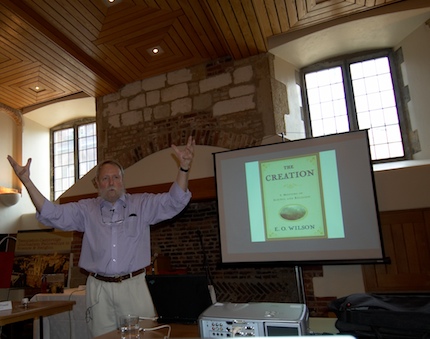
A district court judge in southern California has ruled that a teacher who described creationism as "superstitious nonsense" was making a religious statement, which is impermissible in US public schools. On the face of it, this is completely absurd, even for southern California. Creationism is superstitious nonsense, and teachers should be able to say so. But when you look at the background, the case becomes in some respects less absurd, but also more threatening – especially for hardline rationalists such as Richard Dawkins, who would like to dismiss creationism as beneath contempt.
The first thing to say is that Judge James Selna seems, from his 37-page ruling, to be no friend of fundamentalists. Of the 20 complaints made against the teacher, James Corbett, he dismissed 19; many of them on the face of it much more anti-religious than calling creationism "superstitious nonsense". Second, the lawsuit was clearly a premeditated strike in the culture wars. Orange County, where Capistrano Valley high school is located, is one of the most conservative places in the US. Corbett had been involved in a controversy over John Peloza, a science teacher at the school who in 1994 sued his employers, demanding the right to teach creationism in his science classes. He lost.
Some fundamentalist parents were obviously out to get Corbett. His lessons were secretly recorded to compile evidence against him, and the words for which he has been found guilty were part of a discussion, or argument, about the earlier case: "I will not leave John Peloza alone to propagandise kids with this religious, superstitious nonsense," he said, and those were the words that Judge Selna has found unconstitutional.
Clearly, Corbett walked into a trap that had been dug specifically for him. The fundamentalist lawsuit demanded that he be sacked, rather than pay damages, though both the school and the judge rejected this demand.
From the material quoted in the judgment it does look as if Corbett was the kind of atheist concerned to eradicate religious belief; but you might argue that he was just trying to get students to think. He claimed to have been selectively quoted in some instances, but in
Religion and Science: Conflict or Harmony?
Some of the nation's leading journalists gathered in Key West, Fla., in May 2009 for the Pew Forum on Religion & Public Life's Faith Angle Conference on religion, politics and public life.

.jpg "Graphic of angel & science from Pew Forum on Religion & Public Life")
Some of the nation’s leading journalists gathered in Key West, Fla., in May 2009 for the Pew Forum on Religion & Public Life’s Faith Angle Conference on religion, politics and public life.
Francis S. Collins, the former director of the Human Genome Project, discussed why he believes religion and science are compatible and why the current conflict over evolution vs. faith, particularly in the evangelical community, is unnecessary. Collins, an evangelical Christian, talked about his path from atheism to Christianity and his belief that science provides evidence of God. He cited the Big Bang theory and the fact that the universe had a beginning out of nothing. He added that the laws of physics have precisely the values needed for life to occur on earth and argued that would seem to point to a creator.
Barbara Bradley Hagerty, the religion correspondent for National Public Radio, discussed how the brain reacts to spiritual experiences. She talked about the current debate over whether transcendent experiences are merely physiological events or whether they reflect encounters with another dimension. Bradley Hagerty said she believes that "God is a choice," that people can look at scientific evidence and conclude that everything is explained by material means or that they can look at the universe and see the hand of God.
Helping Christians Reconcile God with Science

For many young Christians, the moment they first notice discrepancies in the Biblical tales they've faithfully studied is a rite of passage: e.g., if Adam and Eve were the first humans, and they had two sons — where did Cain's wife come from? The revelation that everything in the Bible may not have happened exactly as written can be startling. And when the discovery comes along with scientific evidence of evolution and the actual age of planet Earth, it can prompt a full-blown spiritual crisis.
That's where Francis Collins would like to step in. A renowned geneticist and former director of the Human Genome Project, Collins is also an evangelical Christian who was the keynote speaker at the 2007 National Prayer Breakfast, and he has spent years establishing the compatibility between science and religious belief. And this week he unveiled a new initiative to guide Christians through scientific questions while holding firm to their faith.
After his best-selling The Language of God came out three years ago, Collins began receiving thousands of e-mails — primarily from other Evangelicals — asking questions about how to reconcile scriptural teachings with scientific evidence. "Many of these Christians have been taught that evolution is wrong," Collins explains. "They go to college and get exposed to data, and then they're thrust into personal crises of great intensity. If the church was wrong about the origins of life, was it wrong about everything? Some of them walk away from science or faith — or both."
Collins, 59, who with his mustache and shock of gray hair looks like former U.N. Ambassador John Bolton's cheerful twin, seems genuinely pained by the idea that science could be viewed as a threat to religion, or religion to science. And so he decided to gather a group of theologians and scientists to create the BioLogos Foundation in order to foster dialogue between the two sides. The name — combining bios (Greek for "life") and logos ("the word") — is also what Collins calls his blended theory of evolution and creation, an approach he hopes can replace intelligent design, which he derides as "not a scientific proposal" and "not good theology either."
Why There Almost Certainly Is a God
Doubting Dawkins


Would the world change if someone came up with an utterly convincing proof for the existence of God? In 'A Corner of the Veil', a novel by Laurence Cossé, this happens. A conclusive demonstration is formulated by a holy man who hands it to his religious superiors. They read it, are convinced, but panic, fearing anarchy if it should fall into the hands of the faithful. When the government gets wind of the proof, ministers too want to conceal it, fearing that capitalism's ethos would be undermined in an outbreak of compassion.
In his new book, Keith Ward, the former Regius Professor of Divinity at the University of Oxford, seeks to refute the arguments against the existence of God propounded in 'The God Delusion' by Richard Dawkins. 'Why There Almost Certainly Is No God' is the title of Dawkins' fourth chapter. Consider one element of Ward's counter-case.
Dawkins claims that the existence of God is even less likely than the apparently improbable emergence of conscious beings, on the grounds that if God designed such complex entities he would have to be even more complex, making him even more improbable. But rebuts Ward, God is simple, and anyway simple entities routinely give rise to more complex phenomena, a good case in point being the laws of nature themselves. Moreover, to talk of God being more or less probable is simply, or perhaps deliberately, to misunderstand the concept of God: whether or not God actually exists, the idea of God is of a necessary not contingent being.
Ward pursues his quarry along many other twists and turns; part of the pleasure of reading him is staying with him through the metaphysical maze. Whether or not Dawkins will bother to keep up seems unlikely, Ward believes. For one thing, he has heard the rebuttals before, not least in Oxford debates against Ward himself. And yet, '[Dawkins] goes on saying that theologians have never answered his arguments.' This refusal to engage perhaps explains why
Science News: Why Americans Know So Little

Two years ago, when I was applying for a science journalism fellowship at England's University of Cambridge, my screening interview halted briefly after I dropped a comment that American newspapers were abandoning science coverage.
Could that be possible in the United States — the world's capital of scientific discovery — wondered Sir Brian Heap, a prominent Cambridge biologist who was on the screening panel for the Templeton-Cambridge Journalism Fellowships.
Oh yes, indeed, Americans on the panel told him sadly.
The demise came even faster than those of us sitting around that table expected. As print journalism saw itself falling off a cliff, it pushed science coverage over the edge first.
This week, the British journal Nature published an obituary of sorts, making some disturbing points about the implications for our knowledge about science.
Before discussing the highlights, let's consider the context. Truth is that the United States never has been a wellspring of scientific knowledge, even given its great achievements in that regard.
We wring our hands over low math and science test scores, but few adults bother themselves with the details. We get steamed over the politics of stem cells and global warming, but few voters know even the basics of cellular development and carbon emissions.
One in four Americans surveyed in a recent test of scientific literacy did not correctly answer the question, "Does the Earth go around the Sun, or does the Sun go around the Earth?" Nearly half were wrong on the question of whether antibiotics can kill viruses as well as bacteria. Sixty percent could not say whether the North Pole marks an ice sheet on the Arctic Ocean.
At the end of this article, you can test your own answers to the science literacy survey conducted in conjunction with the National Science Board's 2008 report on Science and Engineering Indicators.
Dismal track record
The point of my digression was to say that most Americans need all of the accessible science news they can get just to inform their own decisions about health care and science-based public policy. They still will be able to find it online — if they bother. But that is a big if, given the country's dismal track record.
What Do You Get If You Divide Science by God?
A prize-winning quantum physicist says a spiritual reality is veiled from us, and science offers a glimpse behind that veil. So how do scientists investigating the fundamental nature of the universe assess any role of God, asks Mark Vernon.

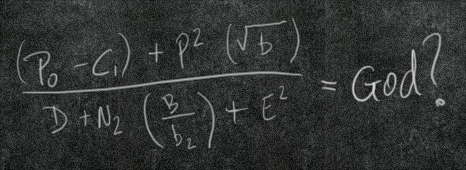
The Templeton Prize, awarded for contributions to "affirming life's spiritual dimension", has been won by French physicist Bernard d'Espagnat, who has worked on quantum physics with some of the most famous names in modern science.
Quantum physics is a hugely successful theory: the predictions it makes about the behaviour of subatomic particles are extraordinarily accurate. And yet, it raises profound puzzles about reality that remain as yet to be understood.
The bizarre nature of quantum physics has attracted some speculations that are wacky but the theory suggests to some serious scientists that reality, at its most basic, is perfectly compatible with what might be called a spiritual view of things.
Some suggest that observers play a key part in determining the nature of things. Legendary physicist John Wheeler said the cosmos "has not really happened, it is not a phenomenon, until it has been observed to happen."
D'Espagnat worked with Wheeler, though he himself reckons quantum theory suggests something different. For him, quantum physics
Knowing the Unknown
Once he's finished paying taxes on his £1 million Templeton Prize, Bernard d'Espagnat says that he wants to use part of his award to foster study of apophatic, or “negative”, theology. “It's the only form of theology that I appreciate,” the French physicist said. “It would be a good thing if it were investigated a little more than it now is.”
D'Espagnat is the 2009 winner of the Templeton Foundation's annual award for affirming life's spiritual dimension. The award, which boasts a monetary value pegged above that of the Nobel Prize, was announced on Monday at Unesco in Paris and will be presented to D'Espagnat by Prince Philip in a private ceremony at Buckingham Palace on 5 May. Now a spry 87, the laureate can look back on a long and illustrious career as senior physicist at the Cern particle physics laboratory in Geneva and physics professor in leading French and American universities. But it's his metaphysical thinking, most recently set out in his 2006 book On Physics and Philosophy, that won him the prize.
Click here to read the full article (65K pdf)
The Scientist Who Leaves Room for Spirituality

The German philosopher Immanuel Kant once wrote that he "had to deny knowledge to make room for faith." The French physicist Bernard d’Espagnat hasn’t denied knowledge in his long career developing the philosophy that won him this year’s $1.42 million Templeton Prize. He was pursuing knowledge to better understand what we can know about the ultimate reality of the world. But just like his philosophy echoes that of Kant’s with its conviction that there are limits on knowing reality, his work leaves some room — he would say for spirituality — by saying that human intuitions like art, music and spirituality can help us go further when science searching to understand the world reaches the end of its tether.
D’Espagnat’s prize was announced at UNESCO in Paris on Monday. The quantum physics at the core of his work presents baffling insights about reality, but his philosophical conclusions from them sound like common sense. Science is an amazing discipline that opens vast areas of knowledge but cannot go all the way to explaining ultimate reality. There’s a mystery at the core of our existence that we can get a little closer to through the untestable but undeniable intuitions we have. That "little closer" still leaves a large black hole in our knowledge, but it is more than we have if we only rely on empirical science.
As often happens in cases like this, d’Espagnat was available for embargoed interviews several days before the prize was announced. I had the pleasure of meeting him on Friday at the Lutetia, a five-star hotel only a short bike ride from my more modest digs in Paris. Now 87 years old, d’Espagnat can look back on a long and illustrious career as a senior physicist at the CERN laboratory in Geneva, professor at the University of Paris ( at its science hub in the suburb of Orsay) and guest lecturer at universities and conferences abroad. His latest book in English, On Physics and Philosophy, came out in the United States in 2006.
At the end, I asked what he would do with his prize money. After paying the taxes on it, he stressed as he started his answer, he would divide it into three equal parts. One would go to promote the study of "negative theology," a theology that he says fits his spiritualist outlook and conviction that we can only describe God by concepts that say what God is not. The second part would go to associations helping the homeless. And the last third he and his wife would use to make their home more senior-friendly. "My wife is handicapped and she would very much like to remain at home as long as possible," he said.
You can read our story here or consult the prize website for more information and an extensive collection of links about his work. Some excerpts from my interview with d’Espagnat are on the next page. Taking a page from Paul Krugman’s economics blog, let me put a health warning on it right away — (wonkish).
French Physicist d'Espagnat Wins Prestigious Templeton Prize
French physicist and philosopher Bernard d'Espagnat has won the 2009 Templeton Prize, billed as the world's largest annual award to an individual, for his work affirming the spiritual dimension of life.

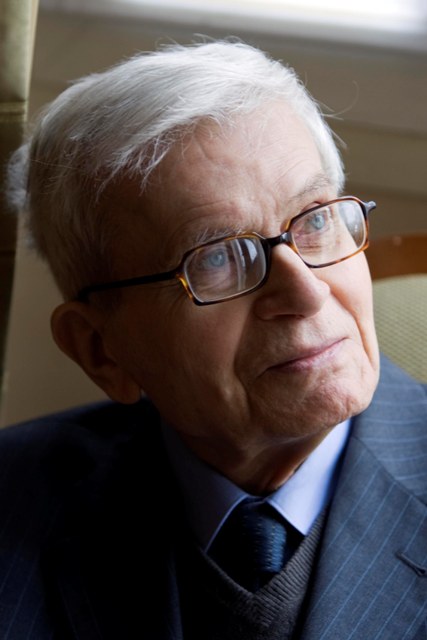
The Templeton Foundation announced the $1.42 million prize at the United Nations Educational, Scientific and Cultural Organization (UNESCO) in Paris on Monday.
Award organizers said his work in quantum physics revealed a reality beyond science that spirituality and art could help to partly grasp.
John Templeton Jr, president of the foundation launched by his late father, said at the ceremony that d'Espagnat, 87, had "explored the unlimited, the openings that new scientific discoveries offer in pure knowledge and in questions that go to the very heart of our existence and humanity."
Previous winners include Russian writer Alexander Solzhenitsyn, United States evangelist Billy Graham and Albanian-born Mother Teresa.
D'Espagnat, a former senior physicist at the CERN particle physics laboratory in Geneva and professor at French and United States universities, argues in his books that modern quantum physics shows that ultimate reality cannot be described.
Classical physics developed by Isaac Newton believes it can describe the world through laws of nature that it knows or will discover. But quantum physics shows that tiny particles defy this logic and can act in indeterminate ways.
D'Espagnat says this points toward a reality beyond the reach of empirical science. The human intuitions in art, music and spirituality can bring us closer to this ultimate reality, but it is so mysterious we cannot know or even imagine it.
"Mystery is not something negative that has to be eliminated," he said. "On the contrary, it is one of the constitutive elements of being."
ON PHYSICS AND PHILOSOPHY
In an interview on Friday, d'Espagnat told Reuters he was brought up a Roman Catholic but did not practice any religion and considered himself a spiritualist.
Some baffling discoveries of quantum physics led him to believe all creation has a wholeness and interrelatedness that many scientists miss by trying to break problems down into their component parts rather than understand them in larger contexts.
One of these is entanglement, the way that paired subatomic particles remain linked even if they move far apart, so that experimenting with one automatically effects the other without any apparent communication between them.
This view clashes with the materialist outlook widespread among scientists.
The Limits of Materialism
The idea that scientific advances will squeeze meaning from the world is a hangover from 19th-century physics.

It's actually quite easy to pick holes in the argument that science will show how consciousness and God are illusions. For example, Colin Blakemore wrote that our intentions are only "what our brains have already decided to do". But is my brain not me too? Surely, he is not suggesting that there is some hidden entity inside each of us that does the deciding and then tricks us into thinking we've done it? That would be to advocate a ghost in the machine.
Blakemore also seems to argue that identifying a biological source of religious feeling would undermine the meaning of religious belief. But that doesn't follow at all. Imagine if geneticists identified the gene that allowed us to solve quadratic equations. Would we be right in concluding that quadratic equations were previously somehow fake? Not at all. Moreover, if some scientist switched the quadratic equations gene off, we would not say that they don't exist. Rather, we would merely conclude that we no longer have the capacity to appreciate their reality and power.
But let's not just seek to score points, because it's interesting to push more deeply into the issue at stake.
Blakemore's views are a product of 150 years of tremendous success in biology, successes built on the assumptions of materialist philosophy and the idea that natural processes are chemical and mechanical. His conviction that faith in materialism will not let you down is entirely understandable. In the struggle for the survival of ideas, it has proven itself to have high adaptive value. But when he proposes that life, consciousness and religion all lie within the grasp of that worldview, he is writing what the philosopher of science, Karl Popper, called a "promissory note". That note says: commit to my materialist conception of the universe and everything will become clear – not yet, maybe not next year, but surely the time will come.
I doubt that and here's one reason why. Consider biology's sister science, physics. Physics had a similar run of success on the basis of a materialist and mechanistic philosophy in the centuries that followed the Copernican revolution. However, that all changed with the emergence of quantum theory. The very stuff upon which materialism is based, atoms, suddenly ceased to look like anything that had previously been called matter. Electrons sometimes looked like particles, and at other times like waves. The even more bizarre thing is that how they look depends upon how the observer chooses to look at them.
So these days, fundamental physicists deal not in atoms but entities such as probability distribution functions. They exist in some kind of higher dimensional universe. How they "collapse" into what might then look like a particle or wave in space and time is a profound conundrum.
New Wave for Islamic Science
Ehsan Masood explores the status of science in the Islamic world today for a new series on BBC Radio 4. He asks whether measures taken to promote science in recent years are having an impact.

In the mid 1990s, I was asked by the science journal Nature to discover the state of science in Pakistan.
Like today, Pakistan had become a democracy after more than a decade of military rule. Benazir Bhutto was prime minister. But science then was not a priority.
The ministry had no minister and - the nuclear programme aside - the national research budget was less than that of an average UK university.
I'd find senior professors sitting behind massive desks in crumbling buildings, with little to do but swat flies and complain how bad everything was.
In subsequent years, I've had the dubious honour of witnessing similar scenes in country after country.
Scientific research and science spending in today's Muslim nations is on a par with the poorest developing countries - even if you include the wealthy oil-producing states.
New wave
Take just one statistic and the extent of the problem becomes clear: between 1996 and 2005, scientists from Turkey, among the Islamic world's most productive nations, published 88,000 research papers.
That's less than what a single university in America's Ivy League would publish in the same period.
Muslim countries spend on average 0.38% of their national wealth on science. The average for a developing country is 0.73%.
But now there are real signs of improvement. Iran has always been at the forefront of getting young people to stay in education longer
Darwin Finds Some Followers in the Pulpits
Henry Green is a rarity among Southern Baptists. The pastor of Heritage Baptist church in Annapolis, Md., is openly skeptical that the Bible is the literal word of God, that the Earth was created in a few thousand years, and that Adam and Eve were created from dirt.
He says that for too long, conservatives have tried to reconcile faith and science by throwing out science.
This weekend, nearly 1,000 clerics worldwide will proclaim their belief that science and religion can coexist as they celebrate the 200th anniversary of the birth of Charles Darwin during events on what has become known as Evolution Weekend.
Believing In God And Science
"Fundamentalists want to take people away from real science and put on some sort of bogus discussion about intelligent design or creationism," Green says. "Well, guess what? I believe God created. But I just happen to believe that the scientists have it right in understanding that creation."
His views haven't made him popular among his fellow ministers. He recalls that when one colleague heard about his views, he began to "witness" to Green.
"He felt like maybe I wasn't a Christian," Green says, laughing. "And he said, 'Well, Henry, if you change your mind, you'd have a lot of friends.' And I looked at him and said, 'Jim, I don't need your friendship that bad.'"
Green says he views Genesis as truth — about God as creator — but not as historical fact.
Jewish Participation
Green is the kind of clergyman Michael Zimmerman has been seeking. The biologist and dean at Butler University in Indiana organized Evolution Weekend four years ago to show that many clergy embrace science.
"With clergy weighing in, it should become clear that the issue is not a fight between religion and science," Zimmerman says, "but that most religious leaders were on the same side as the scientists. And the fight was between different religious groups."
This year, Jews have joined the Evolution Weekend mission. David Oler, the rabbi at Congregation Beth Or, a reform synagogue in Illinois, wrote a letter in July inviting rabbis to oppose creationism in schools. Oler says there is the same kind of split over Darwin within Judaism, though he says because Judaism has a tradition of interpreting stories in a variety of ways, Orthodox Jews have an easier time reconciling Genesis with evolution than do Evangelical Christians.
listen now or download All Things Considered
Physicist and Priest
An interview with John Polkinghorne

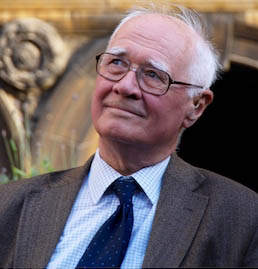
Ordained an Anglican priest after a career as one of the world's top quantum physicists (his work helped lead to the discovery of the quark, a basic element of matter), John Polkinghorne vigorously argues that science and religion are not at odds. He served as the first president of the International Society for Science and Religion and helped organize the Society of Ordained Scientists. He delivered the 1993-1994 Gifford Lectures (which became the book The Faith of a Physicist) and in 2002 received the Templeton Prize for Progress Toward Research or Discoveries About Spiritual Realities.
Polkinghorne has written more than 15 books, including The Quantum World (1985) and Quantum Theory: A Very Short Introduction (2002). His books on science and religion include The Faith of a Physicist (1996), Belief in God in an Age of Science (1999) and, most recently, From Physicist to Priest: An Autobiography (published in the United Kingdom in October).
Do you ever have any regrets about having left the discipline of physics?
No, I think I left at the right time. One reason is that you don't get better at these things as you get older. You probably do your best work in physics before you are 45. The other reason is that the subject has changed. All the time I was in physics, the field was driven by experimentation. There were lots of very clever theorists around, but the experimentalists provided the motivation. Since then the subject has become very speculative, with little empirical input. That's actually not good for physics, and in that respect I'm not sorry to have left the game.
Do you think you would have a similar view if the field were biology?
Biology is different. Accumulated experience is important in biology in a way that isn't the case with mathematical physics. Also, biologists see a different slice of reality from the physicists. Physicists are deeply impressed with the wonderful order of the world, so "mind of God" language comes quite naturally to them, whereas biologists see the much more ambiguous process of life—extinctions
Science & Islam: The Language of Science
A BBC documentary examining the great leap in scientific knowledge that took place in the Islamic world between the 8th and 14th centuries.
Isaac Newton is, as most will agree, the greatest physicist of all time.
At the very least, he is the undisputed father of modern optics, or so we are told at school where our textbooks abound with his famous experiments with lenses and prisms, his study of the nature of light and its reflection, and the refraction and decomposition of light into the colours of the rainbow.
Yet, the truth is rather greyer; and I feel it important to point out that, certainly in the field of optics, Newton himself stood on the shoulders of a giant who lived 700 years earlier.
For, without doubt, another great physicist, who is worthy of ranking up alongside Newton, is a scientist born in AD 965 in what is now Iraq who went by the name of al-Hassan Ibn al-Haytham.
Coupling of Science and Religion

In May 2008, Bloomsbury auctions announced the sale of a letter by Albert Einstein, in which the famed physicist railed against religious beliefs as "childish superstitions . . . the expression and product of human weaknesses."
The letter was something of a curiosity, not because it suggested Einstein harboured a certain hostility toward religion, but because the sentiments it expressed seemed markedly at odds with Einstein's much friendlier public pronouncements about religion, including an exceptionally famous quote about the relationship between science and religion: "Religion without science is lame; science without religion is blind."
Since Einstein's letter was a private affair, it might well have been a more accurate reflection of his true attitude toward religion than his public comments. And the revelation of the great scientist's less than hospitable views toward religion served as a blow to people who maintained that science and religion are compatible, and who often quoted Einstein's words in support of that thesis.
Adherents of this view of science and religion were probably too enthused at the prospect of having the most famous scientist since Isaac Newton on their side. After all, Einstein clearly did not believe in theism, the theory of a transcendent, personal God promoted by the Abrahamic faiths -- Judaism, Christianity and Islam.
At the very most, Einstein's views, like those of a not insignificant number of theoretical physicists, leaned toward a kind of deism -- the belief that some form of impersonal intelligence set the universe in motion, but doesn't intervene in the affairs of creation and hence has no relationship with humans.
LETTER WAS A SIGN OF THE TIMES
In any case, the letter was a sign of the times, because it seems to lend support for the view that has become dominant today: That there is a necessary conflict between science and religion, that these two magisteria -- these two bodies of learning and teaching -- are and always have been locked in a mortal battle which will only be resolved when one triumphs over the other.
The Tension between Science and Religion
Must they compete, or can they complete each other?
Science and religion together can weave a rich tapestry of new meaning for our age. - Philip Hefner
Let us end how we began. At the beginning of Part I, I noted Albert Einstein's famous quote "Science without religion is lame, religion without science is blind." These words, which Einstein may or may not have believed, suggest that science and religion enjoy a mutually beneficial relationship.
And as we saw in Part I, there did exist a complementary relationship between science and religion throughout much of the history of Islam and Christianity. But as we discovered in Parts II and III, science and religion now appear locked in a battle to death.
So where does this leave us? Must science and religion compete with each other, or can they complete each other?
If one believes that Genesis 1 provides a literal account of the natural history of the universe, then the answer is clear: Science must always be at odds with religion, because the results science produces conflict with the Genesis account of creation.
But as we have seen, this practice of reading Genesis 1 literally is a cultural and temporal anomaly. While creationism and the Christian fundamentalism that spawned it currently enjoy considerable influence, they are artifacts of 20th-century America,
Science and Faith, the British Way
Some of the most prominent researchers in England enjoy a vibrant religious life that coexists with their immersion in the scientific world. Indeed, these evangelicals might give American believers, and scientists, something to think about.
From Charles Darwin to Richard Dawkins, science has been seen as an ally of atheism, religion's aggressive adversary.
“Historically, religious faith–and its denial–have played a major part in science,” says Keith Ward, author of The Big Questions in Science and Religion. The pioneering work of Copernicus, Galileo and Kepler all came into conflict with church authorities and doctrines, although these astronomers and cosmologists insisted they were sincere believers. In fact, theology was once considered the “queen of the sciences.”
Modern scientists do not routinely identify their spiritual affiliation; it's extremely difficult to say for certain how many are religious. Even so, among contemporary American scientists, many–perhaps a majority–have declared themselves skeptics, secularists, agnostics and atheists. Carl Sagan, arguably America's best-known cosmologist, and an agnostic, wrote a book titled The Demon-Haunted World: Science as a Candle in the Dark.
Dealing with Evil: Candidates Disagree
Where does evil dwell: in the devil or in mankind?
God either causes or allows "major tragedies to occur as a warning to sinners," say 20% of U.S. adults.
While 43% say most evil is caused by the devil, 47% disagree–a statistical tie.
But most (68%) would not say human nature is basically evil.
So where does evil dwell–in the devil or in mankind? The Baylor survey allows for overlapping views; it finds 36% strongly agree with both statements.
Presence of evil
| % Disagree | % Agree | % Undecided | |
|---|---|---|---|
| Most evil in the world is caused by the devil | 47 | 43 | 10 |
| Most evil in the world is caused by mankind | 7 | 89 | 4 |
| Human nature is basically evil | 68 | 25 | 7 |
Source: The Baylor Religion Survey, the Institute for Studies of Religion, Baylor University. Based on a survey of 1,700 U.S. adults conducted in fall 2007 with a margine of error of ±4 percentage points. Percentages may not add up to 100 due to rounding.
"Those who believe God causes or allows bad things to happen did not speak in terms of tragedies being God's fault," says Baylor sociologist Christopher Bader.
Bader says people told him that "tragedies are our fault. We have sinned as a nation and God has stood aside and allowed terrible things to happen."
Electrons to Enlightenment
The Cosmos

Where do we come from? That’s one of the greatest questions of humankind. For science, it’s the Big Bang. An unimaginable explosion some 15 billion years ago that gave birth to energy and life as we know it. For religion, it’s the mysterious hand of God. Is there room in the cosmos for both? SEGMENT 1: Physicist Joel Primack and Nancy Abrams are the authors of "The View from the Center of the Universe." They tell Steve Paulson how humanity has moved back into the center of our myth-making centuries after Copernicus shattered the old notion of an earth-centered universe. Also, Don Gurnett has been working with NASA, recording audio from space for years. He plays some of his favorite space sounds for Jim Fleming and explains where they come from. SEGMENT 2: Do people believe there is life on other planets? A medley of responses to this burning questions begins this segment. Thebe Medupe is an astrophysicist and producer of the documentary film "Cosmic Africa." He tells Anne Strainchamps about spending time with the Kalahari Bushmen and the Dogon people of Mali to learn their legends about the stars. SEGMENT 3: Daniel Matt is the author of "God and the Big Bang" and one of the foremost scholars of Jewish mysticism and the Kaballah. He tells Steve Paulson that the Big Bang Theory is science's creation myth and that the mystical and rational traditions can inform each other. Also, theoretical physicist Michio Kaku thinks that nature is God's greatest creation. Kaku is the author of "Parallel Worlds: The Science of Alternative Universes and Our Future in the Cosmos."
Electrons to Enlightenment
The Brain and Belief
One of the Dalai Lama's favorite places in America is a neurobiology lab at the University of Wisconsin. Researchers there are putting Buddhist monks inside brain scanners, looking for scientific proof that meditation works. In other labs across the country, radiologists are watching nuns pray and gene hunters are decoding the genetics of faith. In this hour we'll look at the emerging biology of belief. SEGMENT 1: Independent producer Karen Michel reports that some of the country's leading neuro-biologists are collaborating with Buddhist monks in an effort to understand the effects of meditation on the mind and the brain. Karen goes into Richie Davidson's lab at the University of Wisconsin to check out his findings. Also, Andrew Newberg directs the Center for Spirituality and the Mind at the University of Pennsylvania. He's the author of "Why We Believe What We Believe." Newberg tells Steve Paulson what brain imaging technology can tell us about the experiences of Franciscan nuns and Pentecostalists at prayer. SEGMENT 2: Ordinary people share their first memories of God or the first time they were sure god didn't exist. Also, molecular biologist Dean Hamer tells Steve Paulson that human beings are hard-wired for belief and are genetically pre-disposed to reach beyond their own limitations. SEGMENT 3: Deborah Blum is the author of "Ghost Hunters: William James and the Search for Scientific Proof of Life after Death." She talks with Anne Strainchamps about the serious scientific effort undertaken by an elite group of scientists and scholars a hundred years ago to investigate the supernatural. What they found was mostly fraud. Also, Bruce Greyson is considered the father of research into the Near Death Experience. He's the Director of the Division of Perceptual Studies at the University of Virginia and edits the Journal of Near-Death Studies. Greyson tells Jim Fleming what scientific basis there is for believing in NDEs.
Electrons to Enlightenment
Science vs. Religion
Do science and religion have to be at war with each other? Francis Collins doesn't think so. As head of the Human Genome Project, he has a distinguished track record as a gene hunter. He's also an evangelical Christian who believes in miracles. But biologist and atheist Richard Dawkins says religion can never be reconciled with science. SEGMENT 1: Steve Paulson immmersed himself in the subject of science and religion as one of this year's Templeton-Cambridge Fellows. He filed this report on his experience at Cambridge University with comments from philosopher Ken Wilber, socio-biologist E.O. Wilson, popular writer on the history of religion, Karen Armstrong and evolutionary biologist and atheist, Richard Dawkins. SEGMENT 2: We hear some opinions of ordinary people on the relative importance of science and religion. Also, Jim Fleming talks with Rebecca Goldstein, author of "Betraying Spinoza: The Renegade Jew Who Gave Us Modernity." Goldstein explains how Spinoza envisioned God and why his conception appealed to later scientists like Einstein. Also, Francis Collins is one of America's most prominent scientists, longtime head of the Human Genome Project and author of "The Language of God." He's also a Christian and talked with Steve Paulson about his conversion and what it's meant for his beliefs about science and religion. Collins also sings and plays the guitar. We hear a bit of his version of "All the Good People" in honor of the genome's promise for curing rare diseases. SEGMENT 3: Wicca or Neo-paganism began as a movement to recreate pre-Christian nature religions. It turns out to be just what a lot of scientists are looking for. Anne Strainchamps prepared this report on the growing popularity of Wicca. We hear from Ronald Hutton, a historian of paganism and author of "Triumph of the Moon," and from Margot Adler, NPR's New York Bureau Chief and author of "Drawing Down the Moon." We also hear from Wicca practitioners in Wisconsin and Scotland.
Electrons to Enlightenment
Debating Darwin
The theory of evolution is the flashpoint in the war between science and religion. Polls show that nearly half of all Americans believe the Biblical story of creation. Only a quarter accept evolution. And that's infuriated a lot of people. The philosopher Daniel Dennett thinks we need to "break the spell" of religion. But creationist Paul Nelson says evolution simply can't explain certain mysteries. SEGMENT 1: Philosopher Daniel Dennett is the author of "Darwin's Dangerous Idea" and "Breaking the Spell: Religion as a Natural Phenomenon." He tells Steve Paulson why he finds ignorance of evolutionary biology so appalling. Also, Randy Olson is a Harvard-trained evolutionary biologist and creator of the documentary film "Flock of Dodos." We hear a clip, and Olson tells Jim Fleming why he has no use for the intelligent design movement. Also, Steve Paulson reports from Cambridge University in England on Charles Darwin's own views regarding whether his theory of evolution was compatible with religious faith. We hear from Paul White of the Darwin Correspondence Project. SEGMENT 2: Ordinary people weigh in on the evolution/creationism debate. Also, biologist Richard Dawkins (author of "The God Delusion") is the man the Intelligent Design Movement loves to hate. He explains why he thinks Darwinism leads to atheism. And creationist Paul Nelson, a fellow at the Discovery Institute, makes the case for his point of view. Also, paleontologist Simon Conway Morris talks with Steve Paulson about convergence and the evolution of intelligence. Morris is the author of "Life's Solution: Inevitable Humans in a Lonely Universe." SEGMENT 3: Biologist Elisabet Sahtouris is the author of "Earthdance: Living Systems in Evolution." Sahtouris has no truck with Biblical creationists but thinks the standard story of evolution has major problems. She talks with Anne Strainchamps.
Electrons to Enlightenment
Awe and Wonder
In the world where we take out the garbage and brush our teeth, we sometimes brush up against wonder, and awe. Some people live their lives hoping for another glimpse into this realm. We all look for it in different places. Some of us find it in God, like the great mystic poet, Rumi. Others find it on terra firma - in the magnificent intricacies of life on planet earth.
SEGMENT 1: Robert Fuller is the author of "Wonder" - the first in-depth look at one of humanity's most important emotions. Fuller tells Jim Feming wonder may be the bedrock of all spirituality. Fuller teaches religious studies at Bradley University. Also, plant biologist Nicholas Harberd took a year off to study a common weed - the thalecress - he found growing in a country churchyard. He kept a journal that became "Seed to Seed: The Secret Life of Plants." Harberd tells Steve Paulson what he found so fascinating about thalecress and reads from his book. Also, Pulitzer Prize-winning poet Mary Oliver reads her poem "The Kingfisher."
SEGMENT 2: We hear from some ordinary people about what inspires awe and wonder in them and where they find god. Also, cell biologist Ursula Goodenough tells Steve Paulson that she finds the commonplaces of nature entirely miraculous without reference to a Supreme Being. Her book is "The Sacred Depths of Nature." Also, Scott Topper is a geneticist at the University of Wisconsin in Madison, and a poet. He reads from the meditation journal he kept after learning a simple meditation from Buddhist monk George Churinoff.
SEGMENT 3: Coleman Barks has made it his life's work to translate the poetry of 13th century mystic and poet Rumi. Barks recites several short Rumi works for Anne Strainchamps and they talk about mystical ecstasy.
The Religion of Politics
For some, the notion of an amoral world is not in conflict with hope. But what happens when politics appropriates faith and morality?
Nature, one of the world's leading science magazines, normally carries obituaries only of Nobel prizewinners and scientists of similar stature, but it made an exception for Sir John Templeton [subs nec], the financier and philanthropist who gave hundreds of millions of dollars to promote the scientific study of religious beliefs. He thought they were true, or at least referred to real facts about the world, and thus could be studied with profit by real scientists. Naturally, this infuriates the Dawkinsian atheists, who, for all their talk of applying reason to religion, want in fact to abolish it and extinguish its memory except as something with which to frighten children. So I was aware that writing the obituary was a controversial undertaking.
I only had one letter back, though, which surprised me, and it was a reasoned and interesting one from which I learned a great deal. A reader in Dallas, Texas, write in to protest because I had said that people who believed the universe was amoral must think of themselves as being on the losing side.
To many nonbelievers, like myself, we are perfectly content with believing that the universe is amoral and without purpose. Believing this way takes nothing away from our fascination with this place or its mysteries, nor does it make us less emotionally 'positive' than others. To me, believing this way feels neither false to the facts nor to be on a losing side. I assume that those who do believe in a purpose-driven, moral universe also don't feel that they are on a losing side.
Obviously you can be moral and still believe that the universe is not on your side: in some sense, morality wouldn't be morality at all if it consisted only in signing up with the big winner. But it seems to me obvious that if you believe that in the long run all good deeds are
The Truth about Truth

he truth is not out there, after all - even in science. A gathering of European scientists, philosophers, historians and theologians this weekend unanimously concluded that there is no reason for science to claim a monopoly on the truth about how the world works. In a democratic society, the observations of science must not be given a privileged status in debates on issues such as embryonic stem cell research. Instead, scientific consensus must be laid out for members of that society to use as they see fit.
The meeting, held in Lugano, Switzerland, discussed the notion of "truth". Science is not a source of indisputable truth, but best seen as "organised skepticism" with a diversity of opinion on any subject at any one time, Oxford University biologist and former UK chief scientist Robert May told the assembly. Though science creates opportunities to improve life for all, we should continue to think carefully about which of these opportunities we want to take. Just because it has made some things possible, that does not give scientists the right to choose whether they should be followed through. "Science has no special voice," May said. "The job of science is to frame the debate clearly, making plain the possible benefits and costs – and the uncertainties."
The symposium was sponsored by the Balzan foundation, an Italian-Swiss charity that aims to promote debate in the sciences and humanities. If there was a central message to the meeting it was that nothing is reliable – and nothing is sacred. After a Roman Catholic cardinal had attempted to make a virtue of the unknowability of God by discussing the mystery of the incarnation, Oxford University’s Geza Vermes, a Jewish scholar, swept the point aside by laying out historical evidence suggesting Jesus was nothing more that a particularly charismatic Jewish teacher whose work was rudely interrupted by a crucifixion.
Not that history is reliable either – as it turns out, historians have long given up worrying about the truth in their discipline. "Historians don’t have to have a theory of truth," Cambridge University’s Quentin Skinner told the gathering. And, he said, science should adopt the same position.
Science is no different to history, Skinner reckons. "Scientists have a method they work by, but historians have a very similar method," he said in an interview after the meeting. "They ask how a belief about the past sits with any other beliefs, whether there any obvious contradictions, does it all hang together? Scientists do the same. All scientists can do is say of some phenomenon that everyone who has investigated the matter will affirm the same thing. That doesn’t make it true, he contends. "What’s added by saying that it’s true?" Skinner says. "I really don’t want to talk about truth, because I don’t know what it is. Is it a property that things have?"
The Frontiers of Faith and Knowledge
Neither science nor religion can banish uncertainty. If only they could thrive on that shared sense of wonder
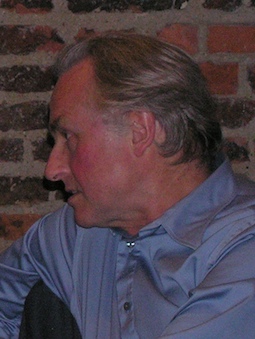
Sir John Templeton, who died last week, gave hundreds of millions of dollars to scientists whom he hoped might put religious beliefs on a more solid foundation. His very substantial Templeton Foundation–with assets of nearly $1.5bn–has attracted particular reprobation in recent years. Some say its aim–to sponsor "human progress" through scientific research in religion–is simply misconceived: in Stephen Jay Gould's famous distinction, science and religion are two magisteria, fundamental but separate.
Others have been more vociferous in their critique. In Richard Dawkins' book, The God Delusion, the Templeton Foundation warrants five index entries, one of three-page length. I do not know whether Dawkins has read much Freud, but he seems to be feeling his way towards the link the founder of psychoanalysis made between gold and excrement.
I should confess that I have been a minor beneficiary of Sir John's largesse, as a Templeton–Cambridge journalism fellow. That said, now might be a good moment to put the aims of the foundation to the test. For what progress has its funding produced in relation to science and religion? It's a big question, but then Sir John liked the big questions. So consider the thoughts of, say, three of his Templeton prize winners. They are, perhaps, illuminating.
Take Freeman Dyson, winner in 2000. The mathematical physicist and Emeritus professor at the prestigious Institute of Advanced Study in Princeton, has written about science and religion on many occasions. There is an article summing up what he thinks in his latest book, A Many-Colored Glass.
Dyson draws an analogy with one of the central ideas in modern physics, that of complementarity. The best-known example of complementarity is that of the dual nature of light. Depending on how you look at it, you see either particles or waves. Light itself is richer than any one picture we might use to describe it.
A Modern Ottoman
The Turkish cleric Fethullah Gülen, winner of our intellectuals poll, is the modern face of the Sufi Ottoman tradition. At home with globalisation and PR, and fascinated by science, he also influences Turkish politics through links to the ruling

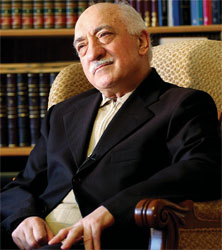
Is it possible to be a true religious believer and at the same time enjoy good relations with people of other faiths or none? Moreover, can you remain open to new ideas and new ways of thinking?
Fethullah Gülen, a 67-year-old Turkish Sufi cleric, author and theoretician, has dedicated much of his life to resolving these questions. From his sick bed in exile just outside Philadelphia, he leads a global movement inspired by Sufi ideas. He promotes an open brand of Islamic thought and, like the Iran-born Islamic philosophers Seyyed Hossein Nasr and Abdolkarim Soroush, he is preoccupied with modern science (he publishes an English-language science magazine called the Fountain). But Gülen, unlike these western-trained Iranians, has spent most of his life within the religious and political institutions of Turkey, a Muslim country, albeit a secular one since the foundation of Mustafa Kemal Atatürk’s republic after the first world war.
Unusually for a pious intellectual, he and his movement are at home with technology, markets and multinational business, and especially with modern communications and public relations—which, like a modern televangelist, he uses to attract converts. Like a western celebrity, he carefully manages his public exposure—mostly by restricting interviews to those he can trust.
Many of his converts come from Turkey’s aspirational middle class. As religious freedom comes, falteringly, to Turkey, Gülen reassures his followers that they can combine the statist-nationalist beliefs of Atatürk’s republic with a traditional but flexible Islamic faith. He also reconnects the provincial middle class with the Ottoman traditions that had been caricatured as theocratic by Atatürk and his "Kemalist" heirs. Oliver Leaman, a leading scholar of Islamic philosophy, says that Gülen’s ideas are a product of Turkish history, especially the end of the Ottoman and the birth of the republic. He calls Gülen’s approach "Islam-lite."
Millions of people inside and outside Turkey have been inspired by Gülen’s more than 60 books and the tapes and videos of his talks.
The Science of Religion: Where angels no longer fear to tread
Science and religion have often been at loggerheads. Now the former has decided to resolve the problem by trying to explain the existence of the latter.


BY THE standards of European scientific collaboration, €2m ($3.1m) is not a huge sum. But it might be the start of something that will challenge human perceptions of reality at least as much as the billions being spent by the European particle-physics laboratory (CERN) at Geneva. The first task of CERN's new machine, the Large Hadron Collider, which is due to open later this year, will be to search for the Higgs boson—an object that has been dubbed, with a certain amount of hyperbole, the God particle. The €2m, by contrast, will be spent on the search for God Himself—or, rather, for the biological reasons why so many people believe in God, gods and religion in general.
"Explaining Religion", as the project is known, is the largest-ever scientific study of the subject. It began last September, will run for three years, and involves scholars from 14 universities and a range of disciplines from psychology to economics. And it is merely the latest manifestation of a growing tendency for science to poke its nose into the God business.
Religion cries out for a biological explanation. It is a ubiquitous phenomenon—arguably one of the species markers of Homo sapiens—but a puzzling one. It has none of the obvious benefits of that other marker of humanity, language. Nevertheless, it consumes huge amounts of resources. Moreover, unlike language, it is the subject of violent disagreements. Science has, however, made significant progress in understanding the biology of language, from where it is processed in the brain to exactly how it communicates meaning. Time, therefore, to put religion under the microscope as well.
I have no need of that hypothesis
Explaining Religion is an ambitious attempt to do this. The experiments it will sponsor are designed to look at the mental mechanisms needed to represent an omniscient deity, whether (and how) belief in such a "surveillance-camera" God might improve reproductive success to an individual's Darwinian advantage, and whether religion enhances a person's reputation—for instance, do people think that those who believe in God are more trustworthy than those who do not? The researchers will also seek to establish whether different religions foster different levels of co-operation, for what reasons, and whether such co-operation brings collective benefits, both to the religious community and to those outside it.
It is an ambitious shopping list. Fortunately, other researchers have blazed a trail. Patrick McNamara, for example, is the head of the Evolutionary Neurobehaviour Laboratory at Boston University's School of Medicine. He works with people who suffer from Parkinson's disease. This illness is caused by low levels of a messenger molecule called dopamine in certain parts of the brain. In a preliminary study, Dr McNamara discovered that those with Parkinson's had lower levels of religiosity than healthy individuals, and that the difference seemed to correlate with the disease's severity. He therefore suspects a link with dopamine levels and is now conducting a follow-up involving some patients who are taking dopamine-boosting medicine and some of whom are not.
Newton's Single Vision
Newton by Peter Ackroyd


For Isaac Newton (1642–1727), the universe was governed by precise laws which could not only be formulated but mathematically proved to a certainty. These physical laws were not sporadic or local; they were universal and extended "everywhere to immense distances," as he wrote in The Principia: Mathematical Principles of Natural Philosophy, first published in 1687. Newton's three laws of motion may not apply at the atomic level or under conditions approaching the speed of light, as we now know, but they apply everywhere else. The fall of that famous apple was no less an effect of universal gravitation than the rhythms of the tides or the orbits of the planets.
But to prove the law of gravity, though an unparalleled accomplishment, was not to understand its final cause. Newton wrote, again in The Principia, that "I have not as yet been able to deduce from phenomena the reason for these properties of gravity." (That "as yet" demonstrates both Newton's supreme self-confidence and his rigorous honesty. To this day no one else has deduced those "properties" either.) In a statement that stands as his scientific signature, he added, "et non fingo hypotheses"—"and I do not feign hypotheses." Even so, this same scorner of the hypothetical would spend much of his career after the amazing two-year period of his greatest discoveries in 1664–66 dabbling obsessively in alchemy, as well as pursuing increasingly fantastic numerological investigations of Scripture.
How to Reconcile Richard Dawkins?
Author of The God Delusion in person is more open-minded than his critics would have you believe.
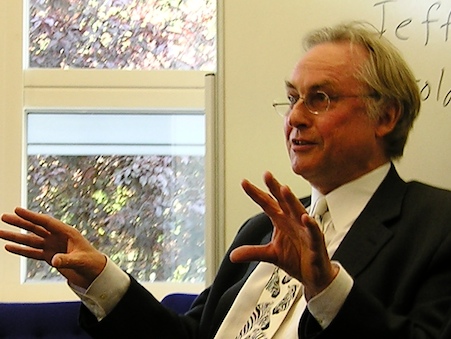
It's often been said that there are two Richard Dawkinses. First, there's the fire-breathing Dawkins of literature, whose books and essays declare religion a virus of the mind, "comparable to the smallpox virus but harder to eradicate," who maintains that religious instruction is a form of child mental abuse, and who will brook no opposition in his war on religious faith.
Then there's the personal Dawkins, the debonair Charles Simonyi Professor of the Public Understanding of Science at Oxford University, a man who is polite and gracious to a fault.
I had the pleasure of sitting down with the second Dawkins Monday morning in Vancouver, so I decided to ask him about the first, and in particular about the many criticisms levelled at him and his most recent book, the bestselling The God Delusion.
The book, which is a sustained attack on both belief in God and the negative consequences that can flow from religious belief, has provoked a litany of hostile reviews, essays and even book-length treatises from theologians, scientists and other observers.
Chief among the criticisms is that The God Delusion presents an all-too-rosy picture of atheism -- Dawkins cites John Lennon's Imagine to paint the picture of what an atheist world would look like -- while accusing religion of inspiring all manner of unspeakable acts, including crusades, wars, witch hunts, suicide bombings, and on and on and on.
Now on that latter point, Dawkins will get no argument from me: Religion has driven otherwise good people to do many evil things.
But what of atheism? Surely Stalin's purges, including his execution of orthodox priests and nuns, and Mao's attempts to eliminate Buddhism count for something, no?
Well, yes and no. According to Dawkins, Stalin was an atheist who did evil things, but there is no direct "logical pathway" from atheism to bad deeds, as there is with religious faith. I have to say I don't entirely understand Dawkins's thinking here -- how, after all, could
You are the river: An interview with Ken Wilber
The integral philosopher explains the difference between religion, New Age fads and the ultimate reality that traditional science can't touch.

Ken Wilber may be the most important living philosopher you've never heard of. He's written dozens of books but you'd be hard-pressed to find his name in a mainstream magazine. Still, Wilber has a passionate -- almost cultlike -- following in certain circles, as well as some famous fans. Bill Clinton and Al Gore have praised Wilber's books. Deepak Chopra calls him "one of the most important pioneers in the field of consciousness." And the Wachowski brothers asked Wilber, along with Cornel West, to record the commentary for the DVDs of their "Matrix" movies.
A remarkable autodidact, Wilber's books range across entire fields of knowledge, from quantum physics to developmental psychology to the history of religion. He's steeped in the world's esoteric traditions, such as Mahayana Buddhism, Vedantic Hinduism, Sufism and Christian mysticism. Wilber also practices what he preaches, sometimes meditating for hours at a stretch. His "integral philosophy," along with the Integral Institute he's founded, hold out the promise that we can understand mystical experience without lapsing into New Age mush.
Revealing Religion
Baroness Williams says that religion is an "anchor."

Easter weekend is one of the great affirmations of faith in the Christian year. To believers, the death and resurrection of Christ is, according to traditional doctrine, the belief that defines their religious experience.
To non-believers, ideas like resurrection are the kind of proposition that makes religious faith impossible.
But for believers and non-believers alike there has been intense interest and much new research in recent years into what exactly religious faith means to people.
Shaping the world?
It shows why faith seems to come naturally to so many communities and cultures - a challenge to many assumptions about the onward march of secular life.
Baroness Williams says that religion is an "anchor."
Religion is clearly a major influence in the shaping of the world. Yet how does belief actually relate to the way in which life is lived, how does it affect thought and action?
Are the sacred texts and doctrines of world religions the best guides to how religion is really believed and understood, or is there a new way of understanding its role in relation to individuals and societies?
In Analysis Andrew Brown explores this research, and talks to leading figures pursuing new understandings of religion and its application to daily life.
They include anthropologist Scott Atran, whose fieldwork has ranged from South America to the families of Palestinian suicide bombers, the veteran British politician and prominent Catholic Shirley Williams, philosopher and atheist Antony Grayling, Justin Barrett,
listen now or download [mp3 audio, 28 minutes, ~6.3 MB]
Einstein, God, and the Universe


Albert Einstein died more than half a century ago, but there's still a raging debate over what he thought about religion. He once said “Science without religion is lame, religion without science is blind.” In this excerpt from To the Best of Our Knowledge, what exactly did Einstein conclude about religion?
Steve Paulson speaks with several scientists, religious scholars and atheists about Albert Einstein's religious beliefs. We hear from Richard Dawkins, Elaine Pagels, and Einstein biographer Walter Isaacson who debate what Einstein meant by “god.”
listen now or download [mp3 audio, 16 minutes 7 seconds, ~7.4 MB]
The Atheist Delusion
Theologian John Haught explains why science and God are not at odds, why Mike Huckabee worries him, and why Richard Dawkins and other “new atheists” are ignorant about religion.

Evolution remains the thorniest issue in the ongoing debate over science and religion. But for all the yelling between creationists and scientists, there's one perspective that's largely absent from public discussions about evolution. We rarely hear from religious believers who accept the standard Darwinian account of evolution. It's a shame because there's an important question at stake: How can a person of faith reconcile the apparently random, meaningless process of evolution with belief in God?
The simplest response is to say that science and religion have nothing to do with each other–to claim, as Stephen Jay Gould famously did, that they are "non-overlapping magisteria." But perhaps that response seems too easy, a politically expedient ploy to pacify both scientists and mainstream Christians. Maybe evolutionary theory, along with modern physics, does pose a serious challenge to religious belief. To put it another way, how can an intellectually responsible person of faith justify that faith–and even belief in a personal God–after Darwin and Einstein?
That's the question John Haught has set out to answer by proposing a "theology of evolution." Haught is a Roman Catholic theologian at Georgetown University and a prolific author. His books include God After Darwin, Is Nature Enough? and the forthcoming God and the New Atheism. He's steeped in evolutionary theory as well as Christian theology. Haught believes Darwin is "a gift to theology." He says evolutionary biology has forced modern theologians to clarify their thinking by rejecting outdated arguments about God as an intrusive designer. Haught reclaims the theology of his intellectual hero, Jesuit priest and paleontologist Pierre Teilhard
Proud Atheists
Steven Pinker and Rebecca Goldstein, America's brainiest couple, confess that belonging to one of America's most reviled subcultures doesn't mean they believe scientists can explain everything.

"I've always been obsessed with the mind-body problem," says philosopher Renee Feuer Himmel. "It's the essential problem of metaphysics, about both the world out there and the world in here."
Renee is the fictional alter ego of novelist and philosopher Rebecca Goldstein. In her 1983 novel, "The Mind-Body Problem," Goldstein laid out her own metaphysical concerns, which include the mystery of consciousness and the struggle between reason and emotion. As a novelist, she's drawn to the quirky lives of scientists and philosophers. She's also fascinated by history's great rationalist thinkers. She's written nonfiction accounts of the 17th-century Jewish philosopher Baruch Spinoza and the 20th-century mathematician-philosopher Kurt Gödel.
Perhaps it's not surprising that Goldstein would end up living with Steven Pinker, a leading theorist of the mind. He's a cognitive psychologist at Harvard; she's a philosopher who's taught at several colleges. Although they come out of different disciplines, they mine much of the same territory: language, consciousness, and the tension between science and religion. If Boston is ground zero for intellectuals, then Pinker and Goldstein must rank as one of America's brainiest power couples.
With a series of bestselling books on language and human nature, including How the Mind Works, Pinker has emerged as his generation's most influential cognitive theorist. His work on the evolution of language, and how humans possess an innate capacity for language, revolutionized linguistics. His writing about the
The Religious State of Islamic Science
Turkish–American physicist Taner Edis explains why science in Muslim lands remains stuck in the past—and why the Golden Age of Mesopotamia wasn't so golden after all.
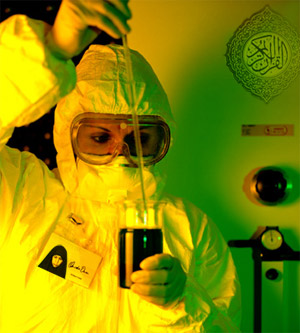
In October, Malaysia's first astronaut will join a Russian crew and blast off into space. The news of a Muslim astronaut was cause for celebration in the Islamic world, but then certain questions started popping up. How will he face Mecca during his five daily prayers while his space ship is whizzing around the Earth? How can he hold the prayer position in zero gravity? Such concerns may sound absurd to us, but the Malaysian space chief is taking them quite seriously. A team of Muslim scholars and scientists has spent more than a year drawing up an Islamic code of conduct for space travel.
This story illustrates the obstacles that face scientists in Muslim countries. While it's always risky to draw generalizations about Islam, even conservative Muslims admit that the Islamic world lags far behind the West in science and technology. This is a big problem for Muslims who envy the economic and military power of the United States.
What's so striking about the Muslim predicament is that the Islamic world was once the unrivaled center of science and philosophy. During Europe's Dark Ages, Baghdad, Cairo and other Middle Eastern cities were the key repositories of ancient Greek and Roman science. Muslim scholars themselves made breakthroughs in medicine, optics and mathematics. So what happened? Did strict Islamic orthodoxy crush the spirit of scientific inquiry? Why did Christian Europe, for so long a backwater of science, later launch the scientific revolution?
Taner Edis, the author of An Illusion of Harmony: Science and Religion in Islam, is in a unique position to examine these questions. He grew up in Turkey, the son of a Turkish father and an American mother, and now teaches physics at Truman State University in Missouri. Though he comes from a Muslim country, his family wasn't religious. Today, Edis calls himself an "Enlightenment rationalist."
God and Science

It’s official. Scientists really are less religious than most folks are. In fact, close to 52 percent of American scientists claim no religious affiliation at all, as opposed to 14 percent of the general population. Should we be surprised?
Probably not. But a new study conducted by University of Buffalo sociologist Elaine Howard Ecklund at least sheds some helpful light on why so many scientists got to be that way.
The biggest revelation, it turns out, is that it wasn’t all those hours in the lab that led white-frocked chemists and biologists down the road to godlessness. Nor was it because they read Darwin or Einstein and concluded that the whole grand scheme of things required no supreme creator. It wasn’t even, in the case of the social scientists, that they converted to those ideologies of disenchantment formulated by Marx or Weber.
Manufacturing Belief
The origin of religion is in our heads, explains developmental biologist Lewis Wolpert. First we figured out how to make tools, then created a supernatural being.

In Lewis Carroll's Through the Looking Glass, Alice tells the White Queen that she cannot believe in impossible things. But the Queen says Alice simply hasn't had enough practice. "When I was your age, I always did it for half-an-hour a day. Why, sometimes I've believed as many as six impossible things before breakfast." That human penchant for belief–or perhaps gullibility–is what inspired biologist Lewis Wolpert to write a book about the evolutionary origins of belief called Six Impossible Things Before Breakfast.
Wolpert is an eminent developmental biologist at University College London. Like fellow British scientist Richard Dawkins, he's an outspoken atheist with a knack for saying outrageous things. Unlike Dawkins, Wolpert has no desire to abolish religion. In fact, he thinks religious belief can provide great comfort and points to medical studies showing that the faithful tend to suffer less stress and anxiety than nonbelievers. In Wolpert's view, religion has given believers an evolutionary advantage, even though it's based on a grand illusion.
p> He has a theory for why religion first took root. He thinks human brains evolved to become "belief engines". Once our ancient ancestors understood cause and effect, they figured out how to manipulate the natural world. In essence, toolmaking made us human. Similarly, early hominids felt compelled to find causes for life's great mysteries, including illness and death. TheyThe New Atheists Loathe Religion Far Too Much to Plausibly Challenge It
Anti-faith proselytising is a growth industry. But its increasingly hysterical flag-bearers are heading for a spectacular failure

It's an extraordinary publishing phenomenon—atheism sells. Any philosopher, professional polemicist or scientist with worries about their pension plan must now be feverishly working on a book proposal. Richard Dawkins has been in the bestseller lists on both sides of the Atlantic since The God Delusion came out last autumn following Daniel Dennett's success with Breaking the Spell. Sam Harris, a previously unknown neuroscience graduate, has now clocked up two bestsellers, The End of Faith and Letter to a Christian Nation. Last week, Christopher Hitchens' God Is Not Great: How Religion Poisons Everything was published in the US. The science writer, Matt Ridley, recently commented that on one day at Princeton he met no fewer than three intellectual luminaries hard at work on their God books.
This rising stack of books has prompted screeds of debate, flushing out all manner of belief and unbelief in blogs, reviews, essays and internet exchanges in the US. The Catholic columnist Andrew Sullivan has just concluded his exchange with Sam Harris on the net, while the philosopher Michael Novak recently took on the whole genre of New Atheism, or neo-atheism. Surely not since Victorian times has there been such a passionate, sustained debate about religious belief.
And it's a very ill-tempered debate. The books live up to their provocative titles: their purpose is to pour scorn on religious belief—they want it eradicated (although they differ as to the chances of achieving that). The newcomer on the block, Hitchens, sums up monotheism as "a plagiarism of a plagiarism of a hearsay of a hearsay, of an illusion of an illusion, extending all the way back to a fabrication of a few non-events." He takes the verbal equivalent of an AK47 to shoot down hallowed religious figures, questioning whether Muhammad was an epileptic, declaring Mahatma Gandhi an "obscurantist" who distorted and retarded Indian independence, and Martin Luther King a "plagiarist and an orgiast" and in no real sense a Christian, while the Dalai Lama is a "medieval princeling"
Gospel According to Judas
The recently unearthed Gospel of Judas “contradicts everything we know about Christianity,” says religious historian Elaine Pagels.
As almost every child knows, Judas was the disciple who betrayed Jesus, selling his life for 30 pieces of silver. If there's an arch villain in the story of Jesus, it's Judas Iscariot. Or is it? The newly discovered Gospel of Judas suggests that Judas was, in fact, the favorite disciple, the only one Jesus trusted to carry out his final command to hand him over to the Romans.
Rumors about the gospel have circulated for centuries. Early church fathers called it a "very dangerous, blasphemous, horrendous gospel," according to historian Elaine Pagels. We now know that the manuscript was passed around the shadowy world of antiquities dealers, at one point sitting in a safe deposit box in a small town in New York for 17 years. Pagels herself was once asked by a dealer in Cleveland to examine it, but he only showed her the last few pages, which revealed little more than the title page. She assumed there was nothing of significance. Finally, the manuscript was acquired by the National Geographic Society, which hired Pagels as a consultant to study it.
More than any other scholar, Pagels has brought the lost texts of early Christianity to public attention. A Princeton historian of religion, she wrote the 1979 bestseller The Gnostic Gospels–the book that launched the popular fascination with the Nag Hammadi manuscripts found by Egyptian peasants in 1945. That book, which
The Modern Muslim
Controversial scholar Tariq Ramadan explains why Mohammed had progressive views of women, why the Quran is a prescription for peace–and why he is banned from Saudi Arabia and the U.S.
Controversial scholar Tariq Ramadan explains why Mohammed had progressive views of women, why the Quran is a prescription for peaceâ€"and why he is banned from Saudi Arabia and the U.S.
Why are there so few moderate Muslims speaking out against Islamic terrorism? That's a common complaint heard in the West, but in truth, plenty of Muslims are critical of suicide bombers. What's harder to find are Muslim leaders who condemn terrorism while also maintaining credibility among disaffected Muslims, and intellectuals who can appeal to both secular Europeans and Middle Eastern imams. That's why the Swiss-born Tariq Ramadan is such a compelling figure.
Ramadan has been called the Muslim Martin Luther King, and he's often described as Europe's most important Muslim intellectual. He has no shortage of charismaâ€"a quality that serves him well as he reaches out to various constituencies. There's no doubt that Ramadan commands a large following. Hundreds of young Muslims turn up at his public talks, and tapes of his lectures are widely circulated. He travels frequently throughout the Islamic world, trying to build bridges between European Muslims and conservative clerics.
But there are some countries Ramadan can't visit. The United States, Egypt and Saudi Arabia have all banned him–each for different reasons. In 2004 Ramadan was all set to move his family to Indiana, where he'd accepted a teaching position at Notre Dame. But the U.S. State Department revoked his visa–though exactly why remains a mystery. Ramadan says it's because he's an outspoken critic of U.S. foreign policy. His critics say he has ties to Muslim terrorists. No evidence of a direct link to terrorism has ever surfaced, though plenty of people have looked for one. Yet his most vocal critics are in France, where Ramadan is a prominent public intellectual. The French journalist Caroline Fourest even wrote a book-length attack on Ramadan, titled Brother Tariq.
One reason Ramadan garners such close scrutiny is his distinguished–some would say notorious–family background. In 1928 his grandfather, Hassan al-Banna, founded the Muslim Brotherhood in Egypt–the group that later spawned al-Qaida's Ayman al-Zawahiri. Al-Banna was murdered in 1949. Ramadan's parents fled Egypt and settled in Switzerland, where his father, Said Ramadan, emerged as a major Islamic thinker. Tariq Ramadan resists simple labels. He's a devout Muslim, but one who wants to loosen the strict interpretations of Islamic law. He embraces the Western values of pluralism and democracy, while also retaining the anti-colonial mantle of his grandfather. Ramadan is often accused of being two-faced, making nice with Western journalists while giving fiery speeches to young Muslims. Ramadan says his tone may change, but he insists that his message is consistent.
France Warns Schools Over Islamic Anti-Darwin Book
France’s Education Ministry has warned schools around the country against Islamic creationism theories after several thousand copies of an anti-Darwinist book from Turkey were mailed to them, an official said on Friday.
The lavishly illustrated Atlas of Creation by Harun Yahya, a shadowy figure who runs a large Islamic publishing operation from Istanbul, was sent to schools and universities over the past 10 days in a move that has baffled authorities, she said.
The Turkish original of the 768-page book, which rejects evolution, first appeared in Turkey late last year when it wa also sent unsolicitedly to schools.
It sees Charles Darwin’s theory of the survival of the fittest as the root of many of today’s ills, including modern terrorism.
Seeing the Light—of Science
Ronald Numbers—a former Seventh-day Adventist and author of the definitive history of creationism—discusses his break with the church, whether creationists are less intelligent and why Galileo wasn't really a martyr.

Despite massive scientific corroboration for evolution, roughly half of all Americans believe that God created humans within the past 10,000 years. Many others believe the ‘irreducible complexity’ argument of the intelligent design movement–a position that, while somewhat more flexible, still rankles most scientists. This widespread refusal to accept evolution can drive scientists into a fury. I've heard biologists call anti-evolutionists "idiots", "lunatics" and worse. But the question remains: How do we explain the stubborn resistance to Darwinism?
University of Wisconsin historian Ronald Numbers is in a unique position to offer some answers. His 1992 book The Creationists, which Harvard University Press has just reissued in an expanded edition, is probably the most definitive history of anti-evolutionism. Numbers is an eminent figure in the history of science and religion–a past president of both the History of Science Society and the American Society of Church History. But what's most refreshing about Numbers is the remarkable personal history he brings to this subject. He grew up in a family of Seventh-day Adventists and, until graduate school, was a dyed-in-the-wool creationist. When he lost his religious faith, he wrote a book questioning the foundations of Adventism, which created a huge rift in his family. Perhaps because of his background, Numbers is one of the few scholars in the battle over evolution who remain widely respected by both evolutionists and creationists. In fact, he was once recruited by both sides to serve as an expert witness in a Louisiana trial on evolution. (He went with the ACLU.)
Numbers says much of what we think about anti-evolutionism is wrong. For one thing, it's hardly a monolithic movement. There are, in fact, fierce battles between creationists
Getting a Rational Grip on Religion
Is religion a fit subject for scientific scrutiny?

If nowhere else, the dead live on in our brain cells, not just as memories but as programs--computerlike models compiled over the years capturing how the dearly departed behaved when they were alive. These simulations can be remarkably faithful. In even the craziest dreams the people we know may remain eerily in character, acting as we would expect them to in the real world. Even after the simulation outlasts the simulated, we continue to sense the strong presence of a living being. Sitting beside a gravestone, we might speak and think for a moment that we hear a reply.
In the 21st century, cybernetic metaphors provide a rational grip on what prehistoric people had every reason to think of as ghosts, voices of the dead. And that may have been the beginning of religion. If the deceased was a father or a village elder, it would have been natural to ask for advice--which way to go to find water or the best trails for a hunt. If the answers were not forthcoming, the guiding spirits could be summoned by a shaman. Drop a bundle of sticks onto the ground or heat a clay pot until it cracks: the patterns form a map, a communication from the other side. These random walks the gods prescribed may indeed have formed a sensible strategy. The shamans would gain in stature, the rituals would become liturgies, and centuries later people would fill mosques, cathedrals and synagogues, not really knowing how they got there.
With speculations like these, scientists try to understand what for most of the world's population needs no explanation: why there is this powerful force called religion. It is possible, of course, that the world's faiths are triangulating in on the one true God. But if you forgo that leap, other possibilities arise: Does banding together in groups and acting out certain behaviors confer a reproductive advantage, spreading genes favorable to belief? Or are the seeds of religion more likely to be found among the memes--ideas so powerful that they leap from mind to mind?
The Gospel Truth
Why some old books are stirring up a new debate about the meaning of Jesus
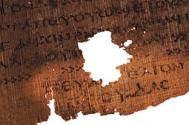
What does The Da Vinci Code have to do with a letter written by the archbishop of Alexandria in the year 367? As it turns out, quite a lot.
Call it part of the Gnostic connection, a long, fine thread of influence connecting contemporary cultural debates with an important struggle in the early Christian movement to define the meaning of Jesus's life and teaching. In that struggle-arguably the most important waged by self-styled correct believers against so-called heretics-orthodox Christians battled Gnostic Christians over their respective interpretations of divinity, human nature, sin, salvation, and other crucial theological and philosophical points. The soldiers of orthodoxy, as we now know, ultimately prevailed, confirming their claim to be the true Christians. But Gnostic principles lived on in isolated communities and, occasionally, sparked Gnostic-like revivals.
Indeed, in recent decades, thanks to the recovery and scholarly interpretations of a trove of Gnostic documents, the ideas of that ancient movement have come to play a surprisingly prominent role in our current culture wars. Today, there are many scholars, theologians, and popular writers who promote the Gnostic perspective as a liberating antidote to close-minded dogmatism, but there are also many others who denounce it as a pernicious and destructive influence. Name many of the issues that fuel our cultural politics today-authority vs. individual freedom, fixed moral precepts vs. moral relativism, religion vs. spirituality-and you can find usable precedents in that long-distant conflict between Gnostic Christians and their orthodox foes. Emory University biblical scholar Luke Timothy Johnson may be right in saying that a new Gnosticism once again "threatens the shape of Christian faith." But the return of Gnostic ideas has also contributed to a larger debate between progressives and traditionalists that goes beyond the strict concerns of one religious tradition.
Esoteric knowledge.
If all of that seems a bit of a stretch, consider the far-reaching historical consequences of Archbishop Athanasius's letter from 367: In addition to providing the first-known list of the 27 books that would eventually constitute the official canon of the Christian New Testament, the letter ordered all Christians to repudiate an assortment of "illegitimate and secret" Gnostic texts that Athanasius deemed heretical. In that one Easter epistle, Athanasius enunciated two bedrock principles of orthodoxy and traditionalism: the importance of scriptural canon, and apostolic authority to determine what is, and is not, acceptable Christian thought.A Free-for-All on Science and Religion
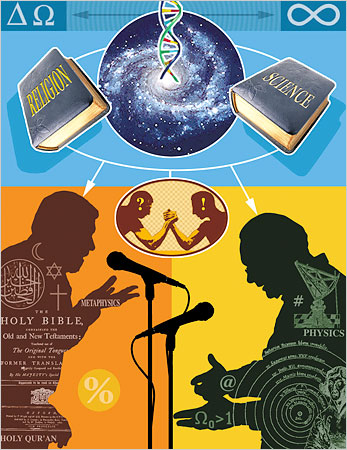
Maybe the pivotal moment came when Steven Weinberg, a Nobel laureate in physics, warned that "the world needs to wake up from its long nightmare of religious belief," or when a Nobelist in chemistry, Sir Harold Kroto, called for the John Templeton Foundation to give its next $1.5 million prize for "progress in spiritual discoveries" to an atheist–Richard Dawkins, the Oxford evolutionary biologist whose book The God Delusion is a national best-seller.
Or perhaps the turning point occurred at a more solemn moment, when Neil deGrasse Tyson, director of the Hayden Planetarium in New York City and an adviser to the Bush administration on space exploration, hushed the audience with heartbreaking photographs of newborns misshapen by birth defects–testimony, he suggested, that blind nature, not an intelligent overseer, is in control.
Somewhere along the way, a forum this month at the Salk Institute for Biological Studies in La Jolla, Calif., which might have been one more polite dialogue between science and religion, began to resemble the founding convention for a political party built on a single plank: in a world dangerously charged with ideology, science needs to take on an evangelical role, vying with religion as teller of the greatest story ever told.
Carolyn Porco, a senior research scientist at the Space Science Institute in Boulder, Colo., called, half in jest, for the establishment of an alternative church, with Dr. Tyson, whose powerful celebration of scientific discovery had the force and cadence of a good sermon, as its first minister.Beyond Belief
In Place of God

It had all the fervour of a revivalist meeting. True, there were no hallelujahs, gospel songs or swooning, but there was plenty of preaching, mostly to the converted, and much spontaneous applause for exhortations to follow the path of righteousness. And right there at the forefront of everyone's thoughts was God.
Yet this was no religious gathering–quite the opposite. Some of the leading practitioners of modern science, many of them vocal atheists, were gathered last week in La Jolla, California, for a symposium entitled Beyond belief: Science, religion, reason and survival hosted by the Science Network, a science-promoting coalition of scientists and media professionals convening at the Salk Institute for Biological Studies. They were there to address three questions. Should science do away with religion? What would science put in religion's place? And can we be good without God?
First up to address the initial question was cosmologist Steven Weinberg of the University of Texas, Austin. His answer was an unequivocal yes. "The world needs to wake up from the long nightmare of religion," Weinberg told the congregation. "Anything we scientists can do to weaken the hold of religion should be done, and may in fact be our greatest contribution to civilisation."
Those uncompromising words won Weinberg a rapturous response. Yet not long afterwards he was being excoriated for not being tough enough on religion, and admitting he would miss it once it was gone. Religion was, Weinberg had said, like "a crazy old aunt" who tells lies and stirs up mischief. "She was beautiful once," he suggested. "She's been with us a long time. When she's gone we may miss
The New Unbelievers
Books on atheism are hot. But do they have anything fresh to say?
Atheism is unknown there; Infidelity rare and secret; so that persons may live to a great Age in that Country, without having their Piety shocked by meeting with either an Atheist or an Infidel.
Little seems to have changed since Benjamin Franklin penned those words of advice to would-be immigrants in 1782. Most polling data suggest that some 90 percent of Americans believe in God or a supreme spirit. And a recent University of Minnesota study finds that atheists—or at least that lonely 1 percent of the national mix that dares to identify itself as such—are the least trusted group in America.
So why in this land of the God-fearing have the gloves-off arguments of a few God-denying intellectuals been garnering such wide popular attention? Consider book sales alone: Richard Dawkins’s well-stocked arsenal of antireligious thought, The God Delusion, currently claims the No. 7 spot on Amazon and No. 10 on the New York Times list, while Sam Harris’s polemical Letter to a Christian Nation bids fair to equal the sales of his 2004 bestseller, The End of Faith: Religion, Terror, and the Future of Reason. Meanwhile, Daniel Dennett’s Breaking the Spell: Religion as a Natural Phenomenon, though published last winter, continues to spark controversy with its Darwinian take on the all-too-human urge to believe. Beyond the world of books, magician Penn Jillette’s paean to godlessness, first broadcast a year ago on NPR’s This I Believe, continues to be among the most frequently visited stories on the NPR website
Rising skepticism?
Do the polls simply have it wrong when it comes to Americans and religion? British-born pundit Christopher Hitchens, author of the forthcoming God Is Not Great, thinks so. "People lie about their beliefs all the time," says Hitchens, who adds that he never gets more praise for his talk-show appearances than when he goes after religion. Anecdotage may not trump polling, but surveys exploring religious convictions in more nuanced terms lend some credence to Hitchens’s skepticism. One recent Harris Poll study found that 42 percent of adult Americans were not "absolutely certain" about the existence of God, up from 34 percent three years ago.
If doubt is on the rise, Dawkins, the Charles Simonyi Professor of the Public Understanding of Science at Oxford University, thinks he knows why: "Six years of Bush, which seems to be a step in the direction of theocracy, and the rise of Islamic fundamentalism seem to suggest that the world is moving toward two extreme religious views." Confessing to surprise at the size of his audiences on his current U.S. book tour, Dawkins suggests that even moderate and liberal believers are beginning to see that the slide into extremism may not be an aberration but a recurrent tendency within religion.
Possibly. But do Dawkins and the other atheists add anything to a vigorous tradition of skepticism and unbelief that includes the witty satire of Voltaire and the brilliant cultural and psychological probings of Friedrich Nietzsche? What is so new about "The New Atheism," as the November cover story of Wired magazine dubbed the phenomenon?
Electrons to Enlightenment
A five-part series on Science & Religion

The Big Questions:
- Science or religion?
- Are We Alone in the Universe?
- What Does God Look Like?
- Do You Believe in Evolution?
- What's Your First Memory of God?
Part One: Science vs. Religion
Can Science ever be reconciled with Religion?
Do science and religion have to be at war with each other? Francis Collins doesn't think so. As head of the Human Genome Project, he has a distinguished track record as a gene hunter. He's also an evangelical Christian who believes in miracles. But biologist and atheist Richard Dawkins says religion can never be reconciled
Scientists on Religion
Theist and materialist ponder the place of humanity in the universe.

Ten years after his death in 1996, science writer Walter Sullivan's byline occasionally still appears in the New York Times on obituaries of important physicists, as though he were beckoning them to some quantum-mechanical heaven. This is not a case of necromancy–the background material for Times obits is often written in advance and stored. If the dead really did communicate with the living, that would be a scientific event as monumental as the discovery of electromagnetic induction, radioactive decay or the expansion of the universe. Laboratories and observatories all over the world would be fiercely competing to understand a new phenomenon. One can imagine Mr. Sullivan, the ultimate foreign correspondent, eagerly reporting the story from the other side.
Light is carried by photons, gravity by gravitons. If there is such a thing as spiritual communication, there must be a means of conveyance: some kind of "spiritons"–ripples, perhaps, in one of M Theory's leftover dimensions. Some theologians might scoff at that remark, yet there has been a resurgence in recent years of "natural theology"–the attempt to justify religious teachings not through faith and scripture but through rational argument, astronomical observations and even experiments on the healing effects of prayer. The intent is to prove that, Carl Sagan be damned, we are not lost among billions and billions of stars in billions and billions of galaxies, that the universe was created and is sustained for the benefit of God's creatures, the inhabitants of the third rock from the sun.
In God's Universe, Owen Gingerich, a Harvard University astronomer and science historian, tells how in the 1980s he was part of an effort to produce a kind of anti-Cosmos, a television series called Space, Time, and God that was to counter Sagan's "conspicuously materialist approach to the universe." The program never got off the ground, but its premise survives: that there are two ways to think about science. You can be a theist, believing that behind the veil of randomness lurks an active, loving, manipulative God, or you can be a materialist, for whom everything is matter and energy interacting within space and time. Whichever metaphysical club you belong to, the science comes out the same.
The Believer
Francis Collins–head of the Human Genome Project–discusses his conversion to evangelical Christianity, why scientists do not need to be atheists, and what C.S. Lewis has to do with it.

As the longtime head of the Human Genome Project, Francis Collins is one of America's most visible scientists. He holds impeccable scientific credentials–a medical degree as well as a Ph.D. in physics–and has established a distinguished track record as a gene hunter. He's also an evangelical Christian, someone who has no qualms about professing his belief in miracles or seeing God's hand behind all of creation. The cover of his new book illustrates this unusual mixture: The book's title, The Language of God, is superimposed on a drawing of the double helix. "The God of the Bible is also the God of the genome," he writes. "He can be worshiped in the cathedral or in the laboratory."
Collins hopes to stake out the middle ground between Darwinian atheists and religious fundamentalists. "Both of these extremes don't stand up to logic, and yet they have occupied the stage," he told me. "We cannot let either side win." Unlike so many of those players most invested in this culture war, Collins sees no inherent conflict between science and religion. Yet his book is likely to alienate plenty of people on both sides of the debate. His frequent references to God's almighty power might be difficult for secular readers to swallow. And his scathing critique of both Young Earth creationism and intelligent design probably won't attract the hordes of readers buying Ann Coulter's latest diatribe against evolution.
The Language of God offers an unusually personal look at a leading scientist's search for meaning. Collins recounts his own struggles with faith, as well as his daughter's rape by a man who broke into her apartment and held a knife to her throat. This trauma became a test of faith for Collins and a lesson in how suffering can lead to personal growth. His book also recaps his scientific triumphs, including his discovery of the long-sought gene that causes cystic fibrosis. And later, when he stood by Bill Clinton's side as the president announced that the mapping of the human genome was complete. It turns out that Collins worked with the president's speechwriter to help craft Clinton's religious spin on this scientific breakthrough. "Today," Clinton said, "we are learning the language in which God created life."
Faith Can Make a Vital Contribution to Both Democracy and Scientific Ethics
For the first time in a generation, religion is part of the national conversation. To reject its wisdom would be folly.
It's time to say goodbye. After 17 years on this newspaper, I'm leaving journalism to run a thinktank. Looking back to the fresh-faced reporter who arrived in the newsroom in 1989, I realise that I've spent as long here as I did in formal education—and it has been a comparably life-forming experience. The decision I made, at the age of 18, to go into journalism—to understand how the world worked (prompted by observing, as a volunteer, Sri Lanka's plunge into civil war in 1983)—has been vindicated here. Not a day has gone by when I haven't glimpsed another small portion of that huge complexity, whether from interviewees, colleagues or readers: any insight or knowledge I have acquired owes much to the generosity of thousands of other minds. Thank you.
But I've reached a point where I want to do more than describe and comment—I want to try to shape debates, to move upstream in the process of how ideas bring about change. A tall order, murmur sceptics, but life has to include some gambles.
As a columnist I have championed particular issues—and some, I'm glad to see, are now part of a new progressive consensus of both left and right, as David Cameron takes up a politics of wellbeing and quality of working life. Soon, I hope, he and Gordon Brown will even start to talk about the care ethic—the vital principle alongside the work ethic at the heart of any society.
However, other issues are still floundering on the margins of public debate—or worse. Some I plan to devote more attention to in my new capacity: for example, the regeneration of an intellectual grounding for centre-left politics beyond the tired managerialism and bankrupted concept of choice. For several decades the left has failed to mount a challenge to Thatcher's ambition that "the economy is the means, the goal is to remake the soul." Another example is the vexed and embittered debate around the entangled questions of the representations of Islam in the west, the boundaries of freedom of expression and what the sociologist Richard Sennett calls the "pivotal concept" of respect.
A New Alliance against Science
The 'anything goes' academic left is coming to the support of the 'God did it' religious right.

The religious right has a new ally, and it's none other than its erstwhile arch-enemy - the academic left.
The latest evidence of this unholy alliance comes from the Social Science and Humanities Research Council of Canada, which recently rejected a research proposal aimed at studying the impact of popularizing intelligent design, the theory that the complexity and supposed design in nature reveal that there must have been a designer.
The proposal, by McGill University's Brian Alters, was titled Detrimental Effects of Popularizing Anti-Evolution's "Intelligent Design Theory" on Canadian Students, Teachers, Parents, Administrators and Policymakers, and that title alone was enough give the SSHRC's review panel the willies.
In its terse rejection letter, the SSHRC said "the proposal did not adequately substantiate the premise that the popularizing of Intelligent Design Theory had detrimental effects" and there was inadequate "justification for the assumption in the proposal that the theory of Evolution, and not Intelligent Design Theory, was correct."
Now those reasons would be laughable if they weren't so pathetic. First, Alters's reference to the detrimental effects of popularizing intelligent design isn't a premise, but a hypothesis. This is what the study was designed to test, so it's a bit much to expect Alters to have the evidence in hand prior to conducting the study. Indeed, were he already in possession of the evidence, there'd be no need to conduct the research.
But as it turns out, the panel's second reason for rejecting funding provided exactly the evidence Alters was looking for. That a committee of "experts" could suggest that ID and evolution are equally plausible theories reveals just how great the detrimental effects
Science and Religion, Still Worlds Apart
One October day in 1947, the director of the local bank in Marksville, La., woke to find that hundreds of fish had fallen from the sky, landing in his backyard. People walking to work that day were struck by falling fish, and an account of the incident by a researcher for the state's wildlife and fisheries department later found its way into the annals of scientific anomalies – phenomena waiting to be understood.
Fish falls have also been reported in Ethiopia and other parts of the world. Whether they are hoaxes, hallucinations or genuine meteorological events – maybe fish can be swept up by a waterspout and transported – scientists are disposed to assume a physical explanation.
The same kind of scrutiny is accorded to miracles – fishes and loaves multiplying to feed the masses and the like. But as two research papers published this month suggest, looking to science to prove a miracle is a losing proposition, for believers and skeptics.
Long-Lost Gospel of Judas Recasts 'Traitor'

(article co-written by Dan Vergano)
Lost for centuries and bound for controversy, the so-called gospel of Judas was unveiled by scholars Thursday.
With a plot twist worthy of The Da Vinci Code, the gospel — 13 papyrus sheets bound in leather and found in a cave in Egypt — purports to relate the last days of Jesus' life, from the viewpoint of Judas, one of Jesus' first followers. Christians teach that Judas betrayed Jesus for 30 pieces of silver, but in this gospel, he is the hero, Jesus' most senior and trusted disciple and the only one who knows Jesus' true identity as the son of God.
"We're confident this is genuine ancient Christian literature," said religious scholar Bart Ehrman of the University of North Carolina-Chapel Hill. He and others on the translation team spoke at a National Geographic Society briefing, where they released a translation.
The manuscript claims that Jesus revealed "secret knowledge" to Judas and instructed him to turn Jesus over to Roman authorities, said Coptic studies scholar Stephen Emmel of Germany's University of Munster, one of the restoration team members. In the gospel text, Judas is given private instruction by Jesus and is granted a vision of the divine that is denied to other disciples, who do not know that Jesus has requested his own betrayal. Rather than acting out of greed or malice, Judas is following orders when he leads soldiers to Jesus, the gospel says.
Other theologians, biblical scholars and pastors say this contrary text is not truly "good news" (the meaning of "gospel") and will make no difference to believers as Easter approaches. The Bible, they say, is a closed book, nearly universally accepted as the official church teachings since the fourth century.
"Just because you can date a document to early Christian times doesn't make it theologically true," said Pastor Rod Loy of the First Assembly of God in North Little Rock "Do you decide everything you read on the Internet is true because it was written on April 6, 2006? Fiction has been around for as long as man."
Found by a farmer
Radioactive-carbon-dating tests and experts in ancient languages establish that the document was written between A.D. 300 and 400, the team said. Written in Coptic, an old Egyptian language, the gospel was unearthed by a farmer in a "tomb-like box" in 1978, said Terry Garcia of the National Geographic Society. It is part of a codex, or collection of devotional texts, found in a cave near El Minya, Egypt.
The farmer sold the codex to an antiquities dealer in Cairo, without alerting Egyptian antiquities officials. In a secret showing in 1983, the antiquities dealer, unaware of the content of the codex, offered the gospel for sale to Emmel and another scholar in a Geneva, Switzerland hotel room.
Given a hurried half-hour to examine the codex, Emmel first suspected the papyrus sheets discussed Judas, he said, based on a hasty glimpse of the text, which was littered with references to the disciple in Coptic. But the asking price was too exorbitant, as high as $3 million, Garcia said.

For the next 16 years, the document moldered in a Hicksville, N.Y., bank safe-deposit box, deteriorating until Zurich-based antiquities dealer Frieda Nussberger-Tchacos purchased it in 2000, alarmed at its fragmentation, Garcia said. National Geographic said it did not know the purchase price.
In 2001, the codex was acquired by the Maecenas Foundation for Ancient Art in Switzerland, Garcia said. The foundation invited National Geographic to help with the restoration in 2004 and also reached an agreement with the Egyptian government to return it after its restoration.
Restoration of the thousands of papyrus fragments has made 80% of the gospel legible. The National Geographic Society learned of the find 2½ years ago, Garcia said. The society recruited the scholarly restoration team and got a $1 million grant from the Waitt Foundation for Historical Studies.
The gospel "is an intriguing alternative view of the relationship between Jesus and Judas," Emmel said. It also has Jesus relating a new creation myth and account of humankind's origins to Judas, which suggest God didn't create the world, contrary to conventional Christian belief.
The key passage has Jesus telling Judas "'you will exceed all of them. For you will sacrifice the man that clothes me,'" Emmel said. The
No Wonder Atheists are Angry: They Seem Ready to Believe Anything
Richard Dawkins's latest attack on religion is an intellectually lazy polemic not worthy of a great scientist

On Monday, it's Richard Dawkins's turn (yet again) to take up the cudgels against religious faith in a two-part Channel 4 programme, The Root of All Evil? His voice is one of the loudest in an increasingly shrill chorus of atheist humanists; something has got them badly rattled. They even turned their bitter invective on Narnia. By all means, let's have a serious debate about religious belief, one of the most complex and fascinating phenomena on the planet, but the suspicion is that it's not what this chorus wants. Behind unsubstantiated assertions, sweeping generalisations and random anecdotal evidence, there's the unmistakable whiff of panic; they fear religion is on the march again.
There's an aggrieved frustration that they've been short-changed by history; we were supposed to be all atheist rationalists by now. Secularisation was supposed to be an inextricable part of progress. Even more grating, what secularisation there has been is accompanied by the growth of weird irrationalities from crystals to ley lines. As GK Chesterton pointed out, the problem when people don't believe in God is not that they believe nothing, it is that they believe anything.
There's an underlying anxiety that atheist humanism has failed. Over the 20th century, atheist political regimes racked up an appalling (and unmatched) record for violence. Atheist humanism hasn't generated a compelling popular narrative and ethic of what it is to be human and our place in the cosmos; where religion has retreated, the gap has been filled with consumerism, football, Strictly Come Dancing and a mindless absorption in passing desires. Not knowing how to answer the big questions of life, we shelve them––we certainly don't develop the awe towards and reverence for the natural world that Dawkins would want. So the atheist humanists have been betrayed by the irrational, credulous nature of human beings; a misanthropy is increasingly evident in Dawkins's anti-religious polemic and among his many admirers.
This is the only context that can explain Dawkins's programme, a piece of intellectually lazy polemic which is not worthy of a great scientist. He uses his authority as a scientist to claim certainty where he himself knows, all too well, that there is none; for example, our sense of morality cannot simply be explained as a product of our genetic struggle for evolutionary advantage. More irritatingly, he doesn't apply to religion––the object of his repeated attacks––a fraction of the intellectual rigour or curiosity that he has applied to evolution (to deserved applause). Where is the grasp of the sociological or anthropological explanations of the centrality of religion? Sadly, there is no evolution of thought in Dawkins's position; he has been saying much the same thing about religion for a long time.
War of the Worlds

The daddy longlegs clinging vertically to my bathroom wall is a marvel of airy symmetry, its tiny head perched delicately at the center of eight arching limbs. A moment later, struck by the back of my hand, it lies crumpled on the floor. I'm sorry, but I don't like spiders in the house.
In fact, as I learn the next morning, it wasn't a spider I killed, an Araneida, but a member of a parallel order, Phalangida—one that lives by eating spiders, including the annoying little ones that bite. My reflexive action was stupidly self-defeating. But my remorse runs deeper. I feel guilty for destroying this elegant arrangement of carbon molecules, and I can't quite understand why. I don't feel a thing when I pull horsetail and cheat grass from our meadow or massacre a swarm of box elder beetles with laundry soap. I am glad when the cats kill a grasshopper or a mouse; indifferent if their prey is a sparrow; sad if it is a hummingbird. There is no definable moral calculus here. All organisms, I know, are nothing more or less than intricate, intertwined chemistry, products of an evolutionary process that is purposeless and blind. Yet I find myself behaving sometimes as though the world were crawling with spirits. I, the materialist, am making godlike judgments as to what has a "soul," whatever that means, and what deserves to live or die.
A believer might say I am wrestling with something "spiritual." I cringe when I hear the word, coming, with all its musty connotations, from the Latin spiritus, meaning "of breathing" or "of wind." People once thought invisible beings swooped through the trees, bending the branches, propelling leaves and dust. They believed the rhythmic inhalation of these spirits—respiration—animated the body (from the Greek anemos, which also means wind).
Keeping God From the Courtroom
What a lost opportunity! When Harriet Miers withdrew as a nominee for the US supreme court, her Christian critics missed out on a chance to show that it is possible to combine integrity and rationality with religious belief. It's an opportunity that these days presents itself all too rarely. Now President Bush has chosen a nominee to please the conservative Christians who operate under the bizarre assumption that faith gives believers special authority on moral issues.
Bush spent weeks under sustained attack for not putting up a hard-line conservative candidate for the supreme court, a siege that eventually broke the Miers nomination. The conservatives' grievance was that Miers, though an evangelical Christian, is not against abortion per se. Indeed, she seems unwilling to use the tenets of her faith to lay down the law on issues of modern ethics. In a 1993 speech unearthed shortly before her nomination was withdrawn, Miers declared that "when science cannot determine the facts and decisions vary based upon religious belief, then government should not act". The hardliners feared she would not vote the "Christian" way on issues such as stem cells and human reproductive cloning, so they got her removed.
Although she didn't say so explicitly, Miers's view seems to be that on many of these issues there is no such thing as a "Christian position". Such a view is correct, and never has there been a greater need for it to be stated explicitly.
Advances in science and technology have thrown up many subjects for debate, but the Bible cannot be said to speak to these issues more clearly than most human beings' moral sense. In fact, those Christians who say their faith somehow gives them special authority on questions of bioethics couldn't be more wrong: they are if anything less well placed than everyone else. That's because, instead of considering the facts of an issue purely on their merits, they are forced to consider also how comfortably these facts sit with their beliefs. They have, in effect, a conflict of interest.
Science and Journalism Fail to Connect
How can we expect Americans to know anything beyond what they happen to remember from science class? Journalists certainly don't tell them.

Evolution is “only a theory.” Global warming is “unproven.” And science itself is “just another opinion.”
Critics of mainstream science seem to be everywhere these days, and we, as journalists, just can’t seem to get enough of them. It’s just about impossible to pick up a newspaper or watch CNN for an hour without being confronted by someone attacking ideas that most scientists think are so settled that they aren’t even worth discussing any more. Meanwhile, the topics that many scientists are working on—the almost daily advances in nanotechnology and genetics, to pick just two—are largely absent from mass-market media coverage. What’s going on?
Nearly 50 years ago, the British physicist and novelist C.P. Snow published his famous “two cultures” essay, which deplores the widening gulf between scientists and their intellectual counterparts in the arts. If Snow was alive today, I think he might have extended his argument to apply to the chasm that now exists between science and just about everyone else in society, including journalists.
Fundamentalism Fails, On Both Sides

It's the end of absolutes for both religion and materialist unbelief.
Neither has the knockout card, the open-and-shut, slam-dunk, airtight case.
And that should knock both of them back a step.
Each has something to say to the other, indeed the same thing: "Give up your fundamentalism—it's toxic, and it's hurting you."
Healthful words now, when evolution and intelligent design are being debated in Dover, Pa.
Both belief and unbelief may be much qualified in the coming decades. In a trend already 50 years old, belief increasingly may get hauled out of church, as believers feel less and less need for an institutional lens through which to believe.
Materialism (sometimes called "naturalism," sometimes "rationalism") is the belief that all that exists is the visible, concrete universe of matter. That's it—nothing else, no spirit realm, no divinities, no afterlife. There is a fine, august tradition behind materialist unbelief. But—especially in the minds of some who believe they are representing or defending science—it has taken on a dismissive energy. In years to come, materialism may actually benefit from admitting it's just a guess, more like other beliefs than most materialists admit.
At least, such are my conclusions after participating in the Templeton-Cambridge Journalism Fellowships in Science and Religion. This summer, 10 journalists attended seminars for two weeks at Cambridge University in England, went home for five weeks to prepare presentations, and returned for a last week of seminars, presentations, debate, English ale, and amazement at our chance to study God and science in 15th-century splendor.
Many stars joined us: evolutionary biologists Richard Dawkins and Simon Conway Morris; cosmologists John D. Barrow, Owen Gingerich, and Paul Davies; theologians Russell Stannard, Nancey Murphy, and Ronald Cole-Turner. They gave brilliant talks, argued with one another, with us, and with the cosmos; challenged us to stretch our minds and write better about science, religion, and the
Agreeing Only to Disagree on God's Place in Science

It was on the second day at Cambridge that enlightenment dawned in the form of a testy exchange between a zoologist and a paleontologist, Richard Dawkins and Simon Conway Morris. Their bone of contention was one that scholars have been gnawing on since the days of Aquinas: whether an understanding of the universe and its glories requires the hypothesis of a God.
The speakers had been invited, along with a dozen other scientists and theologians, to address the 10 recipients of the first Templeton-Cambridge Journalism Fellowships in Science and Religion. Each morning for two weeks in June, we walked across the Mathematical Bridge, spanning the River Cam, and through the medieval courtyards of Queens College to the seminar room.
We were there courtesy of the John Templeton Foundation, whose mission is "to pursue new insights at the boundary between theology and science," overcoming what it calls "the flatness of a purely naturalistic, secularized view of reality."
On matters scientific, Dr. Dawkins, who came from Oxford, and Dr. Conway Morris, a Cambridge man, agreed: The richness of the biosphere, humanity included, could be explained through natural selection.
They also agreed, contrary to the writings of Stephen Jay Gould, that evolution is not a crapshoot. If earth's history could be replayed like a video cassette, the outcome would be somewhat different, but certain physical constraints would favor the eventual appearance
Star Wars: Episodes 1 and 2

The object of the game is to figure out how the universe works by watching tiny lights move across the sky. The answers must be expressed in numbers -- that is the cardinal rule -- but sometimes passions take over, leaving the history of astrophysics bloodied from clashes among some of the smartest people in the world.
Subrahmanyan Chandrasekhar -- associates always called him Chandra -- was 19 when, on a boat from India to Britain, he had an idea whose consequences seemed absurd. Scientists suspected that when a star finally gave out, it would be squashed by its own gravity, growing smaller and denser until it died. But what if a star was so massive it was unable to stop collapsing? As it contracted its gravity would keep increasing until, Chandra concluded, it swallowed itself and disappeared -- a black hole. In the next few years, at Cambridge University, he showed mathematically how this would happen, and in 1935 (he was 24) presented his case at a meeting of the Royal Astronomical Society. The proof was in the equations, but the fight had barely begun.
In ''Empire of the Stars: Obsession, Friendship, and Betrayal in the Quest for Black Holes,'' Arthur I. Miller, a British philosopher of science, describes the scene as Chandra's older colleague Sir Arthur Stanley Eddington rises to the podium and savages the black hole theory. To Eddington, as brash and overbearing as Chandra was reserved and polite, the theory was ''stellar buffoonery,'' and so great was his prestige that five decades passed before Chandra, then at the University of Chicago, was vindicated by a Nobel Prize.