
 About the Fellowship
Beyond Comprehension
We know that genocide and famine are greater tragedies than a lost dog. At least, we think we do.
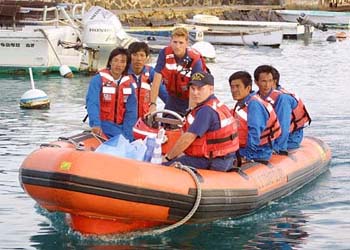
On March 13, 2002, a fire broke out in the engine room of an oil tanker about 800 miles south of Hawaii. The fire moved so fast that the Taiwanese crew did not have time to radio for help. Eleven survivors and the captain's dog, a terrier named Hokget, retreated to the tanker's forecastle with supplies of food and water.
The Insiko 1907 was supposed to be an Indonesian ship, but its owner, who lived in China, had not registered it. In terms of international law, the Insiko was stateless, a 260-foot microscopic speck on the largest ocean on Earth. Now it was adrift. Drawn by wind and currents, the Insiko got within 220 miles of Hawaii. It was spotted by a cruise ship, which diverted course and rescued the crew. But as the cruise ship pulled away, a few passengers heard the sound of barking.
The captain's dog had been left behind on the tanker.
A passenger who heard the barking dog called the Hawaiian Humane Society in Honolulu. The animal welfare group routinely rescued abandoned animals -- 675 the previous year -- but recovering one on a tanker in the Pacific Ocean was something new. The U.S. Coast Guard said it could not use taxpayer dollars to save the dog. The Insiko's owner wasn't planning to recover the ship. The Humane Society alerted fishing boats about the lost tanker. Media reports began appearing about Hokget.
Something about a lost dog on an abandoned ship in the Pacific gripped people's imaginations. Money poured into the Humane Society to fund a rescue. One check was for $5,000.
Donations eventually arrived from 39 states, the District of Columbia and four foreign countries.
"It was just about a dog," Pamela Burns, president of the Hawaiian Humane Society, told me. "This was an opportunity for people to feel good about rescuing a dog. People poured out their support. A handful of people were incensed. These people said, 'You should be giving money to the homeless.'" But Burns thought the great thing about America was that people were free to give money to whatever cause they cared about, and people cared about Hokget.
The problem with a rescue was that no one knew where the Insiko was. The Coast Guard estimated it could be anywhere in an area measuring 360,000 square miles. The Humane Society paid $48,000 to a private company called American Marine to look for the ship. Two Humane Society officers boarded a salvage tugboat, the American Quest, and set off into the Pacific.
Air, sea and high-tech surveillance equipment were all pressed into service. With each passing day, the calls from around the world intensified: Had Hokget been found?
Under the guise of exercises, the U.S. Navy began quietly hunting for the Insiko -- the tramp tanker was deemed a search target for a maintenance and training mission. By April 7, the search had turned up nothing, but the letters and checks continued to pour in.
"This check is in memory of the little dog lost at sea."
"Thank you for pulling my heartstrings and for reminding me of all the hope there is left in this world."
"This story is also great for the children. They learn to respect life."
On April 9, a window of hope opened. A Japanese fishing boat had seen something that looked like the Insiko drifting far outside the Coast Guard's projections and headed in the direction of Johnston Atoll, an unincorporated and uninhabited U.S. territory. Under public pressure to do something about the dog, the Coast Guard finally decided this was a good enough reason to intervene. It dispatched a C-130 aircraft and, after searching another 50,000 square miles of ocean by air, found the Insiko. A photo showed a brown-and-white blur running across the deck of the tanker -- Hokget was still alive. The C-130 wasn't equipped for a rescue, so the crew members dropped their own lunches onto the tanker for the dog -- pizza, granola bars, oranges.
Two fishing vessels eventually reached the ship. But when the fishermen tried to rescue Hokget, the dog fled below decks in the direction of the engine room. The rescuers couldn't follow. The fire had rendered much of the Insiko dangerous -- it was still carrying thousands of gallons of fuel, and no one knew the extent of the damage. The fishermen eventually gave up.
Rusty Nall, vice president of American Marine Corp., was in regular touch with Coast Guard officials and fishing fleets. When he heard the dog had not been seen after it ran below decks, his heart sank. The engine room had a 10-foot drop. Had Hokget been inadvertently injured or killed? Nall felt like giving up, but that when he went home each night, his 9-year-old daughter would ask, "Did you find the doggie, Daddy?" Nall would come back to work the next day and press on.
***
The story of Hokget is touching. Human beings from around the world came together to try to save a dog. The vast majority of people who sent in money would never personally see Hokget. It was, as Pamela Burns suggested to me, an act of pure altruism and a marker of the remarkable capacity human beings have to empathize with the plight of others.
There are a series of disturbing questions, however: Eight years before the Hokget saga began, the same world that showed extraordinary compassion for a dog sat on its hands as hundreds of thousands of human beings were killed in the Rwandan genocide. The 20th century reveals a shockingly long list of similar horrors that have been ignored by the world as they unfolded. Why have successive generations done so little to halt suffering on such a large scale?
The philosopher Peter Singer once devised a dilemma that highlights a central contradiction in our moral reasoning. If you see a child drowning in a pond, and you know you can save the child without any risk to your own life -- but you would ruin a fine pair of shoes worth $200 if you jumped into the water -- would you save the child or save your shoes? Most people react incredulously to the question; obviously, a child's life is worth more than a pair of shoes.
If this is the case, Singer asked, why do large numbers of people hesitate to write a check for $200 to a reputable charity that could save the life of a child halfway around the world -- when there are millions of children who need our help? Even when people are absolutely certain their money will not be wasted and will be used to save a child's life, fewer people are willing to write the check than to leap into the pond.
Our moral responsibilities feel different in these situations; one feels immediate and visceral, the other distant and abstract. We feel personally responsible for one child, whereas the other is one of millions who need help. Our responsibility feels diffused when it comes to children in distant places -- there are many people who could write that check. But distance and diffusion of responsibility do not explain why we step forward in some cases. Why did so many people feel an abandoned dog on a stateless ship in international waters was their problem?
I want to offer a disturbing idea. The reason human beings seem to care so little about mass suffering and death is precisely because the suffering is happening on a mass scale. The brain is simply not very good at grasping the implications of mass suffering. Americans would be far more likely to step forward if only a few people were suffering or a single person were in pain. Hokget did not draw our sympathies because we care more about dogs than people; she drew our sympathies because she was a single dog lost on the biggest ocean in the world. Our hidden brain -- my term for a host of unconscious mental processes that subtly biases our judgment, perceptions and actions -- shapes our compassion into a telescope. We are best able to respond when we are focused on a single victim.
We don't feel 20 times sadder when we hear that 20 people have died in a disaster than when we hear that one person has died, even though the magnitude of the tragedy is 20 times as large. We can reach such a conclusion abstractly, in our conscious minds, but we cannot feel it viscerally, because that is the domain of the hidden brain, and the hidden brain is simply not calibrated to deal with the difference between a single death and 20 deaths.
But the paradox does not end there. Even if 10 deaths do not make us feel 10 times as sad as a single death, shouldn't we feel at least twice as sad? There is disturbing evidence that shows we may actually care less. I suspect that if the Insiko had been carrying 100 dogs, many people would have cared less about their fate than they did about Hokget. One hundred dogs do not have a single face, a single name, a single life story around which we can wrap our imaginations and our compassion.
The evidence for what I am going to call the telescope effect comes from a series of experiments. Psychologist Paul Slovic of the University of Oregon asked two groups of volunteers shortly after the Rwandan genocide to imagine they were officials in charge of a humanitarian rescue effort. Both groups were told their money could save 4,500 lives at a refugee camp, but one group was told the refugee camp had 11,000 people, whereas the other group was told the refugee camp had 250,000 people. Slovic found that people were much more reluctant to spend the money on the large camp than they were to spend the money on the small camp.
Intrigued, Slovic pressed further. He asked different groups of volunteers to imagine they were running a philanthropic foundation. Would they rather spend $10 million to save 10,000 lives from a disease that caused 15,000 deaths a year, or save 20,000 lives from a disease that killed 290,000 people a year? Overwhelmingly, volunteers preferred to spend money saving the 10,000 lives rather than the 20,000 lives. Rather than tailor their investments to saving the largest number of lives, people sought to save the largest proportion of lives among the different groups of victims.
We respond to mass suffering in much the same way that we respond to most things in our lives. We fall back on rules of thumb, on feelings, on intuitions. People who choose to spend money saving 10,000 lives rather than 20,000 lives are not bad people. Rather, like those who spend thousands of dollars to find a single dog rather than directing the same amount of money to save a dozen dogs, they are merely allowing their hidden brain to guide them.
Our empathic telescopes are activated when we hear a single cry for help -- the child drowning in the pond, the dog abandoned on an ocean. When we think of human suffering on a mass scale, our telescope does not work, because it has not been designed to work in such situations. Humans are the only species that is even aware of large-scale suffering taking place in distant lands; the moral telescope in our brain has not had a chance to evolve and catch up with our technological advances. Our conscious minds can tell us that it is absurd to spend a boatload of money to save one life when the same money could be used to save 10. But in moral decision-making, as in many other domains of life where we are unaware of how unconscious biases influence us, it is the hidden brain that usually carries the day.
Slovic once told volunteers about a 7-year-old girl in Mali who was starving and in need of help. They were given a certain amount of money and asked how much they were willing to spend to help her. On average, people gave half their money to help the girl. Slovic asked another group of volunteers the same question, except instead of the girl, volunteers were told about the problem of famine in Africa, and that there were millions of people in dire need of help. The volunteers gave half as much money as the volunteers in the first group.
Slovic took the experiment that showcased the little girl in Africa a step further. He told another group of volunteers about a little boy in Mali. One group of volunteers was asked whether they would give money to the little girl; another was asked whether they would donate money to the little boy. A third group of volunteers was told about both the boy and the girl and asked how much they were willing to give. People gave the same amount of money when told about either the boy or the girl. But when the children were presented together, the volunteers gave less.
Journalists sometimes talk about compassion fatigue, the inability of people to respond to suffering when the scale or length of the suffering exceeds some astronomical number. But Slovic's work suggests that compassion fatigue starts when the number of victims rises from one to two.
"The feelings of sadness dropped," Slovic said of the volunteers who were told about the two children in need of help. He added, "You can't lock onto two people in need of help as closely as you can lock onto one person. You can't make an emotional connection as strongly to two as to one. If empathy is putting yourself in someone else's shoes, think of putting yourself in two people's shoes. It does not work. It falls apart."
***
After would-be rescuers from two fishing vessels frightened Hokget below decks, the effort to save the dog continued, but hope was fading. There was talk of dispatching the U.S. Navy to sink the Insiko as a way of ensuring that any release of hazardous materials would occur hundreds of miles from shore. This, of course, would kill the dog -- assuming it was still alive. Facing intense public pressure to save Hokget, government officials concluded that asking the Navy to sink the tanker -- 750 miles from Hawaii, nearly 2,500 miles from the U.S. mainland, and drifting away from the United States -- posed unacceptable environmental risks. The Coast Guard finally agreed to access $250,000 in U.S. taxpayer funds to recover the Insiko. It wasn't officially called an animal rescue effort. Instead it was authorized under the Oil Spill Liability Trust Fund, based on the argument that if the aimless Insiko managed to drift westward for 250 straight miles, it might run aground on Johnston Atoll and harm marine life. (The environmental concern was a lovely touch, given that the United States used Johnston Atoll for decades as a nuclear weapons test site and a dumping ground for chemical weapons from various wars.)
The American Quest was called up again -- this time funded by taxpayers -- to rescue Hokget. On April 26, nearly a month and a half after the dog's ordeal began, the tugboat's crew found the Insiko and boarded the tanker. The 40-pound female was still alive, and hiding in a pile of tires. It was a hot day, so Brian Murray, the American Quest's salvage supervisor, went in and simply grabbed the terrier by the scruff of her neck. The dog was terrified and shook for two hours. Her rescuers fed her, bathed her and applied lotion to her nose, which was sunburned.
Hokget arrived in Honolulu on May 2 (with the Insiko hauled in tow so its diesel could be salvaged) and was greeted by crowds of spectators, a news conference, banners welcoming her to America and a red Hawaiian lei. After a period in quarantine, Hokget was adopted by the family of Michael Kuo, a friend of the Insiko's captain, who lives outside Honolulu. She put on weight and was signed up for dog classes.
Shankar Vedantam is a Washington Post staff writer and can be reached at [email protected]. This article was adapted from hisbook, "The Hidden Brain: How Our Unconscious Minds Elect Presidents, Control Markets, Wage Wars and Save Our Lives," to be published this week by Spiegel & Grau, an imprint of Random House.For more information, visit www.hiddenbrain.org.
(end of article)
return to list of publications