
 About the Fellowship
How Will the Arab Spring Affect Religion and Science?
by Michelle Boorstein
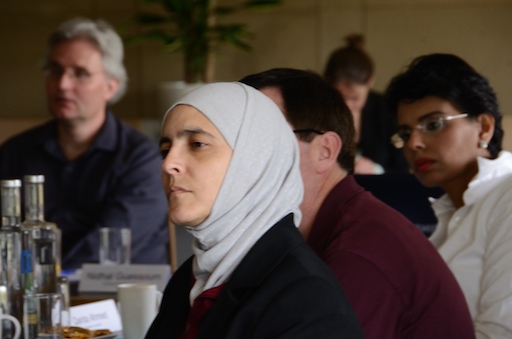
In last week’s news, no doubt the biggest Islam-related story spun off the killing of Osama bin Laden, and how it would affect Islamic radicals for whom he was a leader. But a sadder conversation with broader implications was taking place over candlelight in an elegant dining room one evening in Cambridge, England.
It was the concluding event of a weeklong seminar for religion and science journalists who had come to England to hear from Muslim scientists about the most pressing science issues across their enormous, diverse faith communities. And it was grim.
There was the soft-spoken Jordanian molecular biologist and professor who said over dinner Saturday night that the lack of freedoms in many parts of the Muslim world had resulted in students unfamiliar with basic critical thinking needed to produce real science. Students in her classes don’t question, she said. The Pakistani-British sleep specialist who worked for years in Saudi Arabia and said a culture without freedom of thought had left scientists in many parts of the Muslim world in "an intellectual vacuum."
To whatever degree the handful of speakers at the seminar – which also included an Algerian astrophysicist and a French cosmologist, among others – represent at least a chunk of thought among Muslim scientists working outside the West, the future feels uncertain.
Part of the issue is one of language. There’s obviously no such thing as "the Muslim world," or "Islamic science." But there is certainly a lot of discussion about how recent revolutions across North Africa and the Middle East might affect the advance of science, which was for centuries the pride of the Muslim world.
Rana Dajani, who launched a program to open dozens of public reading spaces for youth in Jordan because she said the country lacks a culture of reading for pleasure, said she is hopeful that loosening of government control will automatically lead to a improved climate for scientists. Less corruption, cronyism, the building of a meritocracy.
And how a rise in science could affect practice and understanding of Islam?
Keith Ward, a British philosopher who was for years the canon of Oxford’s cathedral, argued that the rise of science has led in the Judeo-Christian world to two things: literalism, because people no longer value things they can’t prove, and secularism, because critical thought can tend to shift people to look at the Bible like any other book.
Some of the most talked-about scientific issues in Muslim communities these days, presenters said, include the rise of interest in creationism and astronomy – key to the Muslim daily life as their daily prayers and annual fasts are based on the orbit of the moon. This is because this is the first time that a good number of Muslims are living in places like Sweden, Iceland and other places that stay very light or very dark for parts of the year.
The scientists at the conference agreed, however, that science-religion issues popping up majority-Muslim communities at the moment are unlike the ones we typically see in American public debates, like abortion or euthanasia. Nidhal Guessoum, who was born in Algeria but teaches in the UAE, and Qanta Ahmed, who worked in Saudi Arabia, said they basically never saw Muslim families – whether dealing with abortion or brain death issues – looking to their faith in a very rigid way, with the idea that there was just one "orthodox" solution commanded by the Koran.
"They tend to be very pragmatic," said Ahmed. "They have faith that God is present everywhere." She said people also tend to trust physicians.
The scientists said a hot topic of late has been creationism, apparently fueled by a controversial, colorful, well-funded Turk named Harun Yahya who has sent thousands of enormous, glossy picture books making his case to Western schools. They characterized his movement as a cult with no solid theological basis but also agreed that the topic had resonated among young Muslims attracted to its ideas about numerology and miracles allegedly presented in the Koran.
Bruno Guiderdoni, director of research at the French National Centre for Scientific Research, said the controversy of Yahya’s books played out a particular way in France, where a strongly secular culture left high-school teachers totally unprepared about how to talk about the subject.
(end of article)
return to list of publications