
 About the Fellowship
Rod Dreher
Rod Dreher is an editorial columnist at the Dallas Morning News and the leading religion, culture, and politics blogger on Beliefnet. He was formerly a staff writer for National Review and chief film critic for the New York Post. He has contributed columns and essays to the Wall Street Journal, the Weekly Standard, and USA Today as well as radio commentary to NPR's All Things Considered and television commentary to ABC's Good Morning America, Fox News Channel, CNN, and MSNBC. His book Crunchy Cons, published in 2006, examines the countercultural conservative tradition.
| Column |
 The Hodge Hill ProphecyWhat's really behind the British riots?  Between 2005 and 2010, a team led by Birmingham University education Dean James Arthur launched a character education project called Learning For Life, the first of its kind in Great Britain. Building from a base of solid social science research, Learning For Life seeks to build and strengthen character in families, schools, universities, and on the job. Learning For Life, which was funded by a grant from the John Templeton Foundation, included a comprehensive 2007 survey of character attitudes among disadvantaged English youth in Birmingham’s Hodge Hill constituency and others like it across the UK. To read it today, in the aftermath of youth rioting and looting that shook major British cities, is to encounter a kind of prophecy. Prof. Arthur spoke to us from his home in England after a tumultuous week.
As the principal researcher on the Learning for Life project, were you surprised by the violence and looting that swept England?Not really. I was surprised by the extent of it, but I was not surprised that young people don’t feel a part of society. They also generally do not engage positively in their communities, the exception being Muslim children. The reasons are quite complex, and there’s not an easy answer to the whole thing. I don’t for a second think it was economic. Well over half of [looters] were under the age of 18. Clearly the vast majority of them are not the kind of people who had any sort of higher education. We’re not talking about people who had been at university. We’re talking about a large group of people who have not gained serious qualifications to participate in society. They are young people who live in the most socially and economically deprived areas of our cities.
You’ve got these two groups, poor Afro-Caribbeans and poor whites, who were the main participants in the riots. When I did my research in schools across England, we discovered that it was precisely many of these disadvantaged white children and Afro-Caribbean black children that had the least respect for the basic virtues in civil society — and these were the groups that mainly rioted.
My research found that these children were less happy and less optimistic about the future, and they didn’t feel that they belonged to civil society. They were also less positive about the virtues — honesty, trustworthiness, courage, justice and others. They also had far fewer aspirations for their future compared with other groups.
|
| Interview |
Inside the "Black Box" of PersonhoodNotre Dame sociologist Christian Smith asks, "What is a person?"  Notre Dame sociologist Christian Smith recently spoke with Big Questions Online about his new book What Is A Person? What is a person? And why does it matter how we answer that question?Every social science explanation has operating in the background some idea or other of what human persons are, what motivates them, what we can expect of them. Sometimes that is explicit, often it is implicit. And the different concepts of persons assumed by social scientists have important consequences in governing the questions asked, sensitizing concepts employed, evidence gathered, and explanations formulated. We cannot put the question of personhood in a "black box" and really get anywhere. Personhood always matters. By my account, a person is "a conscious, reflexive, embodied, self-transcending center of subjective experience, durable identity, moral commitment, and social communication who — as the efficient cause of his or her own responsible actions and interactions — exercises complex capacities for agency and inter-subjectivity in order to develop and sustain his or her own incommunicable self in loving relationships with other personal selves and with the non-personal world." Persons are thus centers with purpose. If that is true, then it has consequences for the doing of sociology, and in other ways for the doing of science broadly. Different views of human personhood will provide us with different scientific interests, different professional moral and ethical sensibilities, different theoretical paradigms of explanation, and, ultimately, different visions of what comprises a good human existence which science ought to serve. In this sense, science is never autonomous or separable from basic questions of human personal being, existence, and interest. Therefore, if we get our view of personhood wrong, we run the risk of using science to achieve problematic, even destructively bad things. Good science must finally be built upon a good understanding of human personhood. You argue that the standard sociological view of the human person isn’t sufficient, that sociologists generally do not capture the fullness of human experience with their methods. Indeed, you describe them as living with a kind of "schizophrenia" – believing strongly in a human rights and dignity, but at the same time denying any kind of grounding for those moral commitments. What are they missing?Many, if not most, sociological theories operate with an emaciated view of the person running in the background, models that are grossly oversimplified. Persons are conceptualized as rational reward-maximizers or compliant norm-followers or essentially meaning-seekers or genetic-reproduction machines or whatever else. Often such views are one-dimensional and simplistic. They fail to even begin to portray the complexity and richness of human personal life. Meanwhile, sociologists going about living their own personal lives with often a very different view of humanity in mind. The science does not live up to the reality. I think this is often driven not by the needs of real science but by a kind of insecure scientism. The former is ultimately interested in knowing what is real and how it works, however complex that might turn out to be. The latter, especially in the social sciences, is often mostly concerned to imitate the science of an entirely different sphere of reality, such as physics, which never turns out well. |
| Column |
 What's So Appealing about Orthodoxy?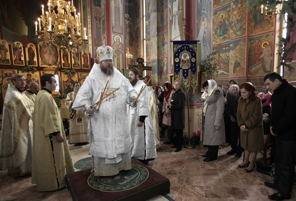 I came to Orthodoxy in 2006, a broken man. I had been a devoutly observant and convinced Roman Catholic for years, but had my faith shattered in large part by what I had learned as a reporter covering the sex abuse scandal. It had been my assumption that my theological convictions would protect the core of my faith through any trial, but the knowledge I struggled with wore down my ability to believe in the ecclesial truth claims of the Roman church. For my wife and me, Protestantism was not an option, given what we knew about church history, and given our convictions about sacramental theology. That left Orthodoxy as the only safe harbor from the tempest that threatened to capsize our Christianity. In truth, I had longed for Orthodoxy for some time, for the same reasons I, as a young man, found my way into the Catholic Church. It seemed to me a rock of stability in a turbulent sea of relativism and modernism overtaking Western Christianity. And while the Roman church threw out so much of its artistic and liturgical heritage in the violence of the Second Vatican Council, the Orthodox still held on to theirs. Several years before we entered Orthodoxy, my wife and I visited Orthodox friends at their Maryland parish. As morally and liturgically conservative Catholics, we were moved and even envious over what we saw there. We had to leave early to scoot up the road to the nearest Seventies moderne Catholic parish to meet our Sunday obligation. The contrast between the desultory liturgical proceedings at Our Lady of Pizza Hut and what we had walked out of in the Orthodox parish down the road literally reduced us to tears. But ugliness, even a sense of spiritual desolation, does not obviate truth, and we knew we had to stand with truth – and therefore with Rome – despite it all. |
| Interview |
 Asking 'Islam's Quantum Question'Can science and Islam be reconciled? A conversation with Nidhal Guessoum.  Revolution is in the air throughout the Arab Muslim world. For some Muslims, hope for political change entails hope for cultural change. And for Algeria-born astrophysicist Nidhal Guessoum, a professor of physics at the American University of Sharjah, the "Arab 1848," as some have called it, opens up the possibility that the Arab Muslim world can join the global scientific mainstream. His new book, Islam’s Quantum Question: Reconciling Muslim Tradition and Modern Science, explores the history of scientific thought in Islam, examines where Muslim intellectual culture went wrong, and offers a constructive way forward for science and religion among 1.6 billion of the world’s people. Guessoum recently spoke to BQO. The United Nations has issued several Arab Human Development Reports over the past decade. They point out how much the Arab world lags in democracy, civil liberties, education, and economic progress. The UN documents are particularly hard on Arab societies for their "stagnation" in scientific research, pointing out, for example, that the number of scientists and engineers working in research and development in Arab countries is roughly one-third of the global average. Do you think that the recent and ongoing revolutions across the Arab world will be good for science?All sectors of activity in the Arab society have suffered during these decades of autocratic rule, from politics and economics to culture, science, and human rights. In my view, that stagnation and continuous falling behind was due to three factors: dictatorship (denial of basic freedoms), corruption (financial and moral), and nepotism and cronyism. The mediocrity of the Arab world’s performance in academic and scientific fields is well documented in various reports, some of which you have mentioned. To give just a few examples: out of 1,000 or so universities in the Arab world, only two or three are in world’s top 500 — and they are ranked between 400 and 500; while the Arab world’s population makes up about five percent of the world’s and its financial resources are much larger than that, only 1.1 percent of the world’s scientific production comes out of the Arab region; the number of frequently cited scientific papers is 43 per million people in the USA, 80 in Switzerland, and 38 in Israel; it is 0.02 in Egypt, 0.07 in Saudi Arabia, 0.01 in Algeria, and 0.53 in Kuwait. One of the reasons for the mediocre state of research in the region is the very low budget allocated for science: the fraction of the GDP spent on scientific research is 0.2 percent on average in the Arab world (0.05 percent in Saudi Arabia), compared to a world average of 1.2 percent. |
| Interview |
Darwin Pushed to MarginsWhy is resistance to evolution so strong among science teachers?  Despite winning court battles at every turn, advocates for teaching evolution as the unshakable bedrock of high school biology courses have been losing on the ground to an astonishing degree. In a recent essay in Science, Penn State political scientists Eric Plutzer and Michael B. Berkman reported that their survey of U.S. public high school biology teachers show that only a relative small minority unambiguously teach the mainstream scientific view of evolution. Only 28 percent of the 926 instructors surveyed consistently implement the recommendations of the National Research Council, which calls on high school biology instructors to present without qualification the overwhelming evidence for evolution. About 13 percent of these public school instructors are active advocates for creationism or Intelligent Design as "valid scientific alternatives" to evolution — and, says Plutzer, "an additional five percent of teachers take the same position, though typically in brief responses to student questions." Plutzer, co-author (with Berkman) of Evolution, Creationism, and the Battle to Control America’s Classrooms (Cambridge, 2010), discusses in a Big Questions Online interview more surprising facts uncovered by the survey, and their implications for science education in America. Many assume that resistance to evolution is something largely confined to the rural South. Do the survey data indicate that the phenomenon is limited to one or more regions of the country?Prior to our study, there were many surveys of teachers that also pointed to widespread teaching of creationism. But these earlier studies never included studies of the California, New York and the New England states. Our national probability sample of teachers confirmed what several scholars had suspected, that active proponents of creationism as science can be found in every state, even in fairly cosmopolitan school districts. Skepticism about evolution can be found all over the country, and many future teachers begin their education as evolution deniers. Those with strong feelings are unchanged by their college science education and bring these feelings to their classrooms. What role does the local community play in the kind of biology taught in their public high schools?The local community plays several important roles, and perhaps the most important is in the hiring and retention of teachers. We found that (on average, of course) teachers who do not accept human evolution tend to find jobs in the most socially conservative districts. Thus many teachers share values with their communities and find it easy to teach in accord with those values. Of course, "mismatches" are quite common, and teachers who find themselves at odds with local sensibilities may try to leave or fit in as best they can without stirring up controversy. However, fitting in and avoiding controversy is not always possible. Many communities have large pro- and anti-evolution constituencies. We found that the teachers who experienced the most pressures to teach in a particular way were those in school districts with both a large number of doctrinally conservative Protestants and a large number of highly educated citizens. In these districts, there is no easy path for teachers to teach in accord with local opinion because local opinion is polarized. |
| Column |
 All-American Grace More than 20 years ago, an elderly, foreign-born Catholic priest told me, "You can't imagine how different it was here when I first came here in the '60s. Catholics and Protestants didn't really talk to each other. It's so much better now." He was talking about clerics, mostly, but it was still startling news to me. I was born in the late '60s, around the time this priest moved to town. Sure, we Protestants had our suspicions about what Catholics really believed, but to keep them at a social distance? People really did that once? It was about as bizarre to folks of my generation as the thought that blacks and whites were once segregated by law. A year after my conversation with the old priest, I joined a parish class of inquirers seeking conversion to Catholicism, but left angry and discouraged after three months of regular meetings. We'd had lots of guided meditation and feel-good talks, but no doctrine, no substance, nothing solid. I complained to a Catholic friend that all of us were going to become Catholics at Easter, but only those of us who had educated ourselves with outside reading were going to have the slightest idea what being a Catholic required of us. My sympathetic friend gave me the number of a crusty old Irish priest who had been stored away in a small inner-city parish. "By the time I get through with you," said Father Moloney, in his chewy Irish brogue, "you might not want to be a Catholic, but you'll know what a Catholic is." I knew then that I was in good hands. That old-school priest grasped that Catholicism made various exclusive truth claims, and that it was important for potential converts to understand what they were assenting to before conversion. The priest at the other parish only seemed to care that his convert class have good feelings about being Catholic. Those two anecdotes illustrate both the good news and the bad news in American Grace, the indispensable new portrait of U.S. religious life drawn by Harvard's Robert D. Putnam and Notre Dame's David E. Campbell, two of the nation's leading social scientists. The good news is that we Americans of different faith traditions get along remarkably well, not by casting aside religion, but by learning how to be tolerant even as we remain religiously engaged. The bad news is that achieving religious comity has come at the price of religious particularity and theological competence. That is, we may still consider ourselves devoted to our faith, but increasingly, we don't know what our professed faith teaches, and we don't appreciate why that sort of thing is important in the first place. |
| Column |
 Studying Voodoo Isn't a JudgmentJournalists should deal with religion respectfully, of course. But that doesn’t mean dismissing the tough questions.  Did you hear about the Protestant minister who said that Haiti "has been in bondage to the devil for four generations"? No, it wasn't Pat Robertson but Chavannes Jeune, a popular Evangelical pastor in Haiti who has long crusaded to cleanse his nation of what he believes is an ancestral voodoo curse. It turns out that more than a few Haitians agree with Jeune and Robertson that their nation's crushing problems are caused by, yes, voodoo. I know this not because I read it in a newspaper or saw it on TV, but because of a blog. University of Tennessee-Knoxville cultural anthropologist Bertin M. Louis Jr., an expert on Haitian Protestantism, posted an essay exploring this viewpoint on The Immanent Frame, a social scientist group blog devoted to religion, secularism and the public sphere. Elsewhere on The Immanent Frame, there's a fascinating piece by Wesleyan University religion professor Elizabeth McAlister touching on how the voodoo worldview affects Haiti's cultural and political economy. She writes that the widespread belief that events happen because of secret pacts with gods and spirits perpetuates "the idea that real, causal power operates in a hidden realm, and that invisible powers explain material conditions and events." Though McAlister is largely sympathetic to voodoo practitioners, she acknowledges that any effective attempt to relieve and rebuild Haiti will contend with that social reality. In a recent New York Times column, religion reporter Samuel G. Freedman rightly lamented the way the American news media have largely ignored voodoo in their Haiti earthquake reporting. But he also chided media commentators (including me) for speculating about voodoo as a harmful cultural force. Freedman quoted academics who praised the Haitian folk religion, and who complained about the ignorance and supposed racism of voodoo skeptics. |
| Column |
When Science Meets Pop Culture Many people think of the scientist as a disinterested observer of the world, an abstracted intellectual who deals with empirical facts, his mind unclouded by subjective passions and dogmas. That's a myth. Scientists are not machines, but human beings, and as such cannot help being influenced by the culture in which they live and work. Take Charles Darwin. In 1859, the publication of his On the Origin of Species was an event so earth-shaking that 150 years later, the trembling still reverberates. In their recent book Darwin's Sacred Cause, Adrian Desmond and James Moore argue that the Darwin family's deep roots in the British anti-slavery movement caused young Charles to start asking questions about the common origins of humanity. "It is the key to explain why such a gentleman of wealth and standing should risk all to develop his bestial 'monkey-man' image of our ancestry in the first place," they write. The authors make a case that Darwin, who was never himself a social activist, undermined racial prejudice with his discoveries. That is true – to a point.It is also true that Darwin's work on evolution and natural selection, as it became popularized, inspired scientists and laymen to take more interest in racial differences, an intellectual passion that would have sinister consequences in the science of eugenics – founded in the late 19th century by Darwin's cousin, Francis Galton. Eugenics attempted to discern genetic characteristics particular to races and classes, with the idea of "improving" humanity through what one might call unnatural selection. Eugenics was considered cutting-edge science, and the Progressive Era policies of "racial hygiene" developed from its research were widely endorsed. The Nazi legacy ended that. So, can Darwin be justly credited for having a role in freeing the slaves? Can he be blamed to some degree for Bergen-Belsen? The problem, says Cambridge University literary critic Gillian Beer, is that you can find support in Darwin's research and writing for both abolitionism and eugenics. |