
 About the Fellowship
John Timpane
John Timpane is the Commentary Page editor for the Philadelphia Inquirer. He also writes unsigned editorials and contributes essays to “Currents”, the Inquirer’s Sunday Ideas section. He came to the Inquirer in 1997, after 16 years as a teacher of English at various colleges. He has a bachelor’s degree in English from the University of California at Irvine and a Ph.D. in English and Humanities from Stanford. Throughout his undergraduate, graduate, and scholarly career, he wrote op-ed and perspective pieces for magazines and newspapers, and he had a flourishing freelance writing career. Among his many awards are the James K. Batten Award for Excellence in Civic Journalism from the Pew Center for Civic Journalism, 2000, and the Association of Opinion Page Editors Award for Best Series, 2004.
| Column |
 Twitter and Other Services Create Cracks in Gadhafi's Media Fortress The popular uprising in Libya is two struggles in one. First is the flesh-and-blood battle fought at horrific cost on the streets of Tripoli and throughout the North African nation. The second, just as grim and no less dramatic, is the battle between Libyans and the government of Moammar Gadhafi over access to media and information. For almost 42 years, Gadhafi has proved a genius in "erecting a seemingly impenetrable fortress, a very complex architecture to assure complete loyalty and unanimity in all messages having to do with Libya," according to Adel Iskandar of the Center for Contemporary Arab Studies at Georgetown University. The assault on that fortress has been joined by the "Libyan diaspora" - expats as well as family and friends of those struggling back home. In little more than a week, the international Libyan community has pulled together into a focused, urgent media world unto itself. The diaspora workers funnel text messages, photographs, and e-mail between Libya and the outside world, to support and guide the struggle back home. Dina Duella, a freelance media professional in Irvine, Calif., is part of that sudden, vast network, relaying political and family news via Twitter, Facebook, and the good ol' telephone. And she's tired. "I haven't slept since last week," she said Thursday by phone, "and I know lots of others in the same situation. It's tense, conflicting, chaotic." "It's an incredibly vibrant, indispensable community," said Iskandar, "literally blossoming all of a sudden, overcoming a very steep learning curve, and becoming radicalized, all in one week. It became a cyberactivist community with remarkable speed." Libya is not much like its neighbor to the east, Egypt. "You can't use the Egypt model in Libya," said Duella, "because it would never work." Only six million people live in Libya, compared with Egypt's 80 million-plus. Egypt's Hosni Mubarak may have been an autocrat, but he seems mild next to Gadhafi and his iron choke hold since 1969 on society, the economy, and information. Gadhafi has always banned the sale of foreign newspapers. There is next to no tourism and no privately held TV or radio. "Compared to other parts of the Arab world," Iskandar said, "there is less use of Internet, less use of Twitter and Facebook, partly out of fear, partly because there just isn't the access." He estimated there were 320,000 regular Internet users there, scant next to the 16 million in Egypt. |
| Review |
Discovering Muslims, Christians of All Kinds'This book really began around the kitchen table at the rectory with crock-pot stew." Eliza Griswold - with a poet's eye for the telling, homely image - is tracing the genesis of her new book, The Tenth Parallel: Dispatches From the Fault Line Between Christianity and Islam. She reads Tuesday night at 7:30 at the Central Library of the Free Library of Philadelphia. It's free. Tenth Parallel pulls together a decade of research traveling the Muslim world - a world of which most Americans have not the faintest idea. Moving, remarkable, Tenth Parallel makes clear there is no one Islam, insists Western talk of "a war of religions" is misled, and honors the role of religion in the lives of the observant. But crock-pot stew? Rectory? Griswold, 37, speaks by phone from a New York deli, where she's ordering a large coffee with cream and honey (echoes of Canaan?): "If I were not who I am, I wouldn't have done this book. I grew up in a house where faith and intellect coexisted." That would be as the daughter of an Episcopal minister, much of that time in Chestnut Hill. Her dad, the Rev. Frank T. Griswold 3d, was rector for 101/2 years at St. Martin-in-the-Fields Church there. He left in 1985 to become a bishop of Chicago. The Tenth Parallel of the title runs through Africa and travels around the Earth 700 miles north of the equator. In many places, it marks off Muslim and Christian worlds. "I'd heard of the Tenth Parallel from Christian missionaries," she says, "but the more I traveled, the more it became a concrete reality, not just a convenient metaphor." Her story is less of warfare than of "the long history," as she writes, "of everyday encounter, of believers of all kinds shouldering all things together, even as they follow different faiths." Griswold has reported on Islam since 2000. But the book proper began when she traveled in 2003 with evangelist Franklin Graham, son of Billy, to visit Omar al-Bashir, ruler of Sudan. It was one surreal, edgy visit. "Franklin had called Islam 'wicked and evil' in 2001, but Bashir invited him because of fears Sudan was next on President Bush's supposed anti-Muslim hit list," Griswold says. "The first thing both men did was try to convert each other! And at the end, Franklin gave Bashir a Re-Elect George Bush campaign button."
|
| Review |
The Language God TalksA search for the secrets of eternity 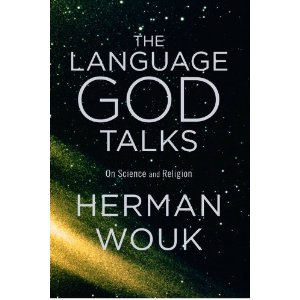 This hodge-podgey little book has at least two very moving high points. The second is a closing coda: the fictional Aaron Jastrow's sermon, "Heroes of the Iliad," delivered at the Theresienstadt concentration camp. It appears in Wouk's massive World War II novels Winds of War and War and Remembrance. Jastrow invokes the book of Job. He ponders cruelty, suffering, injustice in creation. He concludes that Job, "the stinking Jew" who upholds Almighty God in the face of an unavailing universe, who calls God to acknowledge that "injustice is on his side," performs an essential service, for he, in upholding God, upholds humanity. But the first high point is just as gripping. It's an imagined walk-and-talk between Wouk and physicist/Nobelist Richard Feynman. An aggressive, jokey unbeliever, Feynman questions Wouk about Talmud. He's curious why Wouk is Orthodox. Wouk tries to explain, "Not to convince you of my view, but because you asked me." Throughout his long writerly career, Wouk, who turned 95 on May 15, has often pondered belief. In The Language God Talks (a title derived from Feynman's nickname for calculus), Wouk embraces science, assents to the connection between the human mind and the big bang. In the laws science has discovered, he hears a language God talks, and he feels we should listen. This modest and not terribly well-focused book has inherent drama, for it faces nothing less than a huge shift, among some Jews, away from God. The break was the Holocaust. The argument goes: In light of such unanswered injustice, six million unanswered injustices, to cling to the notion of a just God is an obscenity, a way to smooth over, to seek comfort when comfort is unjust. To forget. For some, it is wrong even to question this break. The 20th century saw an exhaustive effort to backfill the tradition, an effort that remains the subject of vigorous disagreement throughout all branches of Judaism. The brilliant, indispensable Jewish insistence on questioning, on debate, on weighing and sifting all sides, was mined for an unbroken skeptical tradition without the God of the Psalms. Atheist Jews could now claim that atheism was always Jewish. |
| Review |
A New Entry in the God DebateThe author says atheists reject the Christian gospel because it is too radical for them. 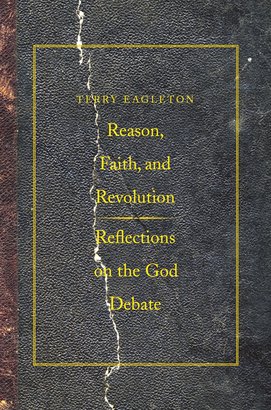 What if the Great God Debate isn't about the existence of God at all? What if the great atheist writers of our age have missed the point? What if, as God debater Terry Eagleton says, "they reject the Christian gospel not because it's garbage, but because it's too radical for them"? The oldest questions of all - Does God exist? Can science prove or disprove it? Is religion good or bad? - have become the highest-profile intellectual debate of the decade. It's a war of books, stoked to white heat by the war on terror, when some have thought the West was in a toe-to-toe cultural Armageddon with Islam. Eagleton is a recent entrant in the God Debate. With a glittering resume ranging from literary criticism to history, he is a writer with serious Marxist and socialist credentials. In his new book, Reason, Faith, and Revolution: Reflections on the God Debate, he comes out squarely - against the atheists. He's diving into a brainiac mosh pit. Richard Dawkins, Christopher Hitchens, Sam Harris, and Daniel Dennett have weighed in on the nay side, and Francis Collins, Chris Hedges, Rick Warren, and Tim Keller on the yea. Eagleton, one of the best-known public intellectuals in the world, holds professorships at Lancaster University and the National University of Ireland, Galway. He has written more than 40 books and all but haunts talk shows, book reviews, and op-ed pages. But against the atheists? Wittily, merrily, trenchantly so. Eagleton mischievously lumps Dawkins and Hitchens together as "Ditchkins" throughout his book. It's unfair. He's glad. Partly, it's to mock what he sees them doing to religion - tarring all belief as fundamentalism. The book grew out of a furious 2006 Eagleton review of Dawkins' The God Delusion, in which the former slammed what he called the latter's ignorance about religion. That led to an invitation from Yale University to give the Dwight H. Terry lectures (which address how science and philosophy inform religion) in April 2008. Eagleton's title: "Faith and Fundamentalism: Is Belief in Richard Dawkins Necessary for Salvation?" His four lectures formed the basis for the book. This attack has come, to put it lightly, as a surprise to many. Speaking by phone from his home in Dublin, Eagleton chuckles and says: "It wasn't such a hard thing to go from Marxism to this debate. It just so happens I have a bit of theological background, enough to know when people are talking out the back of their necks." |
| Broadcast |
Remembering the Meaning of Lent On days like these, all the songs and poems about spring start popping up in your mind. It's time again for flowers, budding trees and… allergies. Gardeners are on hyperdrive, and churches, sanctuaries, and temples are sprucing up for a week of celebrations. As commentator John Timpane remarks, it is a time for renewing the spirit and and remembering the meaning of lent. Timpane: Friends always ask his time of year: What's this Lent thing all about? Here's one answer: Remembering. |
| Article |
Evolution: Playing Politics With Fact
That was the question put to the 10 GOP presidential hopefuls during a May 3 Republican presidential debate on MSNBC. Sen. John McCain (R., Ariz.) already had said he did. But when the rest were asked the same question, three hands went up: those of Sen. Sam Brownback of Kansas, Rep. Tom Tancredo of Colorado, and former Arkansas Gov. Mike Huckabee. Ah, the flood of facile jokes!: Those Luddite Republicans! They don’t believe in evolution because, in their case, it didn’t happen! Et cetera. Hardy har har. Three candidates do not a party make. But it was a telling moment for those wondering where the GOP is headed. |
| Article |
The Future of Free Will
Do we have free will or not? A huge question, not to be dismissed. There’s a reason people have worried it so. Our default belief that we are not compelled in our choices, that we are freely responsible for our lives—this belief is central to our sense of self, of the universe, our sense (if we have one) of the purpose of life. Experiments in neuroscience seem (to some) to threaten all that. And a recent surge of books and articles has frothed the waters. Most visible, perhaps, was New York Times columnist Dennis Overbye’s column in January titled "Free Will: Now You Have It, Now You Don’t". Overbye largely accepts that free will—at least, as it’s often and traditionally defined—is an illusion. An invigorating and necessary debate. Will free will survive? As we forge into the future and encounter more and more new, hard dilemmas, what we think of human choice and responsibility could affect public policy. Suppose it’s determined we really are not in control. That might change our notions of justice, human rights, reward and punishment. And much else. |
| Article |
Plugged into the New ConsciousnessWe are, easily, the most connected and connective society of human beings ever. Our consciousness goes beyond individual minds. We are exquisitely aware. This is both our gem and our canker. This piece is going to give readers their money’s worth. We’ll start by floating a definition of consciousness—both startling and (I hope you’ll think) common sense. On the way, we will consider some bemusing things about the new communications age in which we live. And then—bam—we’re going to propose a morality of consciousness. That’s what I call a Sunday morning’s walk. Here’s my main theme: Consciousness is connectedness. Simple. Sweet. And it sings like the very cosmos. If it’s true, then you, I, and our society are rewiring ourselves and our worlds at breathtaking speed. And we need an ethics for it. Last year, two scientists, Marcello Massimini and Giulio Tononi, performed what might at first seem a simpleminded experiment. They stimulated a number of awake subjects at a small, specific site in the brain. Then they measured where the stimulus went. It did rocket around in there. The awake brain does that: It can refer a single stimulus all over, connect different centers, serve different uses. Sometimes a stimulus ping-ponged around in there for as long as 300 milliseconds (almost a third of a second), a long time to bonk around for brain impulses, which can travel between |
| Discussion |
Q&AQuestion & answer session with John Timpane, associate editor of The Inquirer Editorial Board, editor of Currents, and author of this week's lead piece in Currents. 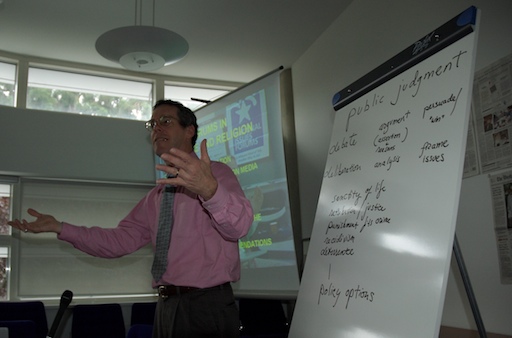 So you want us to be mindful of all the connections we’re making, and to think and act ethically regarding them?
|
| Interview |
Interview with Judge John Jones, the Judge at DoverOn February 14, Judge John E. Jones 3d addressed a crowd at the Lutheran Theological Seminary. Jones presided over the Dover "intelligent design" trial, eventually ruling that the Dover School Board could not order teachers to read a statement referring to intelligent design in classes discussing evolution. During his address, Jones, a Lutheran, said he diverged from those who insisted that either the Bible or the U.S. Constitution should be read literally. He spoke of the excitement and pride with which he conducted the trial: "Most federal judges will tell you they assume their positions to decide important cases." Before his talk, Jones spoke with The Inquirer about when he first heard of intelligent design, and what it was like to be a part of judicial history.
|
| Editorial |
Intelligent Design: The Vatican Weighs InWhat if God spoke, and said: "What's this intelligent design stuff? That ain't science!"? Would ID proponents keep on talking? "Well, not if you redefine science"… "There's too many holes in the theory of evolution"… "Life is too complex for it to be the product of random mutation"… "This is academic censorship!!! " Rather than hurling down serpents, frogs, and thunderbolts, The Divinity might clear the throat and politely restate: "Sorry, one more time: Intelligent design is not science. " This week, it wasn't God talking, exactly—but, by some lights, it came pretty close. On Tuesday, the Vatican newspaper L'Osservatore Romano published an article, by University of Bologna evolutionary biologist Fiorenzo Facchini, which said a Pennsylvania judge was right to nix the Dover school board's attempt to order teachers to read an ID-related statement to students. In agreement with Judge John E. Jones 3d, Facchini wrote that "intelligent design does not belong to science and there is no justification for the pretext that it be taught as a scientific theory alongside the Darwinian explanation. "While the paper is not an official Catholic Church voicebox, anything that gets printed must pass close scrutiny to jibe with Vatican thought. Hilariously, the Discovery Institute, a flimsy cover for neocreationist advocates, and one of the failed powerhouses behind the |
| Editorial |
Intelligent Design Ruling Dashed in DoverThe long-awaited ruling on the Dover "intelligent design" trial came yesterday, and the results were bad for ID—and good for democracy. They were good for those who read the Bible, those who read Darwin, and those who never read anything. This was a triumph for the Constitution, so it is one we all can share. U.S. District Judge John E. Jones 3d ruled that the Dover Area School Board may not order teachers to read a statement about intelligent design in school biology classes on evolution. ID is a theory that questions Charles Darwin's account of evolution and posits that an "intelligent designer" must have directed the development of life forms on Earth. The backbreaker was the judge's ruling, amply backed up by trial testimony, that ID is simply not science. Jones pointed out that a main pro-ID scientist, Lehigh biochemist Michael Behe, had hinged his argument on belief in God. Since no other scientific proposition rests on belief in a deity, "Professor Behe's assertion constitutes substantial evidence that in his view... ID is a religious and not a scientific proposition." Oops! The judge ruled that, since ID is religious rather than scientific, the Dover school board violated the First Amendment's ban on government favoritism toward any particular religious belief in its ID vote last year. (Almost all who voted for ID either have left the board |
| Article |
 Sketchy SpeciesTiny acts, biiiiig consequences Chance is one thing, necessity another. That’s what they say. Right? Chance is what happens for no reason. It just happens to happen. It’s happenstance. Coincidence. Necessity happens for a reason. It’s cause and effect. It’s consequence. But what if these distinctions really don’t hold up? What if chance and necessity aren’t that different? What if they are so intimately knotted we can’t undo them? What if—yikes—what if they’re just about the same thing? When I look at my children, all these questions come bubbling up. I think: How’d they get here? It seems impossible, a miracle. But I know the story, and I start retelling it in my head: My wife and I met… but first her parents and my parents had to meet… and their parents… Many of the things we think are coincidences aren’t that coincidental. My friend and favorite mathematician, John Allen Paulos of Temple University has written this great book called Innumeracy, in which he tells us that many of the things we think are just amazing coincidences aren’t all that. If there are 23 people in a room, chosen from all the world’s people absolutely at random, what is the probability that two of them have the same birthday? One chance in two. It’s not an amazing coincidence but actually pretty likely. How |
| Editorial |
Intelligent Design Flunking ScienceFor the last few weeks, the ID folks have been having their say in the Dover, Pa., "intelligent design" trial. U.S. District Judge John E. Jones 3d may rule as early as mid-month. At issue is whether the Dover school board can order teachers to read a statement about "intelligent design" (ID) before they teach ninth-grade biology classes on evolution. ID argues that life's complexity did not arise by chance (as in Charles Darwin's view) but rather is the work of a knowing, planning designer. Judge Jones should rule against the Dover board. ID deserves passing mention - sidebars in textbooks, perhaps, and some class discussion - but not mandated inclusion in science classes. Why? Because as science, ID just doesn't cut it. Here is the pro-ID strategy, and why it just doesn't hold up:
|
| Article |
Fundamentalism Fails, On Both Sides It's the end of absolutes for both religion and materialist unbelief. Neither has the knockout card, the open-and-shut, slam-dunk, airtight case. And that should knock both of them back a step. Each has something to say to the other, indeed the same thing: "Give up your fundamentalism—it's toxic, and it's hurting you." Healthful words now, when evolution and intelligent design are being debated in Dover, Pa. Both belief and unbelief may be much qualified in the coming decades. In a trend already 50 years old, belief increasingly may get hauled out of church, as believers feel less and less need for an institutional lens through which to believe. Materialism (sometimes called "naturalism," sometimes "rationalism") is the belief that all that exists is the visible, concrete universe of matter. That's it—nothing else, no spirit realm, no divinities, no afterlife. There is a fine, august tradition behind materialist unbelief. But—especially in the minds of some who believe they are representing or defending science—it has taken on a dismissive energy. In years to come, materialism may actually benefit from admitting it's just a guess, more like other beliefs than most materialists admit. At least, such are my conclusions after participating in the Templeton-Cambridge Journalism Fellowships in Science and Religion. This summer, 10 journalists attended seminars for two weeks at Cambridge University in England, went home for five weeks to prepare presentations, and returned for a last week of seminars, presentations, debate, English ale, and amazement at our chance to study God and science in 15th-century splendor. Many stars joined us: evolutionary biologists Richard Dawkins and Simon Conway Morris; cosmologists John D. Barrow, Owen Gingerich, and Paul Davies; theologians Russell Stannard, Nancey Murphy, and Ronald Cole-Turner. They gave brilliant talks, argued with one another, with us, and with the cosmos; challenged us to stretch our minds and write better about science, religion, and the |
| Editorial |
Intelligent-Design TrialGod, Science, and Politics It's hard to overstress the importance of the "intelligent design" trial going on now in Dover, Pa. Science is watching. So are teachers, judges, students, believers, lawyers and political leaders all over the world. The result of Kitzmiller et al. v. Dover Area School District et al. could change how science is taught in schools throughout the land. In October 2004, the board of the Dover Area School District voted 6-3 to reword the ninth-grade biology curriculum. Before beginning to teach evolution, science teachers must now read students a four-paragraph statement on a theory called "intelligent design" or ID. Questioning Charles Darwin's theory of evolution, ID asserts that the complexity of living things could not have come about by random mutation, as in the Darwinian view. There must be an intelligence behind the design of the universe - a designer. Eleven parents have sued in federal court, claiming the board's decision amounts to teaching public school students a particular religious viewpoint and thus violates the constitutional separation of church and state. ID proponents say their theory isn't religious because it does not mention God. Now Judge John E. Jones 3d must decide who's right. |
| Editorial |
Decoding the Chimp's DNAMore about Our 'Next of Kin' In 2001, scientists announced they'd mapped the human genome—the string of genetic instructions woven into our DNA. That map has led scientists to buried treasures of understanding. Now the same thing has happened for the chimp genome. The Chimpanzee Sequencing and Analysis Consortium, a huge international scientist cooperative, announced the sequence in the Sept. 1 issue of Nature. So we're about to know our closest cousins better.
The common chimpanzee (Pan troglodytes) is our closest living evolutionary relative. Both Pan and Homo (our genus) are branches from a common ancestor, from which the two lines went different ways about 6 to 8 million years ago. Chimps have changed since then—and so have we, in spectacular fashion. The chimp genome now gives us a point of comparison. It's close: And ourselves. This new map may help us answer one of the biggest of all questions: What makes us human? Help us answer, mind you—not answer everything. Keep that in mind. |
| Article |
Intelligent DesignTeach it as a belief, but not as science On Monday, in a round-table discussion with journalists from five Texas newspapers, President Bush said he thought intelligent design should be taught to students alongside evolution. "Intelligent design" is the belief that the universe and the Earth show evidence of a thinking, purposeful plan. That belief is thousands and thousands of years old; the phrase is of fairly recent coinage. President Bush made his remarks in the broadest, blandest terms: "I think that part of education is to expose people to different schools of thought." That's the line you're hearing from many politicians: "I think students should learn all sides of an issue," etc. Sounds reasonable, right? No nice person could possibly take exception, right? Ah, but many do. They're afraid intelligent design - especially when it gets capitalized, as in Intelligent Design - is just "warmed-over creationism," anti-scientific Christian fundamentalism looking for a back-door into classrooms. In school districts throughout the land - in Dover, Pa., in Kansas, in Michigan, and elsewhere - debate rages over whether these ideas have any place in the way we teach our children science. |