
 About the Fellowship
Jay Tolson
Jay Tolson is a senior writer at U.S. News & World Report, covering culture, ideas, and religion. Previously the editor of the Wilson Quarterly, he has written for the Washington Post, the Wall Street Journal, the New Republic, the Times Literary Supplement, Civilization, Slate, The Sciences, DoubleTake, and other publications. A graduate of Princeton University, he is the author of Pilgrim in the Ruins: A Life of Walker Percy (1992), which won the Southern Book Award, selected by critics of the Southern Book Association, and the Hugh Holman Prize for Outstanding Scholarship in Southern Literary Studies, and he edited The Correspondence of Shelby Foote and Walker Percy (1996).
| Review |
 Islam's Problem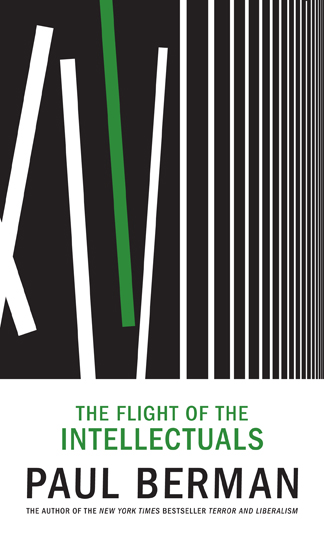 In the annals of well-meaning ineptitude, Western efforts to locate and support moderate Muslim voices deserve a place of distinction. The story begins in the smoky rubble of Manhattan’s Twin Towers and the dawning awareness that Islamist zealots who styled themselves holy warriors were the masterminds of this startling act of mass murder. Such acts had to be understood either as something frightfully sick about Islam or as a radical distortion of Islam. Most reasonable people chose to see them as the latter. But if Islam was being hijacked, who within the Islamic world would resist? Voices of moderation were hastily sought. Understandably, mistakes were made. Even among the Muslims mustered to stand in solidarity with President George W. Bush at the 9/11 memorial service in Washington National Cathedral were a couple whose credentials as champions of moderate, mainstream Islam were questionable. But if that was forgivable because of haste, later missteps were less so.
Wall Street Journal reporter Ian Johnson deftly recounts one such fiasco in a recent issue of Foreign Policy. In 2005, the U.S. State Department cosponsored a conference with the Islamic Society of North America (ISNA) that brought American Muslims to Brussels to meet with 65 European Muslims. The State Department followed up by bringing European Muslims, many of whom had connections to the Muslim Brotherhood—the world’s oldest and arguably most influential Islamist organization, dedicated to making Islam a political program—to the United States for an ISNA-led summer program and imam training. The rationale was that European Muslims, thought to be less integrated into their adopted countries than American Muslims, would learn something valuable about assimilation. All well meaning, of course, but comically misguided. As Johnson notes, "ISNA was founded by people with extremely close ties to the European leadership of the Muslim Brotherhood."
This initiative was only the beginning of protracted efforts by U.S. officialdom to court a number of Brotherhood or Brotherhood-related Islamist organizations and leaders. Instant experts on political Islam from both liberal and conservative Washington think tanks advocated the idea of engaging Islamists who eschewed violence (except, in some cases, violence against Israelis) and endorsed the democratic process, if not liberal values. European officials were wary of this approach, but even the CIA gave a go-ahead.
The folly of this kind of thinking is a major concern of the books under review. In an essay in The Other Muslims, Yunis Qandil, a Jordan-born Palestinian and a lecturer at the Institute of Contemporary Intellectual Studies in Beirut, goes to the heart of the problem: "In the long term, the strengthening of ideological Islam and the granting of official recognition to its ‘moderate’ organizations against jihadism create more problems for us than solutions." Moderate as these Muslim groups in Europe and America may seem, Qandil explains, they represent what moderate, traditional Muslims fight against in their countries of origin: "the instrumentalization of our religion through a totalitarian ideology." While paying lip service to the values of Western societies—notably, the tolerance that allows them to operate—these Islamists fundamentally view such societies as the "archenemy of Islam." So why, Qandil reasonably asks, are European governments "still selecting the adherents of this particular type of Islam as their privileged partners and the recognized representatives of all Muslims"? The same question applies in the case of America.
|
| Review |
 Religion Confuses Even the Best Minds Religion confuses even the best minds -- and maybe the best minds most of all. Chalk that up partly to the contempt most modern intellectuals have felt for the "opiate of the people." That attitude is hardly conducive to deep understanding, and in fact has given rise to a number of popular misconceptions. One is that modernization -- and its handmaidens, mass education and science -- would lead inevitably to the long-heralded twilight of the gods. We would all be good secular humanists one day soon. Confidence in that particular shibboleth took a bad hit in the last decade or so. In addition to 9/11 and other acts of faith-based zealotry, Americans witnessed the boisterous return of religion to their public square. Other evidence from around the world -- whether it's the assertive role of Hinduism in contemporary Indian politics or the renewed interest in Confucian principles in still nominally communist China -- has made it much harder to think that religion is a spent force. Intellectuals friendly to religion have fostered an equally misleading notion, one that is thoughtfully dispelled in Stephen Prothero's book, "God is Not One." Seeing the world's major belief systems through Enlightenment-tinted glasses, a succession of influential philosophers, artists, scholars and even many religious leaders have tended to minimize the differences of ritual and dogma among the various religions to emphasize a supposedly universal and benign truth shared by them all. Such well-meaning believers (and they do constitute a kind of religion of their own) have subscribed to variations of the Dalai Lama's affirmation that "the essential message of all religions is very much the same." It's an uplifting bromide, to be sure, and Prothero, a professor of religion at Boston University, gives its supporters their due. The Golden Rule and other ethical principles are indeed shared by a majority of the world's religions. The mystical traditions of many religions employ similar disciplines and aspire to similar ends, whether transcendence of baser desires or a sense of unity with a supreme being. But if the devil is in the details, the point of Prothero's useful book is that God is, too. Which is to say that the particular and often problematic features of a religion -- from its core narratives and rituals to its arcane points of theology -- are at least as important to its followers as those qualities that it may share with other religions. The universalist impulse may be a "lovely sentiment," Prothero writes, "but it is dangerous, disrespectful, and untrue." |
| Column |
 Islam's Reformation and Obama's SpeechThere has been no dearth of advice, solicited and unsolicited, to U.S. President Barack Obama in the run-up to his eagerly anticipated address to the Muslim world in Cairo this week. Pundits have second-guessed and advised, suggesting what he could or should say, and even where he should say it. Not surprisingly, many would-be counselors focus on either the Palestinian question or Iran and its nuclear ambitions. Others harp on authoritarian leaders and the continuing democracy deficit in most states with predominantly Muslim populations. These are all important questions, of course. Obama has already indicated that he will address them, even while cautioning that no instant solutions are possible. But to say that these immediate political issues -- and America's policy responses to them -- are the topics of greatest importance to the wide and various Muslim world is ultimately to slight that world and the challenges it faces. Worse, it inadvertently endorses the view of those Muslim extremists who would like to reduce the Muslim world to a monolithic bloc of thought, culture, and sensibility, a global community obsessed with the same small set of grievances. ’Civilizational Richness'Fortunately, Obama, whose father was a Muslim and who spent part of his childhood in Indonesia, knows that Muslim realities are far more complex. With more than 1 billion adherents and scores of internal divisions, the House of Islam is not just a religion but the core component of a civilization -- of many civilizations, to be precise. Whether Persian, Turkish, South Asian, or other, these civilizations have sustained and helped to shape varieties of Islam, each strongly inflected by ethnic, national, and regional traditions. While such civilizational diversity has often led to conflicts within the wider Islamic world -- think of the ongoing tensions between Persians and Arabs -- it is also a crucial factor behind Islam's intellectual, artistic, and even theological richness. |
| Review |
 The Day of RestlessnessEvery week, a challenge arises for churchgoers and nonbelievers alike. 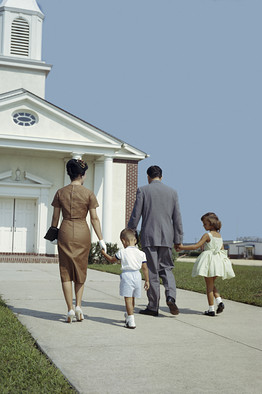 Who, raised in or around the Christian tradition, has not experienced the ambivalent dolors of a Sunday? That is only one question -- but a central and recurrent one -- raised by "The Peculiar Life of Sundays," Stephen Miller's lively history of a day that has exercised a peculiar hold on countless human beings for the past 2,000 years. One might think that, for the devout, this hold would be especially firm. For them, after all, the day is unquestionably holy, unquestionably the Lord's: an Easter in miniature marking their savior's resurrection. But even the faithful can feel uneasy, as Mr. Miller shows by depicting the spiritual struggles of many of his exemplary figures. Consider Samuel Johnson, the 18th-century essayist, conversationalist and one-man dictionary compiler. A committed Anglican and forthright defender of the faith, he nevertheless found it difficult -- indeed, almost impossible -- to haul himself into church on Sundays. Uncomfortable with "publick Worship," bored by most sermons and inclined toward late-rising, Johnson was forever recording his resolution to attend church more conscientiously. But that vow "was little better kept than the others," as the editor of his diaries noted. Without saying so explicitly, Mr. Miller uses Johnson to show how even a deeply religious person can find the outward institutional form of his religion at odds with what he finds most sacred. Johnson's internal struggle, Mr. Miller implies, is part of a much larger culture war within the world that was once, until its 16th-century fragmentation, called Christendom. At the center of that struggle have been conflicting efforts to define the doctrines and practices of a religion based on the life, death and reputed resurrection of a first-century Palestinian Jew, proclaimed by many of his followers as the unique son of the Hebrew God. Inevitably the struggle has involved -- and, yes, to this day still involves -- politics, powerful personalities, sectarian rivalries and other human, all too human, factors. |
| Article |
 Catholics at a Crossroads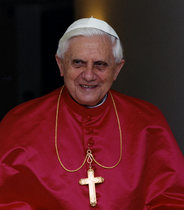 It won't be the easiest roadshow for the leader of the world's largest Christian church, a man who many thought would be a quiet but dogmatic transitional figure focused on preserving the church in an increasingly secular Europe. But Pope Benedict XVI has already upset expectations, and when he arrives this month for his first pontifical visit to the United States, many of his admirers believe that he will overturn more. As Benedict well appreciates, his upcoming six-day visit to Washington and New York City will bring him into direct contact with a nation that has not only the third-largest Roman Catholic population in the world but also the most diverse. In ethnic terms, that variety may be taking on an increasingly Hispanic cast--at almost 30 percent and rapidly growing--but most of America's 195 dioceses can boast of parishes with a mini-United Nations of national flavorings as well as those in which the melting pot has effectively left no particular ethnic imprint at all. But the diversity of America's Roman Catholic Church hardly ends with ethnicity. It also includes a rainbow of attitudes and convictions--political, social, liturgical, even theological--that reflect American individualism in ways that strain even the universalism of the Catholic Church. It's a tough act to read this audience and even tougher to know how to address it. And it makes it no easier that this pope, a private man known for his formidable intellect and doctrinal rigor, follows in the footsteps of the charismatic and beloved John Paul II. Which is not to suggest that most American Catholics are ill-disposed toward Benedict. His former sharp-edged image as God's Rottweiler grew out of his years as chief enforcer of doctrine, the Cardinal Joseph Ratzinger who quashed liberation theology or any other departures from strict church teaching. But now completing the third year of his papacy, having penned major encyclicals emphasizing hope and charity, he appears less concerned with policing borders than with gently reminding the flock of core Christian principles. If he remains firmly orthodox in his teaching, it is an "affirmative orthodoxy," in the words of National Catholic Reporter columnist John Allen. "This has been a far more moderate, gradualist pontificate than most people anticipated," Allen says. And as polls have shown, a large majority of American Catholics say they approve of the German-born prelate, who will turn 81 on his U.S. visit. |
| Review |
Exposing a Network of Powerful ChristiansA new book claims that the "Fellowship" influences key decision makers.  It is an elite and secretive network of fundamentalist Christians that has been quietly pulling strings in America's highest corridors of power for more than 70 years. Or so claims Jeff Sharlet, author of a new exposé, The Family: The Secret Fundamentalism at the Heart of American Power. And in his telling, the group that calls itself the Fellowship operates at the very center of the vast, right-wing conspiracy that has promoted unfettered capitalism and dismantled liberal social policies at home, even while encouraging ruthless but America-friendly dictators abroad. Sharlet, an associate research scholar at New York University's Center for Religion and Media, tells an intriguing story of an organization founded in 1935 by Norwegian immigrant pastor Abraham Vereide. Growing out of Vereide's early struggles against the radical labor movement on the West Coast, the group came to consist of religiously minded businessmen and sympathetic politicians who shared Vereide's mildly pro-fascist sentiments. Vereide is most widely known for launching in 1953 what is now a Washington institution, the National Prayer Breakfast, where movers and shakers come together to pray in an uplifting but blandly interfaith way. But behind the scenes, Sharlet contends, Vereide and his key men worked with politicians and officials to advance unfettered, tooth-and-claw capitalism and engage in secret diplomacy with some of the world's least savory leaders, including, in the past, Indonesia's General Suharto and Haiti's François "Papa Doc" Duvalier. If all that weren't ominous enough, the group's leader since 1969, Doug Coe, has gained something of a reputation for invoking not only Jesus but also Hitler, Lenin, and Mao as models of effective leadership. Sound sinister? To be sure. And Sharlet has done extensive reading in the Fellowship's archival materials to document what he calls "the secret history of Christian fundamentalism's most enduring and most powerful organization." Furthermore, he got started on the project after living in one of the Fellowship's Arlington, Va., homes, a kind of commune for well-off but somewhat undirected young men seeking Christian and worldly guidance from Fellowship elders. Sharlet, in other words, should know whereof he speaks. But there are problems. Sharlet's ease of access to documents and people would seem to belie his characterization of the Fellowship as an obsessively secretive group. Other problems—including many overly broad and unsubstantiated charges—point to some of the larger difficulties that journalists, scholars, and commentators have had in understanding the nexus of religion and power in the post-9/11 world. Writing in the current issue of World Affairs, Adrian Wooldridge, Washington bureau chief for the Economist, describes the core problem succinctly: "In the aftermath of 9/11, however, we arguably have overcorrected—not underestimating the role of religion, as in years past, but exaggerating it. Exaggerating it in the sense of giving it undue emphasis, of turning it into a cartoon. The commentators who not that long ago were heedless of the role of religion and were theologically illiterate now see it everywhere (and remain theologically illiterate)." |
| Article |
Does Wright Represent Black Church-Goers?Two leading experts share their diverging views 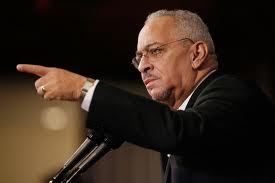 The recent comments of Rev. Jeremiah Wright have not only complicated the presidential campaign of Senator Barack Obama, who for more than 20 years has been a member of the Trinity United Church of Christ that Wright once pastored. Some of Wright's remarks—particularly his claim that criticism of his more provocative sermons "is not an on attack on Jeremiah Wright" but instead "an attack on the black church"—have also sparked wide a debate on whether Wright typifies the beliefs of millions of African-American churchgoers and their ministers. U. S. News approached two leading experts on the African-American church figures with a single question: "How well does Rev. Jeremiah Wright represent the black church in America?" Here are their answers: Dwight Hopkins is a professor at the University of Chicago Divinity School and the author of Heart and Head: Black Theology Past, Present, and Future and many other books."I think his theology and his religious perspective are both very representative, especially linking the personal salvation with social justice critique. In fact, those two focii have been the hallmark of the black church in America since the black church was founded in the period of slavery. But unfortunately what has happened, particularly in the past seven and a half years, is that President Bush has promoted a small group of black clergy to represent all of black Christianity. He's promoted a theological trend called "prosperity gospel" which is basically that individuals should use Jesus Christ plus capitalism to get personally rich. But the contribution the black church made during the period of slavery in this country was linking personal salvation with social critique of public policy—the government's public policy on slavery. Of course people have questions about the form of Wright's presentation but the substance and tradition that he practices both link back with the church that they were founded on." |
| Review |
Why God Won't DieJay Tolson reviews a new book by Charles Taylor, "a profoundly learned thinker (who is also a believing Christian)" that tries to explain the persistence of religion in a secular world.  Something curious happened on the way to the 21st century.Religion—which modernization theorists had said was destined for the dustbin ofhistory—didn’t go away. It even seemed to gain new strength, popping up in the culture wars, claiming space in the public square, and (in its worst manifestations) inspiring angry young men to acts of unspeakable violence. Why, it’s all enough to drive a good secular humanistcrazy—or at least to the bookstores to purchase the reassuring screeds of Sam Harris, Richard Dawkins, Christopher Hitchens, or any of the otherso-called New Atheists. Making sense of secularism, its achievements and its failings, is one of the great intellectual challenges of our time. The word itself has several interlinked meanings, from the political (the separation of church and state) to the sociological (describing the abandonment of religious belief by individuals or society in general) to the ideological (the programmatic conviction that secularity is the logical outcome of enlightenment, science, and progress). A fourth sense is more anthropological, and arguably lies at the root of the other three. This secularism names a profound shift in worldview, one that the eminent McGill University philosopher Charles Taylor defines as a "move from a society where belief in God is unchallenged and, indeed, unproblematic, to one in which it is understood to be one option among others, and frequently not the easiest to embrace." It is this fourth sense that mainly occupies Taylor in hislong-awaited magnum opus, A Secular Age. For nearly 800 pages, Taylor, winner of the 2007 Templeton Prize (religion’s own "genius award"), wrestles mightily with a fascinating subject: how Christianity became the religion that produced the first exit from religion, and how that exit, secularism, never entirely disentangled itself from the religion that made its existence possible. The book is, loosely, a history of ideas, but Taylor’s project is to get at something deeper and broader than the activity of intellectuals and other elites, something he calls the "social imaginary," an ungainly term describing the various ways people "imagine their social existence." Taylor begins, not surprisingly, with theReformation—into which he lumps late medieval developments and theCounter Reformation—because of its crucial role in paving the way for a host of "modern" afflictions, from the confusion of morality with materialism to the disconnection of the individual from tradition and the larger corporate body of fellow believers. If this seems like a fairlywell-trod road, well, it is. But the richness and pleasure of the journey is in seeing how a profoundly learned thinker (who is also a believing Christian) examines the landmarks along the way. For example, Taylor’s treatment of the emergence of a new kind of public sphere in the 18th century allows us to see how radical a development it is. Previously, what brought people together was always "somethingaction-transcendent," Taylor writes, "be it a foundation by God, or a Chain of Being which society bodied forth, or some traditional law which defined our people." This new sphere was "grounded purely in its own common actions." Whatever happenedwithin it—crowds clamoring for lower taxes or members of the Third Estate calling for the end of the OldRegime—was no longer important in relation to eternal time but only in relation to the actually unfolding present and its ideal goal: the future. |
| Article |
God and ScienceIt’s official. Scientists really are less religious than most folks are. In fact, close to 52 percent of American scientists claim no religious affiliation at all, as opposed to 14 percent of the general population. Should we be surprised? Probably not. But a new study conducted by University of Buffalo sociologist Elaine Howard Ecklund at least sheds some helpful light on why so many scientists got to be that way. The biggest revelation, it turns out, is that it wasn’t all those hours in the lab that led white-frocked chemists and biologists down the road to godlessness. Nor was it because they read Darwin or Einstein and concluded that the whole grand scheme of things required no supreme creator. It wasn’t even, in the case of the social scientists, that they converted to those ideologies of disenchantment formulated by Marx or Weber. |
| Interview |
What Americans Don't Know about Religion Could Fill a BookWith roughly 9 in 10 of its citizens claiming to believe in a Supreme Being, America is widely acknowledged to be the most religious of modern industrial nations. Yet when it comes to knowledge about religion, it ranks among the most ill-informed.  With roughly 9 in 10 of its citizens claiming to believe in God or a Supreme Being, America is widely acknowledged to be the most religious of modern industrial nations. Yet when it comes to knowledge about religion, it ranks among the most ill-informed. While close to two thirds of all Americans regard the Bible as a source of answers to life's questions, only half can name even one of the New Testament Gospels. Similarly, in a land of growing religious diversity, only 10 percent of U.S. teenagers can name the world's five major religions. Stephen Prothero, the head of the department of religion at Boston University, calls this condition a "major civic problem." His new book, Religious Literacy, tells how we got here—and how we might do better. Were we once a religiously literate nation?Very much so. Religious literacy and basic literacy used to go hand in hand. The Bible was the first reader of the colonists and early Americans, so as they learned to read, they read the Bible. One important sign of this literacy was that Americans conducted many of their most important civic debates, including the debate over slavery, largely in biblical terms. You name six links in the chain of religious education that once made Americans knowledgeable about religion. What were these, and how were one or two of them weakened, if not demolished? The big links were churches, schools, households, Sunday schools, colleges, and Bible and tract societies. In schools, the chain of memory got broken not in the '60s by secularists, as many conservative Christians claim, or by Supreme Court rulings that outlawed devotional Bible reading and prayers in public schools. Bible courses and the teaching of religion started to go away in the mid-19th century as a result of the debate over which Bible to read—and that was instigated by religious people, not secularists. |
| Article |
The Gospel TruthWhy some old books are stirring up a new debate about the meaning of Jesus 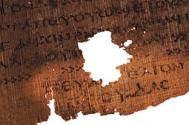 What does The Da Vinci Code have to do with a letter written by the archbishop of Alexandria in the year 367? As it turns out, quite a lot. Call it part of the Gnostic connection, a long, fine thread of influence connecting contemporary cultural debates with an important struggle in the early Christian movement to define the meaning of Jesus's life and teaching. In that struggle-arguably the most important waged by self-styled correct believers against so-called heretics-orthodox Christians battled Gnostic Christians over their respective interpretations of divinity, human nature, sin, salvation, and other crucial theological and philosophical points. The soldiers of orthodoxy, as we now know, ultimately prevailed, confirming their claim to be the true Christians. But Gnostic principles lived on in isolated communities and, occasionally, sparked Gnostic-like revivals. Indeed, in recent decades, thanks to the recovery and scholarly interpretations of a trove of Gnostic documents, the ideas of that ancient movement have come to play a surprisingly prominent role in our current culture wars. Today, there are many scholars, theologians, and popular writers who promote the Gnostic perspective as a liberating antidote to close-minded dogmatism, but there are also many others who denounce it as a pernicious and destructive influence. Name many of the issues that fuel our cultural politics today-authority vs. individual freedom, fixed moral precepts vs. moral relativism, religion vs. spirituality-and you can find usable precedents in that long-distant conflict between Gnostic Christians and their orthodox foes. Emory University biblical scholar Luke Timothy Johnson may be right in saying that a new Gnosticism once again "threatens the shape of Christian faith." But the return of Gnostic ideas has also contributed to a larger debate between progressives and traditionalists that goes beyond the strict concerns of one religious tradition. Esoteric knowledge.If all of that seems a bit of a stretch, consider the far-reaching historical consequences of Archbishop Athanasius's letter from 367: In addition to providing the first-known list of the 27 books that would eventually constitute the official canon of the Christian New Testament, the letter ordered all Christians to repudiate an assortment of "illegitimate and secret" Gnostic texts that Athanasius deemed heretical. In that one Easter epistle, Athanasius enunciated two bedrock principles of orthodoxy and traditionalism: the importance of scriptural canon, and apostolic authority to determine what is, and is not, acceptable Christian thought. |
| Article |
The New UnbelieversBooks on atheism are hot. But do they have anything fresh to say? 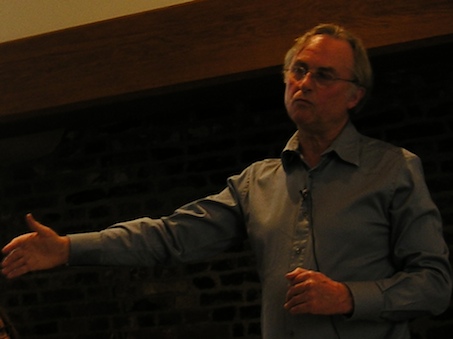
Little seems to have changed since Benjamin Franklin penned those words of advice to would-be immigrants in 1782. Most polling data suggest that some 90 percent of Americans believe in God or a supreme spirit. And a recent University of Minnesota study finds that atheists—or at least that lonely 1 percent of the national mix that dares to identify itself as such—are the least trusted group in America. So why in this land of the God-fearing have the gloves-off arguments of a few God-denying intellectuals been garnering such wide popular attention? Consider book sales alone: Richard Dawkins’s well-stocked arsenal of antireligious thought, The God Delusion, currently claims the No. 7 spot on Amazon and No. 10 on the New York Times list, while Sam Harris’s polemical Letter to a Christian Nation bids fair to equal the sales of his 2004 bestseller, The End of Faith: Religion, Terror, and the Future of Reason. Meanwhile, Daniel Dennett’s Breaking the Spell: Religion as a Natural Phenomenon, though published last winter, continues to spark controversy with its Darwinian take on the all-too-human urge to believe. Beyond the world of books, magician Penn Jillette’s paean to godlessness, first broadcast a year ago on NPR’s This I Believe, continues to be among the most frequently visited stories on the NPR website Rising skepticism?Do the polls simply have it wrong when it comes to Americans and religion? British-born pundit Christopher Hitchens, author of the forthcoming God Is Not Great, thinks so. "People lie about their beliefs all the time," says Hitchens, who adds that he never gets more praise for his talk-show appearances than when he goes after religion. Anecdotage may not trump polling, but surveys exploring religious convictions in more nuanced terms lend some credence to Hitchens’s skepticism. One recent Harris Poll study found that 42 percent of adult Americans were not "absolutely certain" about the existence of God, up from 34 percent three years ago. If doubt is on the rise, Dawkins, the Charles Simonyi Professor of the Public Understanding of Science at Oxford University, thinks he knows why: "Six years of Bush, which seems to be a step in the direction of theocracy, and the rise of Islamic fundamentalism seem to suggest that the world is moving toward two extreme religious views." Confessing to surprise at the size of his audiences on his current U.S. book tour, Dawkins suggests that even moderate and liberal believers are beginning to see that the slide into extremism may not be an aberration but a recurrent tendency within religion. Possibly. But do Dawkins and the other atheists add anything to a vigorous tradition of skepticism and unbelief that includes the witty satire of Voltaire and the brilliant cultural and psychological probings of Friedrich Nietzsche? What is so new about "The New Atheism," as the November cover story of Wired magazine dubbed the phenomenon? |
| Article |
Is There Room for the Soul?New challenges to our most cherished beliefs about the human spirit 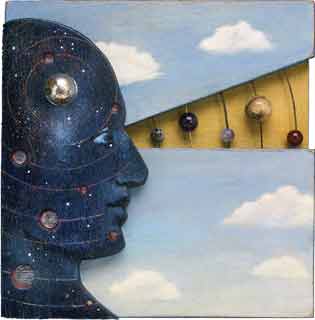 A mind is a tough thing to think about. Consciousness is the defining feature of the human species. But is it possible that it is also no more than an extravagant biological add-on, something not really essential to our survival? That intriguing possibility plays on my mind as I cross the plaza of the Salk Institute for Biological Studies, a breathtaking temple of science perched on a high bluff overlooking the Pacific Ocean in La Jolla, Calif. I have just visited the office of Terry Sejnowski, the director of Salk’s Computational Neurobiology Laboratory, whose recent research suggests that our conscious minds play less of a role in making decisions than many people have long assumed. "The dopamine neurons are responsible for telling the rest of the brain what stimuli to pay attention to," Sejnowski says, referring to the cluster of brain cells that produce one of the many chemical elixirs that activate, deactivate, or otherwise alter our mental state. In a deeper way, he explains, evolutionary factors—the need for individual organisms to survive, find food or a mate, and avoid predators—are at work behind the mechanisms of unconscious decision making. "Consciousness explains things that have already been decided for you," Sejnowski says. Asked whether that means that consciousness is only a bit player in the overarching drama of our lives, he admits that it’s hard to separate rationalizing from decision making. "But," he adds, "we might overrate the role of our consciousness in making decisions." Overrated or underrated, consciousness is not being ignored these days. Indeed, during the past 20 years or so it has become the focus of an expanding intellectual industry involving the combined, but not always harmonious, efforts of neuroscientists, cognitive psychologists, artificial intelligence specialists, physicists, and philosophers.But what, exactly, has this effort accomplished? Has it brought us any closer to understanding how the physical brain is related to the |
| Review |
 The Mind-Brain ProblemPsychologist Jerome Kagan Has Always Known that Biology Is Only a Partial Solution 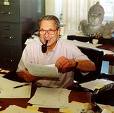 Will the sum and substance of that evanescent phenomenon we call mind one day be completely understood in terms of the physical structure and functioning of the brain? Some philosophers and scientists think so. They believe that even the deepest puzzlements of the human psyche—awareness, the sense of self, and consciousness itself—will yield to the scientific investigations of neuronal circuitry and chemistry. Thanks to a host of new and ever-improving brain-monitoring and imaging technologies, we will come to see not only how brain architecture and activity correlate with consciousness but how they cause it—and even, if we agree with the philosopher Daniel Dennett, how they are it. If successful, this dazzling feat of reductionism will close the Cartesian mind-body divide and bring the intractable mind fully into the Darwinian paradigm, making the seat of the soul no less a mystery than any other highly evolved product of natural selection. Or will it? As one might expect, dissenters and doubters abound. Among them, there is possibly no more interesting or qualified a skeptic than psychologist Jerome Kagan, a professor emeritus at Harvard University and the former director of its Mind/Brain/Behavior Interfaculty Initiative. In a career marked by works that have helped define and shape his still relatively young field—Change and Continuity in Infancy, The Nature of the Child, Galen’s Prophecy: Temperament in Human Nature, and Three Seductive Ideas are just a few of his titles—Kagan has been at the forefront of what is called the cognitive revolution in psychology. More to the point, he has been party to a major paradigm shift within his discipline. Simply put (and granting the existence of widely divergent schools within each broad paradigm), that shift has moved the field from an emphasis on nurture to one on nature, from Freudianism and behaviorism at one end to evolutionary psychology and neuroscience at the other. |