
 About the Fellowship
John Farrell
John Farrell is a freelance journalist whose writing about science and religion appears in Salon, National Review, Skeptic, Cosmos, First Things, and Catholic World Report. His most recent book is The Day Without Yesterday: Lemaître, Einstein, and the Birth of Modern Cosmology. He lives in Boston, where he has worked for the ABC affiliate as associate producer and writer.
| Review |
 Book Notes: Islam's Quantum QuestionThere have been several books published recently touting the historical contributions of Islamic scholars to the early history of science (in the Middle Ages), but fewer assessing the relationship between Muslim tradition and the challenges that modern science presents to it today. Nidhal Guessoum, an astronomer at the American University of Sharjah, takes on this daunting task with his engaging book, Islam’s Quantum Question: Reconciling Muslim Tradition and Modern Science. American readers familiar with the seemingly interminable "debates" between creationists and biologists on evolution, will not be surprised to find that many Muslims, depending on their background, also reject Darwin. But as Guessoum reveals, Islamic attitudes to science are more complex (and also more frustrating), depending on the subject. I was surprised, for example, to read that the Iranian mullahs had no problem approving embryonic stem cell research. But it turns out Muslim tradition has always been fairly liberal in its interpretation about the point at which a fetus can be considered fully human. On the other hand, as Guessoum attests from his own experience, getting officials from any two Muslim countries to agree about the role modern astronomy should play in the correct determination of the new moon, for prayer purposes, can be a daunting task. Just over four hundred pages, Islam’s Quantum Question is organized into three sections. The first reviews Islam, the Qur’an and its attitude toward science, both historically and in the present. Well aware of his audience, Guessoum’s chapters in this first section include several brief bios of historic and recent Islamic philosophers and scientists and their views on how Muslim societies should regard pure science and the applications of technology. The gamut runs from the urgent call to embrace modern science–to warnings that a truly Islamic science needs to avoid the presuppositions of the Western tradition. The second section discusses modern debates on evolution, cosmology and teleology–and how Muslim intellectuals have responded to these issues. It’s startling, for example, to read about the highly regarded Pakistani philosopher and poet, Muhammad Iqbal, a devoutly religious mystic, who dismissed two classic Western arguments for the existence of God–as a complete waste of time. |
| Column |
Remembering 9/11From Longwood Medical Area  Ten years ago today I was working at an educational institute based at the Beth Israel Deaconess Medical Center in Boston. My boss, Dr. J.B. McGee, had developed a prototype for a Virtual Patient program, one that third and fourth year Harvard Medical students could utilize (on CD-ROM) to learn some of the details of patient care that they would not be able to pick up on rounds. In a Managed Care world, patients were not in the hospital long enough for students and interns to get a comprehensive view of a particular disease or condition. J.B.’s program was designed to help fill that void. My job: I was one of the QuickTime guys; shooting and editing the video to embed in the program interface, developed using Macromedia Director and its custom code: Lingo. How clumsy it all seems now. Flash has long since displaced it. J.B. had a cable TV in his office, and we gathered that Tuesday morning, some of us just in from the Green Line with our morning coffee, when he came down the hall to tell everyone that a plane had crashed into the North Tower of the World Trade Center. Like most people, we thought it was some kind of horrible accident; and I remember listening to the voice-over commentary on CNN, even as the second plane appeared in the distant background shot of the live video of the smoking North Tower. What I recall most vividly, though, at the end of that day (or perhaps it was the next): being home after work with my ten-month old daughter. She was just learning to walk. On CNN, they were carrying footage of the Changing of the Guard at Buckingham Palace. The military band struck up the U.S. National Anthem in solidarity. Hundreds of English men and women gathered at the gates, many with tears in their eyes. When my little daughter saw my composure break, she stared at me for a few seconds before bursting into tears. |
| Column |
Science and Censorship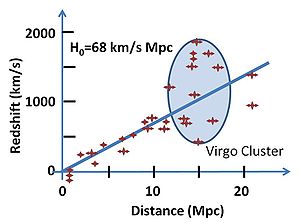 Science journal Nature picked up on my post a few weeks ago on Sidney van den Bergh’s paper on Georges Lemaître and Edwin Hubble. Time for an update on whether the Belgian Father of the Big Bang’s seminal paper was censored in deference to Hubble when it was translated into English. On Monday, Nature News blog featured a discussion with University of Witwatersrand astronomer David Lazar Block, who has followed up on van den Bergh’s paper with an arxiv pdf of his own. As Block shows, there’s been some interesting new information on the case unearthed in the archives of University of Louvain (where Lemaître taught), thanks to the detective work of Dominique Lambert, a physicist and professor of the history and philosophy of science at the University of Namur in Belgium, and author of Un Atome d’Univers, the first comprehensive biography of Lemaître. (Lambert’s excellent book was a primary source for my own short bio of the Belgian priest-physicist.) It now appears that Lemaître translated his own paper in 1931, and agreed to leave out his derivation of what’s become known as the Hubble parameter, when it was politely suggested he do so by the RAS editor, Scottish astronomer William Marshall Smart. According to Nature’s assessment: "In a 1931 letter, Scottish astronomer William Marshall Smart, who handled the translation for the Monthly Notices of the Royal Astronomical Society, writes to Lemaître to ask him to translate his paper from paragraphs 1-72. That would carefully omit paragraph 73, the equation in which the determination of the constant that later became known as Hubble’s constant appears. While this doesn’t demonstrate that Hubble communicated with or influenced Smart, Block notes that Smart would have been aware of Hubble’s desire to be credited with determining the Hubble constant and his "complex personality." |
| Column |
Putting Evolution to Work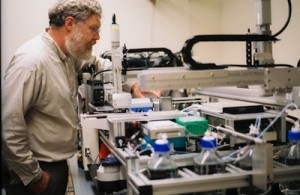 It is perhaps fitting that the new prototype of a machine Harvard Medical School geneticist George Church developed to "mass produce" new genes looks a little like a high-end stove. (Linked Photo courtesy of Marie Wu.) "Cooking," as one lab director once told me, is basically what lab researchers do. They cook with genes. The MAGE (multiplex automated genome engineering device) will allow scientists to cook exponentially faster. One of the major obstacles to genetic engineering has been the cost and labor involved in changing even a small number of genes in an organism. The most basic of traits (for example, the redness of a tomato) can depend on a complicated network of several sequences of genetic code. If any progress is to be made in changing multiple traits in organisms (especially the kind that scientists and entrepreneurs hope can be used to synthetically ‘grow’ alternative forms of fuel), then they will need to come up with a more efficient way to do it. One way, some have suggested, is to let Darwin do the work. And that’s where the MAGE comes in. Church’s machine in essence allows genetic engineers to introduce multiple versions of genes–written and synthesized in the lab–into bacterial cultures. Researchers can then ‘encourage’ (zap) the bacteria into incorporating the new genes, and once assimilated into the organisms’ genomes, multiple generations can be grown in a matter of a few days. In the process, variants of the new genes evolve and the engineers can screen the new organisms for the genomes that are most useful to them. |
| Column |
Why Hubble's Law . . . Wasn't Really Hubble'sFile this one under "Astronomers Behaving Badly" 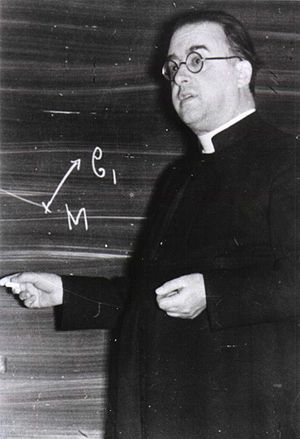 An interesting paper was posted to Cornell’s Physics arXiv this past week, concerning a key point in the history of the Big Bang Theory. As most popular science books attest, American astronomer Edwin Hubble gets the credit for ‘discovering’ the expansion of the universe in 1929 when he published observational data showing red-shifts for several galaxies (at the time they were regarded as extra-galactic nebulae, not galaxies). The red-shifts presented a puzzle to Hubble; their relative velocity, based on Doppler shift, was proportional to their distance from the Earth. He was reluctant to conclude this relationship provided evidence to support the claim that the universe was dynamic. But two years before, in 1927, Georges Lemaître, a Belgian Catholic priest and physicist, published a paper in an obscure Belgian journal, "Annales de la Societe Scientifique de Bruxelles." In that paper, he showed that the data collected by Hubble and two other astronomers up to that time was enough to derive a linear velocity-distance relation between the galaxies, and that this supported a model of an expanding universe based on Einstein’s equations for General Relativity. Lemaître’s paper was really the first attempt by a scientist to ground cosmology in something more solid than abstractions and philosophy. (I covered much of this in my biography of Lemaître in 2005.) The standard story goes that Lemaître’s work was ignored at first, because he chose to publish his paper in the Belgian journal rather than a more prominent journal like "Monthly Notices of the Royal Astronomical Society in Britain." After Hubble published his findings in 1929, he, Einstein, British astronomer Sir Arthur Stanley Eddington, and Dutch astronomer Willem de Sitter, all gathered at a special meeting of the Royal Astronomical Society and pondered how they could account for such developments based on static universe models that Einstein and de Sitter had derived with General Relativity. Seeing that no one realized the significance of his earlier work, Lemaître sent a note to Eddington, in essence, jostling his elbow and reminding his former mentor that he had a solution and had already sent a copy of the paper to him two years before. Chagrined, Eddington immediately dug up his copy, had the paper translated and published in the Monthly Notices, and Lemaître’s work was finally recognized. Up to a point. Lemaître was never given the credit for deriving the linear velocity-distance relation of the receding galaxies, a relation that has always been known as Hubble’s Law, even though it is explicit in his original 1927 paper. |
| Column |
The Myth... of the Myth of Junk DNA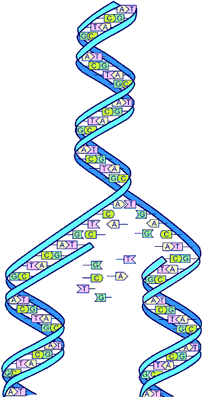 Some interesting items this week in the science blogosphere related to Junk DNA. As University of Toronto biochemist Larry Moran points out, ID proponents are gearing up to tout a new book claiming Junk DNA is a myth–and that the human genome is filled with intelligently designed genes with functions scientists are only now beginning to understand. Key to the "myth" talking points of creationists is the notion that when biologists back in the 1970s first began realizing how large a percentage of the human genome was non-coding, they simply asserted it was functionless ‘junk’ in line with their innate Darwinian bias. And now, suddenly, to their utter surprise and chagrin, various functions are in fact being discovered for the junk. From which we are to conclude, the creationist argument goes, that most scientists are knee-jerk ideological Darwinists, and isn’t this another good reason to get a better theory like intelligent design into the public school science classrooms. T. Ryan Gregory at Genomicron has tirelessly pointed out the problems with the myth argument over the past few years. He cites a number of articles from the journals of the time to show that scientists never dismissed junk DNA in the literature. His blog is a great resource on the subject in general. But also of interest, this week, are two posts (part one, part two) by botanist Stan Rice, author of Life of Earth: Portrait of a Beautiful, Middle-Aged, Stressed Out World reviewing John C. Avise’s book on just how not-so-intelligently designed the human genome actually is. |
| Column |
 Expanding Horizons for Arabic Children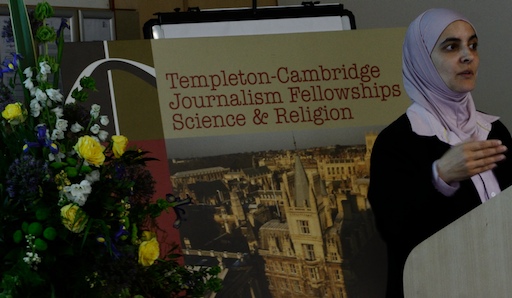 We're accustomed to seeing people reading for pleasure wherever we go: on the subways, in airports, at the beach. We take it for granted: reading as one of our main forms of entertainment. But Rana Dajani, a biologist who spent much of her childhood in the U.S., didn't realize how much it was missing from her homeland in Jordan until she was back, raising her own children. "There was a survey done by the Arabian news," she told me, "that stated Arabs read on average half a page a year compared to eleven books a year in the U.S. But it is a common observation that no one read, and I only did. Also my daughters, they only read." She added, "My daughter once said she can't wait for a day when her class mates don't ask her why she reads but what she reads." In Jordan, Saudi Arabia and elsewhere in the Middle East, she said, people read for study, for school and for their jobs. But not for pleasure. Reading for pleasure was such a key component of her own life, and that of her children, that Dajani felt she had to do something. She invited a small group of children in her neighborhood to gather and listen to her read stories aloud to them. "I thought of inviting children to my house at first," she told me. "But that wasn't an option for the long term. We needed a public place, where the children and their parents would feel they were safe." The obvious place was the mosque. "By implementing our initiative in local mosques," Dajani said, "we are essentially turning mosques into community centers opening the doors to everyone. In the Middle East, the idea of reading to a child is a new concept, as there is little emphasis on reading for pleasure outside of academic or religious contexts. We are transforming these attitudes by inspiring children and their parents to read for pleasure." It is now five years since she launched her program. We Love Reading has since sprouted reading groups and homegrown libraries in towns all over Jordan, as well as Lebanon, Saudi Arabia, the United Arab Emirates, Tunis, Turkey and expanding beyond to Malaysia. "I train someone and tell them don't pay it back, but pay it forward," she said. |
| Column |
Niles Eldredge Awarded a “Friend of Darwin”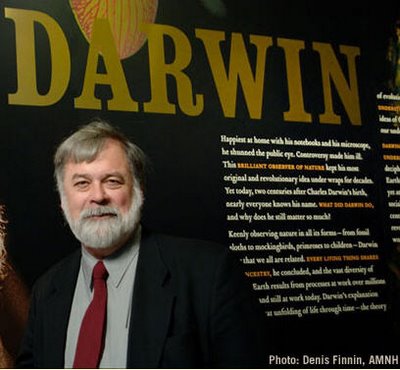 This week the National Center for Science Education awarded paleontologist and writer Niles Eldredge its Friend of Darwin award for 2011. Eldredge, who is Curator and Research Paleontologist at the American Museum of Natural History, is the author of several books on evolution and a leading opponent of creationist attempts to undercut the teaching of evolution in the public schools. In the early 1970s, Eldredge, along with his colleague the late Stephen Jay Gould, formulated the theory of punctuated equilibrium, arguing that evolution over the eons was not as gradual as Darwin argued in his Origin of Species. While Eldredge and Gould engaged in spirited debates about their theory with more ‘gene-centric’ biologists, such as Richard Dawkins, creationists tried to take advantage of the sometimes acrimonious discussion by claiming that Eldredge and Gould had fundamentally undermined "Darwinism" at its core. I contacted Eldredge about this on the day after receiving his award and asked him if this made his theory harder to defend in the early days. "Yes," he said. "Last night when I accepted the NCSE Friend of Darwin award, I started off by saying that in our early years, Steve and I were indeed considered by many, professionals and not—to be no friends of Darwin’s. And creationists did indeed seize on this." For example, he said, in 1980 former aerospace engineer Luther Sunderland, a widely known creationist, prevailed upon Ronald Reagan’s speechwriters to have Reagan allege at a fundamentalist preachers’ gathering in Texas, that evolution is only a theory—and that some scientists were beginning to have problems with it. "The syllogism was Evolution equals Darwin," said Eldredge. "Thus any criticism of Darwin was an expression of doubt about evolution. Ironically, all that was the prime mover to get me to write The Monkey Business [his first book]—to begin to confront this sorry mess." |
| Column |
What Would "Evidence" for God Look Like?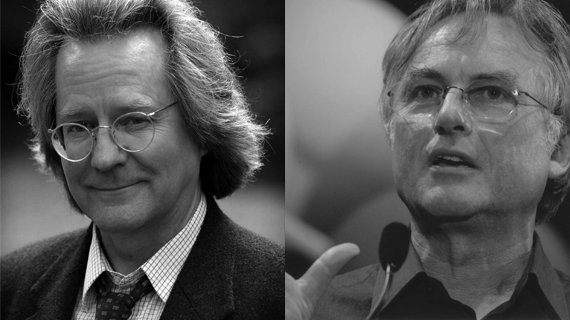 University of Chicago biologist Jerry Coyne was inspired by a recent discussion between Richard Dawkins and A. C. Grayling to defend the notion that there could be scientific evidence that might persuade him to believe in God. Coyne has tangled in the past with other atheists among the science bloggers who on a-priori grounds dismiss any such possible evidence. Maybe I’m foolish or credulous, but I continue to claim that there is some evidence that would provisionally—and I emphasize that last word—make me believe in a god. (One can always retract one’s belief if the god evidence proves to be the work of aliens, or of Penn and Teller). I agree, of course, that alternative explanations have to be ruled out in a case like this, but remember that many scientists have accepted hypotheses as provisionally true without having absolutely dismissed every single alternative hypothesis. If a violation of the laws of physics is observed, that would be telling, for neither aliens nor human magicians can circumvent those laws. While I agree with Coyne, there are good philosophical reasons traditional theists would offer for not expecting to be able to find scientific evidence either. But that’s opening up a can of worms. Grayling soon responded. What I’d like to entertain is a thought experiment that might offer the kind of evidence, or at least data, to make a skeptic take a second look. Here is a scenario I’ve adopted from an idea that New Testament scholar Ben Witherington used in a recent novel. In terms of evidence for God it’s much less fanciful than a being accompanied by angels descending from the sky in view of hundreds of people, but: An archeologist working in Israel, discovers an ossuary from the NT era: the inscription on the stone in Aramaic reads: "Twice dead under Pilatus; Twice born of Yeshua in sure hope of resurrection." And the name corresponds to what in Greek would be Lazarus. |
| Column |
Intelligent DesignLosing the Catholics  This has not been a good year for the Discovery Institute. I'm sure book sales to their core creationist audience of Biblical literalists are steady. And, as Barbara Forrest has shown, they're hoping the Louisiana State Education Act, which is directly based on their own template for state public education policy, allows Fundamentalists in at least one state to disallow biology science textbooks that teach evolution. But that's not the same thing as having one of your Institute Fellows get a paper published in Nature. Or Cell. Or Science. It's not the same thing as celebrating a grant from the NSF to pursue some promising research. The Discovery Institute has from its beginning claimed it would in short order get actual scientists to consider intelligent design as a viable scientific theory, by publishing peer-reviewed articles in the leading science journals. But they've failed. And no matter how much cheering the Institute Fellows get from friendly audiences at Bible schools and church socials, the reality is: this was not the way things were supposed to turn out. And now, they're losing the Catholics. This past year, prominent Catholic conservative intellectuals at once ID-friendly magazines and web sites, started to break their silence about the vapidity of intelligent design. First, Edward Feser, professor of philosophy at Pasadena College, began posting a series of essays showing up the hollow philosophical shell at the heart of intelligent design. Feser's main point is that, at least for Catholics, ID is hopelessly devoid of solid metaphysical grounding: "The problems are twofold. First, both Paleyan 'design arguments' and ID theory take for granted an essentially mechanistic conception of the natural world. What this means is that they deny the existence of the sort of immanent teleology or final causality affirmed by the Aristotelian-Thomistic-Scholastic tradition, and instead regard all teleology as imposed, 'artificially' as it were, from outside." |
| Article |
 Creationism Lives on in US Public Schools IN DOVER, Pennsylvania, five years ago, a group of parents were nearing the end of an epic legal battle: they were taking their school board to court to stop them teaching "intelligent design" to their children. The plaintiffs eventually won their case, and on 16 October many of them came together for a private reunion. Yet intelligent design and the creationism for which it is a front are far from dead in the US, and the threat to the teaching of evolution remains. Cyndi Sneath was one of the Dover plaintiffs who had a school-age son at the time of the trial. She has since become an active member of the American Civil Liberties Union and a member of the Dover Area School Board. "My interest in public education and civil liberties was certainly sparked by the trial," she says. "And that interest permeates our family discussions." Chemistry teacher Robert Eschbach, who was also a plaintiff, says the trial has made teachers less afraid to step on people's toes when it comes to evolution. It "forced me to be a better educator", he says. "I went back and read more of the history around Darwin and how he came to his conclusions." None of this means that the Discovery Institute, the Seattle-based think tank that promotes intelligent design, has been idle. The institute helped the conservative Louisiana Family Forum (LFF), headed by Christian minister Gene Mills, to pass a state education act in 2008 that allows local boards to teach intelligent design alongside evolution under the guise of "academic freedom". Philosopher Barbara Forrest of Southeastern Louisiana University, another key witness for the Dover plaintiffs in 2005, testified against the Louisiana education act. "Louisiana is the only state to pass a state education bill based on the Discovery Institute's template," she says. Similar measures considered in 10 other states were all defeated. Forrest heads the Louisiana Coalition for Science, and has been monitoring developments since the bill passed. In January 2009, the Louisiana Board of Elementary and Secondary Education (BESE) approved a policy that prevents Louisiana school boards from stopping schools using supplementary creationist texts hostile to evolution, such as books published by the Discovery Institute. |
| Column |
Five Years After Court Decision, Intelligent Design Advocates Still Arguing It's hard to believe it's already five years since the Kitzmiller v. Dover Area School District trial was underway at the Federal courtroom in Harrisburg, Pa. There, 11 parents of high school students successfully challenged the attempt of the school board's creationist majority to require that intelligent design be taught as an alternative to evolutionary theory. Judge John E. Jones III agreed with the plaintiffs when he ruled on Dec. 20, 2005 that the school board's action, to have students informed that evolution was not established and that intelligent design should be considered, was unconstitutional pursuant to the establishment clause, the imposition of a religious proposition into a public school science class. Ever since, the Discovery Institute, the conservative organization that actively promotes intelligent design for ideological reasons, has been trying to spin the events surrounding the trial and to denigrate the judge's decision. For a recent example, in the spring of this year, Lehigh professor of biochemistry, Michael Behe, a Discovery Institute Fellow who was a star witness for the defense during the trial, made the claim that the judge was simply not competent to understand what was truly at stake in the case. In a May interview for the Salem News with a friendly correspondent , Behe was asked whether Judge Jones was impartial and unbiased: |
| Column |
Bad Faith (in Science)Darwin as All-Purpose Boogey Man? 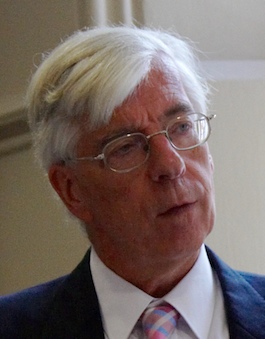 In a press release at the Discovery Institute's Evolution News, Institute Fellow John G. West recently attacked British scientist Denis Alexander for downplaying Darwin's use of the term "survival of the fittest" in his work. The philosopher Herbert Spencer first coined the term, and Darwin had reservations about employing it in his book The Origin of Species. But this is of small consequence to West and conservatives of a certain bent who loathe evolution. As far as they're concerned, evolution simply means survival of the fittest, and the application of natural selection to society in their view has inspired dangerous social movements, from Social Darwinism to Nazism. But this is just the tip of the iceberg. West writes: "Darwin opposed slavery (to his credit), but he also was a thoroughgoing racist who thought natural selection provided a scientific rationale for why we should expect to see races with different intellectual capacities. In his book The Descent of Man, Darwin disparaged blacks and observed that the break in evolutionary history between apes and humans fell "between the negro or Australian and the gorilla," indicating that he considered blacks the humans that were the most ape-like. [Darwin, Descent of Man (1871), vol. I, p. 201] Darwin also predicted that "[a]t some future period, not very distant as measured by centuries, the civilised races of man will almost certainly exterminate and replace throughout the world the savage races." [Darwin, Descent of Man (1871), vol. I, p. 201] Darwin's contribution to scientific racism is hard to deny, no matter how much contemporary Darwinists try to rewrite history. Now, what's interesting about this broadside is the selective quoting to make the point that Darwin was not just your average Victorian with a condescending bias against the intellectual capacity of non-whites. After all, this is an attitude even Abraham Lincoln shared, and he waged a destructive civil war to end slavery and keep the Southern States from seceding from the U.S." West wants his readers to realize that Darwin's racism had murderous overtones and that therefore the science of evolution must be suspect. It goes without saying that neither West nor anyone else at the Discovery Institute has any peer-reviewed research papers to counter the massive scientific evidence for evolution (a healthy sample of which can be found in this new book, already headed for its second printing: Evolution: The Extended Synthesis). |
| Column |
 Catholics and the Evolving Cosmos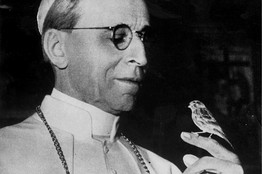 This month marks the 60th anniversary of the papal encyclical "Humani Generis," that laid out the Catholic Church's official relationship with Darwinian evolution. The pastoral letter, issued on Aug. 12, 1950 by Pope Pius XII, confirmed, in broad terms, that there is no intrinsic conflict between Christianity and the scientific theory of evolution. Considering that this was three years before the nature of DNA was even discovered, the pope's foresight in deciding to address the topic is remarkable. Eugenio Pacelli, as Pius XII was known until his papacy, 1939-958, was the first pope to regard science and technology as subjects deserving their own encyclicals, or pastoral letters to Catholics world-wide. For example, one of Pius's longest (and last) encyclicals, "Miranda Prorsus" ("Utterly Amazing," on Motion Pictures, Radio and Television), issued detailed guidelines on how Catholics in the entertainment industry should conduct themselves. In these days of downloadable pornography, and movies and music rife with sex and violence, the pope's enthusiasm for the positive social potential of entertainment, what he termed "food for the mind especially during the hours of rest and recreation," is touching. In an ironic way the pope's hopeful attitude leaves one with a much stronger sense of dismay over how the industry has evolved—or devolved—than if he had simply issued a blanket condemnation of the media as a whole. But it was another encyclical that earned Pius XII a chapter in the annals of the history of science. "Humani Generis" (Of the Human Race) laid out the Catholic Church's accommodation with Darwinian evolution—provided Christians believed the individual soul was not the product of purely material forces, but a direct creation by God. |
| Column |
 Middle Ways on EvolutionSixty years ago Pope Pius XII moved the the Catholic church to a compromise position on human evolution.  More and more these days it seems like evolution is turning into a litmus test with only two possible results. If you accept evolution, creationists consider you a heretic. If you question evolution, Darwinists denounce you as a moron. But history shows that a qualified acceptance of evolution was, from the moment Darwin published his Origin of Species, a default position for many who were open to the theory, even when they were deeply disturbed by it. Sixty years ago the controversial pope Pius XII, for example, made an accommodation with evolution the official position of the Catholic Church, when he wrote in his encyclical Humani Generis, that the scientific investigation of the material origins of the human body was perfectly legitimate, provided Catholic theologians kept in mind that the soul was to be considered always the direct creation of God. This is not a position that would win friends amongst creationists or materialists. But it was a step forward for the Catholic Church, as it had not been nearly so accommodating to theologians even a generation before Pius XII. In two noteworthy cases in the late 19th century, Father Rafaello Caverni in Italy, and Father Dalmace Leroy in France were forced to withdraw from publication thoughtful books they had written attempting to reconcile Christianity with evolution. What's fascinating about the cases of both priests, is that their books were quite modest, and very conservative: both argued—as many theists do today—that all species, with the exception of the human race, could be considered the products of evolution, while reserving for humanity alone a special status as the direct creation of God. [You don't have to be religious to believe that humans are special; it has been the default position of Hollywood filmmakers since Kubrick produced This was not good enough for critics in Rome, and after long deliberations and reviews by the Holy Office, which decided whether certain works should be placed on the Index of Forbidden Books, both men good naturedly submitted in writing retractions that today would be considered utterly humiliating for any scholar. History would prove kinder to them, however. Indeed, one of the reasons Pope Pius XII decided to address evolution formally in 1950 was to alleviate some of the embarrassment the Catholic Church felt over of its treatment of scholars like Caverni, Leroy and others. |