
 About the Fellowship
Barbara Bradley Hagerty
Barbara Bradley Hagerty has been the religion correspondent for National Public Radio since January 2003, reporting on the intersection of faith and politics, law, science, and culture. Before that, she was the Justice Department correspondent. She was the lead correspondent covering the investigation into the September 11th attacks. Her reporting was part of NPR's coverage that earned the network the 2001 Peabody and Overseas Press Club awards. In her capacity as religion correspondent, she received the 2004 Religion Newswriters Association award for radio reporting. Before coming to NPR in 1995, she worked at the Christian Science Monitor and as senior Washington correspondent for Monitor Radio. She has published articles in the Los Angeles Times Sunday Magazine, London Times, and Vogue.
| Broadcast |
 Clergy Insulted by Speaking Ban on 9/11Mayor Michael Bloomberg is banning clergy-led prayer at events marking the 10th anniversary of the 9/11 attacks. The mayor's office says he wants to avoid disagreements. Some religious groups call the ban a sign of prejudice against religion. 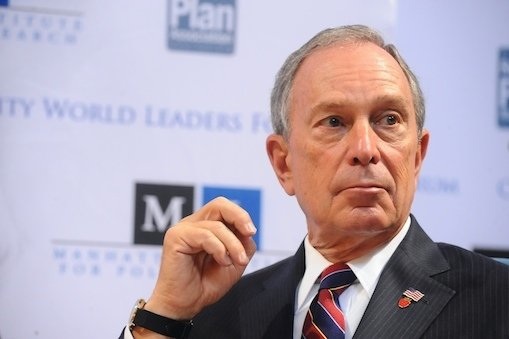 DAVID GREENE, host: When people gather in New York City Sunday to remember the September 11th attacks, members of the clergy will have no official role. That was the decision by Mayor Michael Bloomberg. NPR's Barbara Bradley Hagerty has a look at the reaction. BARBARA BRADLEY HAGERTY: Each year for the past decade, the main ceremony has involved reading the names of victims, allowing moments of silence, but never opening the podium to clergy. Julie Wood, a spokeswoman for the mayor, says it's the way family members want it. Ms. JULIE WOOD (Spokeswoman, Mayor Michael Bloomberg): It's been widely supported in the past 10 years. And, you know, rather than have disagreements over which religious leaders participate, we wanted to keep the focus of the commemoration ceremony on the family members of those who died on 9/11. Dr. RICHARD LAND (Southern Baptist Convention): As more and more people find out about this, they're incredulous. HAGERTY: Richard Land of the Southern Baptist Convention says ground zero is a sacred place, and barring clergy from an official role is an insult. Dr. LAND: It's clear that there are attempts by some to marginalize religious expression and religious faith. |
| Broadcast |
Memories Of Sept. 11's First Recorded Casualty EndureWhen planes hit the World Trade Center on Sept. 11, 2001, Father Mychal Judge ran into the North Tower alongside the firemen he served. Not long after, he became the first recorded victim of the terrorist attacks. But 10 years later, his friends and colleagues remember Judge as vividly in death as they knew him in life: a gregarious, irreverent man wholly devoted to God, whom many considered a saint, in large part because of his own personal struggles. Priest On A Fire LadderFrom the first, Mychal Judge loved to be where the action is. His friend and fellow friar Michael Duffy remembers an episode when they were both young Franciscan priests in East Rutherford, N.J. Judge heard that a man had locked himself in the attic of his home and was threatening to shoot his wife and baby. Soon after, Michael Duffy arrived at the scene. There were police cars, fire trucks, TV crews — and a figure climbing up the ladder to the attic. "Who's on the ladder?" Duffy laughs. "Father Mychal Judge! And in his habit." The priest, in his long brown robe and sandals, climbed in the window and disappeared. "We waited 5 minutes, 10 minutes, 15 minutes. Sweating bullets, waiting for that gunshot," Duffy recalls. "The next thing you know, 20 minutes later, the front door opens, and out comes the wife holding the baby, the man with the guy, and Mychal Judge with his arm around him." So it was no surprise when Judge moved to the priory across the street from the firehouse on West 31st St., one of New York City's busiest fire stations. He became a department chaplain in 1992. Craig Monahan, a retired fireman, remembers Judge as a strapping guy, with big hands and thick, white hair. "He had a deep voice, like a man's man, you know?" Monahan says. "I could picture him, chopping down a door with an axe. He would love to do that, too. He'd love to get in on the drills and practice with the Halligan, swinging it, breaking the door or something. He fit right in, you know?" Another retired fireman, Jimmy Boyle, agrees that Father Mychal was one of the boys — but not when he was performing religious ceremonies. "He could go into the firehouse, have a cup of coffee, have a meal, listen to all the talk, watch the ballgame, hear your problems, talk about anything you want," Boyle says. "But when he said Mass in the firehouse, I always felt when he got to the Eucharist, he just transformed himself. He became like Christ. He was just so pious." |
| Broadcast |
Evangelicals Question the Existence Of Adam And Eve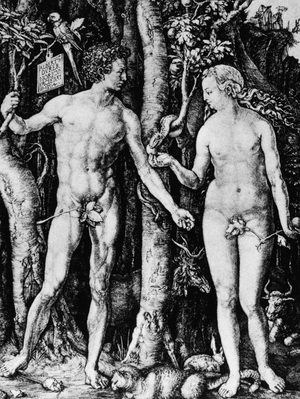 Let's go back to the beginning — all the way to Adam and Eve, and to the question: Did they exist, and did all of humanity descend from that single pair? According to the Bible (Genesis 2:7), this is how humanity began: "The Lord God formed man of the dust of the ground, and breathed into his nostrils the breath of life; and man became a living soul." God then called the man Adam, and later created Eve from Adam's rib. Polls by Gallup and the Pew Research Center find that four out of 10 Americans believe this account. It's a central tenet for much of conservative Christianity, from evangelicals to confessional churches such as the Christian Reformed Church. But now some conservative scholars are saying publicly that they can no longer believe the Genesis account. Asked how likely it is that we all descended from Adam and Eve, Dennis Venema, a biologist at Trinity Western University, replies: "That would be against all the genomic evidence that we've assembled over the last 20 years, so not likely at all." Researching The Human GenomeVenema says there is no way we can be traced back to a single couple. He says with the mapping of the human genome, it's clear that modern humans emerged from other primates as a large population — long before the Genesis time frame of a few thousand years ago. And given the genetic variation of people today, he says scientists can't get that population size below 10,000 people at any time in our evolutionary history. To get down to just two ancestors, Venema says, "You would have to postulate that there's been this absolutely astronomical mutation rate that has produced all these new variants in an incredibly short period of time. Those types of mutation rates are just not possible. It would mutate us out of existence." Venema is a senior fellow at BioLogos Foundation, a Christian group that tries to reconcile faith and science. The group was founded by Francis Collins, an evangelical and the current head of the National Institutes of Health, who, because of his position, declined an interview. And Venema is part of a growing cadre of Christian scholars who say they want their faith to come into the 21st century. Another one is John Schneider, who taught theology at Calvin College in Michigan until recently. He says it's time to face facts: There was no historical Adam and Eve, no serpent, no apple, no fall that toppled man from a state of innocence. "Evolution makes it pretty clear that in nature, and in the moral experience of human beings, there never was any such paradise to be lost," Schneider says. "So Christians, I think, have a challenge, have a job on their hands to reformulate some of their tradition about human beginnings." |
| Broadcast |
Circumcision: Age-Old Rite Faces Modern Concerns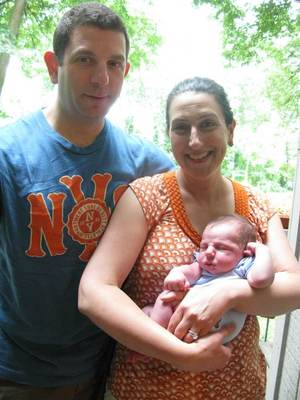 FFor many couples, having a baby is a spiritual experience. For Jews, there's another, religious, element that is intrinsic to the Jewish identity. Nearly all Jewish parents have their baby boys circumcised, as commanded by God in the Bible. And yet, for some Jewish couples, whether to circumcise or not is becoming an agonizing decision. The ritual dates back four millennia to the book of Genesis, where God made Abraham a deal. God promised to give Abraham children, land and a special relationship as his God. In exchange, God said, "Every manchild among you shall be circumcised. And ye shall circumcise the flesh of your foreskin, and it shall be a token of the covenant betwixt me and you." Some 4,000 years after God made that covenant with the world's first Jew, the contract still holds. And on their eighth day, Jewish boys make good on that promise. "This is one of the most important things we do as a people," says Steven Adashek, a doctor and mohel who has performed more than 3,500 circumcisions. "In the 613 Mitzvah commandments given in the Torah, which are given in order of importance, doing the bris [circumcision ceremony] is the second one listed, which means the second most important one that we do," he says. "The only one that takes precedence is that first commandment, which was 'Be fruitful and multiply.'" A 'Transcendent' Bris CeremonyOn 8-day-old Bram Goldstein's big day, several dozen friends and family gather at 10 a.m. at a friends' home in Maryland to celebrate the boy's entrance into Judaism. Susanna Garfein, Bram's mother, says she's emotional, but not squeamish. Neither she nor her husband, Ross Goldstein, is having second thoughts. "It is something that has a history, that more so than anything else, connects people to their Jewish identity," she says. "We knew we wanted to raise him Jewish and that's the first step on that process," adds her husband, Ross. "This is tradition, it is part of our culture, it is what we do, and there was no question that we would do this." Before the ceremony, the parents and Dr. Steven Adashek whisk Bram to a bedroom upstairs, where the mohel does last-minute preparations. Increasingly, couples are seeking out mohels with a medical degree, because they can administer a local anesthetic and help avoid both the pain and the crying during the ceremony. "If we can do something more to alleviate pain, we should," Adashek says. "The Torah says we have to do this on the eighth day, but nowhere does it say it has to hurt. The best bris is where everybody cries except the baby." |
| Broadcast |
U.S. Muslims React: Relief, But Not For All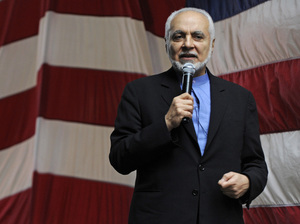 Muslims in the U.S. reacted quickly, and with relief, Monday to the news that Osama bin Laden had been killed. But some wondered if it will really ease tensions that many Muslims feel from their neighbors. On the streets of Dearborn, Mich., Muslims were reveling in the death of the al-Qaida leader. Muslims in the U.S. reacted quickly, and with relief, Monday to the news that Osama bin Laden had been killed. But some wondered if it will really ease tensions that many Muslims feel from their neighbors. On the streets of Dearborn, Mich., Muslims were reveling in the death of the al-Qaida leader. "This guy should have been dead a long time ago," says Hassain Yami. "Hopefully the rest them will be dead soon." "He did not give Muslims a good name, so I think it's definitely a victory for us," says Channah Ali, adding that bin Laden distorted the Muslim faith. Muhammad Cheab says he hopes that now Americans will see Muslims in a new light. "We're good American citizens," he says. "We pay our taxes and live like everyone else does and we're proud to live here." Cheab hopes bin Laden's death will take the heat off Muslims here. Feisal Abdul Rauf, the imam who stepped into controversy by trying to locate a mosque near ground zero, believes it will do just that. "I think that this is a turning point," he says. "There's still an enormous amount of work to be done. But there's no doubt, in the American perception this has helped a lot to bring closure." It's hard to find an American Muslim leader who has criticized the American military action. Some clerics abroad say burying bin Laden at sea violated Muslim laws and was aimed at humiliating Muslims. But not Nihad Awad, executive director of the Council on American Islamic Relations. "The most important issue is that this terrorist has been eliminated," he said at a press conference. "And Muslims do not care about the details of how he was buried." |
| Broadcast |
Hallelujah! At Age 400, King James Bible Still Reigns This year, the most influential book you may never have read is celebrating a major birthday. The King James Version of the Bible was published 400 years ago. It's no longer the top-selling Bible, but in those four centuries, it has woven itself deeply into our speech and culture. Let's travel back to 1603: King James I, who had ruled Scotland, ascended to the throne of England. What he found was a country suspicious of the new king. "He was regarded as a foreigner," says Gordon Campbell, a historian at the University of Leicester in England. "He spoke with a heavy Scottish accent, and one of the things he needed to legitimize himself as head of the Church of England was a Bible dedicated to him." At that time, England was in a Bible war between two English translations. The Bishops' Bible was read in churches: It was clunky, inelegant. The Geneva Bible was the choice of the Puritans and the people: It was bolder, more accessible. "The problem with the Geneva Bible was it had marginal notes," says David Lyle Jeffrey, a historian of biblical interpretation at Baylor University. "And from the point of view of the royalists, and especially King James I, these marginal comments often did not pay sufficient respect to the idea of the divine right of kings." Those notes referred to kings as tyrants, they challenged regal authority, and King James wanted them gone. So he hatched an idea: Bring the bishops and the Puritans together, ostensibly to work out their differences about church liturgy. His true goal was to maneuver them into proposing a new Bible. His plans fell into place after he refused every demand of the Puritans to simplify the liturgy, and they finally suggested a new translation. With that, James commissioned a new Bible without those seditious notes. Forty-seven scholars and theologians worked through the Bible line by line for seven years. |
| Broadcast |
After Tsunami, Japanese Turn To Ancient Rituals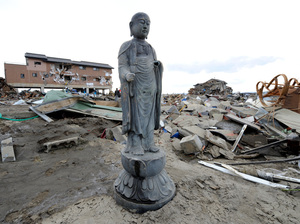 The Japanese are beginning memorial ceremonies for people killed in the earthquake and tsunami. Times of crisis lead many people to turn to religion for strength and comfort. In Japan, the focus will be on honoring the dead, and moving on with life. On Monday, Tokyo Gov. Shintaro Ishihara startled many when he said, "The Japanese people must take advantage of this tsunami to wash away their selfish greed. I really do think this is divine punishment." The governor soon apologized. But people were shocked, not just because it seemed to blame the victims — but also because it is so at odds with the beliefs of modern-day Japanese. Moving Beyond The 'Why'"They know about tectonic plates, geography, geology — they know why tsunamis happen," says John Nelson, an expert on Asian religions at the University of San Francisco. "And they don't need some governor to say it's the will of heaven that this happened," he says. Nelson says that while Japanese society is largely secular, events frequently drive them back to ancient traditions. "There's a famous saying in Japanese that, 'People turn to the gods in times of trouble,' " he says. "And I think we'll see that here." The rituals of Shinto and Buddhism permeate Japanese life. And in these two belief systems, scholars say, people do not focus on why the tragedy happened, but on how they should proceed. After Deaths, Buddhist RitualsDuncan Williams is a Buddhist priest who just returned from Japan. "We can't pinpoint exactly what brought this about," Williams says. "I think the takeaway is that, for Buddhists, it almost doesn't matter what caused this situation; what's important is the response." |
| Broadcast |
A Hearing To Ask: Are Muslims Being Radicalized?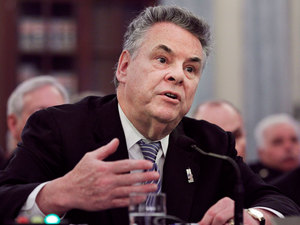 SSome call the hearing a witch hunt. Others say it's a reality check. House Homeland Security Committee Chairman Rep. Peter King, a Long Island Republican, believes the hearing he has scheduled for Thursday morning is a valuable investigation into the "radicalization" of many U.S. Muslims. The hearing, entitled "The Extent of Radicalization in the American Muslim Community and that Community's Response," will help lawmakers better understand the threats posed by radicals who live in the United States — and are tolerated by their fellow Muslims, he says. "We are under siege by Muslim terrorists, and yet there are Muslim leaders in this country who do not cooperate with law enforcement," King told Fox News. "We have the reality that al-Qaida is trying to recruit Muslim Americans, and yet we have people in the Muslim community who refuse to face up to this." King says it's necessary to investigate homegrown terrorism. But Corey Saylor, at the Council on American Islamic Relations, says that might be a valid topic — except that he believes King has an agenda. Stacking The Deck Against Muslims?"He's said things like, 'There are too many mosques in America.' He's alleged that 80 percent of American Muslim leadership is extremist, yet never produced a single bit of evidence to back that up," Saylor says. "So that's the kind of thing that leads you to the Salem witch trials, the Inquisition, and frankly, McCarthyistic hearings." Saylor fears King is stacking the deck against Muslims by calling witnesses who do not represent most Muslims in this country. He points to the primary witness, M. Zudhi Jasser, a doctor in Phoenix who founded what Saylor says is an obscure group called American Islamic Forum for Democracy. For his part, Jasser says, it's clear that many Muslims have been radicalized: There have been 60 terrorism plots in the past two years. "Just look at the arrests — from Portland to Baltimore to the Times Square bomber, and on and on, there have been more and more arrests," he says. "So this is not just a pie-in-the-sky discussion. This is a reality that we have to deal with." Jasser, who says his group has about 2,000 members, says America needs to understand the root cause of this violence. He describes this root cause as a "political movement of Islamism that has as a goal to create Islamic states, that want to put into place Shariah law, that give women third-class status, that give other faiths secondary status, that give moderate Muslims or critics of imams no voice." |
| Broadcast |
Religious Groups Tackle An X-Rated Secret This Super Bowl Sunday, church may be as jarring as a quarterback sack for some worshippers who, after settling into their pews, discover that the subject of the morning's sermon is pornography. More than 300 churches are expected to celebrate National Porn Sunday on Feb. 6. The members will watch a video sermon featuring current and former NFL players talking about their struggles with pornography. "No one knew my problem was this bad," former New York Jets wide receiver Eric Boles says in the video. "I would go home, and I would sit there, and the laptop and I would have a conversation," says Josh McCown, who played quarterback for several NFL teams, most recently the Carolina Panthers. "And I would battle with not even wanting to open it, not even wanting to check e-mails because I knew where it might lead me." "I mean, you go to MSN or CNN or MSNBC," adds quarterback Jon Kitna of the Dallas Cowboys, "and you see this, and it leads to a link to this, and pretty soon I'm into a world that I never knew existed." Elephant In The PewsPresence Church in Addison, Texas, will be one of the churches playing the video on Sunday. Steven Kirlin, the church's pastor, hopes that seeing football stars talk about pornography will break a taboo. "I think that opens up others to say, 'Well, I'm not only going to give this a listen, but I might actually feel a little more free to talk about this because these guys are willing to talk about it,'" Kirlin says. Pornography is the elephant in the pews, says Craig Gross, who produced the video and whose sermon is featured in it. "The statistics say that 48 percent of Christian families are dealing with the issue of pornography in their home," Gross says. "I would say the other 52 percent are just unaware of it being an issue in their house." |
| Broadcast |
Church Foreclosures: Hard Times For God's Work The Lord giveth and the bank taketh away — at least, that is what a lot of churches have found recently. Lenders foreclosed on about 100 churches last year, an enormous increase from just a few years ago. It suggests even doing God's work does not always keep the creditors away. For Dan Burr, the road to losing his church last year began with the greatest of hopes. Twelve years ago, Burr and his wife started to worship with a few friends in their son's house in Fontana, Calif., a community about 80 miles East of Los Angeles. Neighbors began to come to the service. They brought their kids. "And it began to grow, and before we knew it we had a little viable church," Burr recalls. Eventually Crossroads Community Church bought a building of its own — a dilapidated Boy's Club that church members fixed up themselves. Those were the glory days. Fontana was one of the fastest growing cities in the country, church attendance was booming and Burr began to make big plans. "We were looking at [buying] vast tracks of land, building family community centers, day care and youth centers," he says, his voice brimming with enthusiasm. "We were going to really going to do this! It was great — and then BAM!" The economic bottom fell out, and members started losing their jobs. "First, one in 10, then one in eight, then one in six of our wage earners was out of work. They just couldn't find work," Burr says. Church offerings dropped 20 to 25 percent. The church cut staff, trimmed programs to the bone, but finally, it simply couldn't pay the mortgage. A year ago, it gave the building back to the bank. Now members are renting it until the bank finds a buyer and Crossroads is starting over. "We built up this building — just blood sweat and tears — to turn a ratty piece of land into a gorgeously landscaped thing," Burr says. "And to just walk away from it — that's hard." |
| Broadcast |
Army's 'Spiritual Fitness' Test Angers Some Soldiers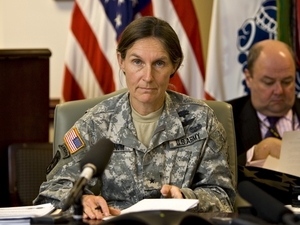 Multiple tours in Iraq and Afghanistan have taken a toll on soldiers: Witness the rise in suicides and other stress-related disorders. A few years ago, the Army noticed that some soldiers fared better than others, and it wondered: Why? One reason, says Brig. Gen. Rhonda Cornum, is that people who are inclined toward spirituality seem to be more resilient. "Researchers have found that spiritual people have decreased odds of attempting suicide, and that spiritual fitness has a positive impact on quality of life, on coping and on mental health," says Cornum, who is director of Comprehensive Soldier Fitness. 'Foxhole Atheist' UpsetWorking with psychological researchers, the Army developed a survey to assess a soldier's family relationships and his well-being — emotionally, socially and spiritually. Every soldier was required to take the survey, including Justin Griffith, a sergeant at Fort Bragg, N.C. Griffith, who describes himself as a "foxhole atheist," says he grew angry as the computerized survey asked him to rank himself on statements such as: "I am a spiritual person. I believe that in some way my life is closely connected to all of humanity. I often find comfort in my religion and spiritual beliefs." "The next question was equally shocking," Griffith says. " 'In difficult times, I pray or meditate.' I don't do those things, and I don't think any of those questions have anything to do with how fit I am as a soldier." Griffith finished the survey, pressed submit, and in a few moments, he received an assessment: "Spiritual fitness may be an area of difficulty." |
| Broadcast |
For These Young Nuns, Habits Are The New Radical For the most part, these are grim days for Catholic nuns. Convents are closing, nuns are aging and there are relatively few new recruits. But something startling is happening in Nashville, Tenn. The Dominican Sisters of St. Cecilia are seeing a boom in new young sisters: Twenty-seven joined this year and 90 entered over the past five years. The average of new entrants here is 23. And overall, the average age of the Nashville Dominicans is 36 — four decades younger than the average nun nationwide. Unlike many older sisters in previous generations, who wear street clothes and live alone, the Nashville Dominicans wear traditional habits and adhere to a strict life of prayer, teaching and silence. They enter the chapel without saying a word, the swish of their long white habits the only sound. It is 5:30 in the morning, pitch black outside — but inside, the chapel is candescent as more than 150 women kneel and pray and fill the soaring sanctuary with their ghostly songs of praise. A few elderly sisters sit in wheelchairs, but most of these sisters have unlined faces and are bursting with energy. Watching them, you wonder what would coax these young women to a strict life of prayer, teaching, study and silence. And did they always want to be nuns? "No," says Sister Beatrice Clark, laughing. "I didn't know they still existed." Clark, who is 27, says she became aware of the religious life when she was a student at Catholic University in Washington. In her junior year, she began feeling that God was drawing her to enter a convent. Over Thanksgiving vacation in 2004, she broke the news to her family. "My parents just sat there and looked at me," she says. "And they cried. And I said, 'I think I'm supposed to enter soon.' And my father said, 'This is the time of life to take leaps.'" She joined the Nashville Dominicans on her 22nd birthday. Silence — SometimesThe sisters eat breakfast in silence, sitting side by side at long tables, served by the novices in white habits and veils. Sister Joan of Arc, who's 27, stoops to pour coffee. At 6 feet, 2 inches, the former basketball player for the University of Notre Dame is hard to miss. Sister Joan of Arc, who was born Kelsey Wicks, like the others here adopted a new name when she entered. She says she worked on refugee issues after college, then received a scholarship to Notre Dame Law School. But her plans shifted when she went on a medical mission trip: In Africa she saw abject physical poverty, but it was nothing compared with the impoverishment she saw when she came home. |
| Broadcast |
 What Do Scientists Believe?Religion Among Scientists and Implications for Public Perceptions On December 15, 2010 DoSER and the AAAS Center for Public Engagement with Science and Technology hosted a lively discussion about the religious beliefs of scientists and the implications for dialogue between the scientific and religious communities. Rice University sociologist Elaine Howard Ecklund described her recent major study of scientists, and NPR religion correspondent Barbara Bradley Hagerty discussed the results in light of the media’s coverage of science and religion and her own experiences in engaging with the public. |
| Broadcast |
Two Views of Likely Catholic Leader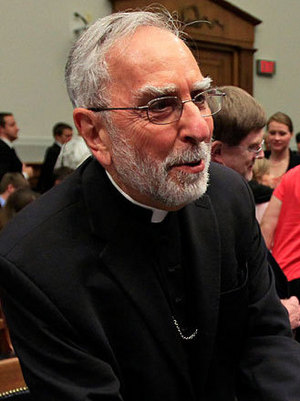 The U.S. Conference of Catholic Bishops gathers in Baltimore this week to decide who will be its next president, and if past is prologue, we know who will win: Bishop Gerald Kicanas of Tucson, Ariz. But this year, what is usually a rote decision is garnering a flurry of debate. Kicanus is seen as an easygoing diplomat who prefers digging into policy papers over hogging the spotlight. And he's popular. "In his diocese, he's seen as one of the most effective bishops in the country," says Rocco Palmo, a close observer of the Catholic Church, who writes the blog "Whispers in the Loggia". Palmo says Kicanas earned that reputation after 2003, when he became bishop of Tucson, where he inherited a diocese rife with sex abuse allegations and on the brink of bankruptcy. "While some dioceses have struggled — and it's been an acrimonious time — the Tucson bankruptcy under Kicanas' leadership has been seen as a national model," Palmo says. The bankruptcy judge publicly praised Kicanas for treating the victims well spiritually and financially, Palmo says, and in a vote of confidence, donations to the bishop's appeal outstripped their expectations a year after the bankruptcy. That's one view of Kicanas. Another is held by Terry McKiernan, who runs the watchdog group BishopsAccountability.org and says practically every bishop in the pipeline for the presidency has been tainted by the sex abuse scandal. |
| Broadcast |
Hitchens Brothers Agree To Disagree Over God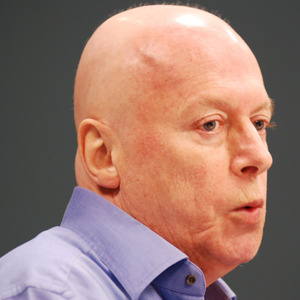 JJournalist Christopher Hitchens is one of the world's most famous atheists. His brother, Peter, insists that a civilized world must believe in God. The brothers have publicly argued over faith for years. But now that Christopher Hitchens has been diagnosed with cancer, the theoretical argument has become real. Just how real was apparent at the Pew Forum on Religion and Public Life, where the brothers were having a public conversation about God. Christopher Hitchens often wears a white straw hat. He says his head, completely bald from chemotherapy treatments, gets cold. He's tired. He's thin. He's off his food. But ask Hitchens, author of "God Is Not Great," if having cancer has changed his view of religion or God. "If anything, my contempt for the false consolation of religion has increased since I became aware that I probably don't have very long to live," he replies. Since Hitchens' cancer diagnosis in June, he has received thousands of letters and e-mails, some from believers asserting that he's getting what he deserves, more from people saying they're praying for his recovery. Hitchens says he has been overwhelmed by the outpouring. But he is annoyed that some writers hope he'll have a last-minute conversion to Christianity. "Under no persuasion could I be made to believe that a human sacrifice several thousand years ago vicariously redeems me from sin," he says. "Nothing could persuade me that that was true — or moral, by the way. It's white noise to me." His brother, Peter, is equally blunt: "There is actually no absolute right or wrong if there is no God," he says. Peter once shared his older brother's views; he burned his Bible when he was a teenager in boarding school. But as he chronicled in his book, "The Rage Against God" — which he wrote as a response to his brother's anti-religious book — he felt drawn back to his Anglican faith starting in his late 20s. He says his work as a journalist in Somalia and the former Soviet Union convinced him that civilization without religious morality devolves into brutality. Moral behavior requires more than higher reasoning, he says; it requires God. "It seems to me to be very, very, very hard to come up with an atheistic explanation of conscience any more than you can have a compass with a magnetic north," he says. "If the magnetic north kept shifting, then it would be very difficult to steer your boat or your plane across the Atlantic." |
| Broadcast |
Teaching Young American Muslims Late last month, the 15 students who comprise Zaytuna College's inaugural class settled in to their first day in a classroom near the University of California, Berkeley. For these students, this is a chance to study with top Islamic scholars. For the school's founders, it's a chance to hone a new image for American Islam. I don't know what I expected to find when I arrived at Zaytuna College in Berkeley, Calif., the country's brand new Muslim liberal arts college. Women in headscarves? Yes, for the most part. Men with heavy beards? No. A lot of prayer and fasting, since it's Ramadan? Absolutely. What I didn't expect was 24-year-old Jamye Ford. "I grew up as an AME, African-American Episcopal, in a very religious Southern family," Ford says in the campus quad. "I went to church every Sunday for hours at a time, I went to Bible study, did all of those things. And from a young age, I had curiosity about religion in general and other religions." Ford bought a Quran at a secondhand bookstore when he was 9 and memorized a few sura or passages, which he always remembered. He entered Columbia University at 16 and graduated with a double major in neuroscience and history. But he was drawn to the poetry of the Quran, and this summer, he began studying Arabic at Zaytuna. |
| Radio Broadcast |
Christian Academics: Hostility on Campus One of the hot debates in academia is now reaching the courts. The question: Do universities discriminate against religious conservatives? Some professors and students say they do, but it's not an easy charge to pin down. When Elaine Howard Ecklund began asking top scientists whether they believe in God, she got a surprise. Ecklund, an assistant professor at Rice University and author of the book Science Vs. Religion, polled 1,700 scientists at elite universities. Contrary to the stereotype that most scientists are atheists, she says, nearly half of them say they are religious. But when she did follow up interviews, she found they practice a "closeted faith." "They just do not want to bring up that they are religious in an academic discussion. There's somewhat of almost a culture of suppression surrounding discussions of religion at these kinds of academic institutions," Ecklund says. She says the scientists worried that their colleagues would believe they were politically conservative — or worse, subscribed to the theory of intelligent design. Ecklund says they all insisted on anonymity. Fewer Evangelicals In AcademiaAnd it appears that climate may extend beyond science departments. A poll of 1,200 academics by the Institute for Jewish and Community Research found that more than half said they have unfavorable feelings toward evangelical Christians. Aryeh Weinberg, who co-authored the study, says one reason for this is that there are relatively few evangelicals in academia. "The question is, why? Do they self-select out, and if they do, why are they self-selecting out? Are they actually not hired? Are they trying to get hired but not getting hired? Are they getting hired then being forced out, not getting tenure?" Weinberg asks. Randall Balmer, a professor of American religious history at Columbia University and an Episcopal priest, disagrees. "I haven't encountered that hostility at all," Balmer says. "I've been a visiting professor at places like Emory and Northwestern and Yale and Princeton and other places. And I simply have not encountered that sort of hostility to my claims of faith or my professions of faith." |
| Radio Broadcast |
Can Your Genes Make You Murder? When the police arrived at Bradley Waldroup's trailer home in the mountains of Tennessee, they found a war zone. There was blood on the walls, blood on the carpet, blood on the truck outside, even blood on the Bible that Waldroup had been reading before all hell broke loose. Assistant District Attorney Drew Robinson says that on Oct. 16, 2006, Waldroup was waiting for his estranged wife to arrive with their four kids for the weekend. He had been drinking, and when his wife said she was leaving with her friend, Leslie Bradshaw, they began to fight. Soon, Waldroup had shot Bradshaw eight times and sliced her head open with a sharp object. When Waldroup was finished with her, he chased after his wife, Penny, with a machete, chopping off her finger and cutting her over and over. "There are murders and then there are ... hacking to death, trails of blood," says prosecutor Cynthia Lecroy-Schemel. "I have not seen one like this. And I have done a lot." Prosecutors charged Waldroup with the felony murder of Bradshaw, which carries the death penalty, and attempted first-degree murder of his wife. It seemed clear to them that Waldroup's actions were intentional and premeditated. "There were numerous things he did around the crime scene that were conscious choices," Lecroy-Schemel says. "One of them was [that] he told his children to 'come tell your mama goodbye,' because he was going to kill her. And he had the gun, and he had the machete." It was a pretty straightforward case. Even Waldroup said so during his trial last year. He said on the murderous night, he just "snapped," and he admitted that he killed Leslie Bradshaw and attacked his wife. "I'm not proud of none of it," Waldroup said. "It wasn't a who done it?" says defense attorney Wylie Richardson. "It was a why done it?" read more… listen… [] |
| Radio Broadcast |
Inside A Psychopath's BrainThe Sentencing Debate  Kent Kiehl has studied hundreds of psychopaths. Kiehl is one of the world's leading investigators of psychopathy and a professor at the University of New Mexico. He says he can often see it in their eyes: There's an intensity in their stare, as if they're trying to pick up signals on how to respond. But the eyes are not an element of psychopathy, just a clue. Officially, Kiehl scores their pathology on the Hare Psychopathy Checklist, which measures traits such as the inability to feel empathy or remorse, pathological lying, or impulsivity. "The scores range from zero to 40," Kiehl explains in his sunny office overlooking a golf course. "The average person in the community, a male, will score about 4 or 5. Your average inmate will score about 22. An individual with psychopathy is typically described as 30 or above. Brian scored 38.5 basically. He was in the 99th percentile." "Brian" is Brian Dugan, a man who is serving two life sentences for rape and murder in Chicago. Last July, Dugan pleaded guilty to raping and murdering 10-year-old Jeanine Nicarico in 1983, and he was put on trial to determine whether he should be executed. Kiehl was hired by the defense to do a psychiatric evaluation. Kiehl with the brain scanner he uses at prisons. He has scanned the brains of more than 1,100 inmates, about 20 percent of whom are psychopaths.(Barbara Bradley Hagerty) In a videotaped interview with Kiehl, Dugan describes how he only meant to rob the Nicaricos' home. But then he saw the little girl inside. "She came to the door and ... I clicked," Dugan says in a flat, emotionless voice. "I turned into Mr. Hyde from Dr. Jekyll." On screen, Dugan is dressed in an orange jumpsuit. He seems calm, even normal -- until he lifts his hands to take a sip of water and you see the handcuffs. Dugan is smart -- his IQ is over 140 -- but he admits he has always had shallow emotions. He tells Kiehl that in his quarter century in prison, he believes he's developed a sense of remorse. "And I have empathy, too -- but it's like it just stops," he says. "I mean, I start to feel, but something just blocks it. I don't know what it is." Kiehl says he's heard all this before: All psychopaths claim they feel terrible about their crimes for the benefit of the parole board. read more… listen… [] |
| Radio Broadcast |
A Neuroscientist Uncovers a Dark Secret The criminal brain has always held a fascination for James Fallon. For nearly 20 years, the neuroscientist at the University of California-Irvine has studied the brains of psychopaths. He studies the biological basis for behavior, and one of his specialties is to try to figure out how a killer's brain differs from yours and mine. About four years ago, Fallon made a startling discovery. It happened during a conversation with his then 88-year-old mother, Jenny, at a family barbecue. "I said, 'Jim, why don't you find out about your father's relatives?' " Jenny Fallon recalls. "I think there were some cuckoos back there." Fallon investigated. "There's a whole lineage of very violent people -- killers," he says. One of his direct great-grandfathers, Thomas Cornell, was hanged in 1667 for murdering his mother. That line of Cornells produced seven other alleged murderers, including Lizzy Borden. "Cousin Lizzy," as Fallon wryly calls her, was accused (and controversially acquitted) of killing her father and stepmother with an ax in Fall River, Mass., in 1882. A little spooked by his ancestry, Fallon set out to see whether anyone in his family possesses the brain of a serial killer. Because he has studied the brains of dozens of psychopaths, he knew precisely what to look for. To demonstrate, he opened his laptop and called up an image of a brain on his computer screen. "Here is a brain that's not normal," he says. There are patches of yellow and red. Then he points to another section of the brain, in the front part of the brain, just behind the eyes. "Look at that -- there's almost nothing here," Fallon says. This is the orbital cortex, the area that Fallon and other scientists believe is involved with ethical behavior, moral decision-making and impulse control. "People with low activity [in the orbital cortex] are either free-wheeling types or sociopaths," he says. Fallon's ScansHe's clearly oversimplifying, but Fallon says the orbital cortex puts a brake on another part of the brain called the amygdala, which is involved with aggression and appetites. But in some people, there's an imbalance -- the orbital cortex isn't doing its job -- perhaps because the person had a brain injury or was born that way. read more… listen… [] |
| Radio Broadcast |
Nun Excommunicated for Allowing Abortion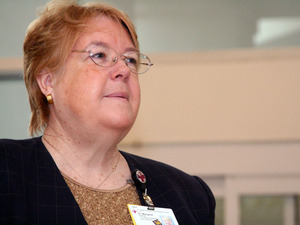 Last November, a 27-year-old woman was admitted to St. Joseph's Hospital and Medical Center in Phoenix. She was 11 weeks pregnant with her fifth child, and she was gravely ill. According to a hospital document, she had "right heart failure," and her doctors told her that if she continued with the pregnancy, her risk of mortality was "close to 100 percent." The patient, who was too ill to be moved to the operating room much less another hospital, agreed to an abortion. But there was a complication: She was at a Catholic hospital. "They were in quite a dilemma," says Lisa Sowle Cahill, who teaches Catholic theology at Boston College. "There was no good way out of it. The official church position would mandate that the correct solution would be to let both the mother and the child die. I think in the practical situation that would be a very hard choice to make." But the hospital felt it could proceed because of an exception — called Directive 47 in the U.S. Catholic Church's ethical guidelines for health care providers — that allows, in some circumstance, procedures that could kill the fetus to save the mother. Sister Margaret McBride, who was an administrator at the hospital as well as its liaison to the diocese, gave her approval. The woman survived. When Bishop Thomas J. Olmsted heard about the abortion, he declared that McBride was automatically excommunicated — the most serious penalty the church can levy. "She consented in the murder of an unborn child," says the Rev. John Ehrich, the medical ethics director for the Diocese of Phoenix. "There are some situations where the mother may in fact die along with her child. But — and this is the Catholic perspective — you can't do evil to bring about good. The end does not justify the means." Ehrich adds that under canon or church law, the nun should be expelled from her order, the Sisters of Mercy, unless the order can find an alternative penalty. Ehrich concedes that the circumstances of this case were "hard." "But there are certain things that we don't really have a choice" about, he says. "You know, if it's been done and there's public scandal, the bishop has to take care of that, because he has to say, 'Look, this can't happen.' " A Double Standard?But according to the Rev. Thomas Doyle, a canon lawyer, the bishop "clearly had other alternatives than to declare her excommunicated." Doyle says Olmsted could have looked at the situation, realized that the nun faced an agonizing choice and shown her some mercy. He adds that this case highlights a "gross inequity" in how the church chooses to handle scandal. |
| Radio Broadcast |
Is The Bible More Violent Than the Quran?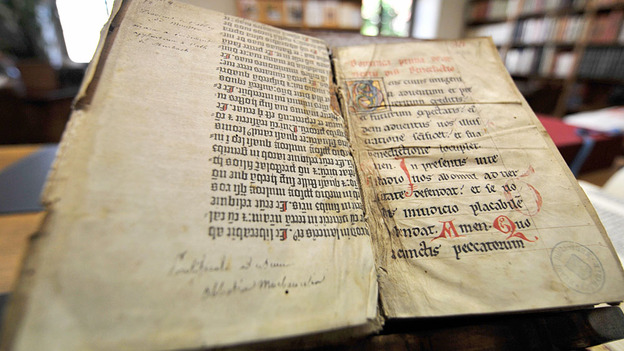 As the hijackers boarded the airplanes on Sept. 11, 2001, they had a lot on their minds. And if they were following instructions, one of those things was the Quran. In preparation for the suicide attack, their handlers had told them to meditate on two chapters of the Quran in which God tells Muslims to "cast terror into the hearts of unbelievers." "Slay the idolaters wherever ye find them, arrest them, besiege them, and lie in ambush everywhere for them," Allah instructs the Prophet Muhammad (Quran, 9:5). He continues: "Prophet! Make war on the unbelievers and the hypocrites! ... Hell shall be their home, an evil fate." When Osama bin Laden declared war on the West in 1996, he cited the Quran's command to "strike off" the heads of unbelievers. More recently, U.S. Army Maj. Nidal Hasan lectured his colleagues about jihad, or "holy war," and the Quran's exhortation to fight unbelievers and bring them low. Hasan is accused of killing 13 people at Fort Hood, Texas, last year. Given this violent legacy, religion historian Philip Jenkins decided to compare the brutality quotient of the Quran and the Bible. Defense Vs. Total Annihilation"Much to my surprise, the Islamic scriptures in the Quran were actually far less bloody and less violent than those in the Bible," Jenkins says. Jenkins is a professor at Penn State University and author of two books dealing with the issue: the recently published Jesus Wars, and Dark Passages , which has not been published but is already drawing controversy. Violence in the Quran, he and others say, is largely a defense against attack. "By the standards of the time, which is the 7th century A.D., the laws of war that are laid down by the Quran are actually reasonably humane," he says. "Then we turn to the Bible, and we actually find something that is for many people a real surprise. There is a specific kind of warfare laid down in the Bible which we can only call genocide." |
| Radio Broadcast |
Catholic Hospitals, Bishops Split on Health Care Bill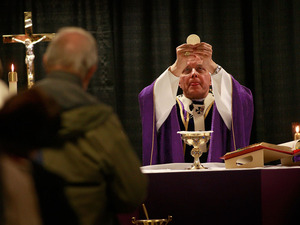 Few people shape the minds of Catholic bishops on abortion more than Richard Doerflinger, their point man on anti-abortion issues. He's studied the House and Senate bills, and he's fine with the House bill. But he says the Senate version presents loopholes that could allow for federally funded abortions. "This would be an enormous expansion of abortion funding that has not been seen in this country for 37 years," since abortions became legal after Roe v. Wade, he says. In the past, the bishops have supported universal health care. But taking Doerflinger's lead, the U.S. Conference of Catholics Bishops is urging lawmakers not to vote for this year's bill. Point Of DepartureUsually Catholic hospitals march in lock step with the bishops on abortion issues — but not this time. Sister Carol Keehan of the Catholic Health Association, which represents Catholic hospitals, is lobbying lawmakers to vote for the bill. "I believe this bill is a good first step," she says, adding that the legislation would provide health care to more than 30 million poor people and ease costs for everyone else. As for abortion, she says her group did its own legal analysis, studied the analyses of other groups, talked to experts and found no loopholes. If there were any concerns, Keehan says, the administration put those to rest. "We have the president, we have the speaker of the House, we have the leader of the Senate, and we have the secretary of HHS [Department of Health and Human Services] saying publicly, there will be no federal funding for abortion," she says. Bishops' Spokesman UnconvincedBut Doerflinger says that as much as the administration promises to prohibit such abortions, "they don't have the authority to do it." Doerflinger points to the community health centers, which are run by Health and Human Services and provide health care to millions of low-income Americans. He says the administration may not intend federal money to go for abortions at these centers, but he says there is no language stopping it. In the past, federal courts have ruled that unless Congress explicitly prohibits it, federal money can be used to pay for abortions. "That overrides the president, that overrides HHS, that overrides the wishes of the community health centers themselves," he says. "You have to have Congress say it, or there is a mandate in the legislation, bred into it by the courts that this includes abortion." The issue has sparked a rare war between the bishops and other Catholic institutions. Now a group representing nearly 60,000 Catholic nuns is urging Congress to pass the bill — arguing that the bishops were making "false claims" about abortion. |
| Radio Broadcast |
Voodoo Brings Solace to Grieving Haitians Erol Josue lost more than two dozen friends and extended family in Haiti's devastating earthquake. The Voodoo priest, who lives in New York, says he has spent the past week saying traditional Voodoo prayers. "We thank God that we are still alive," he says, "but we also pray to give a good route, to give a good path for the people who passed away. And also we pray to ask the question, 'What happened?' " Spirit Worship And RevelationsVoodoo is playing a central role in helping Haitians cope with their unthinkable tragedy. Outside of Haitian culture, few know what Voodoo is. Elizabeth McAlister, a Voodoo expert at Wesleyan University, says at its core, the philosophy is really pretty simple. "Voodoo in a nutshell is about the idea that everything material has a spiritual dimension that is more real" than physical reality, she says. "So everything living — but even rocks and the Earth — is considered to have spirit and have a spiritual nature." McAlister says there is no unified Voodoo religion. There's no "Voodoo Pope" or central authority, no Voodoo scripture or even a core doctrine. "It's a religion that really operates through revelation," she says. "So people can receive dreams or visions, and even be possessed by spirits, and that spirit can tell them something, and that's the revelation." Widespread Below The SurfaceAnd yet, Haitian Voodoo blends many of its rituals and beliefs — which came with the slaves from Africa — with Western Catholicism. For example, Voodoo believers worship Le Grand Maitre, or Grand Master, who is the equivalent of the Christian God. They pray to loa, or spirits, who then intercede with God on their behalf — just as Catholics pray to saints. Voodoo believers also revere their ancestors, who guide them through their daily difficulties. On the books, 80 percent of Haitians say they are Catholic. But Josue says Voodoo is widespread — just under the surface. "Haiti is not a Catholic country," he says. "Haiti is a Voodoo country." Apparently that's what Pat Robertson thinks as well. Less than a day after the earthquake, the televangelist declared that Haiti has been cursed since 1791 when, he said, Voodoo practitioners "made a pact [with] the devil" to rid themselves of French occupiers. |
| Radio Broadcast |
 Fingerprints of GodNational Public Radio correspondent Barbara Bradley Hagerty explores the quest to find actual physical evidence of God in her book, "Fingerprints of God: The Search for the Science of Spirituality." Hagerty spoke about her book as part of Minnesota Public Radio's Broadcast Journalist series. read more… listen… [mpr player, 54 minutes 8 seconds] |
| Radio Broadcast |
A Bitter Rift Divides Atheists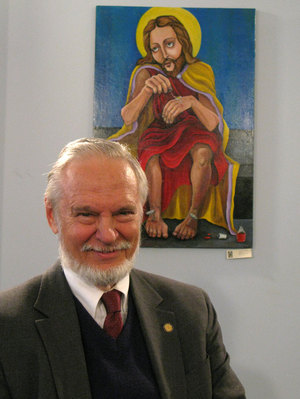 Last month, atheists marked Blasphemy Day at gatherings around the world, and celebrated the freedom to denigrate and insult religion. Some offered to trade pornography for Bibles. Others de-baptized people with hair dryers. And in Washington, D.C., an art exhibit opened that shows, among other paintings, one entitled Divine Wine, where Jesus, on the cross, has blood flowing from his wound into a wine bottle. Another, Jesus Paints His Nails, shows an effeminate Jesus after the crucifixion, applying polish to the nails that attach his hands to the cross. "I wouldn't want this on my wall," says Stuart Jordan, an atheist who advises the evidence-based group Center for Inquiry on policy issues. The Center for Inquiry hosted the art show. Jordan says the exhibit created a firestorm from offended believers, and he can understand why. But, he says, the controversy over this exhibit goes way beyond Blasphemy Day. It's about the future of the atheist movement — and whether to adopt the "new atheist" approach — a more aggressive, often belittling posture toward religious believers. Some call it a schism. "It's really a national debate among people with a secular orientation about how far do we want to go in promoting a secular society through emphasizing the 'new atheism,' " Jordan says. "And some are very much for it, and some are opposed to it on the grounds that they feel this is largely a religious country, and if it's pushed the wrong way, this is going to insult many of the religious people who should be shown respect even if we don't agree with them on all issues." Jordan believes the new approach will backfire. A Schism?Jordan is a volunteer at the center and therefore could speak his mind. But interviews for this story with others associated with the Washington, D.C., office were canceled — a curious development for a group that promotes free speech. |
| Radio Broadcast |
Woman Reads Dan Brown Novel, Discovers Herself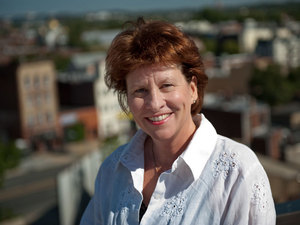 Dan Brown's latest blockbuster, The Lost Symbol, is jampacked with surprising twists and turns — especially for Marilyn Schlitz. "Waking up one morning to find yourself a fictional character in a best-selling novel has taken a little adjusting to," she says, laughing. The day before The Lost Symbol arrived in bookstores, Schlitz began to notice some unusual traffic on Twitter. Rumor had it that the heroine in the book was a woman at the Institute of Noetic Sciences — a real institute in California that conducts research on things like consciousness and healing. Schlitz is president of the institute. She bought the book the next day and read into the wee hours. "As I'm reading along and hearing the descriptions of the types of research that she's doing and the types of data that she's using to support her case, my husband would be falling asleep, and I'd be jabbing him and saying, 'Listen to this!' It was really very surprising and delightful at the same time," she says. Surprising, because Dan Brown never contacted the institute, yet he seemed to know all about their research, even the fact that they had built a 2,000-pound electromagnetically shielded laboratory that Brown calls "the Cube." Then on the day of publication — contact. "Dan Brown sent a very sweet e-mail saying, 'As you know, I'm a big fan of the Institute of Noetic Sciences. I had hoped to give you a heads-up,' " Schlitz says. "But because of the security around the book, he wasn't able to. But he was hoping we were enjoying the attention." They are indeed. Traffic to their Web site has increased twelvefold. New members are joining up, and journalists from places like Dateline NBC — not to mention NPR — are calling for interviews. |
| Radio Broadcast |
The Everlasting Message Of Reverend Ike Frederick J. Eikerenkoetter, was born in Ridgeland, S.C., to a Dutch Indonesian father and African-American mother. He became pastor of his father's Baptist church at age 14. But eventually he moved to a more charismatic faith — one that which focused on faith healing — and he traded the doctrines of sin and suffering for a philosophy of abundance. He became known as Reverend Ike. "He was part revivalist, part evangelist, part Johnny Mathis, if you will," says Jonathan Walton, an assistant professor of religion at the University of California at Riverside, who has written about Eikenerenkoetter. "He would often say these lines such as, 'You know, I come to you today lookin' good, feelin' good and smellin' good.' And this would just kind of ooze off of him. And this charisma just attracted persons from many different ranges of society." In the 1970s, Reverend Ike's sermons drew hundreds to his Palace Cathedral, a renovated movie theater in New York's Washington Heights. He reached millions more through radio and TV with this message, and started a newspaper and a magazine. He was one of the first to advocate what is now known as the "prosperity Gospel." The idea is that God wants each of us to be spiritually and materially abundant. At one of his sermons at a Madison Square Garden, for example, he told the packed crowd: "If you can honestly think and feel that you are worthy or deserve a million dollars, that million dollars must come to you!" "His message is quintessentially American, right?" says Professor Walton. "It's this kind of God is on your side, if you can see it, if you can believe it, you can claim it. And God wants this for you." And Reverend Ike's own success was Exhibit A. He owned multiple homes and more than two dozen cars, including a few Rolls-Royces. He had many critics, who claimed he was preying on the poor. He faced several lawsuits and government investigations into his ministries. Other Christian leaders derided his theology as shallow and misguided.
Initially, Carlton Pearson, interim senior pastor at Christ Universal Temple, says he was once one of them. "People would testify, 'I came here in my raggedy car and I'm drivin' away with a Cadillac!' But we just felt it was what we call carnal, unspiritual, that he was talking to the flesh and speaking to the ego and all that kind of thing." But if leaders didn't like Reverend Ike, his congregants — largely middle- and working-class blacks — did. When others, like the Rev. Martin Luther King Jr., talked of sacrifice and social reform, Reverend Ike spoke of material empowerment. "I say there no virtue in poverty," he would preach. "There is no honor in poverty! There is no style in poverty! Poverty doesn't have any class!" |
| Radio Broadcast |
Mayan Calendar Spurs End-Of-The-World Debate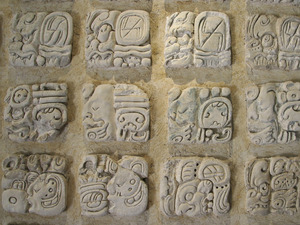 For those people making long-term plans, note this: The end of the world as we know it will be on Dec. 21, 2012 — at least, that's if you believe the Mayan calendar. According to the ancient Mayas, who were known for their timekeeping prowess, the end of the "long count" calendar is only 1,241 days away — and Lawrence Joseph is waiting. "2012 is indeed considered a profoundly pivotal date in human and in terrestrial history," Joseph says. Joseph, who authored Apocalypse 2012, says he began looking at Mayan prophecy several years ago. He noticed that the Mayas' end date coincided with peak activity of solar flares three years from now. He says those flares could fry the world's electrical systems, leaving people without electricity for months or years — affecting the distribution of water, fresh food and medication. "I think we're looking at a nonnegligible possibility that the year 2012 can be really, unprecedentedly tumultuous, and lead to a next and scary chapter in civilization's history," Joseph says. Joseph doesn't predict the end of the world. But Hollywood does. The Sony picture 2012 starring John Cusack comes to theaters this fall, and it's no picnic. There are tsunamis cresting over mountains, covering cities, and toppling the Dome of St. Peter's Basilica in Rome, which then rolls down the avenue. The storyline is drawn from various scenarios laid out in books such as The Complete Idiot's Guide to 2012, which foresee earthquakes, drought and planetary collisions. Those books point both to scientifically accepted events such as an upcoming alignment of planets in our solar system — and to, well, not scientifically accepted events such as the arrival of a mysterious Planet X into Earth's orbit. Skeptical ScientistsNot surprisingly, scientists are not convinced. "We don't miss big things like that," says Lawrence Rudnick, an astronomer at the University of Minnesota. Planet alignment will not change the tides or create tsunamis. There is no Planet X. Scientists don't even talk about 2012. |
| Article |
 The God ChoiceArmed with new technology, scientists are peering into the brain to better understand human spirituality. What if, they say, God isn’t some figment of our imagination? Instead, perhaps brain chemistry simply reflects an encounter with the divine. 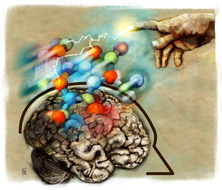 A few years ago, I witnessed two great British scientists in a showdown. Nine other journalists and I were on a Templeton fellowship at Cambridge University, and on this particular morning, the guest speaker was John Barrow. Almost as an aside to his talk, the Cambridge mathematician asserted that the astonishing precision of the universe was evidence for "divine action." At that, Richard Dawkins, the Oxford biologist and famous atheist, nearly leapt from his seat. "But why would you want to look for evidence of divine action?" demanded Dawkins. "For the same reason someone might not want to," Barrow responded with a little smile. For the past century, science has largely discarded "God" as a delusion and proclaimed that all our "spiritual" moments, events, thoughts, even free will, can be explained through material means. But a revolution is occurring in science. It is called neurotheology, and it is sparked by researchers from universities such as Pennsylvania, Virginia and UCLA. Armed with technology Freud never dreamed of, these scientists are peering into the brain to understand spiritual experience. Perhaps, they say, God is not a figment of our brain chemistry; perhaps the brain chemistry reflects an encounter with the divine. In that instant, I thought, there it is. God is a choice. You can look at the evidence and see life unfolding as a wholly material process, |
| Radio Broadcast |
On Science and God NPR's Barbara Bradley Hagerty spent a year exploring the science of spirituality for her book Fingerprints of God, and what she concluded was that science can't prove or disprove the existence of God. "But there was something that I saw in interviewing dozens of scientists," Bradley Hagerty tells NPR's Michele Norris. "The science of spirituality is like a Rorschach test — that you can look at the evidence and come to opposite conclusions." Bradley Hagerty says that a materialist would say a spiritual experience is just brain chemistry — or firings in the temporal lobe of the brain — and it's all explainable by material means. But someone else could look at the same evidence and say that people are wired to be able to connect with the divine and that brain chemistry is a reflection of an encounter. Bradley Hagerty says she could have taken 10 more years to research the book. "One of the great pleasures was interviewing people who have had spiritual experiences; it's not just the scientists," she says, adding she talked with Jews, Christians, Buddhists, Muslims, people who were spiritual but not religious. "One of the interesting things is what they described as a spiritual experience was basically the same: An encounter with light, an encounter with love, often an out-of-body experience. What that told me is spiritual experience is spiritual experience — it's a human phenomenon and in fact, it may be divine." read more… listen… [npr player, 2 minutes 47 seconds; All Things Considered] |
| Radio Broadcast |
Decoding the Mystery of Near-Death ExperiencesMost scientists say that when the brain stops operating, so does consciousness. Materialists say the visions people report experiencing close to death are hallucinations. A few scientists posit that consciousness is related to the material brain. 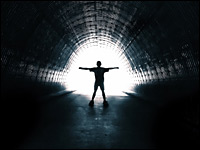 We've all heard the stories about near-death experiences: the tunnel, the white light, the encounter with long-dead relatives now looking very much alive. Scientists have cast a skeptical eye on these accounts. They say that these feelings and visions are simply the result of a brain shutting down. But now some researchers are giving a closer neurological look at near-death experiences and asking: Can your mind operate when your brain has stopped? 'I Popped Up Out The Top Of My Head'I met Pam Reynolds in her tour bus. She's a big deal in the music world — her company, Southern Tracks, has recorded music by everyone from Bruce Springsteen to Pearl Jam to REM. But you've probably never heard her favorite song. It's the one Reynolds wrote about the time she traveled to death's door and back. The experience has made her something of a rock star in the near-death world. Believers say she is proof positive that the mind can operate when the brain is stilled. Nonbelievers say she's nothing of the sort. Reynolds' journey began one hot August day in 1991. "I was in Virginia Beach, Va., with my husband," she recalls. "We were promoting a new record. And I inexplicably forgot how to talk. I've got a big mouth. I never forget how to talk."An MRI revealed an aneurysm on her brain stem. It was already leaking, a ticking time bomb. Her doctor in Atlanta said her best hope was a young brain surgeon at the Barrow Neurological Institute in Arizona named Robert Spetzler. "The aneurysm was very large, which meant the risk of rupture was also very large," Spetzler says. "And it was in a location where the only way to really give her the very best odds of fixing it required what we call 'cardiac standstill.' " It was a daring operation: Chilling her body, draining the blood out of her head like oil from a car engine, snipping the aneurysm and then bringing her back from the edge of death. "She is as deeply comatose as you can be and still be alive," Spetzler observes.read more… listen… [All Things Considered; npr player, 10 minutes 4 seconds] |
| Radio Broadcast |
Can Positive Thoughts Help Heal Another Person?Fourth of a five-part series  Ninety percent of Americans say they pray — for their health, or their love life or their final exams. But does prayer do any good? For decades, scientists have tried to test the power of prayer and positive thinking, with mixed results. Now some scientists are fording new — and controversial — territory.
Mind Over BodyWhen I first meet Sheri Kaplan, she is perched on a plastic chair at a Miami clinic, holding out her arm as a researcher draws several vials of blood. "I'm quite excited about my blood work this time," she says. "I've got no stress and I'm proud of it." Kaplan is tanned and freckled, with wavy red hair and a cocky laugh. She is defiantly healthy for a person who has lived with HIV for the past 15 years. "God didn't want me to die or even get sick," she asserts. "I've never had any opportunistic infections, because I had no time to be down." Kaplan's faith is unorthodox, but it's central to her life. She was raised Jewish, and although she claims no formal religion now, she prays and meditates every day. She believes God is keeping the virus at bay and that her faith is the reason she's alive read more… listen… [npr player, 8 minutes 26 seconds] |
| Radio Broadcast |
Prayer May Reshape Your Brain.... and Your RealityThird of a five-part series  Scientists are making the first attempts to understand spiritual experience — and what happens in the brains and bodies of people who believe they connect with the divine. The field is called "neurotheology," and although it is new, it's drawing prominent researchers in the U.S. and Canada. Scientists have found that the brains of people who spend untold hours in prayer and meditation are different. I met Scott McDermott five years ago, while covering a Pentecostal revival meeting in Toronto. It was pandemonium. People were speaking in tongues and barking like dogs. I thought, "What is a United Methodist minister, with a Ph.D. in New Testament theology, doing here?" Then McDermott told me about a vision he had had years earlier. "I saw fire dancing on my eyelids," he recalled, staring into the middle distance. "I felt God say to me, 'You be the oil, and I'll be the flame.' Then [I] began to feel waves of the Spirit flow through my body." I never forgot McDermott. When I heard that scientists were studying the brains of people who spent countless hours in prayer and meditation, I thought, "I've got to see what's going on in Scott McDermott's head." Focusing Affects RealityA few years later, Andrew Newberg made that possible. Newberg is a neuroscientist at the University of Pennsylvania and author of several books, including How God Changes Your Brain. He has been scanning the brains of religious people like McDermott for more than a decade. read more… listen… [All Things Considered; npr player, 8 minutes 7 seconds] |
| Radio Broadcast |
Are Spiritual Encounters All in Your Head?Second of a five-part series 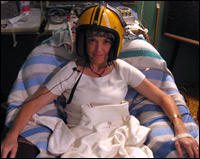 According to polls, there's a 50-50 chance you have had at least one spiritual experience — an overpowering feeling that you've touched God, or another dimension of reality. So, have you ever wondered whether those encounters actually happened — or whether they were all in your head? Scientists say the answer might be both. If you're looking for evidence that religion is in your head, you need look no further than Jeff Schimmel. The 49-year-old Los Angeles writer was raised in a Conservative Jewish home. But he never bought into God — until after he was touched by a being outside of himself. "Yeah," Schimmel says, "I was touched by a surgeon." About a decade ago, Schimmel had a benign tumor removed from his left temporal lobe. The surgery was a snap. But soon after that — unknown to him — he began to suffer mini-seizures. He'd hear conversations in his head. Sometimes the people around him would look slightly unreal, as if they were animated. Then came the visions. He remembers twice, lying in bed, he looked up at the ceiling and saw a swirl of blue and gold and green colors that gradually settled into a shape. He couldn't figure out what it was. "And then, like a flash, it dawned on me: 'This is the Virgin Mary!' " he says. "And you know, it's funny. I laughed about it, because why would the Virgin Mary appear to me, a Jewish guy, lying in bed looking at the ceiling? She could do much better." read more… listen… [npr player, 8 minutes 5 seconds] |
| Radio Broadcast |
The God Chemical: Brain Chemistry and MysticismFirst of a five-part series  For much of the 20th century, mainstream science shied away from studying spirituality. Sigmund Freud declared God to be a delusion, and others maintained that God, if there is such a thing, is beyond the tools of science to measure. But now, some researchers are using new technologies to try to understand spiritual experience. They're peering into our brains and studying our bodies to look for circumstantial evidence of a spiritual world. The search is in its infancy, and scientists doubt they will ever be able to prove — or disprove — the existence of God. Peyote Healing The search for that answer led me to my first peyote ceremony, on a mountaintop on the Navajo reservation at Lukachukai, Ariz. While Fred Harvey, an 87-year-old roadman, or high priest, warmed up his voice, members of his family prepared the peyote, a cactus that induces visions when ingested. Using peyote to touch the spiritual world has been central to the Navajo religion for hundreds of years. Andy Harvey, a ceremony participant, said peyote serves as a mediator between the human world and the divine. "Sometimes we ask the peyote to help us cleanse the illnesses away and cleanse our mental being, our spiritual being," he said. "And we believe that's what peyote does, too. That's why we call it a sacrament, a sacred herb." I spent a year exploring the emerging science of spirituality for my book, Fingerprints of God. One of the questions raised by my reporting: Is an encounter with God merely a chemical reaction? Peyote HealingThe search for that answer led me to my first peyote ceremony, on a mountaintop on the Navajo reservation at Lukachukai, Ariz. While Fred Harvey, an 87-year-old roadman, or high priest, warmed up his voice, members of his family prepared the peyote, a cactus that induces visions when ingested. Using peyote to touch the spiritual world has been central to the Navajo religion for hundreds of years. read more… listen… [npr player, 7 minutes 55 seconds] |
| Article |
Dying In A Brain Scanner, Sort OfExcerpted From 'Fingerprints Of God' 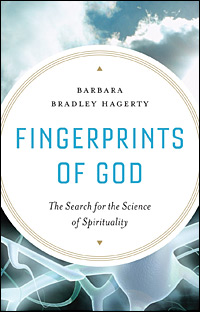 The Holy Grail for near-death researchers is a physical marker, like a stamp in a passport that testifies that Mrs. Brown crossed into sacred territory and returned. In thirty years of focused research, scientists have never located such a marker. Perhaps a marker exists, perhaps it doesn't — but until recently, scientists lacked both the technology and the funding to even try. Neurologist Peter Fenwick believes those markers do lie somewhere in the folds of the brain or the rhythm of its electrical current. Any major neurological event registers in the brain and then manifests itself in behavior. The brain images of people with post-traumatic stress disorder, for example, show cerebral changes. "So it's likely that people who have a transcendent experience will also have changes in their brain as well," Fenwick speculated. "This is shown really because they then have changes in behavior. With post-traumatic stress, it's increased anxiety. In near-death experiences, it tends to be more social awareness, more spirituality, and so on. So these will in fact be accompanied by some cerebral markers. I'm sure we'll find them when we start looking for them." Which brings us to the University of Montreal, where the hunt for a spiritual marker is in full cry. Jorge Medina winced slightly as I shook his hand in the entryway of the University of Montreal Medical Center. We exchanged halting hellos — Jorge in his shy, stuttered English, his third language, after Spanish and French. I searched his face for some signature of trauma, and found wide brown eyes, a hearty black mustache, a face smooth and coppery and completely unmarred. I unclasped Jorge's hand, and let my gaze fall to his forearm. There lay a tapestry of mottled brown-and-white skin, as shiny and inflexible as vinyl. His arm was a partial road map of his journey through the flames. Fire had left ninety percent of Jorge's body with third-degree burns, mercifully leaving his face unscathed. |
| Article |
 Choosing Tylenol and God I would like to say I left the faith of my childhood for exclusively noble reasons. While it is true that I made the final break with Christian Science because I was drawn to a simpler, "mere Christianity," as C.S. Lewis described it, what initially beckoned me from the faith was Tylenol. As a Christian Scientist, I had been taught that prayer and disciplined thinking had the power to alter my experience, whether that was my wracking cough or my employment status, my mood or my love life. I had witnessed many physical healings as a child, and by the age of 34, I had never visited the doctor (except to set a broken bone) never popped a vitamin, never swallowed an aspirin or taken a swig of cough medicine. But on one frigid winter day in 1994, I came down with the flu. I slipped in and out of consciousness all afternoon, but in a moment of lucidity I envisioned the medicine cabinet above the bathroom sink. At that moment, what flashed in my mind's eye like a blinking neon sign was Tylenol, Tylenol, Tylenol. A friend of mine, I recalled, had left some Tylenol during a visit. I slipped out of bed and staggered to the medicine cabinet. Before I could stop myself, I downed one tablet, closed the cabinet, and stumbled quickly back to bed. Five minutes passed. My teeth stopped chattering. Another minute or so, I began to feel quite warm, no, hot, hot, what was I doing under all these covers? I felt the fever physically recede like a wave at low tide, and thought, Wow, I feel terrific! It would take me another 16 months before I would leave the religion of my childhood for good for theological reasons. But I lost something - namely, a way to prove God. Christian Scientists believe that the ultimate evidence for God lay in answered prayers and physical healings - but I no longer counted that as evidence. After all, science has shown the mechanism by which a person's thoughts can affect his body - it has the felicitous name, psychoneuroimmunology, and it has no need for God. Others are looking to quantum mechanics to explain - oh so controversially - why one person's prayers might have an effect on another person's body. God's presence is not required there, either. |
| Discussion |
 Religion and Science: Conflict or Harmony?Some of the nation's leading journalists gathered in Key West, Fla., in May 2009 for the Pew Forum on Religion & Public Life's Faith Angle Conference on religion, politics and public life. .jpg "Graphic of angel & science from Pew Forum on Religion & Public Life") Some of the nation’s leading journalists gathered in Key West, Fla., in May 2009 for the Pew Forum on Religion & Public Life’s Faith Angle Conference on religion, politics and public life. Francis S. Collins, the former director of the Human Genome Project, discussed why he believes religion and science are compatible and why the current conflict over evolution vs. faith, particularly in the evangelical community, is unnecessary. Collins, an evangelical Christian, talked about his path from atheism to Christianity and his belief that science provides evidence of God. He cited the Big Bang theory and the fact that the universe had a beginning out of nothing. He added that the laws of physics have precisely the values needed for life to occur on earth and argued that would seem to point to a creator. Barbara Bradley Hagerty, the religion correspondent for National Public Radio, discussed how the brain reacts to spiritual experiences. She talked about the current debate over whether transcendent experiences are merely physiological events or whether they reflect encounters with another dimension. Bradley Hagerty said she believes that "God is a choice," that people can look at scientific evidence and conclude that everything is explained by material means or that they can look at the universe and see the hand of God. |
| Column |
 On GodTuning in  I was sitting in a small examination room at Detroit’s Henry Ford Hospital when the question hit me with the force of a tank: Is the brain a radio, or a CD player? Not an elegant question, surely, but it has nipped at my heels for the past three years. The conundrum offered itself as I was interviewing a man named Terrence Ayala at the hospital’s epilepsy clinic. Several years earlier, Ayala had undergone an operation that left him with a stuttering problem, and more. Often when falling asleep, but other times as well, he would sense a "dark presence," usually looming over him, as real and tangible as the chair he was sitting on. The neurologists at Henry Ford suspected Ayala’s surgery had left scarring on his brain, which had eventually resulted in temporal lobe epilepsy. And in fact the epilepsy medications he had taken over the past few months had eviscerated this "sensed presence." But rather than relief, Ayala told me he felt robbed—as if someone had dismantled his bridge to the spiritual realm. "We have a habit of trying to bring people into conformity through medication and modern science and all kinds of things," he observed. "Who knows what realities we’re medicating away?" This begged another question in my mind: Are transcendent experiences—not just Terrence Ayala’s, but also Teresa of Ávila’s—merely a physiological event, or does the brain activity reflect an encounter with another dimension? This is where the CD vs. radio debate begins. Reductionists think that the brain is like a CD player. The content—the song, for example—is playing in a closed system, and if you take a hammer to the machine, then it’s impossible to hear the song. No God exists outside the brain trying to communicate; all spiritual experience is inside the brain, and when you destroy that, God and spirituality die as well. |
| Radio Broadcast |
Physician-Sikhs Say Army Ban Is Religious Discrimination Two U.S. Army recruits, who are members of the Sikh faith, have filed a complaint against the Army over rules that require them to cut their hair and beards and forbids them to wear turbans. The Sikhs call it religious discrimination. The Army says it bans overt religious symbols and for practical reasons it cannot accomodates the Sikhs' requirements. STEVE INSKEEP, host: A couple of U.S. military recruits who practice the Sikh religion claim that the U.S. Army is violating their constitutional rights. They filed a complaint yesterday, saying the army is forbidding them from wearing their turbans while on active duty. NPR's Barbara Bradley Hagerty reports. BARBARA BRADLEY HAGERTY: Captain Kamaljeet Kalsi and Second Lieutenant Tejdeep Rattan were both recruited to serve in the U.S. Army - Kalsi as a doctor; Rattan as a dentist. They say at that time they were told that they could wear their turbans and keep their hair unshorn, a symbol of their Sikh religion. Kalsi says Sikhs in general, and his family in particular, have a long history of military service. Mr. KAMALJEET KALSI (Captain, U.S. Army): And just like my father and my grandfather, my great-grandfather before me, we want to serve with both our uniforms, both our religious and our military uniforms - and we've done with distinction. BRADLEY HAGERTY: The men are expected to report for active duty soon, but the army has told them that a 1981 policy prohibits personnel from wearing visible symbols of faith. The Army has declined to comment, but Steven Levine, who served as an Army lawyer between 1992 and 1999, says there are two reasons: unit cohesion and military readiness. Mr. STEVEN LEVINE (Former Army Lawyer): I anticipate the military would argue that the wearing of a turban would interfere with a soldier's ability to put on a gas mask, to wear a Kevlar helmet, to even simply wear a beret. |
| Radio Broadcast |
With Rare Sun Blessing, Jews Marvel At Creation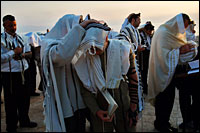 Passover, or the annual celebration of Jews' exodus from Egypt, began Wednesday. This year, it's a once-in-a-generation event. It coincides with the Birkat Hachamah — the "Blessing of the Sun" — a celebration that occurs every 28 years, when the sun is in a precise location in the sky. To mark the occasion, a group of religious Jews gathered for a 7 a.m. standing-room-only service at the Chabad Lubavitch house in Gaithersburg, Md. Men wearing prayer shawls chanted from the Talmud before moving outside into the soft early light. It was time for a special blessing. "Raise your hand if you did this either in 1953 or 1981. Anybody?" asked Rabbi Sholom Raichik. Raichik surveyed the crowd of 100 men and women, and only a half-dozen hands went up. It's not surprising, since the blessing of the sun is so infrequent. He directed them to face east, punctuating the Psalms with explanations. According to Talmudic tradition, on Wednesday morning the sun was at the exact position in the skies as it was the moment the Earth was created — 5,769 years ago. It's a complicated calculation. And after some description, the rabbi defaulted to modern technology. |
| Broadcast |
Darwin Finds Some Followers in the Pulpits Henry Green is a rarity among Southern Baptists. The pastor of Heritage Baptist church in Annapolis, Md., is openly skeptical that the Bible is the literal word of God, that the Earth was created in a few thousand years, and that Adam and Eve were created from dirt. He says that for too long, conservatives have tried to reconcile faith and science by throwing out science. This weekend, nearly 1,000 clerics worldwide will proclaim their belief that science and religion can coexist as they celebrate the 200th anniversary of the birth of Charles Darwin during events on what has become known as Evolution Weekend. Believing In God And Science"Fundamentalists want to take people away from real science and put on some sort of bogus discussion about intelligent design or creationism," Green says. "Well, guess what? I believe God created. But I just happen to believe that the scientists have it right in understanding that creation." His views haven't made him popular among his fellow ministers. He recalls that when one colleague heard about his views, he began to "witness" to Green. "He felt like maybe I wasn't a Christian," Green says, laughing. "And he said, 'Well, Henry, if you change your mind, you'd have a lot of friends.' And I looked at him and said, 'Jim, I don't need your friendship that bad.'" Green says he views Genesis as truth — about God as creator — but not as historical fact. Jewish ParticipationGreen is the kind of clergyman Michael Zimmerman has been seeking. The biologist and dean at Butler University in Indiana organized Evolution Weekend four years ago to show that many clergy embrace science. "With clergy weighing in, it should become clear that the issue is not a fight between religion and science," Zimmerman says, "but that most religious leaders were on the same side as the scientists. And the fight was between different religious groups." This year, Jews have joined the Evolution Weekend mission. David Oler, the rabbi at Congregation Beth Or, a reform synagogue in Illinois, wrote a letter in July inviting rabbis to oppose creationism in schools. Oler says there is the same kind of split over Darwin within Judaism, though he says because Judaism has a tradition of interpreting stories in a variety of ways, Orthodox Jews have an easier time reconciling Genesis with evolution than do Evangelical Christians. |
| Radio Broadcast |
Why Some Anti-Abortion Catholics Support Obama Over the past quarter-century, most anti-abortion Roman Catholics have voted Republican in hopes of overturning Roe v. Wade. But some are rethinking their strategy on abortion and other social issues — and some staunchly conservative Catholics are supporting Democratic Sen. Barack Obama because they believe the battle over Roe is lost. In September, Obama running mate Joe Biden went on NBC's Meet the Press and wandered into the religious minefield that has harmed so many Catholic politicians. Citing Thomas Aquinas, he said it's not clear when life begins. "There is a debate in our church," Biden said. "When Thomas Aquinas wrote Summa Theologica, he said … it didn't occur until quickening, 40 days after conception." One of those watching was Carl Anderson, head of the Knights of Columbus, a Catholic service organization. Days later, he bought several full-page newspaper ads criticizing Biden's stand on abortion. Anderson says he did it to correct what he saw as bad theology. "We felt, look, this is taking the discussion to a different level, and it is a level which can confuse members of the Catholic community about the church teaching. And that's an issue that we should join in," Anderson says. He signed the open letter to Biden "on behalf of the 1.28 million Knights of Columbus." When third-degree knight Rick Gebhard heard about the ad, he thought, "Well, he doesn't speak for me." Gebhard of Manistee, Mich., is married and has two children. He is anti-abortion and supports Obama, and he says he knows a lot of other Catholics who do, as well. "I think a lot of people have been frustrated with supporting the pro-life movement for 30 some years and not see it accomplish anything," he explains. So Gebhard set up a Web site called Knights for Obama. "A few days after the Web site was up, I got a call from an officer in my local council," he recalls. "He said that due to my involvement with the KnightsforObama.org, that lawyers were going to be involved soon, and I shouldn't be surprised when my membership as a knight was terminated." That hasn't happened yet. But the clash suggests how razor sharp the divide has become within the conservative Catholic community. |
| Radio Broadcast |
Obama Redraws Map Of Religious Voters Religious language trips off Barack Obama's tongue as if he were a native of the Bible Belt. From the moment he emerged on the national scene, he has spoken to believers in a language few Democrats have mastered: the language of the Bible and of a personal relationship with God. Sometimes he shares his adult conversion story, describing how he knelt beneath the cross at his Chicago church: "I felt I heard God's spirit beckoning me," he says. "I submitted myself to his will, and dedicated myself to discovering his truth and carrying out his works." Sometimes he speaks of sin and personal responsibility: "When a gangbanger shoots indiscriminately into a crowd because he feels someone has disrespected him," he told a group of religious progressives in 2006, "We've got a moral problem. There's a hole in that young man's heart." And sometimes he borrows code words, not from hymns, but from Christian rock star Michael W. Smith, such as when he proclaimed at the 2004 Democratic National Convention, "We worship an awesome God in the blue states!" It is this ease with religion that has helped Obama win over voters of various religious stripes — including Catholics who traditionally have voted Republican. Pollster Robert P. Jones of Public Religion Research says that Obama's appearance at the 2004 convention was a turning point in the relationship between Democrats and believers. Then, a majority of Americans viewed the Democratic Party as hostile to religion. But Jones' poll this month found a remarkable shift. "Barack Obama was perceived to be more friendly to religion than John McCain," he says. "And that is, I think, an indication of the real sea change that's under way, and the way in which religion is interacting in public life." |
| Radio Broadcast |
Future Of Brutalist-Designed Church Not Concrete In Washington, D.C., about two blocks from the White House, there's a Christian Science church that looks more like a concrete fortress than a house of worship. The Third Church of Christ, Scientist — or the Third Church — is a hulking mass of raw concrete. There's one window, no steeple, and its bells are suspended from a slab of concrete that juts out from the side. When it was built in 1971, it created a sensation. It still does. "It's like a weird box in the middle of Washington, with bells in one side," mused Beltran Romero, visiting the city from Spain. "What is it?" he asks, craning his neck. "Oh! It's a church!" LaVerne Hill, who works nearby, says she's loathed the place for years. "It's awful," she says. "It looks like they just dumped a bunch of concrete down here and shaped it into a box." Which is, in fact, what the architects did. The building was designed by Araldo Cossutta, who worked with I.M. Pei. It is a classic example of Brutalism, which was popular in the 1950s and 1960s but fell out of favor in the 1970s. The concrete was poured on the spot, leaving a 60-foot-tall bunker that is hard to heat and harder to cool. With eight sides of nearly identical concrete and a tucked-away entrance, it's also nearly impossible to find your way inside. 'Stay Away'Darrow Kirkpatrick, a longtime church member, says the building sends precisely the wrong message. "We think it says, 'Stay away.' Something goes on in here that they don't want to get outside, which is exactly wrong for all Christianity. We don't think the architecture conveys taking the Word to the people." |
| Radio Broadcast |
Evangelical Leaders Urge Action on Climate Change Leith Anderson remembers well his "aha" moment on global warming. It was three years ago, when the pastor of Wooddale Church in Eden Prairie, Minn., treated his wife to a long vacation. "My wife and I took an excursion to Antarctica, and for a period of a few weeks, we heard some of the things that were related to global warning as we visited sites," he recalls. "And it impressed me once more that God's gift of our earth is something we need to be effective stewards of." And as an evangelical Christian, Anderson says, he believes global warning is also a social justice issue, because, he says, it is the poor who feel the brunt of famine or flooding that may come from climate changes. "Climate changes in terms of famine, in terms of the inability to grow crops, in terms of the flooding of islands, most affects the poor," he says. "So we here in America probably can do many things to exempt ourselves from the immediate consequences, but the front edge of disaster is most going to affect those who have the least." Anderson, who leads a mega-church of 5,000 worshippers, is one of 86 evangelical leaders who are challenging the Bush administration on global warming. Their "Evangelical Call to Action" argues that there's no real scientific debate about the dangers of climate change — an assertion that many balk at. The group is calling on the government to act urgently, by, among other things, passing a federal law to reduce carbon dioxide emissions. Some of the signatories have star power, at least in evangelical circles. Among them are Rick Warren, pastor of Saddleback Community Church and author of the blockbuster book, The Purpose Driven Life; Duane Litfin, president of Wheaton College' David Neff, editor of Christianity Today; and Todd Bassett, national commander of the Salvation Army. But the names of other evangelical heavyweights are conspicuously absent. "I don't see James Dobson. Is there a more influential evangelican than James Dobson?" observes Richard Land, the president of the Southern Baptist Convention's Ethics and Religious Liberty Commission. "I don't see Chuck Coleson. I don't see Franklin Graham. So these are obviously prominent evangelicans and I — please don't in any way think that I am denigrating anyone who's on this list — but it is not an exhaustive list of evangelical leaders, let's put it that way." Land, along with Colson and Dobson, wrote a letter opposing the Evangelical Call to Action because, he says, there is not consensus about climate change among evangelicals. Land says the Bible makes clear that God expects human beings to take care of the earth. But "human beings come first in God's created order," he adds. "And that primacy must be given to human beings and for human betterment. If that means that other parts of nature take a back seat, well, then they take a back seat, Land argues that slowing economic growth and development by overly strict environmental controls will harm human beings. |
| Broadcast |
Young Imam Serves as Islam's Face to Community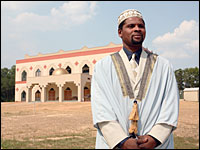 The day is sunny and hot, the hamburgers are on the grill, the kids are jumping on the moon bounce and about 400 people are milling around the brand new Dar Al Noor mosque in Manassas, Va. Neighbors and members of the congregation are here — even Virginia Gov. Tim Kaine is coming. James Dade, a non-Muslim who lives nearby, is manning the grill. As he hands a burger to a Muslim friend, he turns and gives this assessment of his new neighbors. "They're very friendly, very helpful, very community-oriented," he says, noting that his best friend attends Dar Al Noor. "If there were more Christians like my friend, we wouldn't have any problems in this world." It is a happy appraisal on this happy Sunday afternoon in July — the ribbon-cutting ceremony for the new mosque. Sheikh Rashid Lamptey, the new imam, can barely contain his excitement as he waits for the governor to arrive. Lamptey is serving a growing mosque in one of America's fastest-rising religions — with more than 2 million faithful to date. The imam plays a dual role: He's the face of Islam to his congregation and to Americans who might be wary of Muslims. "Look!" says Lamptey, who is slim with dark skin, in contrast to his white robes and a perpetual grin on his face. "Everyone is here: the politicians, the security men, the people who protect us. We have their trust, they have our trust. This is what we want to establish — the trust, so we can work together towards a more peaceful community." A few moments later, the imam introduces Kaine. The governor greets the crowd in Arabic, eliciting applause from his Muslim onlookers, then speaks about America as the bastion of religious |
| Radio Broadcast |
Creation Museum Promotes the Bible over EvolutionProtesters outside the Creation Museum criticized it for trying to replace science with fiction. 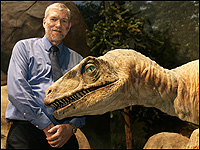 The $27 million Creation Museum opened its doors in northern Kentucky on Monday. Hundreds of people came to the opening of the museum, which promotes the Biblical story of creation over evolutionary science. Protesters outside the museum criticized it for trying to replace science with fiction. Twenty-five years ago, Ken Ham says, he felt a calling to build a museum to promote creationism. A quarter-century and $27 million later, The Creation Museum has opened in Petersburg, Ky., just outside Cincinnati. The displays offer the creationists' view of how the world came to be, which differs sharply from the teachings of science. Ham, a native Australian, breaks down the differences for Steve Inskeep: "There is a conflict if you try to add evolution to the Bible and take Genesis as literal history," he says. "For instance, the Bible teaches man was made from dust in [the book of] Genesis … whereas evolution would teach that man came from some ape-like ancestor. "I know there are many Christians who say they believe in evolution [over] millions of years," he says. "I would say they're being inconsistent in their approach to scripture. A literal Genesis is actually the foundational history for the rest of the Bible for all doctrine. Ham's view explains why visitors enter to see two animatronic baby dinosaurs alongside two children. "When you have dinosaurs and people together, that makes a statement concerning one's belief about the age of the Earth and evolution," he says. "Obviously it flies in the face of what secular evolutionists will teach." Ham says the museum – which drew protesters on Monday – does try to cover both sides of the debate. "We actually do give both sides as people walk in," he says, explaining that a fossil exhibit has "a creation paleontologist" and "an evolutionary paleontologist" offering different interpretations of the same fossil. He rejects the idea that science has a lock on empirical evidence. |
| Radio Broadcast |
Pew Study Sees Muslim Americans Assimilating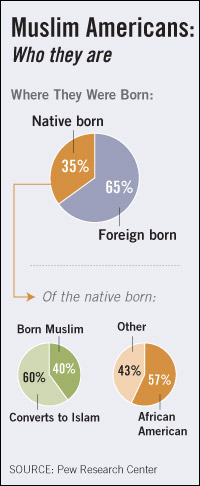 Muslim Americans have integrated into society far better than European Muslims, but there appear to be significant pockets of disaffection — especially among the young and religious. That is the conclusion of an exhaustive survey of Muslim Americans released Tuesday by the Pew Research Center. More than 1,000 Muslims spoke at length about their American experience, and the results were mostly "good news," says Andrew Kohut, president of the Pew Research Center. "The Muslim American population is largely middle class, mostly mainstream, assimilated, happy with their lives and moderate on many of the issues that have divided Muslims and Westerners around the world," Kohut says. But the study found some surprising signs of discontent. More than half of Muslim Americans believe that the U.S. government singles Muslims out for extra surveillance. More than half of Muslims overall hold a very unfavorable view of al-Qaida — but only 36 percent of African-American Muslims do. Only one in four Muslims believes that Arab men conducted the terrorist attacks of Sept. 11, 2001. And most disturbing was what Kohut called "pockets of sympathy for extremism." "Younger Muslims are both more religiously observant, more self-identifying as Muslims than older Muslims, and they're more likely to say that suicide bombing in defense of Islam can be, at least some times, justified," Kohut says. One-quarter of Muslims under age 30 said suicide bombing is legitimate on some occasions. That compares with 6 percent of older Muslims. |
| Radio Broadcast |
Evangelical May Be Up for Grabs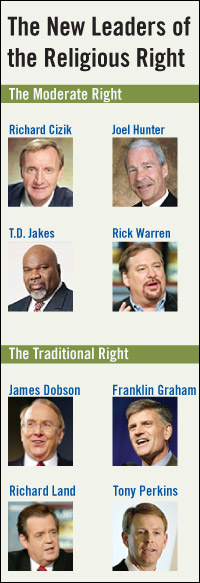 The death of the Rev. Jerry Falwell marks a changing of the guard for religious conservatives that has been under way for several years. In the 1980s, Falwell mobilized millions of evangelicals. But today, younger Christians are becoming restive with the old style and focus. In fact, some pollsters say that more than 40 percent of white evangelical voters could be up for grabs in the 2008 election. Beyond the Wedge IssuesTwo months before he died, Falwell gave a televised sermon about global warming. It was vintage Falwell: grand, pugnacious and, he admitted, politically incorrect. Falwell said that the danger to society is not global warming, but the green movement itself. He worried particularly about evangelicals involved in the green movement: They were being distracted from moral concerns, such as abortion, gay marriage, violence and divorce. "It is Satan's attempt to redirect the church's primary focus," Falwell said in March to his 22,000-person-strong congregation at the Thomas Road Baptist Church in Lynchburg, Va. "I'm telling these guys they need to get off that kick," Falwell said, "because the idea is to divert your energies from the message and the mission and the vision of the church, to something less." But change is afoot in the evangelical world. Comments from high-profile evangelical leaders like Falwell, Pat Robertson and James Dobson are no longer taken as gospel truth. To get an idea of how far some evangelicals have traveled since Falwell's heyday, I visited Joel Hunter at his mega-church in Orlando, Fla. Hunter's vision of the "correct" evangelical view of the environment seems to come from a different continent — or a different God. "Let me tell you one of the reasons I'm so keen on taking care of the environment," he told his 7,700-member church recently. "It's not just that it's beautiful, which it is. But it's the first order we had when we got put into the garden: Cultivate it and keep it." Hunter is a new kind of evangelical: conservative about abortion and gay marriage, but also engaged in other issues, such as the environment. And he's leading his conservative flock in the same direction. A Focus on the 'Compassion Issues'On a recent Saturday morning, I arrived before 7 a.m. at Northland church. The "creation care" team was already assembled and zipping themselves into white HAZMAT suits. The nine church members would spend the next five hours sorting through a week's worth of rubbish generated by the church, picking through diapers, coffee filters, aluminum cans and the occasional pizza crust. "If we want to reduce the church's waste stream, we have to know what's in it, and there's only one way of doing that," explained church member Raymond Randall as he pulled on white surgical gloves. "So we divide the trash into different parts of the church where it's generated, and then sort it into 35 different categories," such as paper, plastic and glass. The group then sorted through the smelly debris, looking for ways to reduce waste. This is called "creation care," Randall told me — and it comes straight from the Bible. |
| Radio Broadcast |
Fighting Poverty in AmericaA jobs program with a spiritual twist  In Orlando, Fla., single moms, recovering drug addicts and others who need help finding jobs are turning to a worker-training program with a spiritual twist. It teaches practical skills, such as resume writing and job-interview tips. But, with the help of a local pastor, participants also get lessons in attitude and character. Pastor Sylvester Robinson volunteers for the Jobs Partnership of Florida, a faith-based group that believes the path out of poverty is through spiritual transformation. Since 2000, more than 600 people have graduated from Jobs Partnership in Florida. The program says it has placed 70 percent of them in a career-path job. More than 3,000 people have gone through Jobs Partnership training in 25 cities across the country. Allen Baldwin is one of the program's success stories. His father went to prison when he Baldwin was 8, and his mother left soon after. He began dealing drugs at 15 and ended up in juvenile detention at 17. At 28, happened upon Robinson's church and committed his life to Jesus. But the only job Baldwin had ever held was selling drugs. And so his pastor steered Baldwin into the Jobs Partnership. Asked to name the most key insight from the program, Baldwin says: "Integrity. What would you do when the boss is not looking? What would you do when you don't have to come in a certain time and you don't have to leave — you don't have to clock in or clock out?… So integrity is a big thing to me and I believe when nobody's watching, God is watching." |
| Radio Broadcast |
Christian Leaders Balk at Robertson's Remarks The Israeli government has taken the unusual step of cutting all ties with an American preacher, the television evangelist Pat Robertson. The move came after Robertson's comments last week about the massive stroke suffered by Israeli Prime Minister Ariel Sharon, who remains gravely ill. Robertson has been working to set up a massive Christian tourism center in Israel, and that deal is now in question. Robertson's statement is the latest in a string of pronouncements that have left Robertson isolated from other conservative Christians.
Robertson has told viewers of his television show, The 700 Club, that he personally likes Ariel Sharon. In fact, Robertson said he's even prayed with him. But the preacher said Sharon made a mistake when he pulled out of the Gaza Strip, and so, he implied, no one should be surprised that Sharon fell ill. "Here he's at the point of death," Robertson told viewers in early January, "he was dividing God's land. And I would say, woe unto any prime minister of Israel who takes a similar course to appease the E.U., the United Nations or the United States of America. God says, 'This land belongs to me. You better leave it alone.' " Today, Robertson apologized, but the damage was done for some Christian leaders. "I was appalled," says Richard Land, president of the Southern Baptist Convention's ethics and religious liberty commission. Besides the insensitivity, Land says, this is bad theology. Saint Paul himself wrote that "God's judgments are unsearchable." When Robertson connects Sharon's stroke with God's judgment, "he's way beyond his theological pay grade," Land says. "That's assuming the prerogatives of God and it betrays both an appalling spiritual ignorance and an appalling spiritual arrogance." Those are tough words from an evangelical leader who long fought on the same side as Robertson in the culture wars. In fact, not so long ago, Robertson was swimming in the conservative evangelical mainstream. When he ran for the Republican nomination for president in 1988, he energized evangelicals who had never entered politics. For a segment of people worried about the country's moral direction, candidate Robertson offered a vision of moral — that is, Christian — certainty. "As a people," Robertson said in a campaign speech in 1988, "we believe our freedoms, our liberties, and our wealth were gifts of almighty God, and we must establish faith in God as our no. 1 priority." read more… listen… [link to story at www.npr.org] |
| Radio Broadcast |
Intelligent Design Hits Snag in California Schools The opening salvo in the next battle over intelligent design has been fired. Coming off a major legal victory in Pennsylvania last month, opponents of intelligent design are seeking to replicate that win in California. Last month, a federal judge in Harrisburg, Pa., ruled that intelligent design cannot be taught in public school science class as an alternative to evolutionary theory. Intelligent design posits that life is too complex to have evolved through random mutation, but must have been guided by an "intelligence."
On Tuesday, opponents of intelligent design took the battle from science class to philosophy class. Eleven parents sued the El Tejon Unified School District in California for offering an elective course about the origin of life. The four-week elective course, called "Philosophy of Design," is being offered at Frazier Mountain High School in Lebec, a rural town north of Los Angeles. Even before the opening class last week, the course was drawing ire from parents and science teachers alike. One concern was the course description, which said the class would look at scientific, biological and biblical ideas that "suggest that Darwin's philosophy is not rock solid." "It's a way to sneak religion into public schools," said Barry Lynn, executive director of Americans United for Separation of Church and State, which is representing the 11 parents. "It's very clever, but it's unpersuasive." No one from the El Tejon school district was available for comment Tuesday. But supporters of intelligent design said that the California lawsuit is disingenuous. Casey Luskin, an attorney at the Discovery Institute, a group that promotes intelligent design, notes that all along critics of the idea have argued that while intelligent design is not science and therefore should not be taught in science class, it is a valid topic in other courses. read more… listen… [link to story at www.npr.org] |
| Radio Broadcast |
Catholics Confront Faith and EvolutionWhile debate rages in this country over teaching science and so-called "intelligent design," the Roman Catholic Church is in the midst of a renewed discussion over the compatibility of evolution and faith. read more… listen… [link to story at www.npr.org] |
| Radio Broadcast |
Intelligent Design Proponents Set Back by Dover CaseA federal judge Tuesday prohibited mentions of intelligent design in Dover, Pa., public school biology classes. The case was closely watched by school districts around the country, and the decision is likely to put a damper on other such efforts. read more… listen… [link to story at www.npr.org] |
| Radio Broadcast |
Teaching Evolution: A State-by-State Debate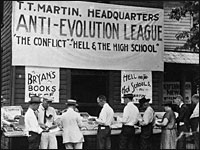 School boards and legislatures across the country are continuing to debate how to teach students about the origins of life on Earth. Policymakers in at least 16 states are currently examining the controversy. In some states, advocates of "intelligent design" — the theory that an intelligent force had a role to play in the creation of the universe — are pushing for the concept to be taught side-by-side with evolution. In other states, schools are incorporating the idea that evolution is "theory, not fact." Below, a look at how the debate is playing out in several states: Alabama: Biology textbooks in Alabama have included a disclaimer describing evolution as a "controversial theory" since 1996. The Board of Education adopted a softer disclaimer when they revised science guidelines in 2004, describing evolution as one of several scientific theories. But on Nov.10, 2005, the board voted to continue requiring the original disclaimer language. Arkansas: After a long battle with the American Civil Liberties Union, the School Board In Beebe, Ark., voted in July 2005 to remove stickers placed in high school textbooks that question the theory of evolution. The sticker says that evolution alone is "not adequate to explain the origins of life." School officials had been awaiting an appeals court decision on a similar case in Georgia before taking action, but reportedly were concerned about lengthy and costly litigation. Georgia: In 2002, biology textbooks in Cobb County, Ga., were labeled with a disclaimer stating that evolution is "a theory, not a fact." The label also said "this material should be approached with an open mind, studied carefully, and critically considered." A federal judge declared the sticker unconstitutional in January 2005, but the county school board appealed the decision. The 11th District Court of Appeals will hear the case in mid-December. |
| Radio Broadcast |
Pennsylvania Judge Bars Intelligent Design in Science Classes A federal judge strikes down a policy in the Dover, Pa., schools that required biology students to hear a statement supporting alternatives to evolution. The ruling is a major blow to backers of intelligent design in public schools. They say life is too complex to have evolved entirely through natural means. But in strong language, the judge said the school board's policy was a thinly veiled attempt to force religion into the teaching of science -- and therefore unconstitutional. A federal judge strikes down a policy in the Dover, Pa., schools that required biology students to hear a statement supporting alternatives to evolution. The ruling is a major blow to backers of intelligent design in public schools. They say life is too complex to have evolved entirely through natural means. But in strong language, the judge said the school board's policy was a thinly veiled attempt to force religion into the teaching of science -- and therefore unconstitutional. A major defeat today for efforts to teach intelligent design in the public schools. A federal judge struck down a policy in the Dover, Pennsylvania, schools that required biology students to hear a statement supporting alternatives to evolution. Backers of intelligent design say life is too complex to have evolved entirely through natural means. But in strong language, the judge said the school board's policy was a thinly veiled attempt to force religion into the teaching of science and, therefore, unconstitutional. We'll have more analysis of the opinion in a few minutes. First, NPR's Barbara Bradley Hagerty reports on the ruling. read more… listen… [link to story at www.npr.org] |
| Radio Broadcast |
Decision Expected in Intelligent Design CaseA federal judge in Pennsylvania is expected to rule in a case about whether ninth-grade biology students in Dover, Pa., could hear intelligent design mentioned in the classroom. At issue is whether public schools can teach alternatives to evolution. read more… listen… [link to story at www.npr.org] |
| Radio Broadcast |
Intelligent Design in American ClassroomsSteve Inskeep discusses the current state of intelligent design in American classrooms with Barbara Bradley Hagerty and with Greg Allen, who covered the intelligent design movement in Kansas. read more… listen… [link to story at www.npr.org] |
| Radio Broadcast |
Intelligent Design and Academic Freedom After publishing an article backing intelligent design, a scientist is targeted for retaliation. Intelligent design—the idea that life is too complex to have evolved through Darwinian evolution—is stirring up controversy not only in high school classrooms but also at universities and scientific research centers. Richard Sternberg, a staff scientist at the National Institutes of Health, is puzzled to find himself in the middle of a broader clash between religion and science—in popular culture, academia and politics. Sternberg was the editor of an obscure scientific journal loosely affiliated with the Smithsonian Institution, where he is also a research associate. Last year, he published in the journal a peer-reviewed article by Stephen Meyer, a proponent of intelligent design, an idea which Sternberg himself believes is fatally flawed. "Why publish it?" Sternberg says. "Because evolutionary biologists are thinking about this. So I thought that by putting this on the table, there could be some reasoned discourse. That's what I thought, and I was dead wrong." At first he heard rumblings of discontent but thought it would blow over. Sternberg says his colleagues and supervisors at the Smithsonian were furious. He says — and an independent report backs him up — that colleagues accused him of fraud, saying they did not believe the Meyer article was really peer reviewed. It was. Eventually, Sternberg filed a complaint with the U.S. Office of Special Counsel, which protects federal employees from reprisals. The office launched an investigation. Ultimately, it could not take action, because Sternberg is not an employee of the Smithsonian. But Sternberg says before closing the case, the special counsel, James McVay, called him with an update. "As he related to me, 'the Smithsonian Institution's reaction to your publishing the Meyer article was far worse than you imagined,'" Sternberg says. McVay declined an interview. But in a letter to Sternberg, he wrote that officials at the Smithsonian worked with the National Center for Science Education — a group that opposes intelligent design — and outlined "a strategy to have you investigated and discredited." Retaliation came in many forms, the letter said. They took away his master key and access to research materials. They spread rumors that Sternberg was not really a scientist. He has two Ph.D.'s in biology — from Binghamton University and Florida International University. In short, McVay found a hostile work environment based on religious and political discrimination. read more… listen… [link to story at www.npr.org] |
| Radio Broadcast |
Pennsylvania Case Weighs Intelligent Design in SchoolsA federal trial begins Monday in Harrisburg, Pa., over a Dover school district disclaimer that introduces the idea of "intelligent design" in high school biology classes. It is the first major test of the issue in a federal court. read more… listen… [link to story at www.npr.org] |
| Radio Broadcast |
Echoes of Scopes Trial in MarylandThe teaching of evolution fuels a dispute over modern approaches to the topic in Cecil County, Md., The case comes as historians note the 80th anniversary of the Scopes Monkey Trial in Dayton, Tenn. read more… listen… [link to story at www.npr.org] |
| Radio Broadcast |
An Astronomer's View of Christianity and ScienceOwen Gingerich, a professor of astronomy at Harvard University and senior astronomer at the Smithsonian Astrophysical Observatory, discusses the role of evolution and the creationist movement called Intelligent Design. Gingerich, a Christian, says he has a problem with Intelligent Design taught as an alternative to evolution. read more… listen… [link to story at www.npr.org] |