
 About the Fellowship
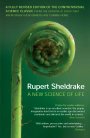
A New Science of Life, the biologist Rupert Sheldrake explores scientifically heretical terrain. In this third edition of his book, originally published in 1981, he postulates his theory of "morphic fields" - elusive forces that bathe nature and influence the development of form. They are imagined as somewhat like electromagnetic fields, only instead of transmitting energy, they store information. Hence, Sheldrake argues, morphic fields act as a kind of memory bank. When a snowflake forms, the details of its shape are recorded by morphic resonance. When birds flock in vast numbers, and shift like dark clouds across the sky, they act as if one because they effectively are one, Sheldrake suggests: they can access another morphic field. Likewise, when laboratory rats learn how to navigate a maze, the solution is morphically imprinted; other rats can then access the memory, navigating the same maze more quickly.
What interests Sheldrake are those features of nature that current science finds hard to explain. If the notion of morphic fields seems excessive, as it does to many, he replies that science needs radically innovative ideas to account for all that we observe. He believes that mechanistic and materialist explanations have been exhausted when it comes to phenomena from cooperation to consciousness. Hence exploring possibilities that lie beyond them. He is also quite clear that he is not conjuring up a pseudo-science. He hopes that every one of his proposals will pass empirical tests.
Sheldrake has been accused of peddling magic, and worse. But then, the same was said of Newton and his theory of gravitation: it was a spooky force that acted at a distance, and seemed to many to illuminate astrology as much as astronomy. Time will be the ultimate arbiter of Sheldrake's ideas. And since it is almost thirty years since this book was first published, and his basic thesis has not yet been verified by repeatable experiments to the satisfaction of peers in the scientific community, it seems that time is making its choice.
(end of article)
return to list of publications