
 About the Fellowship
Mark Vernon

Mark Vernon writes regularly for the Guardian, Financial Times, Times Literary Supplement,Management Today, and Philosophers' Magazine, among many other publications. He broadcasts from a variety of news outlets, including BBC Radio 2, Radio 3, Radio 4, Five Live, BBC Radio London, BBC TV, and ABC Radio National. His books include After Atheism: Science, Religion, and the Meaning of Life; The Philosophy of Friendship; 42: Deep Thought on Life, the Universe, and Everything. His most recent book, Teach Yourself Humanism, will be published later this year.
| Article |
 Why We're All FundamentalistWhen did faith stop being about trust, and become a set of propositions to be believed? Mark Vernon looks back in history for clues to the fundamentals that fire a true life passion for people.  There is a story about Socrates, in which the sage of Athens is looking back on his life1. He recalls one day sitting with Plato, in the days of his great disciple's youth. Plato is talking. Socrates is watching him. He can see the freckles on Plato's face, his intelligent eyes, his seriousness, his confidence. Suddenly, Socrates is struck by a thought: 'I knew that if an archer were to shoot at him, I would step in front of him without hesitating and I'd take the arrow in my chest.' He knew this without a doubt. And then came a feeling that surprised him. 'I was smiling because I was truly happy.' Human beings are all, in a sense, fundamentalists. Or at least, we might all hope to be so - an individual who knows who they would die for; what they would die for. It will be a person or belief so essential, so sacred, that sacrificing for it would not so much end your life as show your life has an end, in the sense of a goal, a reason, a meaning. Further, knowing what you would die for means that you know what you live for. There is nothing that makes life more worth living; it generates purpose, commitment, love. It is liberating too. If you know you could let go of life, you can live more freely now. Socrates smiled. He was happy. Fundamentalism, though, is different. In its rarer, violent forms it is a basic conviction about life too, though gone wrong. Love reveals what you would die for. But the passions of hatred and war can do so too, as the jihadis learnt in the Afghan conflicts of the last decades of the 20th century. Further, this kind of fundamentalism is not so much about what you would die for as what you would kill for. |
| Column |
 Can Evolutionary Theorists Ever Make Sense of Religion?A new theory disregards the dominant evolutionary story, and explores instead religion's origins in playtime and ritual. 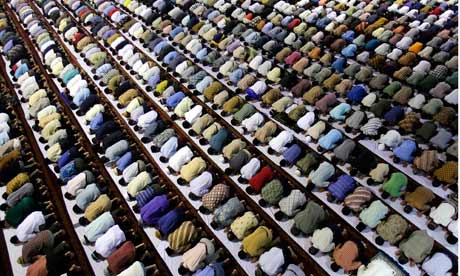 The currently dominant evolutionary story for the origin of religions might be called the "byproduct theory". It goes something like this. The human brain evolved a series of cognitive modules, a bit like a smartphone downloading applications. One was good for locomotion, another seeing, another empathy, and so on. However, different modules could interfere with one another, called "domain violation" in the literature. The app for locomotion might overrun the app for empathy and, as a result, the hapless owner of that brain might discern a spirit shifting in the rustling trees, because the branches sway a little like limbs moving. The anthropologist Pascal Boyer calls such interpretations "minimally counterintuitive". They can't be too random or they wouldn't grip your imagination. But, clearly, they are not rational. Religion is, therefore, a cognitive mistake. It might once have delivered adaptive advantages: swaying branches could indicate a stalking predator, and so you'd be saved if you fled, even if you believed the threat was a ghost. But rational individuals such as, say, evolutionary theorists now see religious beliefs for what they really are. Given that this is the story that often does the rounds, it is striking that Robert Bellah's new book, "Religion in Human Evolution," has no time for it whatsoever. Literally. Look up "Boyer" in the index and you are led to a footnote. "I have found particularly unhelpful those who think of the mind as composed of modules and of religion as explained by a module for supernatural beings," Bellah remarks. They have a "tendency toward speculative theorizing and [a] lack of insight into religion as actually lived". In short, the story is neither convincing when it comes to cognition, nor when it comes to describing religious practice. Bellah's judgment matters because he is a venerable sociologist of religion who takes evolution seriously: it can be revealing about the nature of religion, he insists, though only if you are talking about religions as they actually exist. So what goes wrong? A fundamental mistake, Bellah argues, is to conceive of religion as primarily a matter of propositional beliefs. It is not just that this is empirically false. There are good evolutionary reasons for understanding religion in an entirely different way, too. Go back deep into evolutionary time, long before hominids, Bellah invites his readers, because here can be found the basic capacity required for religion to emerge. It is mimesis or imitative action, when animals communicate their intentions, often sexual or aggressive, by standard behaviours. Often such signals seem to be genetically determined, though some animals, like mammals, are freer and more creative. It can then be called play, meant in a straightforward sense of "not work", work being activity that is necessary for survival. |
| Column |
We Can't Forgive, We Can Only Pretend ToEvolutionary doctrine teaches us that it's in our own self-interest to co-operate and to put up with others.  Forgiveness is impossible. This was the thought of the philosopher Jacques Derrida, and he has a good point. There are some things that we say are easy to forgive. But, Derrida argues, they don't actually need forgiving. I forget to reply to an email, and my friend remarks: "Oh, it didn't really matter anyway." It's not that he forgave me. He'd forgotten about the email too. Then, there are other things we say are hard to forgive, and we admire those who appear to be able to forgive nonetheless. The case of Rais Bhuiyan, who was shot by Mark Stroman, is a case in point. Bhuiyan says he forgave Stroman, and asked the Texas authorities not to execute him for his crime. But did Bhuiyan really forgive? He writes of how Stroman was ignorant and had a terrible upbringing. He had seen signs that Stroman was now a changed man. So, it does not seem that Bhuiyan forgave his assailant. Rather, he came to understand him. He saw the crime from the perpetrator's point of view. There were reasons for the wrongdoing. That lets Stroman off the hook. It's not really forgiveness. CS Lewis wrote: "Everyone says forgiveness is a lovely idea, until they have something to forgive." Which is again to imply that those who think they have offered forgiveness really find they don't have anything to forgive after all. The ancient philosophers appear to have thought that forgiveness is something of a pseudo-subject, too. They hardly touched on it, for all that they dwelt on all manner of other moral concerns. It is not on any list of virtues. Take Aristotle. He wrote about pardoning people, but only when they are not responsible. "There is pardon," he says, "whenever someone does a wrong action because of conditions of a sort that overstrain human nature, and that no one would endure." When nature has not been overstrained, justice must meet wrongdoing. Forgiveness doesn't come into it. All this calls into question a theory in evolutionary psychology. Here, the argument is that forgiveness is essential to our evolutionary success. It's because we forgive one another that we are able to live in large groups. People in collectives like cities are bound to offend one another all the time, the theory goes. It's because we are so ready to forgive and continue to co-operate that we don't, as a rule, destroy ourselves in spirals of retribution. |
| Column |
 Carl Jung, Part 8: Religion and the search for meaningJung thought psychology could offer a language for grappling with moral ambiguities in an age of spiritual crisis.  In 1959, two years before his death, Jung was interviewed for the BBC television programme Face to Face. The presenter, John Freeman, asked the elderly sage if he now believed in God. "Now?" Jung replied, paused and smiled. "Difficult to answer. I know. I don't need to believe, I know." What did he mean? Perhaps several things. He had spent much of the second half of his life exploring what it is to live during a period of spiritual crisis. It is manifest in the widespread search for meaning – a peculiar characteristic of the modern age: our medieval and ancient forebears showed few signs of it, if anything suffering from an excess of meaning. The crisis stems from the cultural convulsion triggered by the decline of religion in Europe. "Are we not plunging continually," Nietzsche has the "madman" ask when he announces the death of God. "Is not the greatness of this deed too great for us?" Jung read Nietzsche and agreed that it was. The slaughter of two world wars and, as if that were not enough, the subsequent proliferation of nuclear weaponry were signs of a civilisation swept along by unconscious tides that religion, like a network of dykes, once helped contain. "A secret unrest gnaws at the roots of our being," he wrote, an unrest that yearns for the divine. Nietzsche agreed that God still existed as a psychic reality too: "We godless anti-metaphysicians still take our fire … from the flame lit by a faith that is thousands of years old." And now the flame is out of control. The sense of threat – real and imagined – that Jung witnessed during his lifetime has not lessened. Ecologists such as James Lovelock now predict that the planet itself has turned against us. Or think of the war games that power an online gaming industry worth £45bn and counting. Why do so many spend so much indulging murderous fantasies? You could also point to the proliferation of new age spiritualities that take on increasingly fantastical forms. One that interested Jung was UFOs: the longing for aliens – we are without God but not without cosmic companions – coupled to tales of being "chosen" for abduction, are indicative of mass spiritual hunger. |
| Column |
Carl Jung, part 7: The power of acceptanceLike the AA movement, Jung believed that acceptance and spiritual interconnectedness were crucial to a person's recovery. 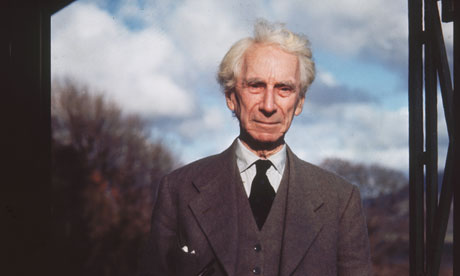 In 1931, one of Jung's patients proved stubbornly resistant to therapy. Roland H was an American alcoholic whom he saw for many weeks, possibly a year. But Roland's desire for drink refused to diminish. A year later Roland returned to Zürich still drinking, and Jung concluded that he probably wouldn't be cured through therapy. But ever the experimenter, Jung had an idea. Roland should join the Oxford Group, an evangelical Christian movement that stressed the necessity of total surrender to God. Jung hoped that his patient might undergo a conversion experience, which, as his friend William James had realised, is a transformative change at depth, brought about by the location of an entirely new source of energy within the unconscious. That might tame the craving. It worked. Roland told another apparently hopeless alcoholic, Bill W, about the experience. Bill too was converted, and had a vision of groups of alcoholics inspiring each other to quit. The Society of Alcoholics Anonymous was formed. Today it has more than 2 million members in 150 countries. I spoke to a friend of mine who attends meetings of Narcotics Anonymous to understand more about the element of conversion. "It's hugely important," he said. His addictions had been fuelled by a surface obsession with career and money, and a deeper anxiety that nothing was right. "It's the first time I'd been prompted seriously to consider something bigger than myself." Calling the experience "spiritual" seems accurate too, because a meeting is about more than gaining a circle of supportive friends. "I have friends," my friend remarks, before continuing that the focused intention of a meeting is about something else: their connection to a very powerful force. "I can't picture it, I can't name it," he says, before adding, "I've never given much thought to church." Narcotics Anonymous literature expresses it more formally: "For our group purpose there is but one ultimate authority – a loving God as He may express Himself in our group conscience." |
| Column |
Carl Jung, Part 6: SynchronicityWith physicist Wolfgang Pauli, Jung explored the link between the disparate realities of matter and mind.  The literary agent and author Diana Athill describes the genesis of one of her short stories. It occurred about nine one morning, when she was walking her dog. Crossing the road, a car approached and slowed down. She presumed someone needed directions. A man leaned out and brazenly asked her whether she would like to join him for coffee. That was odd enough, so early in the day. More oddly still, the man powerfully reminded her of someone else. He looked just like a lost friend and, further, the daring approach was just the kind of thing her friend would have done. She couldn't stop thinking about the coincidence. It left her feeling " energised and strange," a flow that kept bubbling up until she channelled it, producing the short story. It is an example of what Jung called synchronicity, "a coincidence in time of two or more causally unrelated events which have the same or similar meaning" – in Athill's case, the surprising invitation of the man and his looking like her friend. Anecdotally, it seems that such experiences are familiar to many. They are undoubtedly meaningful and produce tangible effects too, like short stories. But they raise a question: is the relationship between the events random or is some hidden force actively at work? Jung pursued this question in an odd relationship of his own, with one of the great physicists of the 20th century, Wolfgang Pauli. The story of their friendship is related by Arthur I Miller, in "137: Jung, Pauli, and the Pursuit of a Scientific Obsession." Pauli was a Jekyll and Hyde character, a Nobel theorist by day and sometime drunk womaniser by night. He turned to Jung when he could no longer hold the competing aspects of his life together. Jung was always fascinated by personality splits, and his analysis helped to steady Pauli. They began working together in a collaboration that lasted for several decades, though mostly behind closed doors: Pauli worried for his reputation, though eventually they published a book together. |
| Column |
If You Want Big Society, You Need Big ReligionFaith communities may encourage their members to contribute to society – but can politicians harness their benefits?  Robert Putnam, Harvard professor of public policy, has been in London, channelling the wisdom of social capital at No 10, as well as talking at St Martins-in-the-Fields on Monday evening. That venue is the big clue to his latest findings. It could be summarised thus: if you want big society, you need big religion. In the US, over half of all social capital is religious. Religious people just do all citizenish things better than secular people, from giving, to voting, to volunteering. Moreover, they offer their money and time to everyone, regardless of whether they belong to their religious group. It could be, of course, that the religious already have the virtues of citizenship. However, Putnam believes the relationship is causal, not just a correlation. Longitudinal studies also show as much. So why? He argues it's not to do with belief, but with being part of a community of belief. An atheist with several churchgoing friends will be a better citizen too. In fact, churchgoing friends are what he calls "supercharged" when it comes to citizenship. Working out just what a religious community gives would be key to generalising the findings beyond faith. |
| Column |
Carl Jung, Part 4: Do Archetypes Exist?Jung's theory of structuring principles remains controversial--but provides a language to talk about shared experience 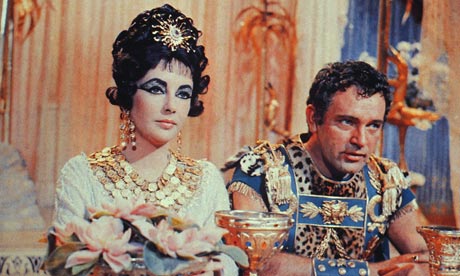 Jung took the inner life seriously. He believed that dreams are not just a random jumble of associations or repressed wish fulfilments. They can contain truths for the individual concerned. They need interpreting, but when understood aright, they offer a kind of commentary on life that often acts as a form of compensation to what the individual consciously takes to be the case. A dream Jung had in 1909 provides a case in point. He was in a beautifully furnished house. It struck him that this fine abode was his own and he remarked, "Not bad!" Oddly, though, he had not explored the lower floor and so he descended the staircase to see. As he went down, the house got older and darker, becoming medieval on the ground floor. Checking the stone slabs beneath his feet, he found a metal ring, and pulled. More stairs led to a cave cut into the bedrock. Pots and bones lay scattered in the dirt. And then he saw two ancient human skulls, and awoke. Jung interpreted the dream as affirming his emerging model of the psyche. The upper floor represents the conscious personality, the ground floor is the personal unconscious, and the deeper level is the collective unconscious – the primitive, shared aspect of psychic life. It contains what he came to call archetypes, the feature we shall turn to now. They are fundamental to Jung's psychology. Archetypes can be thought of simply as structuring principles. For example, falling in love is archetypal for human beings. Everyone does it, at least once, and although the pattern is common, each time it feels new and inimitable. |
| Column |
Human Consciousness is Much More than Mere Brain ActivityWhen we meditate or use our powers of perception, we call on more than just a brain.  How does the animated meat inside our heads produce the rich life of the mind? Why is it that when we reflect or meditate we have all manner of sensations and thoughts but never feel neurons firing? It's called the "hard problem", and it's a problem the physician, philosopher and author Raymond Tallis believes we have lost sight of – with potentially disastrous results. In his new book, Aping Mankind – about which he was talking this week at the British Academy – he describes the cultural disease that afflicts us when we assume that we are nothing but a bunch of neurons. Neuromania arises from the doctrine that consciousness is the same as brain activity or, to be slightly more sophisticated, that consciousness is just the way that we experience brain activity. If you think the brain is a machine then you are committed to saying that composing a sublime poem is as involuntary an activity as having an epileptic fit. You will issue press releases announcing "the discovery of love" or "the seat of creativity", stapled to images of the brain with blobs helpfully highlighted in red or blue, that journalists reproduce like medieval acolytes parroting the missives of popes. You will start to assume that the humanities are really branches of biology in an immature form. What is astonishing about this rampant reductionism is that it is based on a conceptual muddle that is readily unpicked. Sure, you need a brain to be alive, but to be human is not to be a brain. Think of it this way: you need legs to walk, but you'd never say that your legs are walking. The same conflation can be exposed in a more complex way by reflecting on the phenomenon of perception. It is what we do every moment of the waking day. You're doing it right now: casting an eye to the paper in front of you and seeing words on a page. But if you were just a brain, you would not see words. There'd be just the gentle buzz of neuronal activity in the intracranial darkness. |
| Column |
Carl Jung, Part 3: Encountering the UnconsciousJung's Red Book reveals his belief in the painful, personal process of discovering how the unconscious manifests itself in conscious life 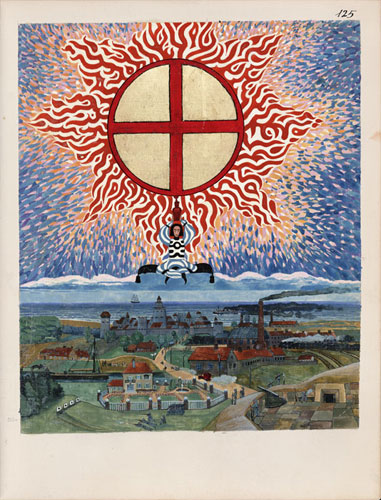 Jung's split with Freud in 1913 was costly. He was on his own again, an experience that reminded him of his lonely childhood. He suffered a breakdown that lasted through the years of the first world war. It was a traumatic experience. But it was not simply a collapse. It turned out to be a highly inventive period, one of discovery. He would later say that all his future work originated with this "creative illness". He experienced a succession of episodes during which he vividly encountered the rich and disturbing fantasies of his unconscious. He made a record of what he saw when he descended into this underworld, a record published in 2009 as The Red Book. It is like an illuminated manuscript, a cross between Carroll's Alice in Wonderland and Blake's The Marriage of Heaven and Hell. Its publication sparked massive interest in Jungian circles, rather like what happens in Christian circles when a new first-century codex is discovered. It is of undoubted interest to scholars, in the same way that the notebooks of Leonardo are to art historians. And it is an astonishing work to browse, for its intricacy and imagination. But it is also highly personal, which is presumably why Jung decided against its publication in his own lifetime. So, to turn it into a sacred text, as some appear inclined to do, would be a folly of the kind Jung argued against in the work that followed his recovery from the breakdown. In particular he wrote two pieces, known as the Two Essays, that provide a succinct introduction to his mature work. (He can otherwise be a rambling, elusive writer.) On the Psychology of the Unconscious completes his separation from Freud. He shows how tracing the origins of a personal crisis back to a childhood trauma, as Freud was inclined to do, might well miss the significance of the crisis for the adult patient now. In The Relations between the Ego and the Unconscious, he describes a process whereby a person can pay attention to how their unconscious life manifests itself in their conscious life. It will be a highly personal and tortuous experience. "There is no birth of consciousness without pain," he wrote. But with it, the individual can become more whole. By way of illustration, Jung considers the example of a man whose public image is one of honour and service but who, in the privacy of his home, is prone to moods – so much so that he scares his wife and children. He is leading a double life as public benefactor and domestic tyrant. Jung argues that such a man has identified with his public image and neglected his unconscious life – though it won't be ignored and so comes out, with possibly explosive force, in his relations with his family. The way forward is to pay attention to this inner personality, literally by holding a conversation with himself. He should overcome any embarrassment in doing so and allow each part of himself to talk to the other so that both "partners" can be fully heard. |
| Column |
Carl Jung, part 2: A troubled relationship with Freud – and the NazisOn the 50th anniversary of Jung's death it is time to put accusations of him collaborating with the Nazis to rest. 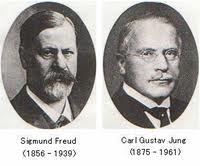 Jung's relationship with Freud was ambivalent from the start. First contact was made in 1906, when Jung wrote about his word association tests, realising that they provided evidence for Freud's theory of repression. Freud immediately and enthusiastically wrote back. But Jung hesitated. It took him several months to write again. They met a year later and then it was friendship at first sight. The two talked non-stop for 13 hours. Freud called Jung "the ablest helper to have joined me thus far", and spoke of how Jung would be good for psychoanalysis as he was a respected scientist and a protestant – a dark observation that was to haunt Jung three decades later when the Nazis came to power. For now, different tensions persisted. A request Jung made highlights one axis of difficulty: "Let me enjoy your friendship not as one between equals but as that of father and son," he wrote. The originator of the Oedipus situation, in which murderous undertones supposedly exist between a father and a son, was alarmed. Freud did anoint Jung his "son and heir", but he also experienced a series of neurotic episodes revealing the fear that Jung was a threat too. One such incident occurred when they travelled together to America in 1909. Conversation turned to the subject of the mummified corpses found in peat bogs, which prompted Freud to accuse Jung of wanting him dead. He then fainted. A similar thing happened again a while later. A different sign of conflict came when Jung asked Freud what he made of parapsychology. Sigmund was a complete sceptic: occult phenomena were to him a "black tide of mud". But as they were sitting talking, Jung's diaphragm began to feel hot. Suddenly, a bookcase in the room cracked loudly and they both jumped up. "There, that is an example of a so-called catalytic exteriorisation phenomenon," Jung retorted – referring to his theory that the uncanny could be projections of internal strife. "Bosh!" Freud retorted, before Jung predicted that there would be another crack, which there was. All in all, from early on, Jung was nagged by the thought that Freud placed his personal authority above the quest for truth. And behind that lay deep theoretical differences between the two. |
| Column |
Carl Jung, Part 1: Taking Inner Life SeriouslyAchieving the right balance between what Jung called the ego and self is central to his theory of personality development.  If you have ever thought of yourself as an introvert or extrovert; if you've ever deployed the notions of the archetypal or collective unconscious; if you've ever loved or loathed the new age; if you have ever done a Myers-Briggs personality or spirituality test; if you've ever been in counselling and sat opposite your therapist rather than lain on the couch – in all these cases, there's one man you can thank: Carl Gustav Jung. The Swiss psychologist was born in 1875 and died on 6 June 1961, 50 years ago next week. His father was a village pastor. His grandfather – also Carl Gustav – was a physician and rector of Basel University. He was also rumoured to be an illegitimate son of Goethe, a myth Carl Gustav junior enjoyed, not least when he grew disappointed with his father's doubt-ridden Protestantism. Jung felt "a most vehement pity" for his father, and "saw how hopelessly he was entrapped by the church and its theological teaching", as he wrote in his autobiographical book, Memories, Dreams, Reflections. Jung's mother was a more powerful figure, though she seems to have had a split personality. On the surface she came across as a conventional pastor's wife, but she was "unreliable", as Jung put it. She suffered from breakdowns. And, differently again, she would occasionally speak with a voice of authority that seemed not to be her own. When Jung's father died, she spoke to her son like an oracle, declaring: "He died in time for you." In short, his childhood was disturbed, and he developed a schizoid personality, becoming withdrawn and aloof. In fact, he came to think that he had two personalities, which he named No 1 and No 2. No 1 was the child of his parents and times. No 2, though, was a timeless individual, "having no definable character at all – born, living, dead, everything in one, a total vision of life". (At school, his peers seem to have picked this up, as his nickname was "Father Abraham".) |
| Column |
Too Much Heat, Not Enough Light in the Creationism WarThe near hysterical way in which intelligent design is treated online only suits those who seek to politicise evolution. 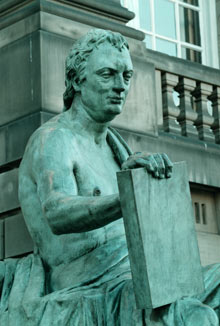 The most dismaying feature of the rise of creationism and intelligent design (ID) in the present day is the success advocates have in distorting so much of the wider public discussion of evolution. In short, evolution has become as much a political question as one of modern science. Culture wars, over the place of religion in society, show no sign of lessening. And so sadly it seems that creationism and ID will remain strong too, because what sustains them is not any serious contribution to science or theology, but precisely the heat of dispute. For example, last week I was talking with a senior biochemist at Cambridge University. He reported that he could not recall a single mention of the word "creationism" during the time he worked in Turkey, which was for much of the 1970s. Nowadays though, it dominates the discussion at a public level – thanks to the activities of individuals like Harun Yahya, whose polemical and widely distributed books, such as The Atlas of Creation, advocate old Earth creationism. At least this can be tackled head-on, for the very reason that it is out in the open. Many in the Muslim world are now doing so. I was also fortunate enough to speak with Rana Dajani last week, a Jordanian molecular biologist. She believes part of the problem is that Darwin was only recently translated into Arabic, and so many people do not have access to quality information about evolution. They only have the polemic and the politics. It's a deficit she, for one, is working hard to put right. But the insidious effects of the culture clashes run deeper too. Consider the current case of the academic journal, Synthese. Synthese is a well-respected philosophy publication, with past contributors including Thomas Nagel and Jerry Fodor. It recently had a guest-edited special issue on "Evolution and Its Rivals". One article in this issue included a critique of the work of Francis Beckwith, a professor at Baylor University. If I tell you that last month he gave a talk entitled, "No God, No Good: Why the Moral Law Requires a Moral Lawgiver", you can see where he's coming from. Allegedly, friends of Beckwith complained at the personal nature of the published critique. |
| Column |
Tunisians' Welcoming of Libyan Refugees is Altruism in ActionTunisian willingness to house fleeing Libyans reminds us that caring for others is really a human, not a technical, act.  Many tens of thousands of refugees have now fled Libya and crossed to the relative safety of Tunisia. Their stories will, no doubt, be ones of terror and horror. And yet, there are tales of deep humanity too in their flight. A UNHCR spokesperson, Andrej Mahecic, has reported that fewer than one in ten of the Libyan arrivals are staying in refugee camps. Instead, the vast majority of those fleeing have been welcomed by Tunisian communities. The homeless Libyans are being hosted by locals, at the locals' expense and with great generosity, given the Tunisians' own resources are not great. It's a moving tale, especially given the worries rattling around rich Europe about the migration implications of the Arab uprisings, given our own habits of locking up immigrants behind bars. Of course, the situation in Libya is an emergency. And there are deep bonds between these peoples, founded upon a common religion. But the story prompts thoughts about the nature of altruism and what happens when caring for others comes to be seen as primarily a technical, rather than a human, problem. There is a lot of discussion about altruism today, driven in large part by the trouble it causes evolutionary theory. In the dog-eat-dog world of crude Darwinism, why should it be that some species collaborate, even to the point of self-sacrifice? In fact, Martin Nowak, author of SuperCooperators, argues that co-operation is quite as central to evolution as competition. You only need do the maths, he explains, the cost-benefit analysis. Working together in groups works. Only, that's not the whole story, he continues. |
| Column |
Tunisia, Libya, and FreedomTunisian willingness to house fleeing Libyans reminds us that caring for others is really a human, not a technical, act.  Many tens of thousands of refugees have now fled Libya and crossed to the relative safety of Tunisia. Their stories will, no doubt, be ones of terror and horror. And yet, there are tales of deep humanity too in their flight. A UNHCR spokesperson, Andrej Mahecic, has reported that fewer than one in ten of the Libyan arrivals are staying in refugee camps. Instead, the vast majority of those fleeing have been welcomed by Tunisian communities. The homeless Libyans are being hosted by locals, at the locals' expense and with great generosity, given the Tunisians' own resources are not great. It's a moving tale, especially given the worries rattling around rich Europe about the migration implications of the Arab uprisings, given our own habits of locking up immigrants behind bars. Of course, the situation in Libya is an emergency. And there are deep bonds between these peoples, founded upon a common religion. But the story prompts thoughts about the nature of altruism and what happens when caring for others comes to be seen as primarily a technical, rather than a human, problem. There is a lot of discussion about altruism today, driven in large part by the trouble it causes evolutionary theory. In the dog-eat-dog world of crude Darwinism, why should it be that some species collaborate, even to the point of self-sacrifice? In fact, Martin Nowak, author of SuperCooperators, argues that co-operation is quite as central to evolution as competition. You only need do the maths, he explains, the cost-benefit analysis. Working together in groups works. Only, that's not the whole story, he continues. The problem with a cost-benefit analysis approach is that it reduces altruism. Instead of being about selflessness, it becomes a new form of selfishness. I'll scratch your back if you scratch mine. Maybe not today. Maybe not tomorrow. But I'll remember what I did for you, and hold you forever in my debt. Transfer that into the moral discourse that shapes a culture, and you find yourself with a world in which virtues such as trust, courage, loyalty and sympathy struggle to thrive. Instead of honour, we write contracts. Instead of bonds of friendship, we work out our relationship to one another in the courts. Nowak recognises that the maths can provide only half the story, and it misses out the most important part too, namely the role played by intention. What are the values that underpin co-operation? What are the beliefs that allow it to flourish? This is the vital discussion, he asserts, and one that must include politicians and philosophers, artists and theologians, alongside the scientists. |
| Review |
The Final Testament of the Holy Bible is Shocking. Shockingly Bad, that is.The problem with James Frey's book isn't blasphemy per se. Good blasphemy, unlike this adolescent theology, is valuable.  Blasphemy is in the news again, and this time it has nothing to do with the Qu'ran or the prophet Muhammad. The novelist James Frey has written a new life of Jesus, The Final Testament of the Holy Bible. It is set in contemporary New York in which a Jesus-figure, Ben, comes back among New York lowlife, as lowlife. His message is the old hippy one – love, love, love – which he pursues in very practical ways. He makes love to almost everyone he meets – women, men, drug addicts, priests. Hence the blasphemy. Or at least, that is what the publishers are hoping. Written on the cover, in bold, we are told that this is Frey's most revolutionary and controversial work. "Be moved, be enraged, be enthralled by this extraordinary masterpiece," it screams in uppercase letters. I hope people don't rise to the bait. The book is more ludicrous than scandalous. The rabbit-like lovemaking is accompanied by dialogue of the "we-screwed-until-dawn-and-it-was-like-being-joined-with-the-cosmos" type. And then there's the adolescent protest theology. Religion is responsible for all ills everywhere, Ben solemnly informs us. The Bible is a stone age sci-fi text. God is no more believable than fairies. Faith is just an excuse to oppress. That said, the book did set me thinking about blasphemy. For it seems to me that there is good blasphemy and bad blasphemy. Good blasphemy is worth studying, whereas bad blasphemy is not. Good blasphemy conveys ethical and theological insights, whereas bad blasphemy is simply about complaint and shock. Both kinds of blasphemy might be published, but only the good type is worth spending time on. (It's a shame when bad blasphemy upsets believers and gains press coverage that encourages others to react to it.) I was myself involved in a blasphemy case, one of the last to be investigated by the police before changes in British law. We'd published a banned poem, The Love that Dares to Speak its Name by James Kirkup. It strikes me now that while there were important principles of free speech to defend in the case, the poem itself is an example of bad blasphemy. It features a Roman centurion having sex with Jesus after his crucifixion, and is naive and clumsy, replete with ban puns about Jesus being "well hung". Aesthetically it's inept, ethically it's simplistic, theologically it's crass. |
| Column |
Martin Rees's Templeton Prize May Mark a Turning Point in the "God Wars"Awarding the Templeton prize to Rees suggests science is rejecting the advocacy of the likes of Richard Dawkins 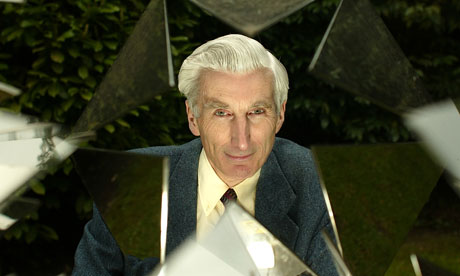 Richard Dawkins – author of The God Delusion and theorist of the selfish gene – could claim to be the most famous scientist in Britain. Sir Martin Rees – astronomer royal, former president of the Royal Society, master of Trinity College, Cambridge – is arguably the most distinguished. Last year, Dawkins published an ugly outburst against the softly spoken astronomer, calling him a "compliant Quisling" because of his views on religion. And now, Rees has seemingly hit back. He has accepted the 2011 Templeton prize, awarded for making an exceptional contribution to investigating life's spiritual dimension. It is worth an incongruous $1.6m. Dawkins is no stranger to pungent rhetoric when it comes to religion. But "Quisling" is strong even by his standards. It was originally hurled against fascist collaborators during the second world war. Rees, a collaborator? What was the crime that warranted such approbation? The Royal Society lent its prestige to the Templeton Foundation by hosting events sponsored by the fund, which supports a variety of projects investigating the science of wellbeing and faith. Dawkins and Rees differ markedly on the tone with which the debate between science and religion should be conducted. Dawkins devotes his talents and resources to challenging, questioning and mocking faith. Rees, on the other hand, though an atheist, values the legacy sustained by the church and other faith traditions. He confesses a liking for choral evensong in the chapel of Trinity College. It seems a modest indulgence. The ethereal voices of rehearsing choristers can literally be heard from his front door. But for Dawkins this makes the man a "fervent believer in belief". And that is a foul betrayal of science. I should declare an interest here, as I too would be what Dawkins calls an "accommodationist", (when he is being polite). I often write about the relationship between science and religion, and have been a Templeton-Cambridge Journalism Fellow, the beneficiary of a first-rate seminar programme organised by Cambridge academics, funded by the Templeton Foundation. But then I love the big questions. |
| Article |
 Are Humans Hard-Wired for God?Some scientists suggest that a belief in God is part of human instinct; others argue that God is a human invention. Mark Vernon looks at the evidence.  MOST human beings, even in the modern world, believe in God or gods. The World Religion Database suggests that at least three-quarters of the world’s population identify with a theistic religion. Conversely, only two per cent are atheists. It is a phenomenon that researchers in the field of cognitive science are investigating, with results that might be thought unsettling for believers. One way to ask why humans believe in God is to study children. The University of Oxford’s Institute of Cognitive and Evolutionary Anthropology and its Institute of Social and Cultural Anthropology has been given a three-year, $3.9-million grant by the John Templeton Foundation to explore exactly this. The psychologist Dr Justin Barrett has concluded that, when young, we are inclined to believe in a kind of natural religion. Children assume that there are divinities who act as agents in the world —which is to say, there are purposive forces abroad in the cosmos. These "God concepts" are associated in the child’s mind with a number of characteristics. A common one is that the world is designed — and in particular, that it is designed for the child concerned. Children will also explain features of the world around them in ways that adults do not teach them. "For instance," Dr Barrett says, "children are inclined to say rocks are ‘pointy’ not because of some physical processes but because being pointy keeps them from being sat upon." Children are also likely to ascribe theological attributes to their view of God. Take a child aged five. He or she knows that, say, there are no corn flakes left in the packet, because of having shaken it. The child will also comprehend that Mummy is wrong when, at breakfast, having put the packet on the table, she insists, "You’ve got the cornflakes." But the child will also understand that God knows that there are no cornflakes left, even though God has not shaken the packet —because, by that age, the child will also assume that God knows everything. |
| Column |
Buddhism is the New Opium of the PeopleWestern Buddhism has a long path to travel before becoming something that resists, rather than supplements, consumerism.  In one of the many living rooms that belong to David and Victoria Beckham, there sits a four-feet-high golden statue of the Buddha. Madeleine Bunting spotted it on TV, she told a packed audience for the last of the Uncertain Minds series. What is it about Buddhism, she mused, that makes it such a perfect fit with modern consumerism? The Buddhist writer Stephen Batchelor who, along with the Buddhist scholar John Peacock, was speaking at the event, replied that there is a temple in Thailand that contains a Buddha rendered as a small image of David Beckham. The symmetry is perfect. And it raises a vital question for western Buddhism. Western Buddhism presents itself as a remedy against the stresses of modern life though, as Slavoj Žižek has noted, it actually functions as a perfect supplement to modern life. It allows adherents to decouple from the stress, whilst leaving the causes of the stress intact: consumptive forces continue unhindered along their creatively destructive path. In short, Buddhism is the new opium of the people. Batchelor and Peacock might agree that this is a serious charge and grave risk. And their efforts can be interpreted as precisely to resist it. Their analysis is different. Western Buddhism is undergoing its Protestant reformation, Batchelor observed. It is about two centuries behind western Christianity in terms of its critical engagement with its canonical texts. The quest for the historical Buddha – an exercise that parallels the 19th-century quest for the historical Jesus – is only just under way. An essentially medieval Buddhism has been catapulted into modernity. It's hardly surprising that it will take two, perhaps three centuries for an authentically western form to emerge – by which is meant, in part, one that resists, not supplements, consumerism. For if Buddhism is to live in the modern world, it must be treated as a living tradition, not a preformed import. As the reformation leaders of the 16th century knew, this is a profoundly unsettling project – though it is also compelling for its promise is new life. |
| Column |
Rob Bell's Intervention in the Often Ugly World of American EvangelicalismIn its treatment of hell, the pastor's book holds two Christian truths in tension: human freedom and God's infinite love.  The question: Who is in hell? I met Rob Bell at Greenbelt, a couple of years back, because we happened to be staying in the same hotel. Though at first, I didn't know who he was. Rather, I saw him coming. He was dressed head-to-foot in black and was accompanied by three other chaps, similarly clad, carrying those impressive silver cases that speak of expensive, hi-tech gear. Then, later, I saw the long queues for his event; they were heavily oversubscribed. I made the link with the inclusive megachurch American pastor who was topping the bill. He draws congregations numbered in the tens of thousands. And now his new book, Love Wins, has achieved the ultimate accolade. A clever marketing campaign led to a top 10 Twitter trend at the end of February. Evangelicals, even liberal ones, believe the Word changes everything, and so they take words very seriously. They are entirely at home in the wordy, online age. The row on Twitter is to do with the content of the book, or at least what a number of conservative megachurch detractors assumed to be the content. It's to do with universalism – the long debate in Christianity about whether everyone is eventually saved by Jesus, or whether only an elect make it through the pearly gates. Bell's opponents assume that he is peddling the message that when the great separation comes, between the sheep and the goats, there won't be any going into the pen marked "damnation". From this side of the pond, it all feels very American, one of those things that makes you realise that the US is a foreign country after all. I'm sure that some British evangelicals debate the extent of the saviour's favour too, only they are also inheritors of the Elizabethan attitude about being wary of making windows into other people's souls. "Turn or burn!" works in South Carolina, not the home counties. (Then again, I was recently in a debate with someone who claimed to know Jesus better than his wife. I wondered whether his wife knew.) |
| Column |
Ultra-Darwinists and the pious geneRichard Dawkins won't like it, but he and creationists are singing from similar hymn sheets, according to a new book. 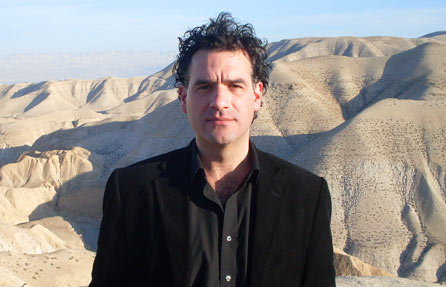 Here are three questions of the kind evolutionary theorists love. First, why do most mammals walk on four legs? Second, how come some single-celled protists have genomes much larger than humans? Third, why have camera eyes evolved independently in vertebrates and octopuses? They're important questions as they challenge certain versions of Darwinism that are dominant today in popular discourse. They are posed, alongside many others, in a rich mix of high theory and low knockabout in a new book by Conor Cunningham, Darwin's pious idea: How the ultra-Darwinists and creationists both get it wrong. Ultra-Darwinism is the kind associated with the new atheism, the selfish gene and what Daniel Dennett calls evolution's "universal acid". Cunningham has form when it comes to critiquing its flaws. You may have seen his TV documentary, Did Darwin Kill God? In the book, he has not one hour but several hundred pages to persuade us that a new consensus is on the way in evolutionary circles and, moreover, it's remarkably amenable to Christian theology. Consider, then, the questions. First, why do most mammals walk on four legs? It may be because four is an optimal adaptation for walking on land. Or it may be because the number four originates with the four fish fins that predate mammal legs. The difference is subtle but much hangs on it. If the number four is an optimal adaptation – not merely a byproduct of fins – then it exemplifies the power of natural selection to explain all sorts of traits. Only, consider a millipede. It would presumably think there's nothing optimal about four at all. I'd blame the fish, it might muse. And we might remember the millipede's contribution because, if it's hard to say whether features of organisms are adaptations or not, that causes all sorts of problems for the universal acid of ultra-Darwinism. Strongly adaptationist explanations are common in ultra-Darwinism and the work of the acid. But as Cunningham repeatedly – actually, obsessively – points out, when they are rehearsed as gospel, they exact a terrible price. They describe such humanly invaluable features as mind, ethics and free will as delusions – akin to what Nietzsche called "true lies". The resulting nihilism is one of Cunningham's prime objections to the paradigm. |
| Column |
Uncertainty's PromiseWhether with science or religion, only by embracing doubt can we learn and grow.  We live in an age intolerant of doubt. Communicating uncertainty is well nigh impossible across fields as diverse as politics, religion and science. There's a fear of doubt abroad too. It's most palpable, at the moment, whenever there's news of economic uncertainty. Waves of nervousness ripple through financial markets and supermarkets alike. And yet, at the same time, few would deny that only the fool believes the future is certain. And who doesn't fear that most shadowy figure of our times, the fundamentalist – with their deadly, steadfast convictions? The confusion is understandable. Doubt is unsettling. It's not for nothing that old maps inscribed terra incognita with the words "here be dragons". Further, the tremendous success of science, and the transformation of our lives by technology, screens us from many of the troubling uncertainties that our ancestors must have been so practised in handling. But are we losing what might be called the art of doubt too? For, in truth, without doubt there is no exploration, no creativity, no deepening of our humanity – which is why the individual who claims to know something beyond all doubt is a person to shun, not emulate. Stick to what you know and you'll find some security, but you'll also find yourself stuck in a rut. Learn to welcome the unknown, to embrace its thrill, and new worlds might open up before you. My old physics tutor, Carlos Frenk, is an excellent case in point. He is one of the world's leading researchers on dark matter – as is advertised by a large poster that hangs outside his office. It is inscribed with five bold words: "Dark Matter – Does It Exist?" To put it another way, Professor Frenk has forged a career out of navigating the terra incognita of the cosmos. He believes there is dark matter. It makes sense of the way visible matter in the universe hangs together. But there are no guarantees. Moreover, that's a fact that his peers ache to exploit. They seek to falsify his thesis, a negative process by which they hope to prove him wrong. That's what you have to live with when your expertise is on what's uncertain. And yet, Professor Frenk remains persistently sanguine. Falsity is the only certainty in science, he tells me. Science is organised doubt. It's only when scientists can no longer say no to a thesis that it stands. |
| Column |
 The Return of Virtue EthicsWhat is the good life? How can we know?  The Enlightenment was a revolution in the way we think about morality. Two ethical models, in particular, have come to dominate ever since. One can be traced back to Immanuel Kant, and is based upon the notion of duty (and hence is called deontological, from the Greek deon, meaning duty.) The second is hedonist and can be traced back to Jeremy Bentham, and his principle of utility: an action can be called good if it increases pleasure or decreases pain. Put them together and you have the liberal approach to asking what’s the right thing to do. It’s liberal not in the sense of being pro-gay or pro-abortion. Rather, it’s liberal in the deeper sense of focusing on the individual and the choices an individual makes. It's ethics conceived of in terms of rights and responsibilities, or in terms of what makes you happy or sad. The philosopher John Stuart Mill summed it up when he wrote: "Neither one person, nor any number of persons is warranted in saying to another human creature of ripe years, that he shall not do with his life for his own benefit what he chooses to do with it." You can understand why Mill wrote what he did. He lived in a period of history in which many people were not free to do as they chose. They were ruled by monarchs and chastised by prelates. The result was the subjugation of women and the owning of slaves. But we don’t live in such a world now. Most enjoy a degree of freedom that would have been unimaginable for most of human history, in the West at least. As a result, the liberal approaches to ethics are increasingly being questioned. Can they tell us what this freedom is for? Is it for more than just more consumption, more accumulation? What is the good life? The problem is that we’ve lost touch with the bigger picture: what is it that makes life good for us humans? The Enlightenment left us with few resources for thinking about that larger question, because it was so focused on winning individuals their freedom. The philosopher Elizabeth Anscombe described our dilemma this way. Our talk of having "moral duties," or our description of actions as "morally right," has become vacuous because we are now free of the law-giving God who fixes those duties and obligations. And Anscombe, as a Catholic, was a firm believer in God — only not a law-giving God but a loving one. In any case, now that we are relatively free, we need to ask again what life is for. There is another ethical tradition that can help. It’s known as virtue ethics. Virtue ethics begins by asking what it is to be human, and proceeds by asking what virtues — or characteristics, habits and skills — we need in order to become all that we might be as humans. It’s much associated with the ancient Greek philosopher Aristotle, who discussed the meaning of friendship as a way to illustrate his approach to ethics. Science tells us we are social animals, Aristotle observed. But in order to live well as social animals, we also need a vision of what our sociality can be. He had a word for that vision: friendship. The good friend is someone who knows themselves, who is honest and courageous, who has time for others, who is engaged not only in their self-interest but has a concern for others. These are some of the virtues we should nurture in order to be fulfilled as friends. |
| Column |
 Is It Fair to Pay Bankers Big Bonuses?It's bonus season for bankers, including at banks bailed out by taxpayers. Is this just? Great thinkers like Aristotle have mulled such questions for centuries. 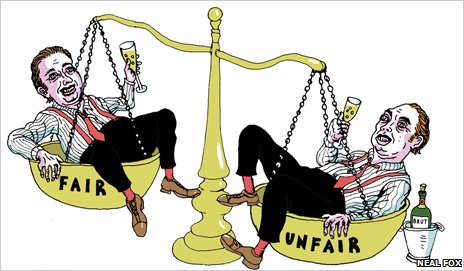 Is it fair and just to pay bankers big bonuses? You can seek an answer in three different ways, according to the three traditions of moral philosophy that dominate in our times, which are also explored in BBC Four's Justice: A Citizen's Guide to the 21st Century. The first answer can be summed up in a word: happiness. It's associated with the British philosopher Jeremy Bentham, who argued that if you want to know the right thing to do, ask yourself what will increase the happiness of most people, and decrease pain. Is it the size of the bonuses paid to bankers that so riles the public? The utilitarian could stress that growth, wealth and GDP contribute much to the happiness of all. These depend upon a functioning banking system. And banks, in turn, need investment bankers to turn a profit. If those bankers are best incentivised by the promise of large bonuses, then so be it. Indirectly, that makes everyone happier. The utilitarian would also consider the amount of outrage and unhappiness that large bonuses generate in the population at large. There may come a point when the happiness generated by profitable banks outweighs the unhappiness of protests at the bonuses. But then again, banks are so fundamental to our economy, and the economy is so fundamental to our happiness, that it seems unlikely this tipping point will be reached - as indeed the British government seems to have concluded. The second tradition might come to a broadly similar view, but for different reasons. It too can be summed up in a word - dignity - and is associated with the German philosopher Immanuel Kant. |
| Column |
How to Meditate: An Introduction'Mindfulness meditation' – getting to know the here and now – could be the key to a calmer, happier, healthier you.  Rates of depression and anxiety are rising in the modern world. Andrew Oswald, a professor at Warwick University who studies wellbeing, recently told me that mental health indicators nearly always point down. "Things are not going completely well in western society," he said. Proposed remedies are numerous. And one that is garnering growing attention is meditation, and mindfulness meditation in particular. The aim is simple: to pay attention – be "mindful". Typically, a teacher will ask you to sit upright, in an alert position. Then, they will encourage you to focus on something straightforward, like the in- and out-flow of breath. The aim is to nurture a curiosity about these sensations – not to explain them, but to know them. There are other techniques as well. Walking meditation is one, when you pay attention to the soles of your feet. That too carries a symbolic resonance: if breath is to do with life, feet are a focus for being grounded in reality. It's a way of concentrating on the here and now, thereby becoming more aware of how the here and now is affecting you. It doesn't aim directly at the dispersal of stresses and strains. In fact, it is very hard to develop the concentration necessary to follow your breath, even for a few seconds. What you see is your mind racing from this memory to that moment. But that's the trick: to observe, and to learn to change the way you relate to the inner maelstrom. Therein lies the route to better mental health. Mindfulness, then, is not about ecstatic states, as if the marks of success are oceanic experiences or yogic flying. It's mostly pretty humdrum. Moreover, it is not a fast track to blissful happiness. It can, in fact, be quite unsettling, as works with painful experiences, to understand them better and thereby get to the root of problems. Research into the benefits of mindfulness seems to support its claims. People prone to depression, say, are less likely to have depressive episodes if they practice meditation. Stress goes down. But it's more like going on a journey than taking a pill. Though meditation techniques can be learned quickly, it's no instant remedy and requires discipline. That said, many who attend lessons or go on retreats find immediate benefits – which is not so surprising, given that in a world of no stillness, even a little calm goes a long way. |
| Column |
How a Marxist Might See the CreedMy take on Terry Eagleton's interpretation of Christianity unites it with Marxism in a rejection of progress.  For the latest event in the Uncertain Minds series, I talked with the Marxist critic Terry Eagleton, author of Reason, Faith, and Revolution: Reflections on the God Debate. We were sitting beneath the stone arches of the Wren suite, in the crypt of St Paul's Cathedral. And as we conversed, I had a very odd experience. It was as if I could hear him reciting a Christian creed – sotto voce – adding in his distinctive gloss on several of the key phrases. Here's something close to what I imagined he said. I believe in God. Obviously, if I were a Christian, I wouldn't believe in God in the way that an alarming proportion of Americans believe in alien abduction. After all, Satan believes in God in that sense. He knows God exists. But he doesn't trust in God and isn't committed to God's ways. Quite the opposite. Alain Badiou, probably the greatest philosopher alive today, writes about having a commitment to a revelatory event. That must be more like what a Christian believes. Creator of heaven and earth. This, of course, has absolutely nothing to do with the big bang. Those who are tempted to think of it as a reference to divine pyrotechnics on a cosmic scale should read a little Wittgenstein. Creator-talk is theology, and that's a different language game from science. Rather, to call God the creator means that you believe the universe has a purpose. As to how it was done – physics has a few ideas. As to what that purpose might be – well, we perhaps glean something from the next line. I believe in Jesus Christ. Jesus is the locus for a remarkable set of stories. They are remarkable because they remember a life that clung to faith even when the subject of that life was hanging half dead from a tree. As my sometime fellow papist Marxist, Herbert McCabe, once put it: if you don't love you die, if you do love they kill you. In this tragic world of ours, that seems to me to be quite true. And remember, tragedy is not the same as pessimism because pessimism gives up hope, which is precisely what Jesus didn't do. Though he had more reason than most to do so. |
| Column |
William James, Part 8: Agnosticism and Pragmatic PluralismWilliam James wanted a philosophy that rested on experience, not logic, because life exceeds logic. 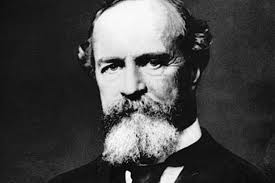 "The most important thing about a man," wrote Chesterton, "is his philosophy." William James agreed. He was fond of quoting the saying. Our philosophy, or "over-belief", shapes our "habits of action," which is to say our ethos – who we are becoming. Pragmatism, the philosophy of "what works," is taken to be James' philosophy. And yet, his pragmatism is different from that of his confrères. Pragmatism is often associated with deflationary accounts of truth. Truth, with a capital T, is a pipe dream, it implies. No fact, rule or idea is ever certain – nor is even the possibility of facts, rules and ideas. Philosophy and science can make progress, but only in relation to current experience. "Truth is the opinion which is fated to be ultimately agreed to by all who investigate", wrote one pragmatist philosopher, John Dewey. Or as Richard Rorty pithily averred: "Time will tell, but epistemology won't." When it comes to religion, such pragmatism implies that theologians are more like poets than metaphysicians. They are aestheticians – conjuring meaning with their descriptive powers, as opposed to capturing Truth in their formularies. It's called ironic pragmatism. "There is an all" is inverted to "that's all there is." Such a stance requires the philosopher, or scientist, to be committed to finding the truth as it if existed, though it probably doesn't. It's truth as a "regulative ideal," to use another phrase. So, if James is a pragmatist, what of his religious quest? Is he condemned to perpetual agnosticism – longing for more and never finding it? It's a big debate amongst Jamesian scholars. But I think his ethos, his philosophy, can be summarised like this. |
| Column |
William James, Part 7: Agnosticism and the Will to BelieveJames observes that the idea you can will belief in God is 'simply silly,' as the nature of real assent consists of many strands.  There is an agnostic sensibility that runs through William James – in this sense: he knows that any claim of knowledge based on religious experience could, in principle, be mistaken. But it may be true, too. He's convinced that the fruits of "spiritual emotions" are morally helpful for humankind, notwithstanding that some fruits become rotten. He's probed mystical experiences – that sense of oneness with the Absolute – to see whether they can decide the case. They can for the individual concerned, he concludes. But, as he observes at the start of lecture 18, mysticism is "too private (and also too various) in its utterances to be able to claim a universal authority". So, in the final sections of the Varieties, the question of whether religious experiences point to objective truth becomes pressing. "Can philosophy stamp a warrant of veracity upon the religious man's sense of the divine?" he asks. Well, first, you've got to ask what religious philosophy is. It seems obvious to him that it is secondary to religious experience because it is passion, not reason, that fundamentally drives such areas of human inquiry (and quite possibly all areas of human inquiry). Philosophy is necessary, but not sufficient. In fact, he loathes what he elsewhere calls "vicious intellectualism" – the preference for concepts over reality. It's cultivated by the fantasy of an objective science – and is insidious because it turns you into a spectator of, not a participant in, life. It encourages speculation for speculation's sake, and like the bankers who engage in the financial equivalent, the result is ideological bubbles. They rise high in the intellectual firmament before they burst and crash back to earth. In the sphere of religion, James detects such "vicious intellectualism" most clearly in the attempts to demonstrate the existence of God as an a priori fact. The ontological and cosmological proofs are for those who wish to cleanse themselves of the "muddiness and accidentality" of the world. Interestingly, he describes the recently beatified John Henry Newman as one such "vexed spirit". He charges the cardinal with a "disdain for sentiment", though I'm not sure that's fair. In fact, Newman seems quite close to James in certain respects, particularly in relation to what Newman called the "grammar of assent". |
| Column |
William James, Part 6: Mystical StatesJames's discussion of mysticism is not unproblematic, but there is significant value in the way he frames the subject.  Mysticism is a crucial aspect of the study of religion. "One may say truly, I think, that personal religious experience has its roots and centre in mystical states of consciousness," William James writes in The Varieties. That said, it's important to be clear about what he means by phrases like "states of consciousness". Our view is coloured by a psychologising tendency that's grown since James. It can be associated, in particular, with Abraham Maslow's notion of "peak experiences" – the ecstatic states that satisfy the human need for self-actualisation. This exaltation of feelings of interconnectedness is questionable on two counts. First, Maslow's analysis is scientifically dubious. As Jeremy Carrette and Richard King put it: "Sampling disillusioned college graduates, Maslow would ask his interviewees about their ecstatic and rapturous moments in life." No offence to students, but they probably do not provide the best samples of mystics. A second critique of Maslow's work is found in the writings of the great spiritual practitioners themselves. The author of The Cloud of Unknowing, for one, explicitly argues that, whatever the mystical might be, it is hidden from experience. Or, as any decent meditation teacher will tell you, clinging to oceanic experiences will hinder your progress quite as much as clinging to anything else. This is not to say that mystical experience has nothing to do with feelings, James continues. Rather, it is a state both of feeling and of knowledge, of wonder and intellectual engagement. The two faculties must be deployed when weighing any insight. "What comes," James explains, "must be sifted and tested, and run the gauntlet of confrontation with the total context of experience." Mystical states can, therefore, be assessed for their truth value. But how? Not, James explains, in the way advocated by the "medical materialists" – those for whom mysticism signifies nothing but "suggested and imitated hypnoid states, on an intellectual basis of superstition, and a corporeal one of degeneration and hysteria". |
| Column |
William James, Part 5: SaintlinessReligious experiences, and their saintly effects, are morally helpful, not damaging or repugnant. 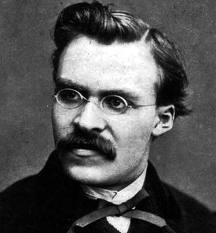 One of Friedrich Nietzsche's fiercest attacks on Christianity pitches against the exalted virtues of saintliness. He believed the worship of the crucified encouraged a vile, slave mentality in its adherents. It's partly a result of being required to submit to a superior deity; partly a result of the moral demand to serve others. Christianity, he concluded, is dehumanising. He has a point. Consider what might happen should you take pity on someone, as the Christian ethic of love requires. This virtue, Nietzsche insists, is really the desire to take possession. Thus, when we see someone who is suffering, and act on a feeling of compassion, we make ourselves their benefactor. We set ourselves over them, and leave them in need of us. We might not only congratulation ourselves for our sympathy, but could well prefer attending to the suffering of others to facing our own distress – the phenomenon of the wounded healer who helps others because they cannot help themselves. Far better, Nietzsche thought, that individuals pursue their own way through suffering – though not in isolation. Rather, do so together, and so learn to rejoice, in spite of it all. That way suffering is not spread, and joy might be increased. This was a conclusion that worried William James, and in the The Varieties of Religious Experience he devotes five lectures to challenging it. It troubled him because he was keen to show that religious experiences, and their saintly effects, are morally helpful, not damaging or repugnant. "The highest flights of charity, devotion, trust, patience, bravery to which the wings of human nature have spread themselves have been flown for religious ideals," he avers. He sets out on a lengthy analysis of cases to prove his point. |
| Column |
William James, Part 4: The Psychology of ConversionReligious conversion, be it sudden or slow, causes a revolution in the personality.  The case of Stephen H Bradley, reported by William James in The Varieties of Religious Experience, is arresting. At the age of 14, he had a vision of Jesus. It lasted only a second. Christ was in the young man's room, "with arms extended, appearing to say to me, Come." From that day on, Bradley called himself a Christian. Then, when he was in his mid-20s, he attended a revivalist meeting. It left him cold, and that troubled him, as he regarded himself as religious. Then, later that evening, he was gripped by an even more profound experience than the first. His heart beat fast. He became elated, while also feeling worthless. He experienced a stream of air passing through him. The next morning, he believed he could see "a little heaven upon earth". He visited his neighbours, "to converse with [them] on religion, which I could not have been hired to have done before". He concludes: "I now defy all the deists and atheists in the world to shake my faith in Christ." Bradley had undergone a religious conversion and, as is his wont, James considers a range of similar cases in the Varieties. They can show a sense of regeneration, or a reception of grace, or a gift of assurance. What distinguishes religious conversion from more humdrum experiences of change is depth. Human beings quite normally undergo alterations of character: we are one person at home, another at work, another again when we awake at four in the morning. But religious conversion, be it sudden or slow, results in a transformation that is stable and that causes a revolution in those other parts of our personality. Hence, before his conversion, Augustine prayed to be chaste but "not yet", which is only to underline that, with his conversion, what was previously impossibility became actual. It's that personal drama that leads the convert to ascribe the change to God. But, strictly as a psychologist, what sense can be made of it? James resorts to what he believes to have been the greatest discovery of modern psychology, namely that subconscious forces play a defining role in the life of an individual, even when they have no conscious awareness of them. |
| Column |
William James, Part 3: On Original SinAre humans born happy, able to create their own well-being, or do we need to be born again to overcome a 'sick soul'? 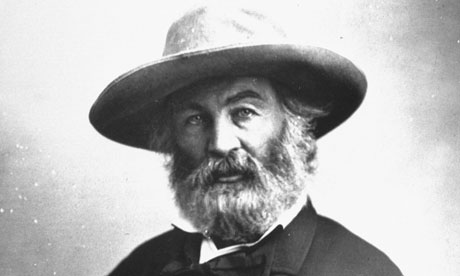 Original sin is a religious doctrine that divides perhaps more than any other. For some, it only makes sense – maybe not the part about the apple and the garden, but the general idea that humankind is flawed: we do what we wouldn't do, and don't do what we would do, as St Paul put it. For others, though, original sin is vile and offensive. It feeds the fear of hell, a hopelessness about progress, and leaves us pathetically dependent on God. Each side has a radically different view of what it is to be human, and William James understands exactly what's a stake. It follows from one of the most interesting distinctions he draws in the Varieties. There are some, he explains, who take the happiness that religion gives them to be the amplest demonstration of its truth. Then, there are others who take the remedy that religion offers for the ills of the world to be the amplest reason for its necessity. James adopts the terms "once-born" to describe the happy sort, and "twice-born" for the more pessimistic. The link between the phrase "once-born" and the positive temperament is that these individuals believe that seeing God – or finding fulfilment, or simply living well – is no more or less difficult than seeing the sun. On some days it will be cloudy. But the skies eventually clear. The cosmos is fundamentally good, they affirm. Human individuals are, basically, kind. Your first birth, as a baby, is the only birth that's required to see the world aright. This temperament is, James explains, "organically weighted on the side of cheer and fatally forbidden to linger, as those of opposite temperament linger, over the darker aspects of the universe." James's favourite example of the once-born is Walt Whitman. "He has infected [his readers] with his own love of comrades, with his own gladness that he and they exist." Alongside Whitman, there are some Christians who fall into this category. (Not all take original sin that seriously.) They are of a liberal sort, believing that the significance of Jesus is found in his moral teaching, which if followed would lead to a more perfect world. Popular science-writing has contributed to the increase of this kind of belief too, as it conveys the conviction that human beings can understand themselves and, thereby, fix themselves. Eastern ideas imported into the west offer something similar. Hence, meditation techniques, such as mindfulness, are sold as being scientific and empowering. |
| Review |
 The Age of EmpathyNature's Lessons for a Kinder Society 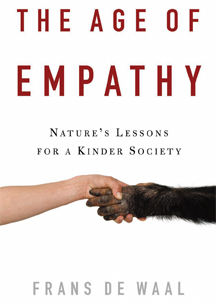 This is a confused book because it is trying to do several things at once. It is partly a study of animal empathy, the area of work for which Frans de Waal is well known. But de Waal is also fighting other battles, notably over whether there are sharp dividing lines between humans and other animals. And here he is much less sure of his ground. The difficulty is that, in stressing the co-operative side of animal behaviour, de Waal sidelines an important trait on which human difference turns: cognition. It was not a mistake Charles Darwin made when, in The Descent of Man (1871), he noted that although animals have "well-marked social instincts", it is "intellectual powers", such as humans have, that lead to the acquisition of the moral sense of right and wrong. The book fails when it comes to the third goal de Waal sets himself: to champion empathy as a solution to social, even political, problems. He resists the notion that empathy is innately morally ambivalent, overlooking how sadistic behaviour, for example, arises from empathising with a victim, too. Occasionally he admits that empathy is psychologically complex, but rather than exploring this complexity, he quickly returns to reciting evidence more congenial to his thesis. He briefly offers a more sophisticated account of emotional connectivity, but again ignores its ramifications. This is a hierarchical model, and begins with the inchoate feelings that arise from witnessing another's exhilaration or distress. Next, there is "self-protective altruism" - doing something that benefits another person, though only in order to protect yourself from unpleasant emotional contagion. Then there is "perspective-taking", which is stepping into the shoes of another. But it is not unless the individual has a further capacity, sympathy, that he or she knows how to improve the lot of others. What distinguishes sympathy is that it allows both emotion and understanding (Darwin's "intellectual powers") to be brought to bear on the situation at hand. Such faculties, however, are not the basis for moral behaviour that de Waal seeks. Indeed, he "shudder[s] at the thought that the humaneness of our societies would depend on the whims of politics, culture, or religion". One may shudder with him, but one might shudder more if our ability to act humanely rested solely on the morally flawed capacity of empathy. |
| Column |
William James, Part 2: The Scientific Study of ReligionJames demonstrates how identifying the physiological bases for religious experience explains very little.  The Scotsman of May 1901 records how William James began the lectures that became The Varieties of Religious Experience, "in the English class-room of [Edinburgh] University, where a crowded audience assembled". He was the kind of communicator who attracted more and more auditors as a course proceeded. When, in 1908, he gave the Hibbert lectures in Oxford, the venue had to be changed from a modest library to the vast rooms of the Examination Schools building. "It is with no small amount of trepidation that I take my place behind this desk," he opened, "and face this learned audience." The reasons for his strikingly humble tone were several. American universities had only recently started to award higher degrees, so thinkers of James' generation travelled to Europe to research. James himself had no such academic qualification. That said, it quickly became clear that he had all the boldness of the brilliant amateur. His lectures would examine the perennial human phenomenon of religious experience, from a psychological not ecclesiastical or theological perspective. He would confine his evidence to records produced by articulate, often remarkable individuals. He would be clear to draw a difference between the nature of religious experiences, and the value of religious truths to humankind. It is easy, he notes, to slip from explaining the former to passing judgment on the latter, though the move is fallacious. James explains why in the first lecture. He was a keen Darwinian, and so he asks us to consider the kind of evolutionary explanation for religion that argues it has some survival advantage, or that draws a connection between, say, religious emotions and sexual life. It's a reasonable hypothesis. Everything has causes. What's a mistake, though, is to think these aetiologies explain away the authority the experiences carry. James calls that error "medical materialism". This "too simple-minded system … finishes up Saint Paul by calling his vision on the road to Damascus a discharging lesion of the occipital cortex, he being an epileptic. It snuffs out Saint Teresa as an hysteric." Paul may well have had an epileptic episode. But that's only to say that there is a biological component to all human experience. "Scientific theories are organically conditioned just as much as religious emotions are; and if we only knew the facts intimately enough, we should doubtless see "the liver" determining the dicta of the sturdy atheist as decisively as it does those of the Methodist under conviction anxious about his soul." |
| Column |
William James, Part I: A Religious Man for our TimesExistentially troubled and intellectually brilliant, James is still well worth reading for matters of truth, pluralism and God.  One of the many spiritual confessions that William James records in The Varieties of Religious Experience stands out. It comes in the lectures on the "sick soul". James explains that he includes it because it has the "merit of extreme simplicity". Is that code for, evidence that well fits my case? It turns out that this particular account of existential collapse, though anonymous, was actually written by James himself. It describes one of the depressive episodes to which he was prone. (He confessed the fact a couple of years after the publication of Varieties, the book version of his Gifford Lectures of 1901.) The incident provides us with a window into the soul of the American philosopher and psychologist. In the lecture, James says the troubled testimony came from a "French correspondent". That too is thin cover. Along with his brother, Henry James, the famous novelist, William was educated as a young man right across Europe. If you want to learn about art, why not go to Florence? Philosophy, then Germany. In 1858, aged 16, he penned a letter from London to an American friend: "We have now been three years abroad. I suppose you would like to know whether our time has been well spent. I think that as a general thing, Americans had better keep their children at home. I myself have gained in some things but have lost in others." Languages were one gain: he was fluent in French and German and had conversational Italian. These linguistic abilities played no small part in his international renown and his colourful, literary style. As to the loses: one biographer called it "growing up zigzag", and James did have trouble deciding just what he wanted to do with his life. He thought of being an artist at first, then trained to be a doctor. The psychology came to him when he was asked to write an introduction to the new subject, a book that finally appeared in 1890 as the hefty Principles of Psychology. The study of religion, and the philosophy, become distinct interests after that. So, the works for which he is remembered now – the Varieties, A Pluralistic Universe, and essays such as The Will to Believe – were published relatively late in his life. He was probably never really sure of his vocation. |
| Column |
John Henry Newman's Last Act of FriendshipWhy the beatified cardinal wanted to be buried with Ambrose St John is disputed, but for me this was an act of 'sworn brothers'  Why was John Henry Newman buried in a shared grave with Ambrose St John? It was his express wish – of St John he wrote: "From the first he loved me with an intensity of love, which was unaccountable" – and has been used to claim he is a gay saint. That's clearly anachronistic and, to my mind, distorts and abuses the significance of Newman's last act, which was actually about friendship. Newman was self-consciously adopting a tradition of centuries, whereby individuals, now called "sworn brothers", were buried together beneath epitaphs such as: "In life united, in death not divided." It was not a romantic gesture, but a theological statement. Committed friendship in life had been for them a foretaste of communion in heaven. It's a view brilliantly expounded in Alan Bray's The Friend. Bray's conclusion is inevitably speculative when it comes to Newman in particular. Newman didn't leave unequivocal evidence about what he was doing, though the circumstantial evidence is compelling. And more so, I think, than an alternative thesis in this month's Standpoint. It's penned by Dermot Fenlon, the academic Oratorian who was expelled from the Oratory and banned from the Newman beatification ceremony. There's nothing of that in the piece. Instead, Fenlon outlines a view of communal burial based on the notion of ad sanctos. Christianity is an incarnational religion, which means that the material world matters. Holy places, in particular, are routinely visited and venerated, none more so than sites where saints are buried. Further, Christians have long sought to be buried near saints – the practice of ad sanctos. Fenlon outlines this tradition and argues that this is what Newman wanted to imitate. It was not friendship but sanctity he sought to express. |
| Column |
How William James Offended the English MindOn the centenary of James's death, is there now more appetite for his pragmatic cherishing of beliefs that are good for life?  Today, in Oxford, a group of academics are trying to right something of a wrong. Meeting in the Rothermere American Institute , they are discussing the work of William James, the psychologist and philosopher whose centenary of death falls this year. He is well celebrated on the other side of the Atlantic, commentators and academics alike routinely citing him. And he is eminently quotable. In one letter to HG Wells he reflected on "the moral flabbiness born of the exclusive worship of the bitch-goddess success". We are indebted to him for expressions such as "stream of consciousness" too. Some have said he was a better writer than his brother, the novelist Henry James. But in Europe he's far less visible, which is arguably an oversight, even injustice. It's this argument that the academics in Oxford will be pursuing today. Why is this so? We can turn to Bertrand Russell for a possible explanation. In his "A History of Western Philosophy," Russell records how James was universally loved as a person. "His religious feelings were very Protestant, very democratic, and very full of the warmth of human kindness," Russell writes. "He refused altogether to follow his brother Henry into fastidious snobbishness." But if Russell is generous about the man, he is less so about the man's philosophy. James was a tremendous populariser of the philosophy of pragmatism. The principle of pragmatism is, roughly, that something can be said to be true if it works. James wrote: "We cannot reject any hypothesis if consequences useful to life flow from it." This led him to the conclusion that "the true is the name of whatever proves itself to be good in the way of belief". He argued that there is a bridge between our ideas about reality and reality itself, and that our notions about what is true can provide us with the bridge. This is what he meant by what works. So, again, he writes: "Realities are not true, they are; and beliefs are true of them." There is something about this way of thinking that is offensive to the English mind, and Russell was quick to spot it. He pointed out that the veracity of some truths do not depend upon their efficacy at all. Did not Columbus sail across the Atlantic in 1492? The truth of the date does not depend upon whether his voyage turned out to be good for humanity. But James can defend himself against that retort, since he also argued that the principle of pragmatism comes into its own when there isn't enough evidence to decide whether something is true. Russell had another line of attack, though, and it was particularly pointed in relation to James's theological views. Religious beliefs are the quintessential case for which there's not enough evidence to decide. The sceptical mind of Russell looks at the evidence for belief in God and, while seeing it's not conclusive, decides that he does not want to believe in God for fear of believing in an error. James, though, has a different thought. He looks at the evidence for belief in God and, while seeing it's not conclusive, feels the force of the duty to believe what's true as well as the duty to avoid error. The sceptic ignores the first part of that duty, which James also called the "will to believe". He noted that while both believer and nonbeliever run the risk of being duped, he thought it was better to be duped "through hope" than "through fear". |
| Column |
You Have to Be Kind to Be CruelEmpathy is held up as humanity's moral salvation, but scientific study exposes its dark and dangerous side.  The primatologist Frans de Waal tells a story about a bonobo. One day, a starling smashed into the glass of the ape's enclosure and fell to the ground. The bonobo approached the stunned bird and set it on its feet; the bird failed to move. So the ape carried it to the top of a tall tree, unfolded its wings and set it free like a paper aeroplane. But the starling spiralled back to the ground. The bonobo descended the tree and protected the bird for some time. Eventually, the bird recovered and flew to safety. De Waal's interest is scientific. Bonobos apparently show empathy, an ability to imagine the circumstances of another creature - another species, in this case. But when he tells the story, he is making a moral point, too. We human beings, by analogy, are not machines run by selfish genes. "We are born with impulses that draw us to others and that later in life make us care about them," he writes in his book Our Inner Ape. His story resonates powerfully today, as it seems that this capacity has become little short of a panacea for our moral ills. It will solve the climate crisis, according to Jeremy Rifkin, author of The Empathic Civilisation. It is the "core of our humanity", says the novelist Ian McEwan, who has argued that the 11 September 2001 hijackers "would have been unable to proceed" if they had had empathy for their victims. It's as if there's a collective sigh of relief that we're not lonely souls, inferring what's going on inside another person's head as we gaze out of our own, as philosophers have told us; we know others from the inside. But does de Waal's story feed a sentimental myth? Can empathy achieve such dramatic moral gains for us? |
| Column |
 Tell All the Truth Slant "Tell all the truth, but tell it slant," wrote the poet Emily Dickinson: "Success in circuit lies." The advice is itself a truth, a commendation in the art of looking sideways. Dickinson lived in an age when it was becoming impossible to find truth straightforwardly, if ever there has been such a time. In her generation, the Victorian crisis about belief in God peaked. Philosophers announced the death of God. Naturalists challenged what had always seemed to be the best evidence for God: nature’s apparent design. What is striking about Dickinson, though, is that she both experienced the darkness of that doubt, and found a way to transform it into an experience that produced meaning. It’s all about the pursuit of the circuitous. That her medium was poetry is no mere detail. It is almost the whole story. Poetry not only allows her to express herself – her desire for consolation, her anxiety about what’s disappearing. It is also the form of writing par excellence that can keep an eye open for what is peripheral. It can discern truths that words otherwise struggle to articulate. It glimpses, and hopes. She was born in 1830, and although her poems are now widely available, most of her work was not published in her own lifetime. That was partly because she lived as a recluse. In the later part of her life, she even refused to leave her room. But she had, no less, many friends and was as prolific a letter-writer as she was a poet. |
| Column |
Science, Evolution, and IdeologyScientists are careful to put ideology to one side in their work – but not when it comes to books 'for the general reader' 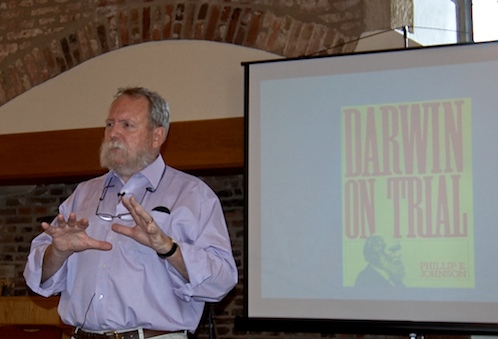 Biology has a long history with ideology. At times, the conflation of the two has led to substantial human suffering. A new collection of essays, published as Biology and Ideology: From Descartes to Dawkins, amply demonstrates the diversity of such mashups. Contributors examine matters from colonialism to eugenics. Here, on Cif Belief, the boundaries between science and polemic blur pretty regularly, and the book has a broad lesson for our forum: whilst it is possible to disentangle past uses and abuses of biology it is more difficult to do so when it comes to instances in our own times. Consider one paper, written by philosopher, Michael Ruse, who looks at the links between evolutionary science and the politics of progress. His account serves as a cautionary tale. He notes that notions of progress, whilst common amongst pre-Darwinian evolutionists, disappeared from the literature once the science became established. This is partly because progress, as an idea, took a "heavy knock" in the Origin of Species. Natural selection relativised everything. Is a big beak an advance on a small one? Is a human an enhanced ape? The answer depends entirely upon context. Hence, although Darwin indulged in a little progressivism in his later Descent of Man, he had previously noted: "Never use the word higher or lower." Mendelian genetics confirmed as much by insisting that the mutations which power natural selection are random. So the palaeontologist Jack Sepkoski could write: "I see intelligence as just one of a variety of adaptations among tetrapods for survival. Running fast in a herd whilst being as dumb as shit, I think, is a very good adaptation for survival." That his colourful turn of phrase implicitly questions progressivism, only demonstrates how hard it is to write about biology without ideological intent – a point to which we'll return. |
| Column |
William Blake's Picture of GodThe muscular old man with compasses often taken to be Blake's God is actually meant to be everything God is not.  Go to see the newly acquired etchings by William Blake at Tate Britain, or take a look online. They display all the unsettling power and apocalypticism we expect from this exceptional, romantic artist. One shows a young man tethered to a globe of blood by his hair. In another, someone burns in a furnace. Underneath, Blake has written lines such as, "I sought pleasure and found pain unutterable," or, "The floods overwhelmed me." What you won't find in the gallery, though, is any explanation of these visions. Instead, Blake is treated as impenetrable, his imagery obscure, his calling idiosyncratic. He's rendered slightly mad, and so safe. We can look and admire, but like a modern gothic cartoon strip – that his art no doubt influences – he can be enjoyed, but not taken too seriously. That's a shame. For not only can Blake be read. What he says carries at least as much force today as it did two hundred years ago. Consider one of the figures who's in the new works: Urizen. He's well known as he's the same figure who appears as Blake's famous "Ancient of Days" – an old man, with Michelangelo muscles, a full head of long white hair, and a wizard-like beard. Urizen is a key figure in Blake's mythology. He is not God. (Blake thought it laughable to imagine the divine as a father-figure, as God is found within and throughout life, he believed, hence referring to Jesus as "the Imagination.") Instead, Urizen is the demiurge, a "self-deluded and anxious" forger of pre-existent matter, as Kathleen Raine explains. His predominant concern with material things is signified by his heavy musculature. He is variously depicted as wielding great compasses, absorbed by diagrams, lurking in caves, and drowning in water – as in the new Tate image. It shows that his materialism has trapped him. Blake loathed the deistic, natural religion associated with Newton and Bacon. He called it "soul-shuddering." Materialism he dismissed as "the philosophy in vogue." He thought the Enlightenment had created a false deity for itself, one imagined by Rousseau and Voltaire as projected human reason. The "dark Satanic mills" of Jerusalem are the mills that "grind out material reality", as Peter Ackroyd writes in his biography of Blake, continuing: "These are the mills that entrance the scientist and the empirical philosopher who, on looking through the microscope or telescope, see fixed mechanism everywhere." |
| Column |
Tariq Ramadan's PluralismTariq Ramadan, the west's most controversial Muslim philosopher, talks about tolerance in his new book. We live in a plural age. But do we have an adequate philosophy for living together in our diversity? Tariq Ramadan, in his new book, The Quest for Meaning, thinks not. We have roughly three options. First, is the pluralist philosophy that underpins what might be called "forbearing empires". The dominant power says, accept our rule, and in return, you will gain our peace – and a relative freedom to maintain your way of life. It's the pluralism of the ancient pax Romana, or the Muslim empires of the medieval period, or perhaps the British Raj. But it's a colonial philosophy too, and so not much championed today. Second, is the pluralist philosophy that underpins the secular settlement. The watchword here is toleration, and the key policy is to separate civil government from the practice of religion – government being concerned with a citizen's welfare in this life, religion in the next. But this philosophy runs into the paradox of toleration, namely who should not be tolerated. For example, John Locke, in his Letter Concerning Toleration, infamously argued that Roman Catholics and atheists could not be endured. Further, if you seek a thriving democracy, merely to tolerate others is too passive a political philosophy. And it's patronising, because diverse groups in an equal society want to be respected, an altogether different proposal. As Ramadan remarked during a talk on his book, "I don't want a peaceful coexistence. I want a living together that is constructive and active." This leads to the third possibility, the one he champions. It's a pluralism prepared to recognise that the individual gains from engaging with the diversity that surrounds them. It's not syncretistic, as if the goal were a perennial philosophy – truths distilled from what is agreed in common. Such a project tends to evacuate religions and philosophies of their particularity and, in turn, nurtures human individuals drained of their colour. Rather, this form of pluralism recognises that what we have in common is not the answers, though there will be overlap, but the need to ask the questions. As Immanuel Kant expressed them: what can I know, what ought I to do, what may I hope? |
| Column |
Afghanistan's Unjust WarWe must apply the just war tradition to our analysis of the conflict in Afghanistan. Otherwise, we risk disaster.  Two things this week have made the hellishness of military violence painfully clear. The first, WikiLeaks' Afghanistan war logs, describes in detail the horror of civilian casualties and "friendly fire" incidents. The second, from the same theatre, is Sean Smith's chilling video of American marines in southern Helmand. Faced with these portraits of war, empathy for the people caught up in it has been unavoidable. But empathy alone is not enough. If you're not a pacifist, you accept that war is vile, but at times an inevitable part of life on Earth. The question is when and how it can be morally justified. Hence the importance of the just war tradition. Thinkers like the theologian Thomas Aquinas sought a way of containing war, by thinking through the desperate feelings that combat does and should evoke. The aim is to keep a steady view on the demands of natural justice, even when the fog of war threatens to blur everything. The war logs in particular afford us a steady view on this current conflict, and what's as unsettling as the tragedy they reveal is the possibility that we lost sight of those demands, at least on occasion. The crucial issue is whether that's happened. An answer can be found by thinking about the relationship between jus ad bellum and jus in bello – the justification for the war itself, and the principles that should operate during the conduct of war. Both matter. Let's assume the war in Afghanistan is justified, and focus on the jus in bello. One of Aquinas's major contributions was the notion of proportionality: how to assess the bad consequences of otherwise well-intended military action. Michael Walzer, a leading modern just war theorist, notes that simply not to intend the death of civilians is not enough. That's "too easy". Instead, there must be a positive commitment to saving civilian lives, rather than just killing no more than is militarily necessary. "Civilians have a right to something more," he concludes. "And if saving civilian lives means risking soldiers' lives, the risk must be accepted." |
| Article |
 The ‘Messy’ God of ScienceA recent conference at Oxford brought scientist-theologians together to discuss the work of John Polkinghorne.  The department of physics in the University of Oxford is a hodgepodge of buildings, old and new. In a warren of rooms, its scientists pursue interests from quantum computing to theoretical cosmology. The diversity says much. As a tree of knowledge, modern physics has branches that shoot off in all directions. Just opposite the department stands a very different building: Keble College. Its unified, gothic structure is unforgettable—built in polychromatic brick, sometimes referred to as the ‘holy zebra’ style. The ‘holy’ refers to the college’s Victorian founder, John Keble, who is famous for spearheading the Catholic revival in the Church of England. Today, Keble College appears to gaze across the road at its neighbor, as if musing on what science has done to religion. So the lecture theaters of the physics department were an excellent place to host a conference on that very subject, celebrating and critiquing the work of John Polkinghorne, one of the best known scientist-theologians of our times. For the first part of his career, Polkinghorne was a mathematical physicist, rising to the position of professor in the University of Cambridge. Then, in 1979, he resigned his chair, and trained to become an Anglican priest. In the quarter century since, he has written about two dozen books on the relationship between science and religion. A delightful man to meet, between papers and presentations he talked quite as easily with humble journalists as with distinguished peers. Polkinghorne describes himself as a ‘bottom-up’ theologian. He is concerned to show not only that modern science is compatible with orthodox Christian belief, but that the believer can have as rational a basis for their commitment as the scientist has for theirs. He borrows a notion put forward by the philosopher Michael Polanyi, of well-motivated belief, which seeks: "a frame of mind in which I may hold firmly to what I believe to be true, even though I know it may conceivably be false." |
| Column |
 Is True Friendship Dying Away?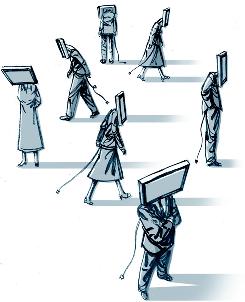 To anyone paying attention these days, it's clear that social media — whether Twitter, Facebook, LinkedIn or any of the countless other modern-day water coolers — are changing the way we live. Indeed, we might feel as if we are suddenly awash in friends. Yet right before our eyes, we're also changing the way we conduct relationships. Face-to-face chatting is giving way to texting and messaging; people even prefer these electronic exchanges to, for instance, simply talking on a phone.Smaller circles of friends are being partially eclipsed by Facebook acquaintances routinely numbered in the hundreds. Amid these smaller trends, growing research suggests we could be entering a period of crisis for the entire concept of friendship. Where is all this leading modern-day society? Perhaps to a dark place, one where electronic stimuli slowly replace the joys of human contact. Awareness of a possible problem took off just as the online world was emerging. Sociologist Robert Putnam published the book Bowling Alone, a survey of the depleting levels of "social capital" in communities, from churches to bowling allies. The pattern has been replicated elsewhere in the Western world. In the United Kingdom, the Mental Health Foundation just published The Lonely Society, which notes that about half of Brits believe they're living in, well, a lonelier society. One in three would like to live closer to their families, though social trends are forcing them to live farther apart. Typically, the pressures of urban life are blamed: In London, another poll had two-fifths of respondents reporting that they face a prevailing drift away from their closest friends. Witness crowded bars and restaurants after work: We have plenty of acquaintances, though perhaps few individuals we can turn to and share deep intimacies. American sociologists have tracked related trends on a broader scale, well beyond the urban jungle. According to work published in the American Sociological Review, the average American has only two close friends, and a quarter don't have any. |
| Column |
Chaos Theory and Divine ActionPhysicist John Polkinghorne is often accused of offering up a God-of-the-gaps argument. But his work has subtler shades.  The question: Can science explain everything?Whether or not science can explain everything is a question that was never far from the minds of a large group of theologians and scientists who met in Oxford last week. They'd assembled to celebrate the 80th birthday of John Polkinghorne, the professor of mathematical physics who made his name for his work on quarks, now an Anglican priest, and author of many books on science and religion. Moreover, it turns out that the question of science's limitations is intimately linked to Polkinghorne's much misunderstood account of God's action in the world. The challenge is to avoid concocting a "God of the gaps" – a deity whose action occurs in the gaps where scientific explanations apparently fall short. The best known example of this is probably the bacterial flagellum. Advocates of intelligent design have argued that these whip-like devices for locomotion can only be explained by divine intervention because of their supposed "irreducible complexity". The trouble is that science progresses. What can't be explained in one decade is often explained in the next. Gaps get filled, and so God gets squeezed out. Polkinghorne has been accused of advocating a God-of-the-gaps approach too. He has been taken to argue that chaos theory offers a way of understanding divine action, by virtue of the mistaken assumption that chaos theory paints a picture of an indeterminate world: if it's impossible to forecast the weather next week with any degree of accuracy, then perhaps that points to a pervasive randomness in the physical world, which God might exploit to divine advantage. But that's not his idea, as Nick Saunders pointed out at the conference. As Polkinghorne knows better than most, the equations of chaos theory do, in fact, yield tightly causal results. The issue at stake in chaos theory is rather that you need to know the initial conditions of any system to an astonishingly high degree of accuracy to make accurate predictions. In practice, that's impossible to achieve. In other words, chaotic systems are not indeterminate, but underdetermined.
|
| Column |
Faith, Hopes, and Policy: Religion in the Public SphereGovernments are learning that religion is important, but they still don't understand it. Nor do faith groups understand government.  Well over 100 academics and individuals from think tanks gathered at the British Library to discuss how faith fits with government policy in the UK today. What they found was change, contradiction, and even chaos. Faith communities almost disappeared from public view during the 1990s, and yet now they're rarely out of the headlines. You might put the re-emergence down to any number of things – 9/11 and 7/7; the self-styled champions of science and secularism; a new outpouring of the Holy Spirit of God. But whilst no-one doubts that religion and politics is a subject with a future once more, few in the field have much idea about what that future will hold. If anything, we must learn to live with contradictions, as events steal headlines and pressure groups wage cultural war. This is a world in which, say, Christian nurses are prosecuted for wearing crosses, even as NHS employees worry about a lack of spiritual care. It's one in which establishment bishops complain of persecution, even as the "big society" agenda, in new government departments, is supplied with ministers and advisers who have explicitly Christian agendas. Alternatively, ours is a country in which Muslims are told that their religion is good when private and bad when political, at the same time as government Prevent programmes infiltrate Muslim communities, drawing Islam into the public sphere whether they like it or not. Or again, we must get used to situations in which issues that are relatively small in terms of the numbers of people they affect, carry totemic significance – such as when Catholic adoption agencies are forced in principle to place children with the tiny handful of gay couples who come to them for help. And when the Pope pays a visit, one thing's for sure. It won't be Northern Irish protestants complaining most vocally, as it was in the 1980s. That's a sign of how dramatically the world has changed. A number of speakers had warnings for faith communities themselves, particularly when tempted by funding to cooperate with government in the delivery of services. Beware that you don't demoralise your volunteers with the weight of bureaucracy that will descend when you're "mainstreamed", advised Margaret Harris of Aston university. Beware when you're asked to deal with social problems that government feels it can't touch, like poor parenting, said Luke Bretherton of King's College, London. |
| Column |
The Dalai Lama on ViolenceThe Dalai Lama's message for Armed Forces Day may surprise those who assume him to be a pacifist.  The Dalai Lama has sent a message of support for Armed Forces Day, which is next Saturday. In it, he writes of his admiration for the military. That is perhaps not so surprising. As he explains, there are many parallels between being a monk and being a soldier – the need for discipline, companionship, and inner strength. But his support will take some of his western admirers by surprise, not least when it comes to his thoughts on non-violence. Attitudes towards violence in Buddhism are enormously complex. There are some traditions that argue aggression, and killing in particular, is always wrong. But there are others which argue that killing can be good, when executed by a spiritually skilled practitioner who can do so with the right motivation. Tibetan Buddhism falls squarely into the latter tradition, and previous incarnations of the Dalai Lama have been such practitioners. The 13th, for example, modernised the Tibetan army. What the present Dalai Lama argues, in his message of support, is that violence and non-violence are not always what they seem. "Sweet words" can be violent, he explains, when they intend harm. Conversely, "harsh and tough action" can be non-violent when it aims at the wellbeing of others. In short, violence – "harsh and tough action" – can be attitudinally non-violent. So what should we make of that? |
| Column |
Has Kylie got Kabbalah?Kylie's wearing the red bracelet. But is Kabbalah an easy option for celebrities who don't want religion to change them too much?  Is Kylie now one of that select group, identifiable by their first names alone – Madonna, Paris, Britney – who might be seen sneaking in and out of the Kabbalah Center in Beverly Hills? She's been photographed wearing the red string around her left wrist, to ward off the evil eye. Her new beau, Andres Velencoso, is said to be interested in the mystical offshoot of Judaism. Should we mock? Or should we don a phylactery with her, even as we don our hot pants? Should we even ask whether there's something in it? What is Kabbalah anyway? It emerged during the 13th century, in Spain, when Jewish philosophers sought a rational understanding of their religion. By this, they meant deploying the science of the day to interpret texts – gematria, which assigns numerical values to letters, and the like. The result was a kind of mystery religion that stressed the unknowability of the Godhead, whom they called En Sof, or "Without End". That combination of pseudo-science and mysticism must be part of the modern Kabbalah appeal. Its devotions are often material and embodied – to do with food, from the rituals of a Shabbat meal to drinking Kabbalah water – and that must resonate with the imperatives of celebrity life, which is nothing if not anxious about the body. And attached to that discipline comes the mysticism – rudely referred to as "McMysticism" or "spirituality for dummies". The En Sof of the first Kabbalists has become the "higher power" of the modern ego. Celebrity narcissism? In some ways, we're talking here about folk who have conquered the world. The "Without End" must be relatively easy to believe in, when fans will fill stadiums to see you, and your smile instantly warms the hearts of millions. |
| Column |
A New Solution to the Problem of Evil?A psychological paper which claims to explain the religious account of evil is troublingly simplistic. 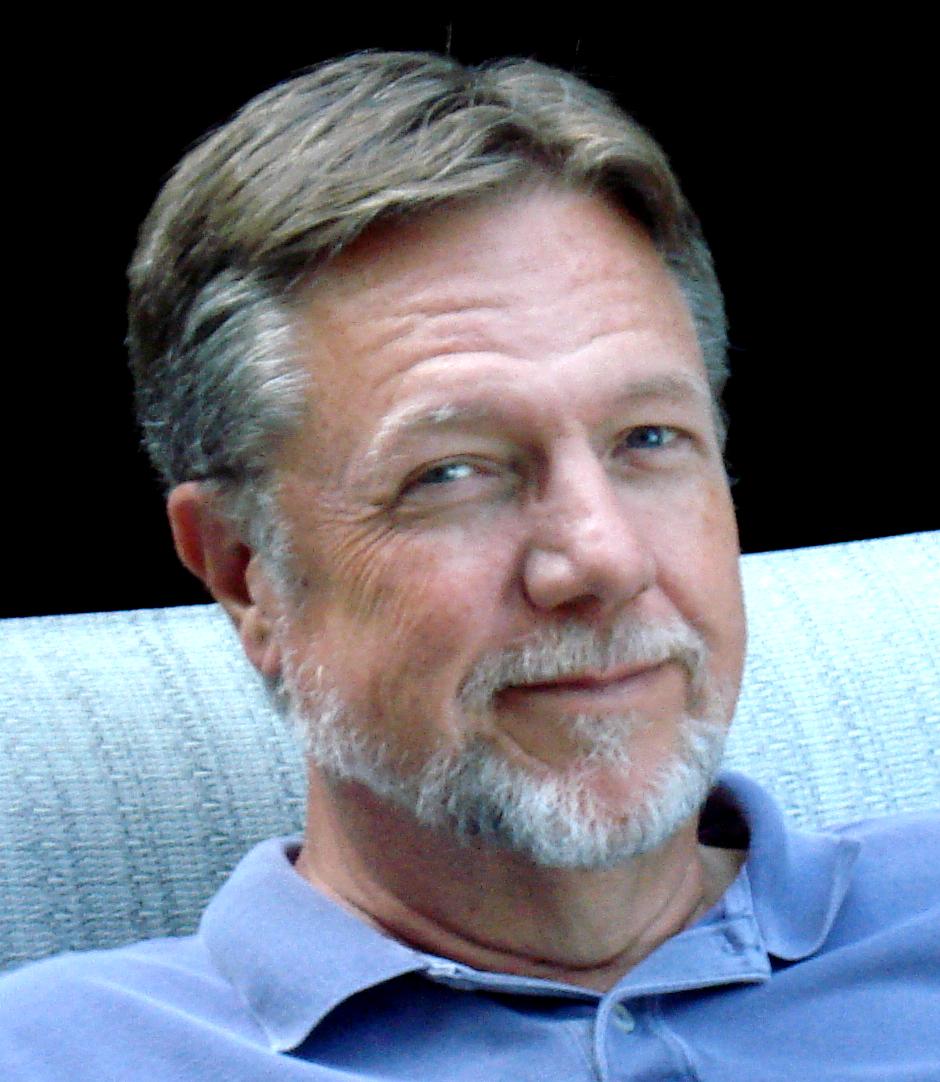 That there is suffering in the world, few would doubt. But whether or not that suffering unsettles belief in God divides individuals roughly into two. For one group, call them rationalists, the fact of suffering is perhaps the best reason for not believing in God. But for the other, call them religionists, the fact of suffering is the very reason to invoke the divine – God being a source of consolation, or a way of talking about the mystery of suffering, the otherwise imponderable "why?" A new paper, published in Personality and Social Psychology Review, has an explanation for why the religionists hold their view, the one that is so bewildering to the rationalists. Kurt Gray and Daniel Wegner, Harvard psychologists, argue that we tend to see moral players as either agents or patients. Agents do good or evil. Patients receive good or evil. Further, we also tend to assume that once an agent always an agent, and once a patient always a patient: individuals are "typecast" into being either heroes and villains, or recipients and victims. This leads to the following conclusion. "When people experience unjust suffering or undeserved salvation, they search for someone to blame or praise, but when no person can be held responsible, they look to the supernatural for an agent, finding God." Link that to moral typecasting, and you get the notion that God is responsible for good, and Satan for what's bad. I have to say that I find the paper wildly simplistic and entirely unconvincing. And troubling too. Why so? Well, for one thing, I can't make the internal logic of the paper itself stack up. It begins by asking why people believe in God when there's suffering, the implied problem being how a good God can cause bad suffering. But then, a few paragraphs on, it's not God who is proposed as the agency behind the bad in our lives, but Satan. And yet, if God is not responsible for suffering, then there's no problem of evil. You can blame it all on Satan. (It's a Manichaeist view of the world, one rejected by orthodox theism, which is why the problem of evil doesn't admit such easy resolution. But that's not the concern here.) |
| Column |
The Vatican Reaches Out to UnbelieversThe Catholic church wants dialogue with agnostics and atheists. So what could we learn from them, and they from us?  It seems that the Vatican is about to create a "Pontifical Council for New Evangelisation". Its goal would be to reach out to agnostics and atheists. (Best guess from one Vatican watcher suggests an announcement on the 29th of this month). The Pontifical Council for Culture has been thinking along such lines since at least 2004, asking how the church should respond to contemporary unbelief and religious indifference. Archbishop Gianfranco Ravasi, who heads up the culture council, has explained that any effort would not be aimed at "polemical" atheists because they "read religious texts like fundamentalists", and so are not open to dialogue. No love lost there, then. But might this initiate make for a real exchange between those on the inside and outside of faith, who value the Christian tradition? If so, the Vatican will have to acknowledge that it can positively gain from the insights of agnostics and atheists – much, perhaps, as the priests need the prophets in the Hebrew Bible. Without such gadflies, the church becomes sluggish simply on account of its size – to recall the remark that Socrates made about ancient Athens. In other words, the Court of the Gentiles, as the new council is also known, will have to be less about evangelisation, and more about dialogue. There are occasionally moments when the Vatican sounds open. "Who are the non-believers? What is their culture? What are they saying to us? What can we say to them? What dialogue can we establish with them?" the Pontifical Council for Culture has asked. Well, here are three suggestions for dialogue where those of us on the outside of faith might have something of value for those on the inside. |
| Column |
Coping in ExtremismIn a world of total uncertainty, can religion's accumulated wisdom offer solace?  Uncertainty was a theme, I think, over the bank holiday at Hay-on-Wye, during the literary festival. Perhaps that's not surprising. Much of what we thought we knew has recently been thrown into doubt, be that in politics or economics. But it was striking how religious language seemed never far from the mouths of those authors with an interest in the theme. You'd expect as much from Karen Armstrong, the historian of religion. Her complaint is that those who talk about God today, be they religious or not, tend to do so as if they knew what they were talking about. It's not a mistake made by the great God-botherers of the past. Take Thomas Aquinas, and his so-called five "proofs" for the existence of God. They're better referred to as five "ways", the word Thomas used being "viae". What Thomas is not saying, then, is that his five ways just about wrap up the case for God. Rather, he is simply beginning with "what everyone understands by God", as he himself puts it. (By everyone, he meant the cutting-edge authorities of his time, notably Aristotelian science and Islamic philosophy.) The ways just set the ball rolling, as the philosopher of religion Brian Davies explains. It's a discussion to which Thomas quickly adds that God's existence does not come to us "in any clear and specific way", because we basically have no idea what we mean when we use the word "God". Instead, we have to work with what we do know, about the world in which we live, and about the experience of our lives. We must be content with what that reveals. David Eagleman, author of the surprise bestseller Sum, said a not dissimilar thing. As a neuroscientist, he describes his work as like being led to the end of a pier, only to realise that there are vast seas of unknowing stretching out before you. Much the same could be said of science in general. His book is a series of often witty sketches about possible scenarios for the afterlife, and he wrote it in order to keep his mind open to what's uncertain. He subsequently coined the word "possibilism", and it's caught on. I think it's fair to say that the word represents the infinity that lies beyond our grasp. Eagleman is no believer. But that's a definition of God with which Thomas might have been happy; a starting point to set the ball rolling. |
| Column |
Reasons to ThinkAt the Guardian Hay debate on reason, atheists and believers found more common ground than might be expected.  People are worried about reason, if the large numbers who attended the Guardian's debate at Hay is anything to go by. It proposed the motion "Reason is always right". But what do we mean by reason? Why the worry? The philosopher, AC Grayling, kicked off the discussion in favour of the motion with a definition. Reason is the quality we want our doctors to practice when diagnosing our complaint. It's the discipline we want engineers to have when designing a passenger plane. It's that approach to life which we call enlightened, scientific. It gathers information, tests evidence, asks questions. The word "rational" is close to the word ratio, or being proportionate. So, the good life is one in which passions and emotions don't run riot too. They are kept within reasonable limits. Thinking is what makes us human, Grayling averred. When our appetites take over, we come to harm. Hence, at the end of the day, reason is indeed always right. Not so!, interjected the second speaker, Richard Harries, the former bishop of Oxford. He told of two women arguing, as they stood on the doorsteps of their respective houses. The couldn't agree because they were arguing from different premises. Ho-ho. But behind the joke lies a serious human issue. Rational discussions are very hard to have because we come to any encounter with jealousies, rivalries, prejudices and assumptions. "In my experience, very few people are capable of arguing objectively," said Harries, who is also a member of the House of Lords. In other words, reason itself is not enough. We need judgment and wisdom, and that requires the moral and spiritual disciplines of conscience and intuition too. The truly wise individual, who can engage in debate well, is the person who can draw on these other capacities. Reason is not always right because reason alone is not enough. Martin Rees, the distinguished scientist whose Reith lectures start this week, spoke next, in favour of the motion – but only just. He confessed to being a "cross-bencher" when it came to reason. It's vital, of course. It should hone arguments and test consistency. And scientific knowledge must be backed by reason. But for human beings, there always comes a point when we hit something that is unconditional for us. Respect for life would be one example. Reason helps to clarify why that's the case, but the principle itself is somehow prior to reason. Reason should take us as far as it can, Rees pressed, but it won't take us all the way. |
| Column |
Friends at the TopNick Clegg and David Cameron appear to get on well. But is friendship really a good basis for fair government?  Another day, another image of the nation's two new best friends: David Cameron and Nick Clegg. And doesn't it feel odd? It's not just about getting used to the "new politics", or the fact that during the election campaign they were at each other's throats. It's seeing a friendship at the helm that's disconcerting. Of course, Gordon and Tony were friends too, sometimes. But they shared an ideology. Dave and Nick didn't and, it seems, could not have assembled a coalition without the personal chemistry. (Gordon couldn't do it because he didn't have enough warmth for Nick, as he implied in his farewell speech.) So should we be bothered, or should we welcome amity at the top, as part of our constitutional growing up? Well, we might be bothered. The crux of the issue is that friendship embodies a very different set of values to democracy. Friendship is nothing if not particular and personal. Your friends are special individuals to you, and you treat them differently from others. To say one person is your friend is to imply others are not, and perhaps further that another again is your shared enemy. To be a friend is to be a favourite, and is to be treated favourably. It's why we get so nervous when friendship is visible in the workplace, deploying those ugly words "nepotism" and "cronyism" to describe it. A boss can be taken to court if they are seen to give friends preferential treatment. Friendship is profoundly unfair. Immanuel Kant thought so. He believed that friendship was unethical. We don't act according to moral laws when we act with our friends. We go on how we feel, our whims, or a sense of loyalty. To put it philosophically, friendship is not amenable to universalisable imperatives, precisely because it is partial. If the golden rule is to do to all others as you would have them do to you, friendship contravenes it. Your friend will do far more for you than they'd do for others. Kant went so far as to say that there would be no friendship in heaven, it being a place of moral perfection. |
| Column |
Bad Science, Bad Theology, and BlasphemyID is indeed bad theology. It implies that God is one more thing along with all the other things in the universe.  The question: Is intelligent design bad theology? You may have caught some of the row that followed Thomas Nagel's recommendation, in the literary pages of the TLS, for 2009 books of the year. He ventured Stephen Meyer's Signature In The Cell: DNA And The Evidence for Intelligent Design. Nagel is one of the most distinguished philosophers living today. And yet, that apparently now stood for nothing. Meyer's book is pro-ID. Everything from Nagel's reputation to his sanity was called into question. I read the book. It felt a little like creeping behind the bike sheds at school to have a cigarette, as if an ID cancer might seize control of my synapses. The temptation was irresistible. What I discovered was an arresting book about science, which is what drew Nagel. But it is close to vacuous when it comes to the theology. That, it seems to me, is the problem with ID. To a non-specialist like myself, Meyer seemed to capture very well the depth of the mystery that the origin of life is to modern science – essentially how DNA, as an astonishingly precise and complex information processing system, could possibly have come about. It's analogous to the monkey-bashing-at-a-typewriter-and-producing-Shakespeare problem, except that with DNA it's even more intractable: you've also got to account for how typewriters and language arose too, they being the prerequisites for the possibility of the prose, let alone the prose of the Bard. That said, it's because of the inscrutable nature of life's origins that I found the book theologically unsatisfying. It proposes, in essence, an argument from ignorance. The ID hypothesis Meyer conveys is, roughly, that life is, at base, an information processing system, information that is put to a highly specific purpose, and that the best explanation for the source of such a system is one that is intelligent. Only an intelligence could get the system going, as it were. It can't be put down to chance, since by massive margins there hasn't been nearly enough time since the Big Bang for the random encounters of organic compounds to form such highly specified self-replicating systems. Neither can it be put down to self-organisation, since what DNA requires to work is not general patterns, but the fantastically fine-grained and specific activity of proteins and amino acids. Intelligent design is, then, the best hypothesis to date. But that qualification, "to date", is the problem. |
| Column |
Eagleton and Hitchens against NihilismTwo recent books converge on a common enemy: the bland atheist managerialism that assumes the point of life is fun.  Peter Hitchens is a Mail on Sunday columnist who writes from the right. Terry Eagleton is a professor of English literature who writes from the left. What's striking, reading their new books alongside each other – Hitchens' The Rage Against God and Eagleton's On Evil – is that they both have the same target in their sights: nihilism. Hitchens wrote his book to unpick the arguments of his brother, Christopher, one of the big gun anti-theists, though much of it is taken up with his thoughts on why Christianity has become so marginal in Britain today. More than anything else, he puts it down to the two world wars, and the Church of England's alignment with these national causes: after all the horror and bloodshed, the pews emptied. Add to that the decline of empire, and the anxiety about what Britain now is, and the established religion inevitably declines and worries about itself too. Hitchens also blames the rampant liberalism if his generation; he was a teenager in the 1960s. They feared the constraints of their parents" lifestyle – post-war rationing coupled to the limitations of life in the suburbs. So, they pursued life goals of unbridled ambition and pleasure, viscerally rejecting anything that smacked of authority and moral judgment. That fed the undermining of Christianity too.When it comes to his brother's blast against God, he makes a number of points. On the "good without God" question, he argues that morality must make an absolute demand on you, so that even though you constantly fail to reach its high standards, you are not able to ignore it, as he believes people and politicians now do every day: witness everything from common rudeness to the suspension of Habeas Corpus. If there are no laws that even kings must obey, no-one is safe. His toughest rhetoric comes when he notes that the Russian communists moved remarkably swiftly to stop religious education, after they had seized power in 1917. He sees clear parallels between this move and his brother's nostalgia for Trotsky, and the argument that religious education is child abuse. "It is a dogmatic tyranny in the making," he concludes.
|
| Column |
Money, Morality, and MarriageThe Conservatives need a more radical policy on marriage to help undo the damage of their neoliberal economics. 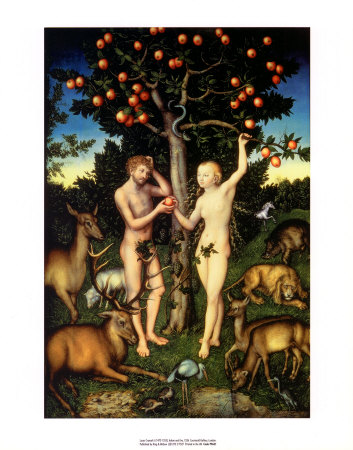 "I hope this marriage lasts," the bride said to me as she adjusted her veil. We were just about to walk down the aisle; I was then a clergyman. "I'm still paying off the loan from my first wedding." We did a lot of them – the church being good for photos, the parish having a young demographic. But that bride's comment carried a pathos that has stayed with me. It seemed to capture a number of the ambivalences associated with marriage today. On the one hand, the majority of people, aged between 20 and 35, say they would like to be married. The same research indicates that eight out of ten of those cohabiting want to marry too. The most common reason people give is the desire to make a commitment. Only two percent say they'd factor any tax benefits into their decision. And yet, modern marriage is also conflicted. It's not just that it often fails, though divorce rates have steadied. Rather, the pathos in the bride's remark stemmed from her equating the financial spend on her wedding with the commitment she felt to it. She needed a further loan to make a splash for the occasion, and so not to feel half-hearted about it. There are a bundle of neo-liberal assumptions packed into that thought, given I've read it right. There's the tendency, that's become the norm over the last 30 years, for moral value to be eclipsed by financial value. Man is no longer the measure of all things. Money is. So deep is this replacement that we now routinely make remarks such as, "I was made an offer I couldn't refuse." Cash must trump all other considerations. And inasmuch as that's true, we've ceased to live in a moral world, for morality has become a subset of economics. It's reflected in the Tories' promise to make the UK the most family-friendly country in Europe by tax breaks and other financial means. The policy shows that the party which unleashed neo-liberalism upon us is still tied to the money-as-morality nexus. And it surely also reveals a kind of displaced guilt. Iain Duncan Smith has convinced his party that family breakdown is linked to social injustice. What the Tories can't admit is how that injustice is linked to the values of Thatcher's free-market, subsequently adopted by new Labour: individualism, short-termism, the choice doctrine, fantasies of self-sufficient freedom. |
| Article |
 One Soul, Two BodiesFriendship is a preparation for a greater love, according to Cardinal Newman, whose own relationship with his fellow priest Ambrose St John was profound, and essential to understanding his thinking.  Friendship all too often seems to have no place in Christian thought. It is regarded as a particular and selfish love, antithetical to the universal and selfless love of agape. St Augustine enjoyed a youthful friendship before he became a Christian. And yet, after his conversion, he came to look upon it with profound ambivalence: "What madness, to love a man as something more than human!" he reflected in his Confessions. Later, he developed the thought in the City of God, apparently glad when he hears of the death of a friend because the possibility that the friend will betray him, in matters of politics or affairs of the heart, has ceased. The shadowy nature of friendship is no more forcefully conveyed than in the writings of the Christian philosopher Søren Kierkegaard, who went so far as to call it idolatrous. He argued that as friendships deepen, so too does the love of the particular over the universal, the self-interested over the selfless, the human over the divine. It’s not for nothing, Kierkegaard muses with dry wit, that the commandment is to love your neighbour. Yet there is another strand in the tradition upon which to draw. And it can be closely associated with Cardinal John Henry Newman, a man who will be much celebrated later this year when the Pope eatifies him during the papal visit to Britain. Newman spelt out his theology of friendship in a sermon he reached on the Feast of St John the Evangelist. The evangelist and the disciple John "whom Jesus loved" are thought by many to be one and the same person. Whether or not the evangelist John was the same individual as the disciple John is a moot point. But Newman takes the feast day as a chance to reflect on the person "whom Jesus loved". For rather than seeking to excuse the apparent particularity that description implies, Newman did the opposite. He made much of the implication that John was the "private and intimate friend" of Jesus, in marked contrast with the other disciples. So how does this square with agape? Here is what Newman said: "There have been men before now, who have supposed Christian love was so diffusive as not to admit of concentration upon individuals; so that we ought to love all men equally … Now I shall maintain here, in opposition to such notions of Christian love, and with our Saviour’s pattern before me, that the best preparation for loving the world at large, and loving it duly and wisely, is to cultivate an intimate friendship and affection towards those who are immediately about us." |
| Review |
 Incredible ViewsReview of four books on atheism  Despite the recent intensification of debate between atheists and religious believers, the result still seems to be stalemate. Protagonists can readily identify their opponent's weak spots, and so delight their supporters. At the same time, both sides can fall back on their best arguments, thereby reviving their fortunes when necessary. The new atheism has created, or recovered, a perfect sport. No one can win in the game called "God"; everyone can land blows. But is anything important or new emerging from the spat? Consider one of the tussles that is rehearsed in the books under review. It centres on the so-called anthropic argument. This is the observation of physicists that certain features in the universe appear to be uncannily "tuned" in favour of life. An anthropic principle was first proposed in 1973, and generally mocked by scientists. Stephen Jay Gould wrote that the principle was like declaring that the design of ships is finely tuned to support the life of barnacles. Since then, however, physicists have become relatively comfortable with discussing the idea. This is for at least two reasons. One is that the anthropic principle, in a weak form, makes predictions about the age of the universe that can be tested. Roughly, the universe has to be a minimal age in order to allow enough time to pass for the constituents of life - such as the element carbon - to be forged in the heart of stars. It passes that test. Second is that the alleged tuning of the universe for life has come to be seen as quite extraordinarily fine. One demonstration of this exactitude concerns "dark energy". It forms about 70 per cent of the stuff of the known universe, and is called dark because astronomers have little idea what it is. The best candidate is the energy associated with a quantum vacuum, a phenomenon that arises from quantum physics. The important point for the anthropic argument is that it turns out that this energy would have to be "tuned" to about one part in 10120. That is a very substantial number, to say the least - way higher than the number of atoms in the visible universe. In a recent issue of the magazine Discover, the robust atheist and Nobel Prizewinning physicist Steven Weinberg described this as "the one fine-tuning that seems to be extreme, far beyond what you could imagine just having to accept as a mere accident." |
| Column |
 Does Evolution Favor Religion?David Sloan Wilson is a biologist who claims that the so-called selfish gene is a myth. What if we have evolved to do what's best not for ourselves, but for the groups we live in? The implications for religion, the ultimate social organism, are huge  I was at a conference just recently, where we told tales of vampire bats that share their blood, bacteria that work together, and monkeys that ease group tensions by making love. It set me thinking about the evolution of morality, for there is one story of it that’s often told, and it begins with a problem. Natural selection favors the best-adapted individual: it’s called survival of fittest. It explains why we feel fear or lust. But how can this ‘selfish’ account of natural selection explain moral emotions like altruism that might lead the individual to abandon their self-interest in favor of others, even to the point of self-sacrifice? The problem is resolved by pointing out that it’s only the gene that is ‘selfish.’ That take allows for circumstances in which the survival of the individual may not best serve the transmission of the gene. For example, the interests of the gene may be better served if the individual is sacrificed for the sake of the group, when the group is composed of kin—other carriers of the gene. That’d explain why parents will surrender all for the benefit of their children. Alternatively, the gene may be best served if the individual is prepared to form cooperative relationships with others, on the basis that if I scratch your back, you might scratch mine. Blessed Mistakes Now, this story accounts for many instances of kin and reciprocal altruism in the natural world. However, it comes unstuck with humans. We look odd from an evolutionary perspective because we will sacrifice ourselves for individuals with whom we don’t share our genes, and when there’s no prospect of the favor being returned. Call it our Good Samaritan tendency. |
| Column |
Evolutionary Geneticist Ayala Wins Templeton 2010Francisco Ayala, an evolutionary geneticist and former monk, has won the world's biggest prize for 'entrepreneurs of the spirit'  Francisco Ayala has been awarded the 2010 Templeton Prize. A distinguished evolutionary geneticist and molecular biologist, he is a former president of the American Association for the Advancement of Science and a holder of the American National Medal of Science. His work on parasites has opened up new approaches in the development of vaccines against malaria. The prize is noted for the size of its award: £1m. Ayala will donate the money to charity. He has been chosen for his longstanding championing of the distinctiveness of science and religion. He was an expert witness in the 1981 court case that overturned the Arkansas law mandating the teaching of creationism alongside evolution. He is the principal author of the National Academy of Sciences publication, Science, Evolution, and Creationism, a refutation of creationism and intelligent design. "Darwin was right in all the respects that are most important to natural selection," Ayala remarked, when I spoke with him at a recent seminar in Cambridge. His position on the relationship between science and religion is close to that of Stephen Jay Gould. They are non-overlapping magisteria. As Gould put it: "The lack of conflict between science and religion arises from a lack of overlap between their respective domains of professional expertise – science in the empirical constitution of the universe, and religion in the search for proper ethical values and the spiritual meaning of our lives." |
| Column |
Religion and the Science of VirtueVirtue and religion are, from a historical point of view, intimately bound up. We discard religious insights at our peril.  There is an intimate link between religion and morality. It's not fashionable to say so: many argue that talk of a link – and talk is all it is – should be stopped. After all, individuals can clearly be good without God, and religious individuals hardly stand much scrutiny as paragons of virtue. However, there's something more subtle to tease out here, and support for a connection is coming not from preachers or prelates, but science. The source is neuroscience and evolutionary psychology. As these new sciences explore the nature of morality, they tell a story that goes something like this. Many animals, perhaps most, don't live in isolation; they co-operate. Even bacteria work together for the sake of the group. There is good reason to think that this co-operation gives rise to behaviour that can be called altruistic: it's good for others but not necessarily for the individual. The story develops further when it's observed that higher animals, like chimps or dogs, don't just behave in ways that might be called altruistic, but have social emotions too. They feel shame; they empathize; they take pleasure in pleasing others. The implication for the human animal is that our morality is based upon an evolved set of predispositions. When we take pride, feel guilty, act honestly, show trust, we too are following social emotions that make us feel good. No doubt, this is the origin of the powerful intuition that the good life is a happy life. |
| Review |
The New Buddhist AtheismA book setting out the principles of a pared-down Buddhism has won praise from arch-atheist Christopher Hitchens.  In God is Not Great, Christopher Hitchens writes of Buddhism as the sleep of reason, and of Buddhists as discarding their minds as well as their sandals. His passionate diatribe appeared in 2007. So what's he doing now, just three years later, endorsing a book on Buddhism written by a Buddhist? The new publication is Confession of a Buddhist Atheist. Its author, Stephen Batchelor, is at the vanguard of attempts to forge an authentically western Buddhism. He is probably best known for Buddhism Without Beliefs, in which he describes himself as an agnostic. Now he has decided on atheism, the significance of which is not just that he doesn't believe in transcendent deities, but is also found in his stripping down of Buddhism to the basics. Reincarnation and karma are rejected as Indian accretions: his study of the historical Siddhartha Gautama – one element in the new book – suggests the Buddha himself was probably indifferent to these doctrines. What Batchelor believes the Buddha did preach were four essentials. First, the conditioned nature of existence, which is to say everything continually comes and goes. Second, the practice of mindfulness, as the way to be awake to what is and what is not. Third, the tasks of knowing suffering, letting go of craving, experiencing cessation and the "noble path". Fourth, the self-reliance of the individual, so that nothing is taken on authority, and everything is found through experience. It's a moving and thoughtful book that does not fear to challenge. It will cause consternation, not least for its quietly harsh critique of Tibetan Buddhism as authoritarian. It is full of phrases that stick in the mind, such as "religion is life living itself." Hitchens calls it "honest" and "serious", a model of self-criticism, and an example of the kind of ethical and scientific humanism "in which lies our only real hope". The endorsement makes sense because Batchelor's is an account of Buddhism for "this world alone". His deployment of reason and evidence, coupled to the imperative to remake Buddhism and hold no allegiance to inherited doctrines, would appeal to Hitchens. And not just Hitchens. |
| Article |
 We Need a Debate about Ethics in a Time of Economic CrisisHow do we decide our values? How can we do economics as if ethics matters?  One of the striking characteristics of the ongoing financial crisis and recent political scandals is that, although they have profoundly shaken our political economy, virtually no-one has broken the law. We will be living with the aftershocks of these events for years, possible decades, and there is a widespread perception that both of these systems of power have been found wanting; and yet, we seem at an almost complete loss as to know quite how to address what's happened as an issue of justice. What's actually happened is that the ethics of individuals, businesses, institutions and government have all proved shockingly flawed or non-existent. It's that crisis of values that lies behind both events, and that we now don't appear to know how to debate, with any force. Add to that the environmental challenges we face too and it's obvious that the question of ethics in our public life is pressing. The poverty of our moral discourse raises major questions, though they are unlikely to feature significantly at the forthcoming general election, where the argument will fall back on how to decrease the deficit. We think we need to learn how to debate ethics again. In conjunction with The Guardian, we've published a pamphlet,Citizen Ethics in a Time of Crisis, to stir up this vital element of our public life. Contributors include Philip Pullman, Michael Sandel, Jon Cruddas, Rowan Williams, Richard Reeves, Mary Midgley, Polly Toynbee, Camila Batmanghelidjh, and about 25 others. The aim of the pamphlet is to gather together a wide group of individuals - a from the left and right, secular and religious spheres, in public life and politics - who share a common concern about the ethical crisis we face. Ethics is not just an optional extra for our political economy. Take the economic crisis. What it shows is that we don't live in the real world if we don't have an ethical sense. Instead, we live in a world of fantasy and wishful thinking - one in which economists have lost touch with the realities of material existence, making the assumption that more growth is always possible. They've also lost touch with the context in which they make decisions, as if they were not themselves morally responsible but can offload that onto free markets. |
| Column |
 Pluralism Isn't a Modern Invention We live in a plural world. It's a place in which every day you rub up against people with very different worldviews than your own. Your neighbor might be an atheist, a theist, a polytheist, an agnostic. Every variation on these metaphysical themes is being played out in a human life near you. It's a new world, we think. Moreover, no one appears to be weakening in their convictions. If anything, divisive beliefs grow stronger. The Internet and Web sites; best-selling books; TV and radio programs tackling the 'big questions'. They tend to entrench views, not mediate differences. After all, conflict secures sales, not debate. A different opinion is not something to be shared, it's something to be defeated. Which highlights something else about our plural age: it is quite possible to imagine changing worldview yourself. We imagine that before modern times, a Christian, say, might have met an atheist, but they could no more have thought of becoming one than changing their sex. You can, in fact, now do both. Or, today you might be an agnostic, though you remember what it was once like to believe. You've changed once, so you might change again, and in a world of change, odds are that you will. So how can you be sure of what you now hold dear? Or perhaps it's like investing in a stock market of meaning. It's hard to predict which belief stocks will rise or fall. Religious shares are volatile but high yielding. Perhaps agnostic bonds are a safer bet. And yet, who doesn't fear a faith crunch. It all creates a deep sense of uncertainty and insecurity. The distinguished Canadian philosopher, Charles Taylor, has called them 'cross-pressures'. And it raises a big question: how are we to live together with these cross-pressure - different and yet still needing to share some sense of the common good. There is no easy answer, but some clues might come from looking to the past. It's easy to think that pluralism is a quintessentially modern experience, and yet it was something that the ancient Roman world knew too. It was a plural place as well, the Mediterranean sea being the information superhighway of the times. In particular, Christians would sit at the feet of pagans, and vice versa, each learning from one another. |
| Column |
A Very Modern IllusionCharles Taylor shows how faith and scientific progress both require leaps into the unknown  Is science closer to religion than is typically assumed? Is religion closer to science? Might rational enquiry, based on evidence, share similarities with faith? These questions were raised by Charles Taylor, the distinguished Canadian philosopher, speaking at a Cambridge University symposium (pdf). He suspects that in the modern world we've bought into an illusion, one that posits a radical split between reason and revelation. Today, given the tension and violence that arises from misunderstandings about both, is a good time to examine them again. The illusion, if that is what it is, emerged after the Enlightenment, when epistemological authority was questioned. It came to be assumed that you have to chose between one or the other – or, at least, if you appeal to revelation, its "truth" will only stand if allowed by the court of reason. The new power invested in reason itself arose from the tremendous success of the natural sciences. Physics, geology and the like set a new standard of rational enquiry that is couched in procedural terms. Hence, what is rational has come to be equated with what is logically coherent. Further, it must be derived by proper methods including repeated observation and correct inference. In short, it's what scientists do. Further, science's success carries political implications, for it seems that the rational can be disengaged from the specifics of culture, ethnicity and religion. A physicist in Sante Fe can communicate easily and directly with a physicist in Shanghai. From that observation, which is undoubtedly true, comes the dream of a brighter tomorrow: if only humanity could approach all its problems in the same way – deferring only to evidence and reason – then perhaps it could solve its problems too, or at least a fair number of them. Moreover, if people would only drop their appeals to revelation – which conflict, are irrational, and have a marked tendency towards violence – then perhaps the world would become a more peaceful place. That's the promise. Who'd deny its appeal? |
| Review |
A Third Way through the BibleIn his take on the Bible, Howard Jacobson avoided religious and atheistic extremes, finding something much more worthwhile.  "Absolute atheism and absolute creationism dance to the same tune." So observed the atheist author and journalist, Howard Jacobson, in his TV programme on the Bible's account of creation last night. Too true. We'd already seen Richard Dawkins, whom Jacobson called the "high priest" of contemporary atheism, solemnly intoning his condemnation of the God of the Hebrew Bible. Dawkins was not interviewed for the film, but was shown in old footage, which had the subtle effect of casting him as yesterday's man. As for the absolute creationists, we met a handful. One was a Christian, Greg Haslam, whose church "honours the whole of God's word as unchanging truth". Haslam seemed like an unobjectionable pastor, though a quick glance online suggests that his church is something of a family affair: Ruth Haslam is his pastoral assistant; Andrew and Joshua Haslam run the youth group and website. Hardly a place that seems to be commanding a wide and diverse following. I wonder whether the programme makers actually had difficulty finding a creationist church to film. That aside, a clear message came across. Poor Greg is fighting a losing battle: he believes that science will show the account of the flood to be literally true. That's what a youth spent watching too many Charlton Heston films does for you. The other creationists we met were strictly observant Jews from Jacobson's own family. They were more interesting, because when Jacobson asked them why they believe in the traditional six days, the response was because it's the tradition. This kind of biblical literalism, if that is what it is, is not so much a desire for certainty as a desire for identity. But Jacobson's issue is different. How can he, a person repelled by both absolutes alike, find a way of appreciating a text that is holy, for want of a better word. "In the beginning God created heaven and earth." The exquisite beauty and serenity in those lines was noted repeatedly, as was the power of a poetry that speaks to our existence, that roots us in the drama of our own story. It addresses Jacobson's humanity, which is to say it enlarges his humanity. Could he, as a non-believing secular Jew, find a way to honour that? |
| Review |
The Fruitless Search for FactAN Wilson's 'Jesus' shows how anyone combing the gospels for history is likely to be disappointed. 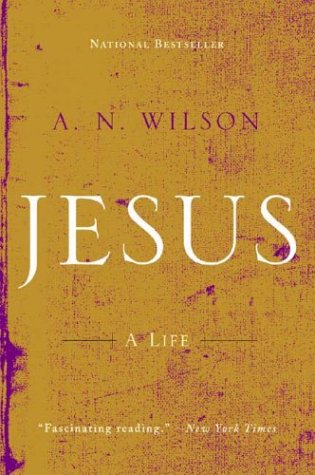 The Jesus seminar is a group of scholars who have adopted a systematic approach to the search for the historical Jesus. Listing all the sayings and acts attributed to him, they colour code the likely veracity of each according to the standards of biblical criticism. For example, if the saying or act fits uneasily with subsequent Christian teaching, it's likely to be true, for only that could have stopped its suppression. One of these sayings is Jesus' injunction to turn the other cheek. An "inauthentic" saying is the beatitude he supposedly pronounced on those persecuted for following the Son of Man. The work has led the scholars to conclude that Jesus was an extraordinary ethical teacher, perhaps akin to Gandhi. It's an answer to the question of who this man was that AN Wilson, in his book "Jesus", utterly refutes. It's not that what's recorded about him in the four gospels is not fascinating to search and weigh. Rather, it's that the ethical teaching is too muddled. Jesus has been read as a pacifist, as the saying about turning the other cheek might imply. And yet his disciples apparently carried swords in the Garden of Gethsemane. He taught that the poor would be blessed, though archaeological evidence suggests he lived for most of his life in a comfortable home. It just doesn't add up. "A patient and conscientious reading of the gospels will always destroy any explanation which we devise," Wilson writes. "If it makes sense, it's wrong." His book is written in an open-minded, if questioning tone. He tests the evidence, whilst respecting the faith of ordinary Christians. His barbs are mostly saved for institutions like churches, who have consistently shown "contempt" towards what their supposed founder reportedly said. Some allow divorce, when Jesus is almost certain to have forbidden it. Others claim Jesus as their founder, when the fact that he didn't present his teachings in anything like a systematic form, but rather engaged with existing Jewish teaching, implies otherwise. He seems to have regarded himself as an authoritative, reformist rabbi, with apocalyptic leanings. He almost certainly believed that a new kingdom was coming, one so imminent that his disciples could live by it already. |
| Column |
The Doctrine of Mary's VirginityThe virgin birth is a scientific impossibility. Shouldn't we remember Mary for the real woman she was?  The question: What would you get rid of for Christmas? The first followers of Jesus – those individuals whom the church now celebrates as apostles and saints – could not have believed in the virgin birth of the messiah, let alone the perpetual virginity of Mary, his mother, a doctrine which the Roman Catholic church subsequently declared necessary to confess for salvation. The apostles knew of the surviving brothers and sisters of Jesus, and probably knew them in person. Seeing her as a virgin mother would have been vergin' on the ridiculous. The New Testament remembers Jesus' siblings too. Reconciling the biblical evidence with official doctrine has been a problem for believers ever since. As Erasmus put it: "We believe in the perpetual virginity of Mary, although it is not expounded in the sacred books." He was scholar. He knew that Matthew was misquoting when, in his gospel, he recorded a virgin conceiving and bearing a son called Emmanuel. The original passage from the Hebrew Bible refers, merely, to a "young woman." Matthew had the luxury of writing long after Jesus' contemporaries were dead. So the first reason for wanting to be rid of the references to virginity at Christmas are historical. It's not true, and no one amongst Jesus' intimates, not least his mother, could possibly have believed it. |
| Column |
The Economics of MistrustThe current crisis might not sink us financially. But when the dust settles, how will our sense of humanity have fared?  Just how serious is the economic state we're in? At a debate on Christian responses to the recession, Andrew Dilnot, the well-respected economic commentator and evangelical Christian, suggests the crisis isn't so bad. Recessions are part of life in a capitalist economy: the real question is why there hasn't been a recession for the last 16 years, since in previous decades recessions have come every 3 or 4. He also thinks that the worry about the levels of debt the UK is now carrying is a worry about the wrong thing. Debt is basically a good thing, at the macroeconomic level: it is the key that liberates people from poverty. Ask yourself how one billion children have been lifted out of poverty in Asia. It couldn't have been done without the alchemy of debt, the ability of the countries concerned to borrow and lend. As for UK's debt, it's larger than it was, but it is still pretty modest by historic standards. So why the sense of panic? Dilnot's suggestion is that it's a moral issue. He believes that there is a kind guilt lying behind much of the current anxiety about economic woes. We, in the UK, are a rich generation – four times as rich as our parents and grandparents were after the second war. So we need to get used to our prosperity, and not let the media drive us into paroxysms of fear, which actually make things worse since they stop us enjoying the benefits of wealth. Dilnot is at pains to point out that we are a massively redistributive economy too: 1% of earners at the top of the pile pay 25% of all income tax; the bottom 20% of earners are 60% better off because of the welfare benefits taxation funds. This redistribution he interprets as a practical application of the commandment to love your neighbour. Humans have a tendency to greed. But Christians should be proud of their economy, even celebrate it as a manifestation of Christian faith. That was the pollyannarish view. But his opponent was John Milbank, the well-respected theologian. When he stood up to speak, he lambasted the analysis. The big issue is not the ups and downs of the economic cycle, but it is the kind of people we are becoming because of late capitalism. Whilst we are richer, that wealth has been bought at the price of massive social disruption, which is corrosive of civic virtues like trust. Further, the world has become a different place because, now, banks are bigger than governments. This means that governments are arguably more beholden to the markets than to the people – which is to say our system might be described as a market oligarchy. Sound excessive? Well, consider that as a result of the banking crisis, a few rich "lords" have been bailed out at the expense of the masses of poor "serfs", in possibly the biggest redistribution of wealth in history – and a redistribution in exactly the opposite direction to that celebrated by Dilnot.
|
| Column |
Face to FaithGalileo's lunar work drew on another Christian iconoclast who had lived 1,000 years earlier.  Galileo's earliest surviving drawing of the moon can be dated to 30 November 1609, almost exactly 400 years ago. In the months before he made his observations, he'd become aware of an extraordinary new instrument that brought the far away much nearer: the telescope. Immediately, he'd seen its potential for science. And now, having polished up the original designs, and improved on its power, he turned the new instrument to the starry heavens and the still lunar surface. On that night – armed with his watercolours, ink and brushes too – he was the first to capture that most extraordinary of celestial sights: the details of an alien world. What he experienced can still be enjoyed today. For it is easy to capture the wonder of the moment by focusing a telescope or binoculars on our heavenly companion. As an undergraduate I studied physics, and for one project I had to measure the heights of lunar mountains – a task that Galileo himself undertook. I had to take photographs of the shadows that fell across the peaks, valleys and plains. My efforts were, of course, utterly trivial so far as science is concerned. However, the experience was invaluable. I rose at 3am on dark, frosty mornings to ensure that there'd be clear skies. It reminded me of the monks who say the office of matins at similar hours while the world sleeps. What awaited was the gift that comes with contemplating the lunar surface, if through bleary eyes. The moon is a high-contrast place of greys and whites. Pitted like pumice, it feels close even when viewed through a relatively low-powered instrument. Galileo's exploration of the moon was aesthetic as well as cartographical. In the book he wrote about his observations, The Sidereal Messenger, he commended his readers to the "great and marvellous sights" he'd seen. He also included one image painted in 1609 that was adjusted to make it more beautiful. "Galileo is much more interested in the play of light and shadow than in accurate mapping," explains Owen Gingerich of the Harvard-Smithsonian Centre for Astrophysics. "He is interested in the heights and depths that reveal an earthlike moon." And that, in fact, is the lasting legacy of Galileo's work. He imagined the moon as earthlike. That could not be more significant. According to Aristotelian cosmology, the objects that filled the heavens were perfect, nestling among crystalline spheres. Rendering the moon with apparent flaws, such as craters and peaks, shattered those assumptions. Galileo's drawings were another nail in the coffin of the old cosmology. Only, Galileo was far from the first to think like this. In order to interpret what he saw, he drew on an Alexandrian philosopher, John Philoponus, who'd lived 1,000 years before him. John was a Christian thinker who wrote about physics and theology. He challenged Aristotelian cosmology too, by reasoning that the earth and the heavens must be alike, and his ideas were known to many. But they were resisted by the establishment, perhaps because John had been declared a heretic by the church – not for his scientific views but because of his speculations about God. So, it is fascinating to ponder whether Galileo felt John was a kind of soulmate, as the Italian too headed for trouble with the church. He certainly cites John frequently in his writings. When he sketched his first images of the moon, he must have been thinking of the older iconoclast. |
| Column |
Rowan's Vision for DevelopmentCan giving to the poor be seen not simply as alleviating the suffering of others, but about receiving a gift in return?  Rowan Williams has called for a broadening of the development agenda, so that secular agencies working in developing countries might become more fluent in the language of faith. Conversely, he stressed, faith-based communities must be more open to the imperatives of the "development establishment." Learning from each other would not only be good for development. It might make possible the "distribution of dignity", alongside the establishment of rights, he said. The Archbishop of Canterbury has a remarkable ability to highlight key issues of our day, issues that many then recognise, even though they don't share his faith commitment. He has done so again with his analysis of the work of development. It came at the culmination of a series of RSA-sponsored lectures entitled New Perspectives on Faith and Development. (He also achieved what must be a rare eclecticism for public talks, commending to his audience both a papal encyclical by Benedict XVI and a volume written by George Monbiot.) Williams's analysis is premised on the observation that there has been, and remains, a longstanding unease between the development establishment and faith communities. The development establishment is often wary of the way faith communities operate, believing they undermine the universal ethic that inspires development. So, the fear is that faith communities may prefer to care for their own, not for all. Or they may hinder the spread of human rights, particularly to women. Or they may use development as a cover for proselytising. Conversely, religious communities are often suspicious of the secular agenda of development agencies, feeling they ride roughshod over deeply held convictions and patterns of life, and impose an essentially foreign view of the good life, imported from the materialistic culture of the rich west. Williams is clearly on the side of faith in this debate. But he is not seeking to score points. Rather, he points to what might be gained should both sides transcend their prejudices. That would be nothing less than a renewed vision for development. |
| Column |
More Confusion than Light from SacksThe chief rabbi's speech last week contained some dramatic soundbites. But the reasoning behind them doesn't stack up.  "Falling birth rate is killing Europe", "Islam must separate religion from power". Just two of the striking headlines that followed the Theos lecture last week, given by Jonathan Sacks. What had the chief rabbi said? Were strong headlines riding roughshod over his nuance? It seems not. For having read the lecture, there is something about it that is unsettling. It's not that his arguments appear a little confused, though they do. For example, at one point, Sacks argues we need religion because science can't yield meaning, only later to declare that science is yielding "wonderful new insights" into meaningful behaviour. Or, he commends Tocqueville on the separation of religion and politics, apparently forgetting that he is the ennobled Lord Sacks of Aldgate. Rather, it is the discussion of cultural decline, on which he spent some time, that is disquieting. Sacks links a supposed European decay to falling population levels – or to be more precise, to falling indigenous birth rates. He illustrates his point by quoting the historian Polybius, who developed a similar line of rhetoric to explain the apparent decline of ancient Greece. The people "had entered upon the false path of ostentation, avarice and laziness," Polybius wrote. Hence, they were not prepared to have children, or only to have one or two. Now, Sacks is simply wrong about the population, at least in the UK. Levels are rising according the Office for National Statistics because of immigration, decreases in deaths and increases in births. Sacks could well be mistaken to quote Polybius too, because scholars debate why Athens declined. Perhaps it was as a result of the conquests of Alexander, not any collapse in Greek personal morality. After all, the Stoics and Epicureans of the Hellenistic period taught that the good life is a virtuous life, and these philosophies continued to shape people's lives for centuries, as the Greek world became Roman. Following that, Stoicism greatly influenced the formation of Christianity and even, it has been argued, the life of at least one very well known first century Jew, called Jesus. |
| Column |
Religious Stock and the Belief CrunchBuy Buddhism, sell Anglicanism? Be careful, because, just as in financial markets, shocks and bubbles can test your faith.  Faith markets are perhaps like financial markets. After all, religions have become global: opinions and beliefs are traded every day in the world's cosmopolitan cities, much like stocks and shares. Faith markets might even have their own kind of securities, as people hedge against overpricing in their main faith holding by buying into the practices of a different philosophy – the Christian who reads the astrology columns, the Buddhist who interprets meditation through neuroscience. Moreover, theologians appear to hold to the faith equivalent of the efficient market hypothesis. They tend to assume that their beliefs can withstand the external shocks of encountering other traditions, and further, that the eternal truth will out – perhaps as economists have believed that markets tend towards equilibrium. Then again, that last point could be wrong. Rather like the economists who failed to foresee the credit crunch, sociologists failed to see that secularisation would not destroy faith but rather reinvigorate it. So perhaps we can refine the analogy by borrowing some of the insights put forward by George Soros, that master of markets. He might help us better understand today's faith markets. Soros proposes two key doctrines. First, that market prices always distort the underlying fundamentals, his doctrine of fallibility. Second, that this mispricing itself affects reality, his doctrine of reflexivity. Take the doctrine of fallibility. You might feel that Anglicanism has the best assets, at least in the UK, what with its glorious cathedrals and seats in the House of Lords. What fallibility warns is that such pricing does not necessarily make it a stock with a future. Add in the doctrine of reflexivity, though, and the picture changes again, for it may be the case that those assets themselves convince the market that Anglicanism is, in fact, worth investing in. It all depends upon cultural feedback mechanisms and whether the owners of the assets can leverage them to their greatest advantage – whilst watching that they don't become over-leveraged, of course, and so precipitate a faith crunch. |
| Column |
Sacrifice: Bringing Evolution and Religion Together?Sarah Coakley is among those who argue that co-operation may be as fundamental in evolution as natural selection.  Sacrifice. It doesn't seem the most promising subject with which to commend Christian thought to a sceptical world. Surely compassion or wonder would play better, as experiences everyone has anyway. But sacrifice. It seems primitive, bloody, irrational. Part of religious history to overcome and leave behind. In fact, there has been a revival of sacrifice amongst philosophers of religion in the 20th century. The man here is René Girard. His idea, roughly, is that our desires are mimetic – we desire what others desire – and that this leads to conflict, since we therefore desire the same things. This instils cycles of violence in human cultures, as desire provokes conflict provokes revenge. And the only way to break the cycles is to load the build up of violence onto a scapegoat, a party innocent of the original mimesis who acts as a sacrifice. Christ's death on the cross might be the supreme example. But on Tuesday this week, Sarah Coakley, delivering her inaugural lecture as Norris-Hulse Professor of Divinity at the University of Cambridge – the one that covers philosophy of religion – contested Girard's interpretation of sacrifice as irrational (because of the mechanism upon which it's based), but commended sacrifice to us nonetheless – a commendation based upon evolutionary theory, no less. Her argument stems from her collaboration with Martin Nowak, professor of biology and mathematics at Harvard University. He's been working on the possibility of a new principle in evolution, that of co-operation, without which, he's shown using game theory, "competitiveness dethrones itself" – which is to say that natural selection couldn't work. By co-operation he means something quite specific: foregoing of fitness advantage so that others may have it. His work resonates with that of other evolutionarists, notably Lynn Margulis, who's argued that multicellular life could never have evolved without symbiosis. The point is that this kind of co-operation is not just a supervenience on essentially selfish mechanisms, as advocated in the work of Richard Dawkins. Individual advantage cannot explain it, co-operationists say. If that's right, co-operation must be as fundamental in evolution as mutation and natural selection. |
| Column |
Exploring the MultiverseDo quantum computers offer proof of parallel universes? And where does that leave philosophers?  The concept of the multiverse is not new. In 55 BC, Lucretius speculated that the motion of atoms might be energetic enough to propel them into parallel worlds. During the Renaissance, Giordano Bruno raised a similar possibility, his speculations causing him tragic trouble with the church. The poet, Thomas Traherne, raised the thought again in the 17th century: God's love is infinite, he mused, so maybe there are an infinite number of worlds over which that love moves. The history of the idea is worth bearing in mind since it suggests something: the multiverse proposal appears when the cosmology of the day reaches a limit of understanding. Today, it arises in a number of contexts. Consider just one, the way it tackles a paradox of quantum theory. The quantum world is described as a superposition of states, expressed by the wave function. However, we don't live in a superposition of states, but just one. The paradox is how the two relate. In the Copenhagen interpretation of quantum mechanics, the wave function is said spontaneously and mysteriously to collapse into the state we actually observe. John Gribbin, the popular science writer who has a new book out, In Search of the Multiverse, rejects that. Instead, he follows Hugh Everett and David Deutsch who have argued that in the superposition of states, the wave function actually describes the parallel worlds of a multiverse. What we experience, then, is just one part of the wave function, other parts existing in other universes. So, in the famous Schrödinger's Cat thought experiment, it is not that the cat lives or dies according to the choice of an observer. Rather, it is that there is one universe in which the cat lives, and another in which it never lived. Gribbin familiarises the possibility by appealing to the sci-fi trope of parallel universes in which, say, I never wrote this article, and another again in which you never read it. You can then have fun asking which universe you'd prefer to be in. Perhaps there is even a universe in which everyone on Cif threads cordially and routinely agrees. |
| Review |
ScienceA review of Rupert Sheldrak's A NEW SCIENCE OF LIFE  A New Science of Life, the biologist Rupert Sheldrake explores scientifically heretical terrain. In this third edition of his book, originally published in 1981, he postulates his theory of "morphic fields" - elusive forces that bathe nature and influence the development of form. They are imagined as somewhat like electromagnetic fields, only instead of transmitting energy, they store information. Hence, Sheldrake argues, morphic fields act as a kind of memory bank. When a snowflake forms, the details of its shape are recorded by morphic resonance. When birds flock in vast numbers, and shift like dark clouds across the sky, they act as if one because they effectively are one, Sheldrake suggests: they can access another morphic field. Likewise, when laboratory rats learn how to navigate a maze, the solution is morphically imprinted; other rats can then access the memory, navigating the same maze more quickly. What interests Sheldrake are those features of nature that current science finds hard to explain. If the notion of morphic fields seems excessive, as it does to many, he replies that science needs radically innovative ideas to account for all that we observe. He believes that mechanistic and materialist explanations have been exhausted when it comes to phenomena from cooperation to consciousness. Hence exploring possibilities that lie beyond them. He is also quite clear that he is not conjuring up a pseudo-science. He hopes that every one of his proposals will pass empirical tests. Sheldrake has been accused of peddling magic, and worse. But then, the same was said of Newton and his theory of gravitation: it was a spooky force that acted at a distance, and seemed to many to illuminate astrology as much as astronomy. Time will be the ultimate arbiter of Sheldrake's ideas. And since it is almost thirty years since this book was first published, and his basic thesis has not yet been verified by repeatable experiments to the satisfaction of peers in the scientific community, it seems that time is making its choice. |
| Review |
On The Evolution of GodRobert Wright's latest book sees moral progress in terms of evolution. But is his approach really suited to religion?  God is being reinvented by atheists. It's an unexpected phenomenon. Martin Seligman, the psychologist responsible for the surge of interest in happiness, talks of never being able to get on with the God of the Christians. However, he speculates about a deity that will emerge in time: "I am optimistic that God may come at the end," he has written. Or there's the theoretical biologist, Stuart Kaufmann. His reflections on evolution lead him to suggest that "the unfolding of the universe … appears to be partially beyond natural law" and hence he is "happy to accept this natural creativity in the universe as a reinvention of 'God'." The work of the author and journalist Robert Wright is caught up in this movement. Much as evolution seems directed towards growing physiological complexity, he detects moral progress in the evolution of humanity. It's an insight supported by game theory. Very roughly, some activities we see in nature are zero-sum: one player wins, and the other must lose. There is no progress in that. However, some activities are non-zero-sum: it is possible to devise outcomes that are win-win. In such situations, to put it crudely, people can afford to be nice to each other. Seen as a force of history, that leads to an increase in compassion and the creation of the moral ideal of universal love. In his new book, The Evolution of God, Wright links that to Jewish, Christian and Muslim explorations of the divine. He believes his method points to a synthesis of faith and science, one that transcends contemporary antagonisms. He even leaves open the possibility that the God of Abraham, Isaac and Jacob exists, though he's more inclined to the view that "God" is a creation of the human imagination, if one to be valued not dismissed; without "God", he suggests, our moral sensibilities would be indistinguishable from those of beasts. He comes closest to affirming a transcendent force for the good when exploring the work of Philo of Alexandria. This Jewish thinker envisaged a principle running through the cosmos, which he called the Logos. That abstract conception of God suits Wright's game theory, and its cost-benefit analysis: he calls Philo's Logos "the divine algorithm." |
| Column |
Marx's ChallengeMarx saw religion as a comforter. But the real challenge is to live without the 'heart in a heartless world' that it provides.  Karl Marx was a serious atheist. He didn't think that religion was mad or particularly bad: it was "the opium of the people" but "the heart in a heartless world" too. Instead, he had a theory about the nature of religion that attempted to penetrate to the heart of the human condition. For Marx, the human animal is fulfilled in its labouring. We are made from the earth – we are "of nature", as he wrote in his early Economic and Philosophical Manuscripts of 1844. So, when tilling the soil, we connect to the stuff of which we are made, reshaping it, and thereby shaping ourselves. Therein lies our satisfaction. We find ourselves through our labour in fields – even in gardens, that bourgeois mode of self-realisation. However, those acts of self-realisation are increasingly thwarted in organised society. When people learn to cooperate, a struggle ensues because we become disconnected from the products of our labour. The ever-more complex modes of production manifest in capitalism lead to the deepest sense of alienation. We lose touch with the land, though can't give up on the expectation that work will fulfil us, even when it abuses and empties us. As a result, human individuals seek consolation. Perhaps one of the reasons that going for a picnic is such a joy in the summer is that eating sandwiches on the earth reconnects us with that of which we are made. Picnicking involves taking our food to the fields – back to the fields, you might say. It symbolically reforms the link between our alienated selves and our nature-loving labouring selves. Therein lies its pleasure, at least as Marx might have had it. |
| Review |
Crazy for YouReview of Norah Vincent's VOLUNTARY MADNESS: My year lost and found in the loony bin  Norah Vincent is making a career out of adopting different disguises. For her previous book, Self-Made Man (2006), she dressed up as a man for a year, fooling everyone she met. The tensions that resulted from living and working in male guise, however, "that psycho-emotional contradiction", caused her to have a breakdown. And this new book picks up where that leaves off. This time she's off to the asylum, ostensibly feigning madness, though as the book unfurls, it becomes clear that her interest in mental institutions has much to do with her own search for mental well-being too; she has a history of depression of which her breakdown was a part. Her technique is called "immersion journalism", and it is to writing what method acting is to performance. The idea is to literally become the part. It's also a good way of gaining readers: My year lost and found in the loony bin is a far more gripping subtitle than something equally accurate, such as "An examination of the contradictions inherent in the care of the mentally ill". Over the course of a year or so, Vincent has three short sojourns in three different American institutions - one public, one private, one based on complementary therapies. She self-refers in order to get herself committed, adding to the symptoms of her previous mental illness the sort of thing that doctors need to hear, and it turns out to be surprisingly easy to do. That said, she is never actually in one hospital for more than a couple of weeks, though she writes powerfully enough about the experience to create the illusion that she has been committed in each case for a long time. Her descriptions convey many uncomfortable things about the way people suffering from mental illness can be treated in these places, not least in terms of how dehumanizing such care can be. She is also good at describing the effects of different drugs from the point of view of the individual who takes them, "the undisclosed or unknown dangers and unpleasant side effects". During the course of the research that also forms part of the project, Vincent is "appalled to read, first in books, then in newspapers, of how thoroughly corrupt the drug development and approval processes are in [the United States]". Her analysis of what it is to be institutionalized is also illuminating: "It doesn't just happen to you. You allow it to happen to you. You partake". In fact, that theme of responsibility - whether that be the responsibility of doctors, carers or patients - is the main theme of the book. She concludes that although institutions may offer a sufferer of mental illness some respite from the pressures of everyday life, sufferers must aim to take responsibility for themselves in order to recover, or at least to learn to live with their illness: "nothing and no one can do for a person what he will not do for himself, even if he is crazy". Medicine may help. But medication is a far from complete answer. |
| Article |
God, Dawkins, and Tragic HumanismIn a new book, Terry Eagleton argues that liberal humanism woefully underestimates the horrors of which humans are capable.  But this month, two books are a cut above the rest. For one thing, they pack hilarious rhetorical punch. You'd expect that in Reason, Faith and Revolution: Reflections on the God Debate, by Terry Eagleton. His review of The God Delusion in the London Review of Books became a minor publishing event in its own right: "Imagine someone holding forth on biology whose only knowledge of the subject is the Book of British Birds, and you have a rough idea of what it feels like to read Richard Dawkins on theology," it began. However, there is something deeper going on in Eagleton's book than highbrow trench warfare. As there is in the second work, Atheist Delusions: The Christian Revolution and Its Fashionable Enemies by David Bentley Hart. Eagleton does not let up now. Of Daniel Dennett's scientific treatment of belief, he writes: "[Dennett] is rather like someone who thinks that a novel is a botched piece of sociology." To Christopher Hitchens, whom he respects, Eagleton says: "Christianity was never meant to be an explanation of anything in the first place. It is rather like saying that thanks to the electric toaster we can forget about Chekhov." However, there is something deeper going on in Eagleton's book than highbrow trench warfare. As there is in the second work, Atheist Delusions: The Christian Revolution and Its Fashionable Enemies by David Bentley Hart. They're worth considering even if you naturally |
| Review |
Why There Almost Certainly Is a GodDoubting Dawkins  Would the world change if someone came up with an utterly convincing proof for the existence of God? In 'A Corner of the Veil', a novel by Laurence Cossé, this happens. A conclusive demonstration is formulated by a holy man who hands it to his religious superiors. They read it, are convinced, but panic, fearing anarchy if it should fall into the hands of the faithful. When the government gets wind of the proof, ministers too want to conceal it, fearing that capitalism's ethos would be undermined in an outbreak of compassion. In his new book, Keith Ward, the former Regius Professor of Divinity at the University of Oxford, seeks to refute the arguments against the existence of God propounded in 'The God Delusion' by Richard Dawkins. 'Why There Almost Certainly Is No God' is the title of Dawkins' fourth chapter. Consider one element of Ward's counter-case. Dawkins claims that the existence of God is even less likely than the apparently improbable emergence of conscious beings, on the grounds that if God designed such complex entities he would have to be even more complex, making him even more improbable. But rebuts Ward, God is simple, and anyway simple entities routinely give rise to more complex phenomena, a good case in point being the laws of nature themselves. Moreover, to talk of God being more or less probable is simply, or perhaps deliberately, to misunderstand the concept of God: whether or not God actually exists, the idea of God is of a necessary not contingent being. Ward pursues his quarry along many other twists and turns; part of the pleasure of reading him is staying with him through the metaphysical maze. Whether or not Dawkins will bother to keep up seems unlikely, Ward believes. For one thing, he has heard the rebuttals before, not least in Oxford debates against Ward himself. And yet, '[Dawkins] goes on saying that theologians have never answered his arguments.' This refusal to engage perhaps explains why |
| Article |
What Do You Get If You Divide Science by God?A prize-winning quantum physicist says a spiritual reality is veiled from us, and science offers a glimpse behind that veil. So how do scientists investigating the fundamental nature of the universe assess any role of God, asks Mark Vernon. 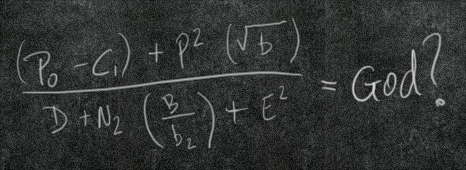 The Templeton Prize, awarded for contributions to "affirming life's spiritual dimension", has been won by French physicist Bernard d'Espagnat, who has worked on quantum physics with some of the most famous names in modern science. Quantum physics is a hugely successful theory: the predictions it makes about the behaviour of subatomic particles are extraordinarily accurate. And yet, it raises profound puzzles about reality that remain as yet to be understood. The bizarre nature of quantum physics has attracted some speculations that are wacky but the theory suggests to some serious scientists that reality, at its most basic, is perfectly compatible with what might be called a spiritual view of things. Some suggest that observers play a key part in determining the nature of things. Legendary physicist John Wheeler said the cosmos "has not really happened, it is not a phenomenon, until it has been observed to happen." D'Espagnat worked with Wheeler, though he himself reckons quantum theory suggests something different. For him, quantum physics |
| Column |
The Limits of MaterialismThe idea that scientific advances will squeeze meaning from the world is a hangover from 19th-century physics.  It's actually quite easy to pick holes in the argument that science will show how consciousness and God are illusions. For example, Colin Blakemore wrote that our intentions are only "what our brains have already decided to do". But is my brain not me too? Surely, he is not suggesting that there is some hidden entity inside each of us that does the deciding and then tricks us into thinking we've done it? That would be to advocate a ghost in the machine. Blakemore also seems to argue that identifying a biological source of religious feeling would undermine the meaning of religious belief. But that doesn't follow at all. Imagine if geneticists identified the gene that allowed us to solve quadratic equations. Would we be right in concluding that quadratic equations were previously somehow fake? Not at all. Moreover, if some scientist switched the quadratic equations gene off, we would not say that they don't exist. Rather, we would merely conclude that we no longer have the capacity to appreciate their reality and power. But let's not just seek to score points, because it's interesting to push more deeply into the issue at stake. Blakemore's views are a product of 150 years of tremendous success in biology, successes built on the assumptions of materialist philosophy and the idea that natural processes are chemical and mechanical. His conviction that faith in materialism will not let you down is entirely understandable. In the struggle for the survival of ideas, it has proven itself to have high adaptive value. But when he proposes that life, consciousness and religion all lie within the grasp of that worldview, he is writing what the philosopher of science, Karl Popper, called a "promissory note". That note says: commit to my materialist conception of the universe and everything will become clear – not yet, maybe not next year, but surely the time will come. I doubt that and here's one reason why. Consider biology's sister science, physics. Physics had a similar run of success on the basis of a materialist and mechanistic philosophy in the centuries that followed the Copernican revolution. However, that all changed with the emergence of quantum theory. The very stuff upon which materialism is based, atoms, suddenly ceased to look like anything that had previously been called matter. Electrons sometimes looked like particles, and at other times like waves. The even more bizarre thing is that how they look depends upon how the observer chooses to look at them. So these days, fundamental physicists deal not in atoms but entities such as probability distribution functions. They exist in some kind of higher dimensional universe. How they "collapse" into what might then look like a particle or wave in space and time is a profound conundrum. |
| Column |
The Faithful Come OutChina is experiencing a religious resurgence and, remarkably, the government is letting it happen.  If you walk down Battery Path in central Hong Kong you are likely to see a silent protest on one side of the pavement. Two or three demonstrators sit, cross-legged on the ground, in meditation. Next to them, on boards, are displayed the hideous images of individuals who have been beaten and presumably tortured. Passing parents shield the eyes of their children. These are supporters of Falun Gong, the religious movement founded in the 1990s. It is distinguished by being probably the highest profile victim of the Chinese government's fear of organised religion. A clampdown began after a peaceful protest in July 1999 in Tiananmen Square when Falun Gong was outlawed. According to Amnesty International, the government then launched "a long-term campaign of intimidation and persecution, directed by a special organisation called the 610 Office." Protests are allowed in Hong Kong, just yards away from government offices, because of the status of the Special Administrative Region. It is a clear reminder of the dark side of the Chinese authority's approach to religion. However, it is not the whole story. Martin Palmer is the secretary-general of the Alliance of Religions and Conservation (ARC). He runs one of the few organisations that have a license from the Chinese government to work with religious groups in the country. He can hardly stress enough how profound the changes now taking place are. So are they a sign of a more relaxed attitude towards freedom of religious expression? About three years ago, he was approached to make contact with Taoists. This followed similar suggestions about working with Buddhists, three years before that. These invitations struck Palmer as odd, to say the least. After all, this is a regime that had tried to wipe out Taoism, destroying about 98% of its temples, statues and scriptures. However, reforms have continued apace. Just last year, in 2008, several public holidays were reformed, again indicative of development. The May Day holiday, symbolic for any socialist, was downgraded and in its place two others were revived. One is the Qing Ming, or Festival of the Dead, on which Chinese people remember their ancestors. A second is the Dragon Boat Festival, which partly commemorates a famous mandarin who warned an emperor against corruption. The significance of that story will not be lost on the Chinese people. |
| Article |
The Philosopher and the WolfMark Rowlands and his wild lessons in externalism One day, the eye of the philosopher Mark Rowlands was caught by an advertisement in his local newspaper, the Tuscaloosa News: "Wolf cubs for sale, 96 per cent". Rowlands was eyeballing the father of those cubs just an hour later, the wolf’s yellow eyes on a level with his own, the beast’s enormous paws propping it up against a stable door. This encounter had the opposite effect to that which it would have on most human beings, who fear wolves with a primordial terror. Rowlands purchased one of the cubs and his life changed. Within hours, Brenin had savaged his furniture and destroyed the air conditioning. When Brenin was alive, he was the centre of Rowlands’s life; each day the creature had to be exercised, fed and settled before the philosopher could embark on anything else. The demand the wolf made on him reminds Rowlands of the myth about St Francis and a wolf that terrorized a village. St Francis made a deal with the wolf, whereby the creature would cease his hostilities if the villagers promised to feed him regularly. The arrangement worked, and firm arrangements are what you need to make with wolves if the relationship is to flourish. Now that Brenin is dead, the philosopher still thinks of his "brother wolf" every day. He misses the relationship that was one of the most formative in his life, and confesses to worrying about Brenin’s bones, now that they lie buried in a lonely spot in the South of France. In his professional life, Rowlands is known for the idea that consciousness is embedded in the world around us as much as within us. |
| Column |
God or a Multiverse?Does modern cosmology force us to choose between a creator and a system of parallel universes? 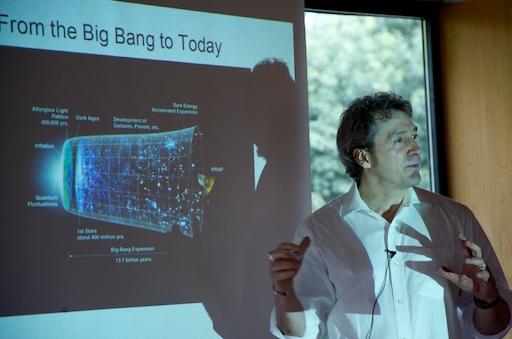 Is there a God or a multiverse? Does modern cosmology force us to choose? Is it the case that the apparent fine-tuning of constants and forces to make the universe just right for life means there is either a need for a "tuner" or else a cosmos in which every possible variation of these constants and forces exists somewhere? This choice has provoked anxious comment in the pages of this week's New Scientist. It follows an article in Discover magazine, in which science writer Tim Folger quoted cosmologist Bernard Carr: "If you don't want God, you'd better have a multiverse." Even strongly atheistic physicists seem to believe the choice is unavoidable. Steven Weinberg, the closest physics comes to a Richard Dawkins, told the eminent biologist: "If you discovered a really impressive fine-tuning ... I think you'd really be left with only two explanations: a benevolent designer or a multiverse." The anxiety in the New Scientist stems in part from the way this apparent choice has been leapt upon by the intelligent design people. Scientists don't like that since it seems to suggest that ID offers a theory that cosmologists are taking seriously. It doesn't of course: ID wasn't science before the multiverse hypothesis gained prominence, just a few years ago; and it hasn't become science since. Further, if you bow to ID, the implication is that science should brush certain ideas under the carpet just because its ideological opponents find false succour in them. Physics has already learnt not to do that: some cosmologists ignored the hypothesis of a big bang for a while, believing it lent credence to the account of creation in the Bible. The big bang, though, turned out to be hugely more likely than the steady state theory that preceded it. The correct stance is to recognise that reading creation myths as scientific theory is just a category mistake. Which is precisely why the choice between God or a multiverse is false too. If divinity is an explanation for anything, it is not a scientific explanation. A scientific explanation is precisely that, an explanation from within the laws of science. God, for believers, is the condition without which science cannot even get going; divinity is a final explanation for the laws of science, as a philosopher of religion would say. To confuse the two is the fundamental theological mistake made by ID. It is also why you could have God and a multiverse without creating any significant theological problems. Believers don't have to choose. They can have both if they want. read more… |
| Review |
Not so Highly EvolvedRichard Dawkins' TV show on Darwin ignores compelling new science such as evolutionary convergence: it's a chance missed.  The 2009 Darwin celebrations are officially under way, now that we are halfway through Richard Dawkins' flagship TV series, The Genius of Charles Darwin. But I can't help but feel they have not begun well. Dawkins' exploration of the science seems to be driven mostly by his desire to score atheistic points: this is not evolution as survival of the fittest but as zero-sum game. It is a wasted opportunity on at least two accounts. First, making much of creationism and intelligent design only feeds them the oxygen of publicity. Most Christians find accommodation with evolution, and welcome it. "Darwinism appeared, and, under the guise of a foe, did the work of a friend," wrote Aubrey Moore, the late-Victorian Anglo-Catholic theologian. Why not celebrate that? Wouldn't it be a better strategy than giving creationism prime time? It would leave more room for the science too. Which leads to the second point. The science of evolution is becoming much more interesting than a black and white presentation of it allows. Moreover, for believers, it is starting to look far less bleak than the phrase "survival of the fittest" implies. Such directions are explored in a new collection of essays by leading evolutionists, philosophers and theologians in a book, entitled The Deep Structure of Biology. The central issue under discussion in this case is that of evolutionary convergence. The editor of the book is also the great champion of convergence, namely the Cambridge paleontologist Simon Conway Morris. The work of Conway Morris, and now many others, is showing that evolution keeps coming up with the same solutions to natural problems. One of the better-known examples is that sabre-toothed cats. They evolved on at least three different occasions along independent Darwinian paths. And yet they look almost exactly the same. Dozens of examples of convergence have now been documented across a wide variety of biological phenomena, from animal and plant physiology to molecular biology. |
| Article |
The Frontiers of Faith and KnowledgeNeither science nor religion can banish uncertainty. If only they could thrive on that shared sense of wonder  Sir John Templeton, who died last week, gave hundreds of millions of dollars to scientists whom he hoped might put religious beliefs on a more solid foundation. His very substantial Templeton Foundation–with assets of nearly $1.5bn–has attracted particular reprobation in recent years. Some say its aim–to sponsor "human progress" through scientific research in religion–is simply misconceived: in Stephen Jay Gould's famous distinction, science and religion are two magisteria, fundamental but separate. Others have been more vociferous in their critique. In Richard Dawkins' book, The God Delusion, the Templeton Foundation warrants five index entries, one of three-page length. I do not know whether Dawkins has read much Freud, but he seems to be feeling his way towards the link the founder of psychoanalysis made between gold and excrement. I should confess that I have been a minor beneficiary of Sir John's largesse, as a Templeton–Cambridge journalism fellow. That said, now might be a good moment to put the aims of the foundation to the test. For what progress has its funding produced in relation to science and religion? It's a big question, but then Sir John liked the big questions. So consider the thoughts of, say, three of his Templeton prize winners. They are, perhaps, illuminating. Take Freeman Dyson, winner in 2000. The mathematical physicist and Emeritus professor at the prestigious Institute of Advanced Study in Princeton, has written about science and religion on many occasions. There is an article summing up what he thinks in his latest book, A Many-Colored Glass. Dyson draws an analogy with one of the central ideas in modern physics, that of complementarity. The best-known example of complementarity is that of the dual nature of light. Depending on how you look at it, you see either particles or waves. Light itself is richer than any one picture we might use to describe it. |
| Review |
Infinitely DemandingA review of Simon Critchley's "Infinitely Demanding: Ethics of commitment, politics of resistance"  Modern philosophy begins not in wonder, as it did for the ancients, but in disappointment. There is religious disappointment that the world has no meaning in the absence of a transcendent deity. This provokes nihilism, expressed in fundamentalist violence and non-theistic, passive spirituality. Then there is political disappointment inasmuch as justice has become meaningless. This is a crisis of ethics, in particular due to the lack of an ethical experience. That experience would be the feeling of a moral claim that was internally compelling, not merely externally compulsory. This is the current impasse identified by Simon Critchley. "Infinitely Demanding" is a little book with a big idea; through high theory and wry observations, Critchley seeks to describe a way forward. In short, this is to find an ethics of commitment based on a demand that is felt to be infinite. Critchley uses Alain Badiou's idea of fidelity and Levinas's of the other, inter alia. But in order to ensure that the individual is not crushed by the impossibility of such responsibilities - a failure that would result in another kind of nihilism - his ethical subjectivity turns on itself and finds humour at its own tragic inauthenticity. As Woody Allen put it, "comedy is tragedy plus time". Conscience, then, is "dividuated" subjectivity. Politics becomes grass-roots interventions by those who are against the consensus sanctioned by the state, an activism that also serves as a definition of democracy. It cultivates a kind of self-assertion driven by anger. But what about the problem of violence? Humour is an inadequate safeguard: after all, soldiers joke in the face of atrocity as a way of coping because it can keep the ethical at bay. But there is another ethical attitude that Critchley never quite addresses, namely that of compassion. This is an identification with another (related to but different from respect for the other), which is an ekstasis, a stepping out of yourself. It is also the beginnings of a meaningful transcendence not guaranteed by God but born of a sense of infinite mystery, and wonder. |