
 About the Fellowship
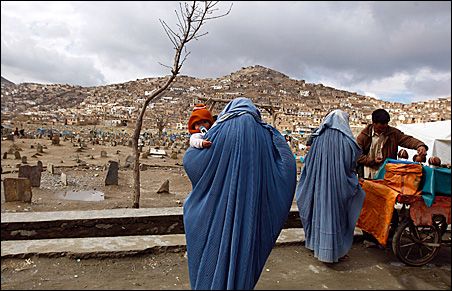
In western minds, the blue burqa stands as an icon for the oppression of Afghanistan's women because the Taliban forced women to wear the full body and face cover while they were in public.
But the misery of millions of Afghan women goes far beyond the confines of the burqa, and it predates the Taliban rule a decade ago.
Women and their supporters worldwide took heart after the Taliban were toppled in 2001 and the new government in Kabul declared a high priority on improving women's lives and rights. Girls went to school; their mothers, to work — most of them trading the burqa for the more traditional scarf draped loosely around their faces.
Now comes news that Afghanistan's Parliament has passed a law forcing Taliban-style restrictions on women in Afghanistan's Shiite minority.
The law reportedly would restrict when and how women could leave their homes. In the case of a divorce, it would grant child custody to the father. And it would force healthy women to have regular sex with their husbands — a provision denounced around the world as a sanction of marital rape.
When I heard the news, I couldn't help but personalize it, remembering faces I had seen while reporting stories in that country in 2004.
There were the tiny faces of baby girls in a hospital ward for malnourished children. Flies swarmed on the listless body of one six-month old girl who weighed just eight and a half pounds. The mother at her bedside was as gaunt as she was. Doctors explained why: When food was scarce it went first to the men and boys in a family, and the women all too often were too malnourished to produce milk for their babies.
There were the eager faces of girls in classrooms that had been forbidden to them under the Taliban rule. These were the faces of bravery because some other girls were shot on their way to schools and some of their schools were bombed, burned and raided by hardliners who to this day oppose the education of women. These girls were trailblazers in a country where three in four women were illiterate.
There was the sad, frustrated face of a rural public-health nurse who saw many young girls die in childbirth. One patient she lost had walked for eight hours while in hard labor seeking the help her family could not provide at home.
One in nine Afghan women die in childbirth, according to the World Health Organization, giving the country one of the highest maternal mortality rates on Earth. The upshot is that life expectancy for Afghan women is 46 years.
The reasons are set deep in a complex culture guided by tribal codes of honor, pockets of Islamic law and the common rule of the Kalashnikov.
In some rural provinces girls are given to older men to settle legal disputes. .
In many provinces, parents arrange for their daughters to be married at age 12 or 13. A year or two later, they give birth before their pelvic bones are fully formed. When such a young a girl's labor is obstructed, her uterus ruptures and she dies a horrible death, health workers told me.
Even older women are vulnerable because so many are malnourished, according to a recent Reuters report. Hunger leaves many pregnant Afghan women severely anemic, Karima Mayar of the Afghan Ministry of Public Health told Reuters.
"If they get post-partum hemorrhage, they will die 100 percent of the time," Mayar said.
But UN officials and some women in Afghanistan have said the legislation is real.
Shaken support. Meanwhile, worldwide anger over the law is not helping Obama's efforts to bolster support from other countries for his stepped up mission in Afghanistan. . NATO's secretary general questioned why the alliance was sending men and women to fight in Afghanistan when discrimination against women was condoned by law, the Times said. Italy's defense minister said his country was considering a temporary withdrawal of the women serving in its force in Afghanistan to protest the law.. Canada called in the Afghan ambassador for an explanation. And news reports in Canada this week said this development was making it increasingly difficult for that government to maintain its commitment to keep combat troops in Afghanistan until 2011.. "Canadians' tepid support for the combat mission in Afghanistan would turn icy should the Afghan government proceed with a law allowing marital rape, a new poll suggests," said a report on The Canadian Press.. What support there has been in Canada was "based — at least in part — on a belief that Canada is helping to improve the lot of women, whose rights had been severely restricted under the oppressive Taliban regime," it said.. Now the challenge for Obama — and, presumably, for Secretary of State Hillary Rodham Clinton — will be to convince the West that prospects for the women are even worse if everyone pulls out of Afghanistan..(end of article)
return to list of publications