
 About the Fellowship
Emily Yoffe
Emily Yoffe writes the Dear Prudence and Human Guinea Pig columns for Slate.com. As Prudence she offers advice on love, work, relationships, and family. As the Human Guinea Pig she takes on readers’ challenges. For example, she has let 23 medical students perform their first physical exam on her, taken a vow of silence, and made her singing debut (despite being tone deaf). For Slate, she has also written on science, medicine, politics, and popular culture. Her work has appeared in many publications, including, the Los Angeles Times, Washington Post, New Republic, New York Times, Esquire, O, Oprah magazine, and Weekly Standard.
| Column |
 The Medical RevolutionWhere are the cures promised by stem cells, gene therapy, and the human genome? 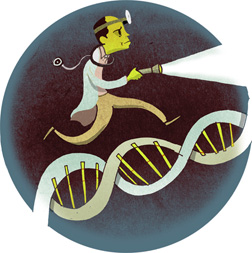 Dr. J. William Langston has been researching Parkinson's disease for 25 years. At one time, it seemed likely he'd have to find another disease to study, because a cure for Parkinson's looked imminent. In the late 1980s, the field of regenerative medicine seemed poised to make it possible for doctors to put healthy tissue in a damaged brain, reversing the destruction caused by the disease. Langston was one of many optimists. In 1999, the then-head of the National Institute of Neurological Disorders and Stroke, Dr. Gerald Fischbach, testified before the Senate that with "skill and luck," Parkinson's could be cured in five to 10 years. Now Langston, who is 67, doesn't think he'll see a Parkinson's cure in his professional lifetime. He no longer uses "the C word" and acknowledges he and others were naive. He understands the anger of patients who, he says, "are getting quite bitter" that they remain ill, long past the time when they thought they would have been restored to health. The disappointments are so acute in part because the promises have been so big. Over the past two decades, we've been told that a new age of molecular medicine—using gene therapy, stem cells, and the knowledge gleaned from unlocking the human genome—would bring us medical miracles. Just as antibiotics conquered infectious diseases and vaccines eliminated the scourges of polio and smallpox, the ability to manipulate our cells and genes is supposed to vanquish everything from terrible inherited disorders, such as Huntington's and cystic fibrosis, to widespread conditions like cancer, diabetes, and heart disease. Adding to the frustration is an endless stream of laboratory animals that are always getting healed. Mice with Parkinson's have been successfully treated with stem cells, as have mice with sickle cell anemia. Dogs with hemophilia and muscular dystrophy have been made disease-free. But humans keep experiencing suffering and death. Why? What explains the tremendous mismatch between expectation and reality? Are the cures really coming, just more slowly than expected? Or have scientists fundamentally misled us, and themselves, about the potential of new medical technologies? |
| Column |
Oh, BrotherWhy, exactly, do our siblings drive us so crazy?  It seems like such a trivial reason for murder. When God belittled Cain's gift to him of produce from his own garden, then praised his brother Abel for offering a sheep, Cain snapped. But as you get ready to gather with your family and unwrap presents, the Bible's first homicide starts to make sense. If being with your siblings this Christmas fills you with unalloyed joy, then you might be a member of the Duggar family. The rest of us—and about 80 percent of Americans have siblings—probably experience what evolutionary biologists say is a genetically programmed, emotional tug-of-war with our siblings. There may be no way out of this difficult combination of allegiance and rivalry. Debra Lieberman, an evolutionary psychologist at the University of Miami, studies the origins of sibling altruism—for example, why we would be far more willing to donate a kidney to a sibling than to a neighbor. She describes the joy of seeing her own sister over the holidays, the pleasure at being with someone who truly understands her. Yet even Lieberman says such togetherness has its limits. "We can hang out for 12 hours, then it all goes to hell," she says. "There will be a misunderstanding, a harsh word." There are reams of pop-psych books on the effect your parents had on you and that you have on your kids. You couldn't plow through all the literature about getting along with your spouse. But the sibling shelf is sparse. It's as if the self-help movement has given siblings a shrug. Yet your relationship with your siblings is likely to be the longest one of your life. The writers of the Bible, with its parade of warring brothers and sisters, understood its complications and passions. Evolutionary behaviorists are trying to understand why it is that the emotional connection, and conflicts, between siblings can last a lifetime. The prevailing theory is that it all comes down to math. With our nearest relatives—each parent, our full-siblings, and our children, we share 50 percent of our novel genes. This overlap, and gap, helps explain the continual cycle of family love and conflict. The shared 50 percent is the basis for our instinctive willingness to make all sorts of investments and sacrifices—even perhaps the ultimate sacrifice—for those with whom we are closest. On the level of the gene, it's a good idea to ensure those most like us will |
| Column |
SeekingHow the brain hard-wires us to love Google, Twitter, and texting. And why that's dangerous. 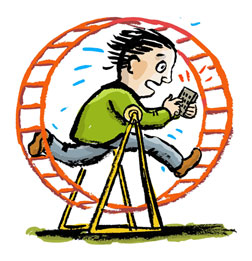 Seeking. You can't stop doing it. Sometimes it feels as if the basic drives for food, sex, and sleep have been overridden by a new need for endless nuggets of electronic information. We are so insatiably curious that we gather data even if it gets us in trouble. Google searches are becoming a cause of mistrials as jurors, after hearing testimony, ignore judges' instructions and go look up facts for themselves. We search for information we don't even care about. Nina Shen Rastogi confessed in Double X, "My boyfriend has threatened to break up with me if I keep whipping out my iPhone to look up random facts about celebrities when we're out to dinner." We reach the point that we wonder about our sanity. Virginia Heffernan in the New York Times said she became so obsessed with Twitter posts about the Henry Louis Gates Jr. arrest that she spent days "refreshing my search like a drugged monkey." We actually resemble nothing so much as those legendary lab rats that endlessly pressed a lever to give themselves a little electrical jolt to the brain. While we tap, tap away at our search engines, it appears we are stimulating the same system in our brains that scientists accidentally discovered more than 50 years ago when probing rat skulls. In 1954, psychologist James Olds and his team were working in a laboratory at McGill University, studying how rats learned. They would stick an electrode in a rat's brain and, whenever the rat went to a particular corner of its cage, would give it a small shock and note the reaction. One day they unknowingly inserted the probe in the wrong place, and when Olds tested the rat, it kept returning over and over to the corner where it received the shock. He eventually discovered that if the probe was put in the brain's lateral hypothalamus and the rats were allowed to press a lever and stimulate their own electrodes, they would press until they collapsed. Olds, and everyone else, assumed he'd found the brain's pleasure center (some scientists still think so). Later experiments done on humans confirmed that people will neglect almost everything—their personal hygiene, their family commitments—in order to keep |
| Article |
Why Humans are so Quick to Take OffenseAnd what that means for the presidential campaign 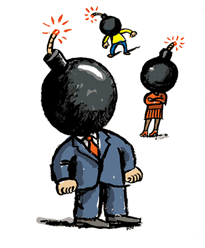 "No man lives without jostling and being jostled; in all ways he has to elbow himself through the world, giving and receiving offense." —Thomas Carlyle Rarely has it been thought that the way to show you deserve to be the most powerful person on earth is to demonstrate you're also the touchiest. This presidential campaign has been an offense fest. From the indignation over a fashion writer's observation about Hillary Clinton's cleavage, to the outraged response to the infamous Obama New Yorker cover, to the histrionics over "lipstick on a pig," taking offense has been a political leitmotif. Slate's John Dickerson observed that umbrage is this year's hottest campaign tactic. And we can assume it will reach an operatic crescendo in these final weeks before Election Day. Feeling affronted has global implications: Islamic organizations and countries seek to ban speech anywhere they decide is insulting to Islam, asserting that a perceived insult can justify a deadly response. Study the topic of "taking offense" and you realize people are like tuning forks, ready to vibrate with indignation It's often the pettiest–seeming things that drive people mad. Or worse. Jostling our way through the world can have violent consequences. A significant percentage of murders occur between acquaintances with the flash point being a trivial insult. Sometimes it seems we live in a culture devoted to retribution on behalf of the thin–skinned –just think of university speech codes. Comedian Larry David even celebrates his skill at giving and taking offense on his television show Curb Your Enthusiasm. Feeling affronted has global implications: Islamic organizations and countries seek to ban speech anywhere they decide is insulting to |
| Article |
I Hate Me, I Really Hate Me Dear Prudence, I'm in my early 30s and the married mother of two young children. I have a good job, and my husband and I get along well. My problem lies within myself. I suffer from something I can only describe as "self-loathing." It started as a teenager (with cutting my arms, drinking, smoking, running with the wrong people). Now I try to keep it all neatly tucked away in my psyche. I've been to therapists and take antidepressants, but this lingering self-hate always surfaces. My symptoms cause me to withdraw, hit myself with hangers, and say and think the most horrible thoughts about myself. Even with my accomplishments, I don't think much of myself. I'm not suicidal, but I frequently entertain thoughts of cutting my arms and legs or having someone else beat me until I'm black and blue, as though I deserve punishment for being who I am. I compare myself to others nonstop and sometimes withdraw for days if I meet someone I envy. It's awful! In addition to antidepressants, I've resorted to taking the painkiller Tramadol daily, as it tends to lift my mood and help with these feelings of inadequacy. I do not want to pass this on to my kids, whom I love more than anything. Why in the world won't this stop? —Wish I Liked MyselfDear Wish, Through some combination of genes and upbringing, you were given this painful thought disorder. And look at how remarkably you've dealt with it. You have a happy marriage, a good career, and a loving relationship with your children. Many people who were handed easy-going genes and happy childhoods have not been able to pull off that trifecta. Also impressive is your self-insight and ability to |